Although the Greeks were responsible for the first systematic philosophy of which we have any record, they were not alone in the Mediterranean world and were happy to draw inspiration from other traditions; traditions that are now largely neglected by philosophers and scholars. This book tells the story of 'Greek Philosophy', paying due attention to its historical context and the contributions made by Egyptians, Hebrews, Persians and even barbarians from northern Europe. Stephen Clark provides a narrative history of the philosophical traditions that took shape over several centuries in the Mediterranean world and offers a comprehensive survey of this crucial period in the history of philosophy.
The book includes a thorough historical and philosophical overview of all the key thinkers, events and ideas that characterized the period and explores in detail central themes such as the contest of gods and giants, the contrast between the reality and appearance, and the idea of the philosopher. Ideal for undergraduate students, this concise and accessible book provides a comprehensive guide to a fascinating period in the history of philosophy.
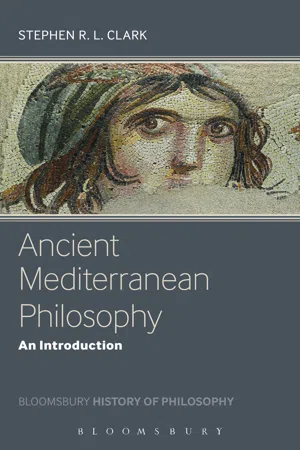
- 240 pages
- English
- ePUB (mobile friendly)
- Available on iOS & Android
eBook - ePub
About this book
Information
CHAPTER ONE
Beginnings
Pre-historical speculations
The curtain of history rises on a world already ancient, full of ruined cities and ways of thought worn smooth. Mediterranean peoples knew there had been disasters, but remembered little in detail. As an Egyptian priest, according to Plato (c430–347 BC), told Solon of Athens (c638–558 BC),
[T]here is no opinion or tradition of knowledge among you which is white with age. . . . Like the rest of mankind you have suffered from convulsions of nature, which are chiefly brought about by the two great agencies of fire and water. . . . The memorials which your own and other nations have once had of the famous actions of mankind perish in the waters at certain periods; and the rude survivors in the mountains begin again, knowing nothing of the world before the flood. (Plato Timaeus 22B)
Xenophanes of Colophon (570–478 BC) reckoned that there was more evidence of this than anecdote:
[S]hells are found inland and in the mountains, in the quarries at Syracuse the impression of a fish and seaweeds has been found; . . . on Malta there are slabs of rock made up of all kinds of sea-creatures. He says that these came about a long time ago, when everything was covered with mud, were produced when everything was long ago covered with mud, and that the impression became dried in the mud. He claims that the human race is wiped out whenever the earth is carried down into the sea and becomes mud, that then there is a fresh creation. (21A33DK: Waterfield 2000, p. 29)
The generations of humankind stretch back indefinitely into the forgotten past, and we are always reinventing ourselves – even the Egyptians. Maybe there was never an absolute beginning, and we have reinvented ourselves infinitely many times. Or maybe there were the Firstborn – but a very long time ago. Opinion was divided.
One group, which takes the position that the universe did not come into being and will not decay, has declared that the race of men also has existed from eternity, there having never been a time when men were first begotten; the other group, however, which hold that the universe came into being and will decay, has declared that, like it, men had their first origin at a definite time. (Diodorus 1.6.3)
We know a little more than Solon did. There were people physically much like ourselves a hundred thousand years ago. Some scholars have suggested that though they were anatomically human, they had not yet developed human languages or culture, since such stone artefacts as we have found, whether from our own or other hominid species, remained unchanged in style for millennia (Wade 2010). The inference is unsound. We do not know what other, transient, artefacts they made: woven baskets, linens, face paints, sand paintings and dramatic art. Even in a later time, one reason why we know so little of how Phoenicians thought is that they wrote, alphabetically, on paper or on parchment, rather than incising ideograms on stone or clay (Van De Mieroop 2004, p. 208): because they were more advanced, their records were evanescent! We have been warned.
A culture as abundantly supplemented with artefacts as any non-metal, non-pottery, Neolithic culture in the world could have existed for two thousand centuries and we would know nothing about it. It is problematic on this time scale whether our own culture will leave anything more permanent. (Greene 1992, p. 19)
Why was it that our own ancestors survived and bred? It may be that they killed the Neanderthals and any other hominid species they encountered. It may be that they simply multiplied a little faster, and so gradually cut surviving Neanderthals off from each other (to the point where all their little tribes drifted slowly into extinction). And maybe our own survival was an accident: genetic evidence suggests that we are all descended from a population of no more than five thousand African humans, and most non-Africans from no more than a few hundred who left Africa around 40,000 BC. Probably the attempt had been made on even earlier occasions and failed each time for no particular reason.
Other hominid populations are half-remembered in our Folklore: almost ‘human’ peoples who seemed to our ancestors to be ‘dwarfish’, ‘elvish’, giants, ogres and goblins. But any philosophical insights or arguments attributed to such ‘fairies’ are probably our own fancies. Fairies, as we remember and reinvent them, are disengaged from ordinary reality, unappreciative of our customs, mischievously deceptive and careless of the time. They are different, that is, from what we think we are. We know little more about our own ancestors. The experience of present-day primitives suggests that even without our tools, in normal times, they easily provided for their daily needs and had plenty of time for play. They chose not to improve their tools, maybe, because their tools were adequate, and they preferred not to be too ‘efficient’ for their own good. Our ancestors’ arrival in any region was regularly followed by the extinction of larger mammals – perhaps including hominids – who were their prey or their rivals. There may have been other reasons for the extinctions, but if our ancestors were responsible, some of them perhaps repented. ‘Wanting More’ (Greek moralists called it pleonexia) is the disease of progress: not everyone has succumbed.
The earliest tales seek to explain why non-human animals no longer speak like us, why the sky no longer rests upon the earth, why brothers and sisters must not mate, why we age and die (which was not so, we said, in the beginning) and why there is anything at all. Many of these stories show how courage and quick wits – or even courage and slow wits – can defeat the monsters, whether these are dragons, ogres or ordinarily human. There were warriors then, and gardeners, builders, weavers, nurses, cooks, craftsmen and magicians. Some painted pictures deep in caves, where they would only be seen by torchlight. Some buried their dead with flow, or their favourite tools. Some made up and repeated stories.
The mythologies we find recorded by later, literate thinkers are ‘the remnants of philosophy that perished in the great disasters that have befallen mankind, and were recorded for their brevity and wit’ (Aristotle, On Philosophy, fr.8 Rose: Ross (1952) p. 77 [fr.10]).1 We wanted – some of us wanted – to make sense of things, to know why things weren’t as we thought they should be. We wanted – some of us wanted – to inspire an interest in what happened, even without explaining it. That may indeed have been the more important task: myths are more often inspirations than explanations. That the sun rises every morning is not news: saying that he is a bridegroom coming from his chamber, rejoicing as a strong man to run his race (Psalm 19.5), or that he is the king of heaven in a glowing chariot, is a way of seeing more richly.
‘What,’ it will be Question’d, ‘When the Sun rises, do you not see a round disk of fire somewhat like a Guinea?’ O no, no, I see an Innumerable company of the Heavenly host crying, ‘Holy, Holy, Holy is the Lord God Almighty.’2
Similarly, when our ancestors divided time into days, months, seasons, years and even astronomical ages, this was not to explain why night and day were different, or why the seasons alter. They were not alien beings landed on an unfamiliar planet. Quite otherwise, they came to life and understanding in the same world as our non-human forebears and found it all familiar: for most of them, as also for most of us, what is familiar needs no explanation, and is hardly even noticed until some shock of change, or an inquisitive stranger, draws our attention to it.
In dividing up their time, they were invoking deity.
General opinion makes the Hours goddesses and the Month a god, and their worship has been handed on to us: we say also that the Day and the Night are deities, and the gods themselves have taught us how to call upon them. (Proclus, In Timaeum, 248d: Cumont 1960, p. 61)
Our ancestors even built the solar year into their architecture, so that the sun’s morning light shone on particular spots at different seasons of the year. It may even be that they noticed, after generations, something strange. Because the earth’s axis itself rotates, like a gyroscope’s, the sun will seem to rise, over the course of a Great Year, against a different stellar background at equivalent moments of the solar year, and gradually trace a circle round the sky until it rises again, most famously at equinox and solstice, within the same zodiacal figures as once upon a time it did. Ptolemy attributed the discovery or the plausible hypothesis (extrapolating from a tiny observable change) to Hipparchus of Rhodes (c140 BC; Ptolemy 1998, 3.1; 7.1–3).3 Proclus (412–85 AD) reckoned that the Egyptians and Chaldaeans (‘who even before their observations were instructed by the gods’) had reached the same conclusion – though he himself found it incredible that the stars should ever change (Proclus, In Timaeum, 40AB: Kidd 1999, p. 269). Every 2000 years or so, the sun slips back, at its rising at the spring equinox, into a different zodiacal sign, passing from Bull to Ram to the Christian Fish (and so, quite soon, to Aquarius). Another way of putting the same point is to say that the Virgin will have a son: that is, the sun rises in Virgo at the autumn equinox when it rises in the Fishes in the spring.4 Coincidentally, the Classical period was the Age of the Ram, and its first great adventure was the quest for the Golden Fleece by Jason and his Argonauts, sailing from northern Greece to the eastern edge of the Black Sea. Another Greek story concerned the killing of the Minotaur, the monstrous offspring of a bull and a Cretan queen. Such stories, whether or not they have a zodiacal significance, would have been told to organize and inspire, not to explain. This is the dawning of the Age of Aquarius (or not, as the case may be)!
We are not immune to such fables. Some modern writers suppose that a settled European population served the Earth Mother and her attendant spirits till the displaced hordes of horsemen serving the Sky Father disrupted the ancient harmonies and installed patriarchy and priesthood in the hearts of their successors. Yet others believe that there was a pan-European culture, linked by stone circles, ley-lines and a shamanic metaphysics, somehow derived from Egypt – or Atlantis. But the story that has most affected recent writers is that our ancestors were enmeshed in superstition, that ‘the Greeks’ invented science to escape, then lost their nerve and succumbed again to ‘Oriental’ fantasies. Popular works on science refer disparagingly to the ‘Dark Ages’ and to ‘Medieval Superstition’. This story too is a fable.
Mythos and logos
The earliest written stories combine political realism and ‘fantasy’ in ways we now find strange: though the gods no longer share one world with us, they often visit, and the heroes may cross over into that other world more easily than shamans. ‘Surely’ their authors ‘must have known’ they were writing fantasy. Gilgamesh, king of Uruk, didn’t ‘really’ battle past monsters to visit the two immortal survivors of the Flood. The gods did not ‘really’ manifest themselves at Troy, Odysseus wasn’t held captive by a minor goddess, and neither did Pheidippides encounter the god Pan upon the road from Sparta. The gods who engendered royal dynasties must ‘obviously’ have been artefacts, pretentious ways of saying both that the new king was to be feared and ‘who his father was, God knows’. We react, in fact, like someone saying that Picasso’s Guernica distorts the truth, because it’s not ‘realistic’. We forget what our experience is really like. Our visual field is fractured and delusive, and only our ‘reason’ – or our ideology – tells us that ghosts, will-o’-the-wisps and monsters don’t exist. Our memory is a constant confabulation – and the notion that it was ‘the Greeks’ who invented Reason is only another delusion, with which most Greeks did not themselves agree. Those who did were consciously controversial.
So Diogenes Laertius, writing his Lives of the Philosophers in the early third century AD, recorded the opinion that ‘the Persians have had their Magi, the Babylonians or Assyrians their Chaldaeans, and the Indians their Gymnosophists; and among the Celts and Gauls there are the people called Druids or Holy Ones’. He himself responded bluntly (in his Prologue, ch. 1) that ‘the achievements which some attribute to the barbarians belong to the Greeks, with whom not merely philosophy but the human race itself began’. By Diogenes’ time, the issue was ideological. Christians like Clement of Alexandria (c150–c215 AD), were sure that many of the Greeks’ own favourite philosophers were actually ‘barbarians’.
Pythagoras is shown to have been either a Tuscan or a Tyrian. And Antisthenes was a Phrygian. And Orpheus was an Odrysian or a Thracian. The most, too, show Homer to have been an Egyptian. Thales was a Phœnician by birth, and was said to have consorted with the prophets of the Egyptians; as also Pythagoras did with the same persons, by whom he was circumcised, that he might enter the adytum and learn from the Egyptians the mystic philosophy. He held converse with the chief of the Chaldeans and the Magi. . . . And Plato does not deny that he procured all that is most excellent in philosophy from the barbarians; and he admits that he came into Egypt.5
Nowadays, it is routinely claimed that there were two distinctive features of those Greeks who rediscovered writing after the long collapse of Minoan and Mycenaean culture: they preferred impersonal explanations and argued for their theories. Where other peoples thought that trees and cities fell or winter followed summer because the gods were squabbling, or a witch ill-wished them, some Greeks began to appeal to ‘Law’ instead. At first that Law was simply Destiny: that nothing is allowed to grow too high, that everything has limits, that winter follows spring. Even Zeus, the greatest of the gods, is subject to Moira, Destiny. But if Zeus does not, or cannot, subvert that Law, we can do without him. Second, where other peoples defended particular stories by appeal to the authority of chosen texts or prophets, some Greeks began to demand that they be given reasons that did not rely on authority. They invented – or discovered – a world no longer arbitrary, ruled by changing purposes; they insisted that no special gifts – except to follow the argument where it led – were needed to uncover it. That is the world that enlightened people have inherited, although there are archaizers with us still, content to appeal to scriptural authority or charismatic prophecy to defend their moralizing account of how things are. ‘The Greeks’ triumphantly ‘demystified the sacred’ – or at any rate some few thinkers did.
Those who insist that ‘the Greeks’ made all the difference also distinguish Mythos and Logos. Kirk, Raven and Schofield (hereafter KRS), for example, insist in their account of ‘Presocratic Philosophy’ that proper rational and philosophical thinking must do away with personification ‘before anything resembling logic could appear’. Only so could the Greeks move away from ‘the closed traditional society . . . toward an open society in which the values of the past become relatively unimportant and radically fresh opinions can be formed both of the community itself and of its expanding environment’ (KRS 1983, pp. 73–4). But we should not demand a particular metaphysical doctrine from all would-be philosophers. Nor is it obvious that ‘the useful and malleable symbols’ which KRS wish to see abandoned are any less ‘open’, ‘fresh’ or innovative than the myths (of a cosmos ordered by impersonal law, and the ‘rational man with a strong sense of what properly counts in human existence’) they prefer.
Traditional ‘myths’ may imagine gods and heroes, with back stories and personal motivations, but these are often allegorical, no more to be taken ‘literally’ than rhetoric about the ‘selfish genes’ that control us lumbering robots. Nor are modern ‘scientific’ explanations necessarily coherent: physicists agree that light and matter alike are simultaneously made of particles and waves, and that the two greatest achievements of twentieth-century physics (namely quantum mechanics and general relativity) have at least not yet been shown to be consistent.6 We may hope that ‘there is no discord of truths which ever sure in union join’ (Boethius, Consolation, 1969, p. 154: 5.3): it does not follow that we can expect to have that truth entire. The claim that mythic traditions are conservative (and the rational enterprise, by contrast, always changing and prepared for change) can also hardly survive an inspection of mythological or more generally religious history, or any contact with actual living scientists and philosophers. It is also false that myth-makers, even traditional myth-makers, never engage in argument – though the criteria by which one version of a myth is preferred over another may not be as exact or as conclusive as we...
Table of contents
- Cover-Page
- Half-Title
- Series
- Title
- Copyright
- Contents
- Preface
- Acknowledgements
- Map of Ancient Mediterranean World
- 1 Beginnings
- 2 Influence from outside
- 3 Inspired thinkers
- 4 Travellers and stay-at-homes
- 5 Divine Plato
- 6 The Aristotelian synthesis
- 7 Living the philosophical life
- 8 Ordinary and supernatural lives
- 9 Late antiquity
- 10 An end and a beginning
- Notes
- Recommended reading
- Works cited
- Index
Trusted by 375,005 students
Access to over 1.5 million titles for a fair monthly price.
Study more efficiently using our study tools.
Frequently asked questions
Yes, you can cancel anytime from the Subscription tab in your account settings on the Perlego website. Your subscription will stay active until the end of your current billing period. Learn how to cancel your subscription
No, books cannot be downloaded as external files, such as PDFs, for use outside of Perlego. However, you can download books within the Perlego app for offline reading on mobile or tablet. Learn how to download books offline
Perlego offers two plans: Essential and Complete
- Essential is ideal for learners and professionals who enjoy exploring a wide range of subjects. Access the Essential Library with 800,000+ trusted titles and best-sellers across business, personal growth, and the humanities. Includes unlimited reading time and Standard Read Aloud voice.
- Complete: Perfect for advanced learners and researchers needing full, unrestricted access. Unlock 1.5M+ books across hundreds of subjects, including academic and specialized titles. The Complete Plan also includes advanced features like Premium Read Aloud and Research Assistant.
We are an online textbook subscription service, where you can get access to an entire online library for less than the price of a single book per month. With over 1.5 million books across 990+ topics, we’ve got you covered! Learn about our mission
Look out for the read-aloud symbol on your next book to see if you can listen to it. The read-aloud tool reads text aloud for you, highlighting the text as it is being read. You can pause it, speed it up and slow it down. Learn more about Read Aloud
Yes! You can use the Perlego app on both iOS and Android devices to read anytime, anywhere — even offline. Perfect for commutes or when you’re on the go.
Please note we cannot support devices running on iOS 13 and Android 7 or earlier. Learn more about using the app
Please note we cannot support devices running on iOS 13 and Android 7 or earlier. Learn more about using the app
Yes, you can access Ancient Mediterranean Philosophy by Stephen Clark in PDF and/or ePUB format, as well as other popular books in Philosophy & Ancient & Classical Philosophy. We have over 1.5 million books available in our catalogue for you to explore.