- 256 pages
- English
- ePUB (mobile friendly)
- Available on iOS & Android
eBook - ePub
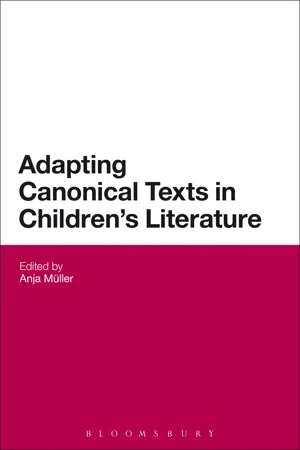
Adapting Canonical Texts in Children's Literature
About this book
Adaptations of canonical texts have played an important role throughout the history of children's literature and have been seen as an active and vital contributing force in establishing a common ground for intercultural communication across generations and borders. This collection analyses different examples of adapting canonical texts in or for children's literature encompassing adaptations of English classics for children and young adult readers and intercultural adaptations of children's classics across Europe. The international contributors assess both historical and transcultural adaptation in relation to historically and regionally contingent concepts of childhood. By assessing how texts move across age-specific or national borders, they examine the traces of a common literary and cultural heritage in European children's literature.
Information
1
Shakespeare for Girls: Victorian versus Contemporary Prose Versions of Hamlet and The Merchant of Venice
Laura Tosi
One of the main concerns of this chapter is the female readership of Shakespeare’s plays and the way abridgements, adaptations and appropriations have mediated and still mediate the cultural relationship that girls or young women establish with the Bard. I hope to show that despite differences in their respective socio-historical contexts, Victorian and Edwardian versions of Shakespeare’s plays for a female audience share a number of stylistic and ideological features with contemporary novels based on Shakespeare’s plays, such as the choice to focus on a traditionally undeserving or marginalized female character, the construction of a fictional sequel within the narrative and the investigation of the (formal, emotional, religious) education, or lack of it, received by the heroines. It would be impossible to discuss the early appropriations without taking into account the fact that in the nineteenth century, when prose versions of Shakespeare started to appear, female critics in particular were developing ways to discuss Shakespeare’s female characters as if they were idealized models of real human beings (see Marshall 2009) with which girl readers could identify: ‘Long before a feminist sisterhood was born in the 1960s, nineteenth-century women writers appealed to an audience of fellow women among whom they expected to find sympathetic readers’ (Ziegler et al. 1997, p. 19).
The emergence of feminist criticism in the last decades has contributed to transferring general critical attention onto Shakespeare’s female characters, exploring in a more theoretically nuanced way gender constructions of identity and the way they interacted in early modern England. It is very tempting to paraphrase Ian Kott’s old ‘adage’ and declare that ‘every historical period finds in Shakespeare’s heroines what it is looking for and what it wants to see’ (Kott 1996, p. 5), as for most of the nineteenth- and twentieth-century heroines have acted as sites of not only projection but also of negotiation, for different constructions of femininity.
Female readers of Shakespeare
Ever since the Lambs’ Tales from Shakespeare (1807), young female audiences have always been an essential part of the history of children’s adaptations of Shakespeare. In the ‘Preface’ to the Lambs’ Tales, we learn that the intention was to ‘make these tales easy reading for very young children’ (Lamb 2007, p. 3). Immediately after, though, the author of the ‘Preface’ (presumably Mary who, because of her lack of formal education, may have been sensitive to the issue of giving girls the chance to read Shakespeare), added that
For young ladies too it has been my intention chiefly to write, because boys are generally permitted the use of their fathers’ libraries at a much earlier age than girls are, they frequently having the best scenes of Shakespeare by heart, before their sisters are permitted to look into this manly book. (Lamb 2007, p. 4)
Access to Shakespeare, Mary suggested, had to be provided with brothers acting as intermediaries, and in the ‘Preface’ she begs ‘their kind assistance in explaining to their sisters such parts as are hardest for them to understand’ (Lamb 2007, p. 4).
In the second edition of the Tales (1809), an ‘Advertisement’ identifies a less wide readership than the 1807 edition:
The Proprietors of this work willingly pay obedience to the voice of the public. It has been the general sentiment that the style in which these tales were written, is not so precisely adapted for the amusement of mere children, as for an acceptable and improving present to young ladies advancing to the state of womanhood. (Lamb 1809, p. iii)
This edition clearly posits the original reference to young children as no longer applicable. A relationship between prose adaptations of Shakespeare and girls (possibly still with the required assistance of a male family member) is, therefore, established very early and is crucial in the construction of a Shakespearean canon for children (a number of studies of the Lambs’ Tales have discussed in various ways the tensions between representations of gender within the patriarchal order of the plays, see Marsden; James; Wolfson). Both Gary Taylor’s Reinventing Shakespeare (1989) and the anthology Women Reading Shakespeare (1997), among others, have also made it clear that popular dissemination of Shakespeare’s plays was never an all-male phenomenon – in the nineteenth century, in particular, women studied Shakespeare in large numbers (Taylor 1989, p. 205) and popularized Shakespeare’s plays through children’s and adult editions and by contributing articles to journals (Thompson and Roberts 1997, pp. 3–4). As Thompson and Roberts have put it succinctly, ‘women’s writing on Shakespeare flourished in the nineteenth century’ (1997, p. 2). Mary Cowden Clarke was one of these quite exceptional female scholars of Shakespeare and had already an established career as editor and philologist (she published the first Full Concordance to Shakespeare in 1845, a work that had taken 16 years to complete; Thompson and Roberts 1993, p. 175) when she wrote The Girlhood of Shakespeare’s Heroines (1850–52), a collection of 15 novellas that reconstruct the childhood and teenage years of a number of Shakespeare’s female characters. Cowden Clarke was persuaded that ‘himself possessing keener insight than any other man-writer into womanly nature – Shakespeare may well be esteemed a valuable friend of woman-kind’ (1887, p. 355).
Cowden Clarke’s novellas can be considered as part of the tradition of character criticism of Shakespeare’s heroines that had become prominent in the nineteenth century, especially thanks to the hugely popular Characteristics of Women, Moral, Poetical and Historical (1832), by Anna Jameson. As Julie Hankey notes, ‘After Jameson it became commonplace to describe Shakespeare as the “champion” of women’ (1994, p. 427). Ruskin’s lecture ‘Sesame and Lilies’ (1864), later converted into an essay, in the section ‘Of Queen’s Gardens’ appears to be affected by this critical tradition when he writes that ‘Shakespeare has no heroes; only heroines’ and that Shakespeare’s women are agents of redemption and guides – except ‘weak’ Ophelia, ‘because she fails Hamlet at the critical moment’ (see Ruskin 1905, p. 114).
By moving female characters from the margins to the centre and validating their perceptions and experiences, Clarke’s novellas inevitably change the reader’s perception of the heroines’ contributions to the original plays. The protofeminist agenda that was at work in many Victorian fairy tale writers can also be perceived, although in a more subtle way, in The Girlhood. Cowden Clarke recognizes a bond with Mary Lamb (she claimed that Mary had taught her Latin):
Happy is she who at eight or nine years old has a copy of Lamb’s Tales from Shakespeare given to her, opening a vista of even then understandable interest and enjoyment! Happy she who at twelve or thirteen has Shakespeare’s works themselves read to her by her mother, with loving selection of fittest plays and passages! (Clarke 1887, p. 369)
Mothers are indeed the co-protagonists of many novellas of Clarke’s collection where, unlike what happens in most Shakespearean plays, the reader can see their formative (both for good and bad) influence at work and ponder on the way this relationship affects the future behaviour of the heroine. We should not forget that mothers were also the recipients of these tales which were suitable for family reading (in their own very peculiar way, these tales can be considered an early example of crossover fiction). The theme of education in these tales is central, as we follow in detail the heroines’ emotional, intellectual and sentimental education (or lack of it – as in the case of Lady Macbeth). The heroines’ future choices appear to be determined primarily by the kind of family environments they were born into, from what they learnt (or rather, by what they did not learn) first from their mothers and secondly from their masters, friends, nurses and mentors. Everything that happens in the plays appears to be accounted for in the tales, and everything the girls say or do in Shakespeare fits in with the kind of education they receive in these fictional speculations. What is most noticeable about Clarke’s endeavour is the attempt to provide motivation (see Brown 2005, p. 95): her tales give space to minor or absent characters and provide causal connections as well as substantial additional information which ultimately point to a new interpretation of Shakespeare’s plays.
In this chapter, I will concentrate on Clarke’s prequels (especially The Merchant of Venice and Hamlet, which centre on the characters of Portia and Ophelia) in order to contrast them with a number of recent novels for a girl/young adult audience based on a fictional biography of a number of Shakespeare’s heroines: Hamlet’s Ophelia and Portia and Jessica in The Merchant of Venice. The last 50 years have seen a spate of novels about Elizabethan theatre – some contemporary juvenile novels are set in the Elizabethan age with witches and spirits, while a number of historical novels for young adults feature Shakespeare as a character who interacts with the adolescent protagonists.1 In very recent years, no less than three novels2 have reformulated and expanded on Hamlet as a teenage story. The female perspective is also present in teenage novels about Shakespeare’s daughters.3 These operations of centring around Shakespeare as a romantic lover or father, the Bard as seen through the eyes of doting female relations or would-be relations, are not entirely new, as is evidenced by such works as William Black’s Judith Shakespeare (1884) and Sara Hawks Sterling’s Shakespeare’s Sweetheart (1905). Turning Shakespeare’s life into romance appears to be a component of the larger (and continuing) process of idealizing the Bard which continues well into our days and blends in with our contemporary fixation with fictional biography and postmodernist rewriting of history (see Hateley 2009, pp. 49–81).
Portia and Jessica in Victorian and Edwardian prose revisions of The Merchant of Venice
Both Clarke’s tales and many contemporary teenage retellings of Shakespeare can be considered appropriations rather than adaptations – my working definition of appropriation being that provided by Julie Sanders:
Appropriation frequently affects a more decisive journey away from the informing source into a wholly new cultural product and domain. This may or may not involve a generic shift, and it may still require the intellectual juxtaposition of (at least) one text against another that we have suggested is central to the reading and spectating experience of adaptations. (Sanders 2006, p. 26)
Like collections of prose retellings from Shakespeare for children (notably, the Lambs’ Tales), Clarke’s tales and contemporary novels are characterized, roughly speaking, by the transposition of one genre (drama) into another (prose fiction), by excision of plot lines, scenes and characters, and by simplification of style. Shakespeare’s own words are generally summarized or quoted or intercalated in the rest of the prose (although, often, some linguistic archaisms are retained). However, unlike the Lambs’ Tales and many other children’s Shakespeares, Clarke and the novels in question are defined by their massive use of addition and expansion devices: new characters and new incidents or episodes (including new endings, as far as the contemporary novels are concerned) are interpolated into the familiar world of the plays. A trait shared by these texts, despite the time gap, is narrative amplification in the sense used by Genette: ‘amplification proceeds chiefly through diegetic development (that is the role of expansion: distension of details, descriptions, multiplication of episodes and secondary characters)’ (1997, p. 264). Characters whose mere names are mentioned in Shakespeare’s plays become fully developed characters in Clarke and the novels, and they are involved in a story line. Through the use of doubles (generally invented female characters who interact closely with heroines and often mirror their destiny), Clarke’s narrator points out the dangers girls must identify and escape, while contemporary authors enlist a number of female helpers that do not necessarily mirror the fate of the heroine. Clarke’s focus is on the heroines’ ‘past’ where we find the femal...
Table of contents
- Cover-Page
- Half-Title
- Series
- Title
- Copyright
- Contents
- List of Illustrations
- List of Contributors
- Introduction: Adapting Canonical Texts in and for Children’s Literature
- 1 Shakespeare for Girls: Victorian versus Contemporary Prose Versions of Hamlet and The Merchant of Venice
- 2 Shylock’s Daughter (Shylocks Tochter) – Nathan and his Children (Nathan und seine Kinder): Mirjam Pressler’s Adaptations of European Classics for Young Adult Readers
- 3 Shakespeare in Children’s Literature; Two Approaches: Susan Cooper’s King of Shadows and Tad Williams’ Caliban’s Hour
- 4 Shakespeare for Beginners: The Animated Tales from Shakespeare and the Case Study of Julius Caesar
- 5 Adapting and Parodying Shakespeare for Young Adults: John Marsden’s Hamlet and Andy Griffiths’ Just Macbeth!
- 6 Shakespeare Comic Books:Visualizing the Bard for a Young Audience
- 7 Adapting an Old English Epic: The Case of Rosemary Sutcliff’s Beowulf: Dragonslayer
- 8 The Kids of the Round Table – Arthurian Legends Adapted for Children and Young Adults
- 9 Downsizing Dickens: Adaptations of Oliver Twist for the Child Reader
- 10 The Nutcracker from ETA Hoffmann to Matthew Bourne: Adaptation of a Children’s Story with Adult Messages
- 11 Pinocchio in English
- 12 To Be or Not to Be a Canonical Text of Children’s Literature: Polish and Italian Translations of Winnie-the-Pooh
- 13 DisneyNeverland’s Tinker Bell
- Index
Trusted by 375,005 students
Access to over 1.5 million titles for a fair monthly price.
Study more efficiently using our study tools.
Frequently asked questions
Yes, you can cancel anytime from the Subscription tab in your account settings on the Perlego website. Your subscription will stay active until the end of your current billing period. Learn how to cancel your subscription
No, books cannot be downloaded as external files, such as PDFs, for use outside of Perlego. However, you can download books within the Perlego app for offline reading on mobile or tablet. Learn how to download books offline
Perlego offers two plans: Essential and Complete
- Essential is ideal for learners and professionals who enjoy exploring a wide range of subjects. Access the Essential Library with 800,000+ trusted titles and best-sellers across business, personal growth, and the humanities. Includes unlimited reading time and Standard Read Aloud voice.
- Complete: Perfect for advanced learners and researchers needing full, unrestricted access. Unlock 1.5M+ books across hundreds of subjects, including academic and specialized titles. The Complete Plan also includes advanced features like Premium Read Aloud and Research Assistant.
We are an online textbook subscription service, where you can get access to an entire online library for less than the price of a single book per month. With over 1.5 million books across 990+ topics, we’ve got you covered! Learn about our mission
Look out for the read-aloud symbol on your next book to see if you can listen to it. The read-aloud tool reads text aloud for you, highlighting the text as it is being read. You can pause it, speed it up and slow it down. Learn more about Read Aloud
Yes! You can use the Perlego app on both iOS and Android devices to read anytime, anywhere — even offline. Perfect for commutes or when you’re on the go.
Please note we cannot support devices running on iOS 13 and Android 7 or earlier. Learn more about using the app
Please note we cannot support devices running on iOS 13 and Android 7 or earlier. Learn more about using the app
Yes, you can access Adapting Canonical Texts in Children's Literature by Anja Müller in PDF and/or ePUB format, as well as other popular books in Literature & European Literary Criticism. We have over 1.5 million books available in our catalogue for you to explore.