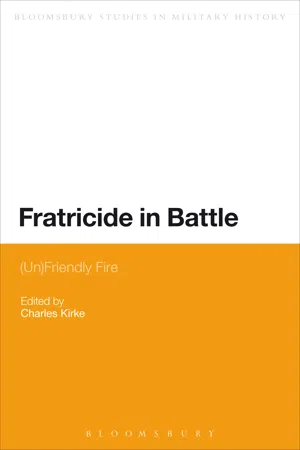
Fratricide, or 'Friendly Fire', is a persistent and unwelcome feature in war. Can it be avoided? How can it be properly understood?
Beginning with a historical analysis, Fratricide in Battle examines all aspects of the problem, covering both human and technical factors, before looking at a range of measures currently in use to tackle the issue.
Charles Kirke brings together an international group of experts in the field, from both military and academic backgrounds, to provide a thorough examination of this crucial subject. Taken together, their contributions offer a comprehensive understanding of fratricide in its historical context and suggest important lessons for future generations.
- 288 pages
- English
- ePUB (mobile friendly)
- Available on iOS & Android
eBook - ePub
Chapter 1
Introduction
Charles Kirke
Battle is dangerous. It is characterized by the use of lethal weapons in an environment rife with noise, confusion, urgency, fear, fatigue, excitement and many other distractions. Under such circumstances it is hardly surprising that errors occur: people harm those they do not wish to harm, and when this happens it is always tragic. Nobody can take back the bullets, the shells and the bombs that they fired in error. Nobody can put right their effects, and fratricide can haunt all those involved for the rest of their lives. So what can be done about it?
Nobody has yet produced a comprehensive answer to this question, though many have tried, attempting to achieve ‘Combat ID’ – a widely used generic term that encompasses any and all of the measures that can be taken to counter fratricide. In itself, the term stands for ‘Combat Identification’ but there is more to Combat ID than simply the identification process. In essence, it consists of two separate forms, ‘Situational Awareness’ (SA) and target identification or ‘Target ID’. The former is a somewhat clumsy term but it covers a significant activity. In theory, if everyone knew exactly what and who was where on the battlefield, then nobody would shoot at the wrong target. In practice, of course, this idea is never tested because it has never been possible to reach this ideal state of affairs. Nevertheless, there is a strong body of opinion that the more that can be done to improve everyone’s knowledge of what is going on in battle the better, and many human and technical measures have been taken over time at least to increase SA. Target ID is a last-chance activity for those just about to shoot or release weapons, in which a final attempt is made to gauge whether the target aimed at is enemy, friendly or neutral. In support of these two activities, armed forces continue to develop Tactics, Techniques and Procedures (TTP) to reduce the conditions for fratricidal incidents.
This book brings together the work of people engaged in the hardware and software of science and technology: scientists who specialize in developing and applying knowledge about human beings and military practitioners. Between them they bring a new perspective on the causes of fratricide in battle and on the methods that can reduce the chance of it happening. The different approaches contain two significant themes: an interest in the human contributions to fratricide and fratricide avoidance, and a sense of history. Fratricide is an intensely human action with human consequences. In almost every case of fratricide an individual or a group has contributed to the event by creating or following through the conditions for lethal error. History, in the sense used here, runs from the course of very recent events right back to the start of written records. A fratricidal event in the Peloponnesian War is as relevant to the subject as incidents in the Falkland Islands in 1982, in Iraq in 2003 or Afghanistan in 2012.
But what is fratricide? This question is explored in more detail in Chapter 3, but it is sufficient to say here that the term can have different meanings, and the definition in use when the topic is discussed has a crucial effect on how it is addressed. There is also potential cause for significant confusion when two parties to the discussion are using different definitions, especially when they are trying to agree on policies and practice for countermeasures.
However it is defined, fratricide is a serious matter for the military. This constituency is represented in this book by the contributions of Andrew Gillespie (ex-British Army), Fin Monahan (Royal Air Force) and Al Mosher (ex-US Army); and by military/academics John Ash (Cambridge University and ex- Royal Air Force and Royal Navy) and myself (ex-British Army and currently at Cranfield University). This brings a practical perspective to the work – all of us have had to face the prospect of (un)friendly fire at some time or another – but it brings another, perhaps unexpected and unwelcome, consequence. In recent years members of the military, at least in the West, have found ourselves swimming daily in a sea of the acronyms that are so much a part of ‘military speak’ that they pass unnoticed among us. This book has a substantial glossary, and the editing process has involved the explanation and/or the removal of nearly all specialist terms and their acronyms, but it is inevitable that some will have got through without adequate explanation. This is an editorial responsibility and the fault is entirely mine as editor.
The contribution of the scientific authors is equally important – indeed one of the intended strengths of this book is the bringing together of military thought and experience with human science and technical research and expertise. Paul Syms has devoted many years to the study of fratricide incidents through history, compiling an unsurpassed database of facts and analysis. Dermot Rooney’s work on the human side of command and control is based on a long sequence of studies in the field, observing both the behaviour of soldiers in headquarters and also the evolution of command and control equipment. Claire Outteridge and her colleagues have applied their human science experience over the past ten years to investigating the many causes of fratricide that arise from the human condition, and David Dean has applied his knowledge of modelling and systems engineering to the production of a model through which errors in direct fire engagements can be examined. Jorma Jormakka brings a Finnish perspective to the topic, approaching it from a completely different angle.
It must be made clear right from the start that, throughout this book, the views expressed are those of the various authors and do not reflect official policy or thought.
There is a trajectory to this book. Part One sets out aspects of the fratricide problem. Paul Syms provides an overview encompassing fratricide on land, sea and air, from the earliest fratricidal events in recorded military history (Chapter 2). He explores the causes of fratricide and the countermeasures in use through time, and the interaction of ever more lethal weapons and more effective command and control systems on rates of fratricide. In Chapter 3, I attempt to explore the variables in defining fratricide and its wider consequences, and then present an analytical framework in which any Combat ID system or process can be placed (human and technical) and expose the wider issues in implementing them and their potential effectiveness. This is followed by John Ash’s chapter applying the concept of dynamic risk management to potentially fratricidal circumstances, giving consideration to the task confronting commanders whose responsibility it is to direct fire and control the exposure of their personnel to risk (Chapter 4).
The four chapters in Part Two explore the human dimension to fratricide. It opens with Dermot Rooney’s presentation (Chapter 5) of how mistakes can be generated through over-complexity in command and control of the battle, a major consideration as more and more technology is applied to headquarters. This is followed by Chapter 6 written by Claire Outteridge and her colleagues, which examines the central role played by human beings in the unwitting construction of fratricide incidents. They show how such incidents can have their origins in precursor human activity well before they take place, and produce a classification of contributing factors and recommendations as to how they may be offset. David Dean explores the modelling of the engagement process to obtain insights into the processes through which fratricide can take place, and presents a particular model as a case study (Chapter 7). I then examine the processes that take place inside a modern tank in the course of engaging a target, and set the complexity and difficulty of the process from the crew’s point of view against academic studies of human error (Chapter 8).
Part Three presents measures that are currently in place, or being considered, to tackle fratricide. Fin Monahan, in Chapter 9, takes us through the process of a close air support mission and sets out the web of human and technical measures that are in place to minimize the chances of fratricide. Al Mosher starts with the case of the Battle of Antietam in 1862 and assesses the causes of the high rates of fratricide there. He then considers the US Army’s response to fratricide incidents and their causes over the past 20 years in the light of current battle conditions (Chapter 10). Andrew Gillespie carries out a similar analysis, in Chapter 11, from the British point of view starting with the Falklands War, and tracks the development since then (especially since the First Gulf War) of a considerable array of anti-fratricide measures, and their limitations. Finally in this section, Jorma Jormakka discusses the options for anti-fratricide measures from a Finnish point of view, questioning the need to acquire special anti-fratricide systems (Chapter 12).
Finally, in Chapter 13, I assess the key issues brought forward in this book, weighing up the common elements that will not go away, and considering what might happen in the future. This assessment may in time be seen as prescient or may equally well be pushed aside by the tide of events, but one thing is certain: there is no clear agreement yet about how much time and money should be dedicated to anti-fratricide measures, or how that time and money are to be balanced against other military requirements. Furthermore, it is unlikely that a firm consensus will emerge in the foreseeable future; that is why the contributions of the authors in this book are so important as expert voices in the discussion.
Part One
The Problem
Chapter 2
An Historical Analysis of Fratricide
Paul R. Syms
Introduction
In order to understand friendly fire, it is necessary to chart its history. For, although the weapons have changed beyond measure, the people behind them have not – and it is the people who make the decisions that can lead to friendly fire. This chapter describes the history of fratricide in battle from its likely beginnings, through early and modern written history, to arrive at the point we are at in the twenty-first century. To do so it follows three themes: the first examines the three domains of fighting, on land, at sea and in the air, and of course the incidents that occur at the interfaces between them. The second examines some common threads, namely the frequent clusters of events that occur when a new weapon system is introduced, and those events that have arisen from technical and procedural efforts to avoid friendly fire. The final part discusses the similarities between events through history, and how the history and mechanisms of friendly fire have been researched.
The incidents discussed in this chapter are drawn from a wide variety of sources. There have, however, been a few studies devoted to friendly fire in history, most notably the books by Townshend Bickers (1994), Kemp (1995) and Regan (1995). There have also been studies of friendly fire in particular wars, notably the first such work by Percin (1921) on the Allies in First World War (WWI), and that by Garrison (1999) on friendly fire in the American Civil War. However, most recorded events are scattered in ones and twos through the rest of historical writing, while many more – in fact, the majority – must have gone unrecorded.
Prehistory
‘Friendly fire’ is an enduring feature of fighting that must be almost as old as warfare itself. Recent studies of apes, for example Jane Goodall’s on the chimpanzee (1986), have shown that organized warfare is by no means confined to mankind. If warfare is defined as a sustained campaign of group-on-group intra-species aggression, then it is now known to be practised to a greater or lesser extent by most of the Old World apes.
We cannot speak with assurance of the earliest origins of fratricide in battle. If we accept that early hominids shared these warlike behaviours with their close cousins, then as tool-making (as opposed to simply tool-using) developed, it is highly likely that the first tools developed for hunting, namely spears, knives and special throwing stones, would also have been used in intra-species warfare. We can surmise that it would not have been long before the first incident in which a member of a group accidentally lashed out at a member of his own group in a mêlée, or targeted a friend with a stone or a spear. Indeed, it may even be that it happens in ‘warfare’ among the apes. The invention of the simple bow by our later hominid ancestors made this a virtual certainty.
To know about the earliest fratricidal events in military history we must wait for the invention of writing, and by that time many of the features of warfare that we take for granted, such as the hierarchy of command, standing armies, specialisms such as reconnaissance and communications, and identification procedures such as field signs and passwords were well established.
Current interest in these events is not entirely historical since, as will be shown, there can be surprising parallels between recent incidents and events in the remote past, which tells us that the friendly fire phenomenon often owes more to the workings of the human mind under the pressures of battle than to the technologies involved. One reason that fratricide is thought of as a new phenomenon by many, particularly by those who have never served in the military, is that it has only recently become the subject of systematic and academic study; this will be discussed in more detail later. Table 2.1 summarizes some of the worst known friendly fire events in history, in all domains, measured by the numbers of casualties caused.
History of Friendly Fire in Land Warfare
One of the first recorded fratricidal events in battle was that at Delion (or Delium) in 424 BC in the Great Peloponnesian War, described by Thucydides (Book IV).1 During the battle, the Athenian infantry managed to encircle and crush an allied force of Thespian infantry on the Boeotian left. But as the encircling Athenians fought, they fell into confusion while surrounding their trapped enemy, mistook and killed each other. The situation was made worse by the fact that there were no obvious differences in uniform to distinguish the sides, and that both armies spoke the same language (Regan, 1995). This error, together with the sudden appearance of Boeotian cavalry on the other flank, cost Athens the battle, for they were routed.
A far more common cause of fratricide in history was fighting and crushing within close-order units, such as spear and pike phalanxes, that were fleeing from an enemy that had routed them. Many are recorded, from Epipoli (in 413 BC), Adrianople (in AD 378), Morgarten (in 1315), Agincourt (in 1415), through to Genappe (in 1815) in the gunpowder era, when French soldiers fought each other in panic to cross a narrow bridge while being harried by Prussian cavalry (Regan, 1995). A more recent event of this type in battle was when routing Cossacks fired on the Russian hussars in the crush for a bridge at Balaklava, in 1854 (Brighton, 2004). Militarily, these incidents have ceased to be common since combat is now in open order ‘skirmish lines’, and often so dispersed that it is not uncommon for a battalion of 600 men to be responsible for 10 km (6 miles) of front. The phenomenon does, however, still have echoes in incidents where crowds at spectator events have been fleeing danger, such as a fire.
The advent of gunpowder weapons, often wielded by many thousands of poorly trained militias and levies, brought with it new opportunities for fratricide, which could (for the first time) be correctly labelled ‘friendly fire’.2 In the gunpowder age, a majority of soldiers, not just a few highly trained archers, wielded a weapon that was capable of hitting a target outside easy visual identification range, and one that was more easily discharged accidentally into one’s own ranks. The problem was exacerbated by gun-smoke: after one or two volleys had been exchanged between packed ranks no more than 100 m apart, unless there was a brisk wind, the ability to distinguish uniforms and standards rapidly deteriorated. On the positive side, however, the availability of portable optics in the shape of the telescope made it possible for the generals at least to distinguish friendly and enemy formations at longer ...
Table of contents
- Cover
- Half-Title
- 1. Introduction
- Part One – The Problem
- Part Two – Understanding the Human Dimension to Fratricide
- Part Three – Tackling Fratricide
- Conclusions
- Glossary
- Bibliography
- Index
Trusted by 375,005 students
Access to over 1.5 million titles for a fair monthly price.
Study more efficiently using our study tools.
Frequently asked questions
Yes, you can cancel anytime from the Subscription tab in your account settings on the Perlego website. Your subscription will stay active until the end of your current billing period. Learn how to cancel your subscription
No, books cannot be downloaded as external files, such as PDFs, for use outside of Perlego. However, you can download books within the Perlego app for offline reading on mobile or tablet. Learn how to download books offline
Perlego offers two plans: Essential and Complete
- Essential is ideal for learners and professionals who enjoy exploring a wide range of subjects. Access the Essential Library with 800,000+ trusted titles and best-sellers across business, personal growth, and the humanities. Includes unlimited reading time and Standard Read Aloud voice.
- Complete: Perfect for advanced learners and researchers needing full, unrestricted access. Unlock 1.5M+ books across hundreds of subjects, including academic and specialized titles. The Complete Plan also includes advanced features like Premium Read Aloud and Research Assistant.
We are an online textbook subscription service, where you can get access to an entire online library for less than the price of a single book per month. With over 1.5 million books across 990+ topics, we’ve got you covered! Learn about our mission
Look out for the read-aloud symbol on your next book to see if you can listen to it. The read-aloud tool reads text aloud for you, highlighting the text as it is being read. You can pause it, speed it up and slow it down. Learn more about Read Aloud
Yes! You can use the Perlego app on both iOS and Android devices to read anytime, anywhere — even offline. Perfect for commutes or when you’re on the go.
Please note we cannot support devices running on iOS 13 and Android 7 or earlier. Learn more about using the app
Please note we cannot support devices running on iOS 13 and Android 7 or earlier. Learn more about using the app
Yes, you can access Fratricide in Battle by Charles Kirke in PDF and/or ePUB format, as well as other popular books in History & 20th Century History. We have over 1.5 million books available in our catalogue for you to explore.