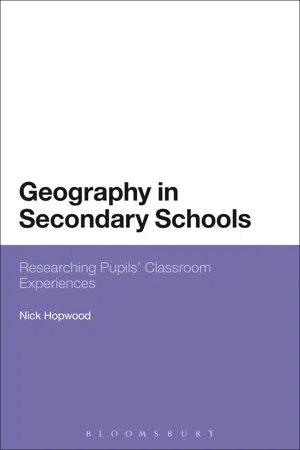
Gaining a better sense of how pupils conceive school geography is crucial if we are to understand the ways in which their ideas and values mediate learning processes. Geography in Secondary Schools explores how pupils experience geography lessons, what they think geography as a school subject is about, and what it means to them. School geography aims to help young people think about the world and their place in it in a distinctive - geographical - way. However very little is known about the kinds of thinking and values they associate with the subject.
Researchers are increasingly taking young people's ideas seriously as important and worthy of investigation in their own right. In this book, Nick Hopwood takes such an approach to explore the relationships between pupils and geography as a school subject. He follows six pupils through their geography lessons for a period of three months, discussing their learning experiences in depth with them. Their participation in class, written work, and comments made in interviews form the basis for a detailed investigation of their ideas.
- 224 pages
- English
- ePUB (mobile friendly)
- Available on iOS & Android
eBook - ePub
About this book
Information
1
Introduction
Beginnings
This book tells a story about six pupils, how they experience geography lessons, and their ideas about geography as a school subject. I refer to the ways in which pupils reflected on their classroom experiences and talked about geography in terms of their subject conceptions. This is not intended to invoke a static cognitive entity that is separate from being in classrooms, learning or experiencing the world as a young person. Rather, I hold subject conceptions to be active, constantly under construction and reconstruction, ways of thinking about and articulating links between self, subject and what happens and is learnt in geography lessons.
Bart, Lisa, Matt, Sara, Jenie and Ryan (as they chose to call themselves) were all 13 or 14 years of age at the time fieldwork was conducted. Each pupil was in the final year of compulsory geography study in English state-run comprehensive schools (Year 9). They all gave generously of their time over a period of several months, helping to build a rich and detailed picture of what they think of school geography. Why write a book just about six pupils? Because we can learn a great deal by exploring the way young people make sense of their world and learning experiences in depth. In the place of sampling a large number of pupils, this approach offers opportunities to understand their ideas in direct relation to their varied classroom experiences. Data came from spending considerable time in classrooms, following selected pupils through their geographical learning experiences over a period of three months each. Contact with pupils in previous research convinced me thoroughly that they had, and were able to articulate, sophisticated and complex ideas about the subjects they study in school. What studies based on larger samples gain in generalizability, they lose in doing justice to the complexity of pupils’ ideas and being able to link analysis to classroom experience.
The decision to work with only six pupils over an extended period of time was not just a methodological correction to the trend towards abstract approaches and larger samples in existing studies (see Chapter 3; Butt 2010a, 2010b); it also stemmed from a commitment to writing about pupils’ ideas as fully and as richly as possible, giving an expansive rather than reductionist account of what they had to say about school geography.
I was strongly influenced by the work of Rosalind Driver and colleagues in the context of school science (Driver 1983; Driver et al. 1985, 1994, 1996). These studies took pupils’ ideas seriously, exploring them in their full complexity, open to contradictions as natural and lived with, rather than as problems. They also maintained a close connection between investigating pupils’ ideas about science and their experiences of science lessons in schools. Driver’s work is widely recognized for its value in helping science teachers and science education researchers think differently about pupils, to better understand what pupils think science is and who they think they are as school scientists. My aim in my research and in writing this book is to bring at least some of this value to school geography: a rich, empirically derived picture of what geography and geography lessons mean to pupils.
Given my aims to represent the scope and complexity of pupils’ ideas, it is difficult to articulate one simple argument that this book makes. It certainly adds to arguments made by others – that we should take pupils’ ideas seriously, that their interpretations of classroom experiences and subject conceptions matter, and that these vary in striking ways. If readers are persuaded of anything further by this book, I would hope it to be that pupils’ experiences and conceptions of school geography are rich, multifaceted and, perhaps, contradictory. While elements of them can be mapped onto aggregated categories or adult-derived themes, the nature and structure of pupils’ conceptions are unique and are strongly influenced by their sense of who they are in the world, their values and interests. The passionate attachments we have to school geography as adults, teachers, researchers and educators shape our professional lives and interactions with young people. We cannot take pupils’ ideas for granted, but we can act from a position of respect for and recognition of their views if we take them seriously enough to explore them in detail. Understanding this contributes to the broader project of understanding what and how pupils learn in geography, what they value in that learning and how they relate their school subject experiences to themselves as young people.
Readers might be surprised at how little reference is made in this book to teachers and teaching. My intention is not to devalue the role of teachers or to erase their presence from these accounts. However, my overriding focus on pupils follows through on the principle of taking them and their ideas seriously, as valuable in their own right, without weaving them into stories of adult teachers’ practices or intentions. I hope the descriptions of the lessons I observed, and the frequent reference the pupils themselves made to their teachers, gives sufficient presence to those adults who created and scaffolded the learning experiences that provided such a rich basis for pupils to engage and talk to me about. That two pupils from the same class spoke so differently about geography and particular geography lessons is, in my view, testament to the creativity and openness with which these teachers set up learning experiences, creating a climate in which pupils had space to interpret knowledge and ideas in different ways.
Readers might also ask themselves whether more could be said about what and how these pupils learnt from particular experiences or lessons. Most certainly this is the case. When beginning my analysis I was confronted with a series of difficult questions as to where exactly ideas of learning should fit in. As I read and re-read the data I became increasingly convinced that there was valuable work to be done in delving deeply into pupils’ experiences and conceptions, exploring how different ideas about geography as a subject, and the different responses to classroom experiences, come together and relate to young people as individuals. In this way a strong sense of learning comes through in pupils’ remarks about particular lessons, tasks or assignments.
However, the analyses presented in this book are not situated within a trajectory of progress against curriculum benchmarks, level descriptors or achievements in assessments. To me such an approach would re-situate pupils’ ideas back within the context of adult agendas, and I was keen to remain closely and richly within the world of pupils’ ideas and experiences. Of course, pupil achievement matters, and not just to adults, but the approach I have taken steps back from this dominant way of investigating classrooms, instead offering an account that is immersed in pupils’ accounts of learning, but also of their personal values, ideas, images of their futures and sense of self. These rich connections to pupils as young people may have been sidelined in analyses that sought to document and explain learning per se. Nonetheless, ideas and accounts of learning permeate the chapters describing each pupil’s conceptions (Chapters 4–6), and the subsequent discussions of their ideas at more abstract and thematic levels (Chapters 7–8).
The research context in which this book is situated is significantly different from that during the period when fieldwork was conducted. As Lambert (2010) notes, there has been a steady growth in geography education research over recent years. Of particular significance is the growth in research conducted by teachers associated with the re-designation of many initial teacher education (the PGCE) courses so that they offer Master’s level credits (Brooks 2010). I would like to think that the insights offered into pupils’ experiences of and ideas about school geography, and the questions raised, might whet other researchers’ appetites and provoke further pupil-focused research in geography. The study I describe in this book by no means constitutes a singular end-point, but rather opens up numerous empirical beginnings. While I have avoided detailed methodo-logical discussion in order to leave space for greater focus on what happens in classrooms and what pupils had to say, I believe that this book illustrates the value of in-depth study, and might encourage others to develop new ways of working with pupils in order to investigate their ideas.
My hope is that this book can serve as a useful resource for teachers of geography in secondary schools in their classroom capacity too. It is not a guide to practice, but rather offers a means for readers to immerse themselves in the world of pupils, leaving open a series of questions and issues that have an important bearing on lesson planning, teaching, assessment and other aspects of geography teaching. When I fed back findings to the teachers involved in this study, their most common response was to say how valuable this kind of work can be in helping them understand where their pupils are coming from, to ‘start where the learners are at’. The account that follows can help teachers consider what school geography might mean to pupils in secondary school, imagine different ways in which pupils bring values, personal interests and imagined futures to bear upon their learning experiences, and perhaps speculate as to how a lesson or particular task may be interpreted by and meaningful to pupils in different ways.
Why research pupils’ conceptions and experiences of school geography?
Taking young people’s views seriously
The idea that as researchers we should take young people’s views seriously is not particularly new. Studies of children and their views have a long history. How...
Table of contents
- Cover-Page
- Half-Title
- Series
- Title
- Copyright
- Dedication
- Contents
- List of Tables
- List of Figures
- Acknowledgements
- Foreword
- 1 Introduction
- 2 School Geography in England
- 3 Building on Prior Research
- 4 Springfield School: Lisa and Bart
- 5 Belmont School: Sara and Matt
- 6 Cedar Grove School: Jenie and Ryan
- 7 Describing and Evaluating School Geography
- 8 Themes in Pupils’ Ideas About School Geography
- 9 Conclusions
- References
- Index
Trusted by 375,005 students
Access to over 1.5 million titles for a fair monthly price.
Study more efficiently using our study tools.
Frequently asked questions
Yes, you can cancel anytime from the Subscription tab in your account settings on the Perlego website. Your subscription will stay active until the end of your current billing period. Learn how to cancel your subscription
No, books cannot be downloaded as external files, such as PDFs, for use outside of Perlego. However, you can download books within the Perlego app for offline reading on mobile or tablet. Learn how to download books offline
Perlego offers two plans: Essential and Complete
- Essential is ideal for learners and professionals who enjoy exploring a wide range of subjects. Access the Essential Library with 800,000+ trusted titles and best-sellers across business, personal growth, and the humanities. Includes unlimited reading time and Standard Read Aloud voice.
- Complete: Perfect for advanced learners and researchers needing full, unrestricted access. Unlock 1.5M+ books across hundreds of subjects, including academic and specialized titles. The Complete Plan also includes advanced features like Premium Read Aloud and Research Assistant.
We are an online textbook subscription service, where you can get access to an entire online library for less than the price of a single book per month. With over 1.5 million books across 990+ topics, we’ve got you covered! Learn about our mission
Look out for the read-aloud symbol on your next book to see if you can listen to it. The read-aloud tool reads text aloud for you, highlighting the text as it is being read. You can pause it, speed it up and slow it down. Learn more about Read Aloud
Yes! You can use the Perlego app on both iOS and Android devices to read anytime, anywhere — even offline. Perfect for commutes or when you’re on the go.
Please note we cannot support devices running on iOS 13 and Android 7 or earlier. Learn more about using the app
Please note we cannot support devices running on iOS 13 and Android 7 or earlier. Learn more about using the app
Yes, you can access Geography in Secondary Schools by Nick Hopwood in PDF and/or ePUB format, as well as other popular books in Education & Education Curricula. We have over 1.5 million books available in our catalogue for you to explore.