What does it mean to be a Catholic in today's world? What distinguishes the modern Catholic from anyone else? At a time when the Vatican provokes hostility by its opposition to contraception, abortion and the use of condoms in fighting AIDS, how many Catholics share its views? And if they don't, how can they in good conscience stay in the Church? These are among the many questions that writer and broadcaster Peter Stanford is addressing here. There is a whole spectrum of response in this entertaining and enlightening collection.
'Fascinating... a surprisingly uplifting book.' Sunday Telegraph
'A hard-hitting book which criticizes as much as it praises... it should be read by anyone interested in the phenomenon of organized religion.' Spectator
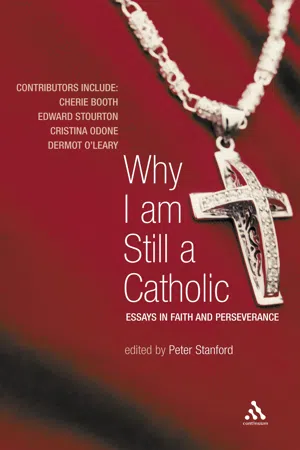
- 154 pages
- English
- ePUB (mobile friendly)
- Available on iOS & Android
eBook - ePub
About this book
Information
A Global Caravan Site
Frank Cottrell Boyce, 44, is an award-winning scriptwriter whose credits include the Oscar-nominated Hilary and Jackie, 24 Hour Party People and Millions, which was based on his novel of the same title. He lives in Liverpool with his wife and seven children.
I’m too young to have been taught my catechism, a fact which I’ve always regretted. So I thought I’d write my own catechism, but it turned out that I didn’t know enough and then the questioner turned nasty:
Why are you still a Catholic?
Why would I stop being a Catholic?
Well, where would you like me to start? Sex scandals? Financial scandals? Political scandals? Sexy political scandals involving money? The Da Vinci Code?1 The Christian Brothers?
For some reason, they just don’t bother me.
So you’re a Catholic through mental lethargy? That’s got to be a sin of omission.
I admit that as far as world Churches go, ours is probably the dodgiest but that’s about the institution, not the faith. The bombing of Dresden and Hiroshima, and the events of 9/11 all represent a misuse of aeroplanes. They might make you wonder just how beneficial aviation is, or how safe it is. What they don’t do is make you doubt the possibility of flight. No one says, ‘In view of what happened to the Hindenberg I no longer believe in lift.’
But you’re a member of an institution – the Catholic Church. You are flying in the dodgy airship.
I’ll take the risk.
Surely you can believe in God without buying into organized religion?
Actually you can’t. God said – and He should know – ‘wherever two or three are gathered together in My name’. Anyone who says different is just wrong.
Two or three is one thing. A big spiritual global corporation is another.
But you don’t go to mass in a global corporation. You go in your parish. A parish is an amazing thing. Nowadays everyone is always fretting about social fragmentation. If you go to a Catholic parish on a Sunday, you’ll see the opposite of that. You’ll see people of all races and ages, and social class, coming together to share something really profound. And making a common identity for themselves. Every parish has the potential to be a neighbourhood Utopia.
So a bit like a static caravan site then?
I actually quite like caravan sites. The thing that’s different with a parish is that you and your neighbours are joining yourselves to something genuinely global.
The caravan club has branches all over the world.
What I’m trying to get at is a sense of connection. A parish can have a tiny geographical definition – maybe just a few streets – but it’s also probably twinned with somewhere in South America or Africa. And at Christmas all the kids will do those shoeboxes for Romania, and everyone will send Christmas cards to prisoners of conscience in China or America. So you have all these things that are forcing you to look outwards, to connect with the world, at the same time as making you spend time looking into your own soul. And at the centre of all that is the mass, and at the centre of mass is the consecration. So you’ve got all these people, all over the world, concentrating on this single moment. That’s a powerful thought.
Like in Peter Pan when everyone is supposed to clap their hands to stop Tinkerbell dying?
Except it’s real.
No, it’s like Tinkerbell.
I had this unusual experience. I was working on a project about Caesar Augustus so I was reading lots of first-century writing. And by chance, I ended up stuck with nothing to read in a hotel room except the gospels and – even though they were so familiar – it was like electricity. Because they are nothing like, nothing remotely like, anything else that was being written at the time. I know that as historical documents they’re full of contradictions and interpolations because our attitudes to history have changed and so on. But the thing that jumps out at you in the context of other stuff from the period is that they are absolutely bursting with authenticity. That someone would write about fishermen and prostitutes at that time – it’s staggering. And that things like St Peter’s accent would be noteworthy. And that amazing sense you get in the Passion narrative of a group of hicks coming into the city and creating panic and suspicion just by beingthere. The tension in the streets is palpable and so real.
I’m not disputing that something happened then. I’m saying it’s just history. It’s not mystically lingering like King Arthur asleep in his cave.
Christ is really present, in the present tense, in the mass.
No, He’s not.
Yes He is.
If He is, it’s in such an abstract way that it’s meaningless.
It’s the connection thing again. The structure of the Church connects you to people all over the world. The structure of the mass connects you to moments all the way through history. You’re commemorating the Last Supper in a way that people have been doing almost since it happened. Sometimes – like in the cathedral in Syracuse – you’re in a building that’s been used for that purpose for thousands of years. Sometimes – like in the Sistine – you’re doing it under the eyes of the greatest masterpieces of European art, which were created and put there just to help you concentrate. You’re plugged into the dynamo of history.
I can’t see that it’s anything more than a kind of domestic Sealed Knot thing – a historical re-enactment. Like when out-of-work actors dress up as mill girls at Wigan Pier or New Lanark.
It’s nothing like that. It’s not just about an historical moment. It’s opening a door into eternity. It’s saying that this moment happened a longtime ago but in another sense, it is always happening. The Last Supper is always in the present tense. And you are present at it. So on a Sunday when everyone else is in IKEA or reading the paper, Catholics are sitting there experiencing the limits of linear time.
I defy you to take me through the physics of that.
Well, any physicist will tell you that time is much more complicated than it appears and that we have to dumb down our understanding of time in order to function.
You find me a physicist who will say that a single unique event, which happened 2000 years ago in Judea, is also continuously reoccurring in Pennsylvania and St Petersburg and Prescott.
Some things are hard to believe but that doesn’t stop them being true. Black holes for instance. Or the amount of time evolution takes. It’s difficult to get your mind around the idea that Jesus died for you personally. At the same time it’s truer than anything else.
What!?!
It’s the only thing I know that can give you a proper understanding of your place in the universe – that you’re simultaneously an insignificant speck and also infinitely important and valuable. I meet people all the time who believe that they’re utterly worthless and – especially in the film industry – I also meet people who think they exert more gravitational pull than the whole cosmos. It’s actually very difficult to grasp that you’re both things simultaneously but it is true. Not just theologically either. That’s true in an evolutionary sense. In the broad scheme of evolution you’re totally disposable but you might also be crucial because no one knows what’s going to be important.
You’re basically saying that being a Catholic is good for your self-esteem, like learning kickboxing.
When I was a child I lived in a fairly run-down area and later I lived on what should have been quite a boring estate. But in both places, I had access to this place of amazing beauty – the church – with its exotic smells and rituals and its direct line to Michelangelo and Leonardo and great poetry. Obviously that raised my expectations of life and that’s great. But much more importantly it told me – it made me experience the fact – every fleeting moment is also an access point to the eternal, to another dimension.
When I was at primary school I remember collecting for the Holy Souls in Lent and then going to mass and watching the priest put the chalice in the tabernacle, and for some reason I had the impression that cash we’d raised was in the chalice and that when he put it in the tabernacle it went down in a kind of dumb waiter into purgatory, and they used the cash to buy themselves out. We lived in a block of flats at the time and there was a cupboard where the heating pipes ran. You could float bus tickets on the thermals. I remember thinking they ran down into purgatory.
Yes but you were wrong.
Anyone who’s ever loved someone knows that that is true. You love someone – a spouse or a child – and you get used to them, irritated by them or whatever, and then the light will change and suddenly you’ll see them as they were years ago and your sense of time gets more complicated because the past is still there and the future is sort of almost visible.
But like you said, anyone can experience that. It’s there in Thomas Hardy’s love poems and he was an atheist.
You can experience it without knowing what it is. Hardy ended up believing all kinds of barmy things about fate and coincidence and stuff. It’s like Chesterton said, when people stop believing in God, they don’t believe in nothing, they believe in anything.2 Like they believe shopping will make them happy or that they’ll never die. Or wearing a brand name on your chest will make you cool, like members of a cargo cult.
Now you’re sounding dogmatic and superior.
I love what my faith gives me and it’s hard not to feel bad for people who’ve lost that. There’s a special kind of time which I experience only in the supermarkets, or in reading the Sunday papers. It’s sort of time in second gear – unpunctuated, steady, lacking in consequence. Like supermarket food: it doesn’t come in seasons and it therefore lacks flavour, like those bloated, watery, Christmas strawberries. It’s my faith that gives the world its flavour and its point. Even in the most mundane way – like fasting in Lent and feasting at Easter. It’s to do with rhythm.
The rhythm method.
Ha, ha.
But you’re still saying you’re better than the rest of us. Scratch the surface and you find the old Inquisition is still there.
No. Whatever’s gone on in the past, Catholicism is essentially the opposite of fundamentalism. Come on, it’s a strictly monotheistic religion which is functionally polytheistic, what with saints and angels and Our Lady. Its aspirations are insanely high (weekly Communion with the Godhead) and its expectations are depressingly low (you’ll need weekly Confession).
But there are doctrines that you have to believe in.
And they’re true but they may not be the whole story. It’s like my computer. My computer is a very complicated machine. It doesn’t really contain filing cabinets, or have a desktop or whatever. But if I’m going to get anything out of it, I have to buy those metaphors. If I try to keep in mind what’s really happening in there, it won’t be of any use to me. It’s important that your faith is useful.
But you’re saying you can only experience God through the consecration, so you’re excluding everyone who’s not at mass.
No I’m not. It’s there in all creativity for instance. He made us. We’re His works of art. And when you’re creating – I mean when you’re being truly creative, not when you’re just doing the job – you can feel a creative energy there that I believe is exactly the same as the original creative energy. You’re carried beyond yourself into a space that must be His. Every creative act participates in the original creative act – which includes scoring an unlikely goal, or making an amazing cake, as well as paintings and music and poems and stuff.
Then why go to church?
I can only tell you how it is for me. I remember the first time I went into Notre Dame in Paris. I remember having what seems like a contradictory feeling – on the one hand of stepping into a realm of impossible beauty and on the other of coming home. I remember thinking, is all this for me? And answering, yes it is. And it’s also for everyone else. All I can say is, that’s how I’d like my children to feel. That’s the best I can do.
NOTES
1. Dan Brown, The Da Vinci Code (London: Corgi, 2003).
2. G. K. Chesterton, What’s Wrong with the World, 1910).
Roots and Reins
Cristina Odone, 44, was editor of the Catholic Herald for four years and deputy editor of the New Statesman for six. She is a columnist for the Observer and has written two novels. She lives in London with her husband and daughter.
As a child, I used to spend my summers in a small village in northern Italy. Here my beloved great-aunts, Meri and Pina, took care of a brood of us cousins. My great aunts, childless widows both, were extremely devout, and although they did not insist that we accompany them to mass every morning, we were marched there on a Sunday at 11 am every week.
I was not, I confess, the most attentive among the congregation. I would lose myself in day dreams prompted by the stained-glass windows with their medieval saints, or in contemplation of the glossy plaits of my older cousins in the pew in front. The villagers too kept me occupied: elderly women, bowing and murmuring, their mantillas concealing their faces; stocky farmers wearing their Sunday best, surrounded by their wives and children.
One villager in particular always drew my gaze. She was a good-looking, middle-aged woman, whose sophisticated, city clothes betrayed the summer visitor. My great aunts would greet her on our way into church, but she never visited us, nor did they ever speak of visitingher. This alone might not have roused my curiosity, were it not for the fact that I had noticed something altogether more disturbing about the lady: she never took Communion.
I knew from my catechism classes that the sacraments were essential to a Catholic life. There is no greater gift than to share in the body and blood of Christ, and to be forced to forego such a blessing spoke of a great sinner indeed. While everyone else wo...
Table of contents
- Cover Page
- Title Page
- Copyright Page
- Contents
- Foreword
- 1 A Global Caravan Site
- 2 Roots and Reins
- 3 A Little Bit of Grit
- 4 Put to the Test
- 5 The Ant on the Face of the Computer
- 6 On the Sidelines of a Culture of Death
- 7 Angels and Dirt
- 8 Thy Will Be Done
- 9 More than a Plastic Paddy
- 10 Locked Away Like a Nun
- 11 Only When I Laugh
- 12 Final Perseverance
- 13 This Peculiar Marriage
- 14 A Work in Progress
Trusted by 375,005 students
Access to over 1.5 million titles for a fair monthly price.
Study more efficiently using our study tools.
Frequently asked questions
Yes, you can cancel anytime from the Subscription tab in your account settings on the Perlego website. Your subscription will stay active until the end of your current billing period. Learn how to cancel your subscription
No, books cannot be downloaded as external files, such as PDFs, for use outside of Perlego. However, you can download books within the Perlego app for offline reading on mobile or tablet. Learn how to download books offline
Perlego offers two plans: Essential and Complete
- Essential is ideal for learners and professionals who enjoy exploring a wide range of subjects. Access the Essential Library with 800,000+ trusted titles and best-sellers across business, personal growth, and the humanities. Includes unlimited reading time and Standard Read Aloud voice.
- Complete: Perfect for advanced learners and researchers needing full, unrestricted access. Unlock 1.5M+ books across hundreds of subjects, including academic and specialized titles. The Complete Plan also includes advanced features like Premium Read Aloud and Research Assistant.
We are an online textbook subscription service, where you can get access to an entire online library for less than the price of a single book per month. With over 1.5 million books across 990+ topics, we’ve got you covered! Learn about our mission
Look out for the read-aloud symbol on your next book to see if you can listen to it. The read-aloud tool reads text aloud for you, highlighting the text as it is being read. You can pause it, speed it up and slow it down. Learn more about Read Aloud
Yes! You can use the Perlego app on both iOS and Android devices to read anytime, anywhere — even offline. Perfect for commutes or when you’re on the go.
Please note we cannot support devices running on iOS 13 and Android 7 or earlier. Learn more about using the app
Please note we cannot support devices running on iOS 13 and Android 7 or earlier. Learn more about using the app
Yes, you can access Why I Am Still a Catholic by Peter Stanford in PDF and/or ePUB format, as well as other popular books in Theology & Religion & Christian Denominations. We have over 1.5 million books available in our catalogue for you to explore.