- 224 pages
- English
- ePUB (mobile friendly)
- Available on iOS & Android
eBook - ePub
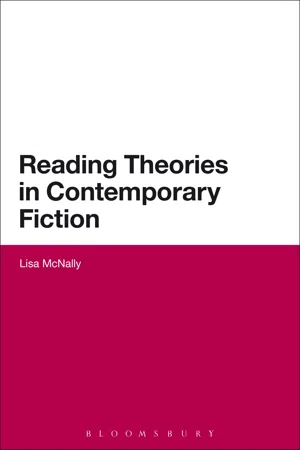
Reading Theories in Contemporary Fiction
About this book
Even after the upheavals wrought by Theory, literary criticism has generally ignored the act and experience of reading itself, proceeding as though something so fundamental to our experience of texts could be taken for granted. Reading Theories in Contemporary Fiction draws on deconstruction and the thought of Jacques Derrida to explore the ways in which contemporary fiction engages with reading, its power, the elusive nature of its experience and the failures of understanding inherent in it. Along the way, the book proceeds through close readings of such authors as J.M. Coetzee, David Mitchell, Toni Morrison and Philip Roth.
Information
1
Composition
Reading cannot be captured or grasped, but might, in this failure, happen. Literary criticism, by loosening its pretensions to represent, must attend to this impossibility. In order to consider how it might do this, we must pay attention to criticism’s composition, to the way in which it is written.
Derrida writes that we must accept ‘the impossibility of [the work] ever being present, of its ever being summarized by some absolute simultaneity or instantaneousness. This is why, as we will verify, there is no space of the work, if by space we mean presence and synopsis’ (Derrida 1978a, p. 14; italics in original). Derrida points out that the work is never yet determined. And yet the literary criticism that would treat of this work has, for Derrida, ‘already been determined, knowingly or not, voluntarily or not, as the philosophy of literature’ (Derrida 1978a, p. 28; my italics). As a ‘philosophy’, literary criticism speaks ‘objectively’ – detached and definitive – adopting an authoritative tone. It claims to know the text about which it writes, proceeding as though both its rules and its object of study were laid out in advance.
As I showed in my introductory chapter, however, such calm authority and detached commentary is not in fact possible; this tone masks the actual impossibilities of representation. Criticism institutes itself at a false distance from the reading and writing upon which it would comment; it disavows its role in the constitution of the textual object, which is, in fact, as I have shown, determined (and necessarily compromised) only at the point at which it is read. Critical writing is not in fact detached and definitive. To appear ‘distant and penetrative’, it ‘pushes’ its ‘writing-strokes away’ (Wood 2007, p. 143). Sarah Wood, whose creative-critical work questions the need for this pushing-away, points out in ‘All the way to writing’ that ‘[i]t is a frequent pretension of critical writing to imply that its significance depends on hypostasising the movements of writing that get critical activity started in the first place’ (Wood 2007, p. 143). It is a ‘pretension’ of critical writing to hypostasize its movements and to disaffirm its status as writing; Wood points out, however, that these movements are the very thing that gets it started. Critical writing will always, inevitably, be composed of ‘writing-strokes’, no matter how hard it attempts to deny this fact.
Wood thus challenges us to reconsider critical writing’s relation to the philosophical. Wood invokes Derrida, who ‘writes that one day criticism will not have to wait for philosophy . . . He writes about going all the way to writing: “Jusqu’à l’écriture” ’ (Wood 2007, p. 137).1 Wood pursues a critical (or, as she often calls it, a ‘poetic’) writing conscious of its always-implicated investments. Wood, arguing that ‘[c]ritical writing that goes all the way to writing invites readers to forget, to un-know how to read literature and in so doing to pay attention to the movements of writing’ (p. 137), performs a criticism which endeavours to keep literature and reading open, denying her readers the ability to ‘know’ what either might be. As I will show in more detail in my chapter’s first section, Wood’s critical writing draws us towards a more ‘literary’ and uncertain, less ‘philosophical’, form of critical pursuit.2
She is not the only one to promote this shift in focus. Maurice Blanchot claims in The Infinite Conversation that ‘the work counts less than the experience of the search for it . . . an artist is always ready to sacrifice the work’s accomplishment to the truth of the movement that leads to it’ (Blanchot 1993, p. 397). Blanchot aligns the ‘movement that leads to’ the work, rather than the work itself, with ‘truth’; the work or effort which produces the finished text is, for him, more important than the product itself. Roland Barthes, too, asserts that the ‘writerly’ or ‘ourselves writing’ is ‘our value’ (Barthes 1974, pp. 4–5; italics in original). And Hélène Cixous announces that for writers ‘what’s important is the process. The tempest, the rough draft’ (Cixous 1998, p. 44). Cixous, like Blanchot and Barthes, attributes composition a greater importance than the composed; she declares ‘I love the creation as much as the created, no, more’ (Cixous 1998, p. 20). Derrida, Wood, Cixous and Blanchot all encourage us to think a mode of critical writing conscious of its status as writing and attentive to its movements.3
This interest in the nature of composition is not new; it is shared, for example, by two much earlier writers: Henry James and Edgar Allan Poe. In ‘The philosophy of composition’, Poe announces ‘I have often thought how interesting a magazine paper might be written by any writer who would – that is to say, who could – detail, step by step, the processes by which any one of his compositions attained its ultimate point of completion’ (Poe 2009, p. 61). James echoes this sentiment; in The Art of the Novel he declares that ‘it would be really interesting’ to map ‘the how and the whence and the why’ of a novel’s gestation (James 1962, p. 339). Poe and James do not, of course, simply speculate; in the works from which I just quoted, they also perform the proposed project. James ‘[trusts]’ that the ‘numerous pages’ of his prefaces ‘record with clearness’ what he ‘saw’ when writing his fictions (p. 341).
However, the project Poe and James pursue differs from the one suggested by Derrida, Wood, Cixous and Blanchot. Poe and James reflect, in essays detached from the work itself, upon a writing which has already taken place, upon a composition which is now completed. Derrida, Wood, Cixous and Blanchot, in contrast, long for a writing that displays its own composition. But what would such a writing look like? How might we capture this tempestuous ‘process’? A number of Wood and Cixous’ works explicitly undertake the proposed project: Wood’s ‘All the way to writing’ and ‘Edit’ and Cixous’ ‘Without end, no, State of drawingness, no, rather: The Executioner’s taking off’ in Stigmata and ‘Post word’ in the collection Post Theory. Both Wood and Cixous take the process of composition as their theme; they allude to the production of the work, ‘[t]he to-be-in-the-process of writing’ (Cixous 1998, p. 20). Cixous is fascinated by ‘creation’ and keen to ‘confide’ to her readers ‘the mysteries of passage’ (p. 143). She attempts in her writing to grasp ‘“the beforehand of a book”’ (p. 20) and the ‘[t]empest before the immobilisation, the capture, the concept’ (Cixous 1999, p. 211). Wood, too, promises in her essays to ‘[investigate] writing as it is born, before it aligns itself with anything, before it amounts to much, before judgement. Even before a priori. Freshly picked or still growing’ (Wood 2007, p. 140). Both writers claim to represent the moment before completion, before writing is fully formed and fixed.
However, my reading of these essays is, perhaps, already too philosophical. Cixous’ claim that ‘I love the creation as much as the created, no, more’ is not as definitive as my analysis suggests. Cixous’ original French announces ‘j’aime la création autant que la créé, non, plus’ (Cixous 1991, p. 55). Both the French and the English play on the phrase non plus/no more. Without the comma, Cixous’ sentence implies that she loves the creation more than the created ‘no more’. That is to say, not any longer. When read attentively, the language of this passage hints at a less emphatic, more dissatisfied, relation to writing’s ‘creation’.
I noted James’s claim that his prefaces ‘record with clearness’ the genesis of his fictions. He follows this claim, however, by noting that ‘one element of fascination tended all the while to rule the business – a fascination, at each stage of my journey, on the noted score of so shifting and uneven character of my original passage’ (James 1962, p. 341). Here, James concedes that his ‘original passage’ was ‘shifting and uneven’ – less clear than he at first intimates. Indeed, James admits that it would not only be ‘really interesting’ but also ‘admirably difficult’ to map composition. Poe makes a similar admission; he punctuates his search for a ‘writer who would . . . detail, step by step, the processes by which any one of his compositions attained its ultimate point of completion’ with the phrase ‘that is to say, who could’. Poe’s aside suggests that the project might be more difficult than he first implies.4 Again, when read attentively, these essays appear less positive about their ability to record the act of composition.
I will return to consider the necessity of such an attentive reading in my chapter’s third section. First, though, I will outline the reasons behind these equivocations by reading Cixous and Wood’s work alongside a number of fictional texts, which also take composition as their theme. As I will demonstrate in my chapter’s second section, these fictional texts make especially clear the impossibilities we encounter when trying to represent the act of writing and thereby highlight a dilemma we must bear in mind when approaching Wood and Cixous’ work.
Many texts attempt to capture the act or event of writing. The example par excellence, Sterne’s Tristram Shandy, ‘makes the process of composition part of [its] narration’, as Everett Zimmerman points out (Zimmerman 1987, p. 127). This chapter focuses on a number of more recent works that display a similar fascination with their own production: J. M. Coetzee’s Diary of a Bad Year, Philip Roth’s Zuckerman Bound trilogy, A. S. Byatt’s The Biographer’s Tale and David Mitchell’s Black Swan Green. In all four of these novels, the protagonist is a writer. Jason in Black Swan Green is a young poet whose work is published in the parish newsletter under the pseudonym Eliot Bolivar. In the opening paragraph of the first novel in Roth’s Zuckerman Bound trilogy, The Ghost Writer, the novel’s first person narrator, whose name we later learn is Nathan Zuckerman, introduces himself as a man of ‘twenty-three, writing and publishing my first short stories’ (Roth 1998, p. 3). Zuckerman thus establishes himself as ‘the writer-hero of Roth’s own version of an artist’s life’, as Thomas Pughe points out (Pughe 1994, p. 83). Elizabeth Lowry notes that ‘the hero’ of Coetzee’s Diary of a Bad Year ‘is an ageing writer who bears a striking resemblance to Coetzee’ (Lowry 2007, p. 3). When he first meets Anya, a woman who lives in his apartment complex and whom he eventually employs as his typist, he tells her ‘I happen to be a writer by profession’ (Coetzee 2008, p. 17). Finally, in Byatt’s The Biographer’s Tale, the protagonist, Phineas G. Nanson, abandons his academic life and the language of literary theory in order to become a writer; he ‘[becomes] addicted to forbidden words, words critical theorists can’t use and writers can’ (Byatt 2001, p. 250).5 He tells us that ‘in terms of writing, this looks like a writer’s story. PGN was a mere Critick, steps centre-stage, assumes his life, Finds his Voice, is a Writer’ (Byatt 2001, p. 251).6 Louisa Hadley thus suggests that we label Byatt’s novel a ‘Künstlerroman, a novel that traces the development of the artist’ (Hadley 2008, p. 89). We could, equally, describe the other three novels I will discuss in the same way.
Wallhead suggests that ‘Byatt . . . is developing one of her favourite subjects, the analysis of artistic creativity, its sources and procedures’ (Wallhead 2003, p. 294). Similarly, Stephen Wade claims that Roth’s Zuckerman Bound offers us ‘cumulative discourses and dialogues on art, on the relationship between life and writing, the idea of what is “real” and the pains of authorship’ (Wade 1996, p. 90). Critics of these novels point out that they pose questions concerning artistry, creativity and creation. They suggest, moreover, that these questions are asked and answered thematically, at the level of representation and deliberate reflection. However, the situation is yet more complex. The protagonists of my chosen novels are presented to us not only as writers but, moreover, as the authors of the very texts we read. John Bayley points out that ‘Byatt’s biographer introduces himself to us in a manner not exactly auspicious: indeed he has hardly opened his mouth before we know him to be the author . . . of the book’ (Bayley 2001, p. 16).
Phineas tells us ‘I don’t think my mother’s death had anything to do with my decision, though as I set it down, I see it might be construed that way’, that ‘[t]he pleasure, for me, I suppose, as I write, is that this time I was thinking of Foucault, and even more of Linnaeus, amongst things’ and that ‘[a]ll writing about photographs, including this writing I am at present engaged in, has something decayed (decadent) and disgusting about it’ (Byatt 2001, pp. 1, 115, 140; italics in original). The phrases ‘as I set it down’, ‘as I write’ and ‘this writing I am at present engaged in’ all refer, in the first person and the present tense, to the process by which Phineas constructs his text. Thus, these comments generate a second narrative alongside the main story Phineas purports to tell us; they invite us to picture Phineas seated at a desk putting together these words. They invite us to picture him in the act of writing the text that we read.
Diary of a Bad Year, Zuckerman Bound and Black Swan Green also suggest – although more subtly – that their protagonists have authored the work we encounter. In Coetzee’s Diary of a Bad Year, Señor C tells Anya
What I am in the process of putting together is strictly speaking not a book, I said, but a contribution to a book.
The book itself is the brainchild of a publisher in Germany. Its title will be Strong Opinions (Coetzee 2008, pp. 20–1).
‘Strong Opinions’, we notice, is also the title of the novel’s first section; it is implied that the text Señor C supposedly composes and that which we read are one and the same. Similarly, at the end of Roth’s The Ghost Writer, Lonoff tells Zuckerman:
‘And you must have things to write down. There’s paper on my desk.’
‘Paper for what?’
‘Your feverish notes.’ (Roth 1998, p. 128)
I will discuss the complexities of Lonoff’s suggestion in more detail in my chapter’s second section. It suffices to point out here, however, that Lonoff tells Zuckerman to begin making notes for his next novel or short story. He tells him ‘“I’ll be curious to see how we all come out someday. It could be an interesting story. You’re not so nice and polite in your fiction . . . You’re a different person”’ (p. 129). Lonoff authorizes Zuckerman to place him and Hope into fiction. The novel we have just read is, of course, such a story. It is implied that the words we have read are those that Zuckerman has written.7 Similarly, in Black Swan Green, in a scene I will again examine more closely in my second section, Jason sits down to write and the words he composes are those we have already read in the novel. Mitchell’s work is, for Thomas Jones, the ‘story of a stammering poet finding his true voice as a writer of fluent prose’ (Jones 2006, p. 34). Jones implies that Jason is the author of the ‘fluent prose’ that we read as Black Swan Green.
Thus, these texts purport to unfold writing as it happens, depicting its moment or present and claiming to subject us to composition in their very texture. These novels write about their writing and refer to their gestation. This self-reflexivity is frequently celebrated as a sophisticated gesture; Patricia Waugh suggests that novels such as those I will examine (to which she applies the label ‘metafiction’) signal a ‘mature recognition’ of their ‘existence as writing’ (Waugh 1984, p. 19; italics in original). Similarly, Hal Jensen claims that in The Biographer’s Tale we encounter an ‘exposure of the tricks of literary composition’ (Jensen 2000, p. 23). Waugh frames the self-consciousness of these novels as their coming-of-age; she implies that the novel finally recognizes its written form, attaining a self-awareness it previously lacked. Jensen, too, aligns the trope with ‘exposure’ or revelation.
The situation with which these novels present us is, however, more complex than th...
Table of contents
- Cover-Page
- Half-Title
- Series
- Title
- Copyright
- Contents
- Acknowledgements
- Introduction: Telling Truths about Reading
- 1 Composition
- 2 Traces
- 3 Deconstruction and Ethics
- 4 Tact
- 5 You
- Coda: Desire
- Notes
- Bibliography
- Index
Trusted by 375,005 students
Access to over 1.5 million titles for a fair monthly price.
Study more efficiently using our study tools.
Frequently asked questions
Yes, you can cancel anytime from the Subscription tab in your account settings on the Perlego website. Your subscription will stay active until the end of your current billing period. Learn how to cancel your subscription
No, books cannot be downloaded as external files, such as PDFs, for use outside of Perlego. However, you can download books within the Perlego app for offline reading on mobile or tablet. Learn how to download books offline
Perlego offers two plans: Essential and Complete
- Essential is ideal for learners and professionals who enjoy exploring a wide range of subjects. Access the Essential Library with 800,000+ trusted titles and best-sellers across business, personal growth, and the humanities. Includes unlimited reading time and Standard Read Aloud voice.
- Complete: Perfect for advanced learners and researchers needing full, unrestricted access. Unlock 1.5M+ books across hundreds of subjects, including academic and specialized titles. The Complete Plan also includes advanced features like Premium Read Aloud and Research Assistant.
We are an online textbook subscription service, where you can get access to an entire online library for less than the price of a single book per month. With over 1.5 million books across 990+ topics, we’ve got you covered! Learn about our mission
Look out for the read-aloud symbol on your next book to see if you can listen to it. The read-aloud tool reads text aloud for you, highlighting the text as it is being read. You can pause it, speed it up and slow it down. Learn more about Read Aloud
Yes! You can use the Perlego app on both iOS and Android devices to read anytime, anywhere — even offline. Perfect for commutes or when you’re on the go.
Please note we cannot support devices running on iOS 13 and Android 7 or earlier. Learn more about using the app
Please note we cannot support devices running on iOS 13 and Android 7 or earlier. Learn more about using the app
Yes, you can access Reading Theories in Contemporary Fiction by Lisa McNally in PDF and/or ePUB format, as well as other popular books in Literature & Literary Criticism. We have over 1.5 million books available in our catalogue for you to explore.