Winner of the 2014 Bertrand Russell Society Book Award
Bertrand Russell was one of the greatest philosophers of the twentieth century. Over his professional career of 45 years Russell left his mark and influence in many domains of intellectual inquiry. This includes the foundations of mathematics, the philosophy of science, metaphysics, the theory of knowledge, the philosophy of language, education, religion, history, ethics and politics.
In Russell: A Guide for the Perplexed, John Ongley and Rosalind Carey offer a clear and thorough account of the work and thought of this key thinker, providing a thematic outline of his central ideas and his enduring influence throughout the field of philosophy. The authors lay out a detailed survey of Russell's academic, technical philosophy, exploring his work on logic, mathematics, metaphysics, language, knowledge and science. This concise and accessible book engages the reader in a deeper critical analysis of Russell's prolific philosophical and literary output.
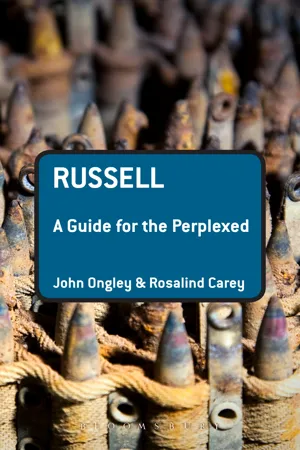
- 208 pages
- English
- ePUB (mobile friendly)
- Available on iOS & Android
eBook - ePub
Russell: A Guide for the Perplexed
About this book
Information
CHAPTER ONE
Introduction
Bertrand Russell (1872–1970) was arguably the greatest philosopher of the twentieth century and the greatest logician since Aristotle. He wrote original philosophy on dozens of subjects, but his most important work was in logic, mathematical philosophy, and analytic philosophy. Russell is responsible more than anyone else for the creation and development of the modern logic of relations—the single greatest advance in logic since Aristotle. He then used the new logic as the basis of his mathematical philosophy called logicism.
Logicism is the view that all mathematical concepts can be defined in terms of logical concepts and that all mathematical truths can be deduced from logical truths to show that mathematics is nothing but logic. In his work on logicism, Russell developed forms of analysis in order to analyze quantifiers in logic and numbers and classes in mathematics, but he was soon using them to analyze points in space, instants of time, matter, mind, morality, knowledge, and language itself in what was the beginning of analytic philosophy.
This first chapter introduces Russell’s work in logic, logicism, and analysis, and then introduces his broader inquiries of analytic philosophy in metaphysics, knowledge, and meaning. Subsequent chapters treat each subject in detail. However, all of Russell’s technical philosophy revolves around his logicism. Because Russell’s mathematical philosophy is the key to the rest of his work, and because it is the most difficult part of it, we begin this chapter with a discussion of logicism, then keep circling back to it, relating it to the rest, until it seems to the reader that it is the easiest thing in the world to understand.
1 Logic and logicism: Basic concepts
Let’s start with some basic logical concepts. A sentence is a group of words that express a meaning that is a complete thought. A declarative sentence expresses a meaning that is either true or false. A proposition is the meaning expressed by a declarative sentence such as the true proposition “The earth is round” or the false one “The earth is flat.” So propositions are either true or false. The declarative sentences that express them are also said to be true or false.
Subjects and predicates follow. The subject of a proposition is who or what the proposition is about. “The earth is flat” is about the earth. So the earth is the subject of that proposition. The predicate is what is said about, or attributed to, the subject. Here, the proposition attributes flatness to the earth, so “ ______ is flat” is the predicate. Logicians write predicates using blank spaces, or more usually, variables like x, y, or z to indicate where the subject goes in relation to the predicate. Bertrand Russell called predicates propositional functions. In this book, we use the terms interchangeably.
The predicate “x is flat” is a one-place predicate, because it only has one place where a subject can go—it attributes a property to one thing. Two-place predicates are relations like that in “Indiana is flatter than Ohio.” Here, the subjects are “Indiana” and “Ohio” and the predicate is “x is flatter than y.” (In grammar, the first is the subject and the second is the object; in logic, they are both subjects.) Common two-place relations in mathematics are x = y, x > y, and x < y. There are also three-place relations like that in “Ohio is between Indiana and Pennsylvania,” where the predicate is “x is between y and z,” which is often used in geometry. There are also four-place relations, and so on.
Before Russell’s logic of relations, logic consisted principally of the Aristotelian logic of one-place predicates. This simple logic can analyze sentences that use one-place predicates to attribute properties to objects like “Tom is tall” or “The sky is blue.” It can also analyze slightly more complex sentences like “All humans are animals” (if someone is human, that person is an animal) and “Some humans are thoughtful” (at least one person is both human and thoughtful) and from these two sentences infer that “Some animals are thoughtful.” You can’t get too far with such a simple logic and you certainly can’t analyze many mathematical or scientific statements with it.
It was Russell’s first great achievement to develop the more powerful logic of relations to describe concepts such as “x is taller than y” used in propositions like “Tom is taller than Bob,” which you can’t say with a one-place predicate like “x is tall.” This allowed Russell to describe propositions containing two-place mathematical relations like x = y or “x > y” (needed for arithmetic and algebra), three-place relations like “x is between a and b” (needed for geometry), and the like. With it, all of the concepts of pure mathematics can be expressed, which can’t be done with the logic that came before it.
Russell’s logic includes set theory. This is because his logic contains predicates and every predicate defines a set. For example, the predicate “x is human” defines the set of all things that can replace the x to make “x is human” a true proposition, namely, the class of humans. The comprehension axiom is the assumption that every predicate defines a class. It is an assumption of Russell’s logic. Thus, Russell’s logic contains sets and a theory of sets, as well as one-place predicates and two-place relations. Russell refers to sets as “classes” and set theory as “the theory of classes.” We will use both ways of speaking indifferently and without distinction.
2 The emergence of logicism
After the logic of relations, Russell’s greatest achievement is his theory of logicism—the view that mathematics is just logic, so that all mathematical concepts can be defined with logical concepts and all mathematical truths derived from logical truths. Russell’s logic and his logicist philosophy were first fully described in his 1903 Principles of Mathematics. The actual derivation of mathematics from logic, to prove that all mathematics can be derived from logic, occurs in the three-volume 1910–13 Principia Mathematica that Russell wrote with Alfred North Whitehead. Russell also presents logicism simply and informally in the 1919 Introduction to Mathematical Philosophy.
Logicism comes down to is this: In the nineteenth century, mathematicians had shown that all of classical mathematics can be defined in terms of, and derived from, arithmetic. Most importantly, Richard Dedekind had shown in 1872 that the real numbers can be defined in terms of rational numbers. Then rational numbers were defined in terms of natural numbers, thus demonstrating that the real numbers can be derived from natural numbers. The next step was taken when Giuseppe Peano, based on work by Dedekind, showed in 1890 that arithmetic can be reduced to five axioms and three undefined terms.
To reduce mathematics to logic, one then simply has to define Peano’s three concepts with logical concepts, thus expressing Peano’s axioms logically, and then derive the axioms from logical truths, thus showing that Peano’s axioms, and all the mathematics based on them, are logical truths. Russell starts by defining natural numbers logically as classes of classes. Specifically, a natural number is the class of all classes containing the same number of things, so that the number 1 is the class of all singletons (classes with one member), 2 is the class of all couples, and so on. With this definition, Russell then defines Peano’s other two basic concepts logically and derives Peano’s axioms from logic.
Put this way, demonstrating logicism is a seemingly simple task. But Russell and Whitehead soon ran into difficulties, namely, contradictions Russell found in the new logic and set theory. The most famous of these is called Russell’s paradox. Some sets are members of themselves, others are not. The set of things that are not red is itself not red, so it is a member of itself, but the set of red things is not red, so it is not a member of itself. This allows us to construct the predicate “x is not a member of itself,” which defines the set of all sets that are not members of themselves. But is the set itself a member of itself? If it is a member of itself, then it isn’t. But if it isn’t a member of itself, then it is. A contradiction ensues no matter how one answers.
To avoid this and similar paradoxes, Russell’s logic, and the logicism based on it, became quite complex, and the ultimate success of this logicism is still a matter of debate. Many believe that it cannot be carried out completely. Others say the final verdict is not yet in. Still others say it can be done. In any case, it is significant and astonishing how much of mathematics Russell and Whitehead demonstrated can be reduced to logic. And if one is willing to tolerate a few pesky contradictions here and there, it absolutely can be done.
Russell’s original form of logicism, in his 1903 Principles of Mathematics, did not attempt to avoid the paradoxes of the new logic, and so did not contain the complex mechanisms Russell later added to his logic to avoid them. It is a straightforward theory, containing all of logicism’s basic elements. We present this basic logicism, which we call naïve logicism, in Chapter 2. The complex version meant to avoid paradoxes, which occurs in the 1910–13 Principia Mathematica, we call restricted logicism. We describe that in Chapter 3.
3 Logicism and analysis
As well as founding the logic of relations, developing the theory of logicism, and discovering fundamental contradictions in logic and set theory, Russell more than anyone else founded the twentieth-century movement of analytic philosophy that still dominates philosophy today. Analytic philosophy as practiced by Russell logically analyzes language to say what there is and how we know it. Analysis is a significant part of analytic philosophy and its role in the movement is largely due to Russell. His logical analysis of mathematics is the primary example of analysis.
Notions of analysis vary from one analytic philosopher to another and from one analysis to another by a single philosopher. This last case is true of Russell himself. Most generally, “analysis” for him means beginning with something that is common knowledge and seeking the fundamental concepts and principles it is based on. This is followed by a synthesis that begins with the basic concepts and principles discovered by analysis and uses them to derive the common knowledge with which one began the analysis.
In Russell’s own words (Introduction to Mathematical Philosophy): “By analyzing we ask . . . what more general ideas and principles can be found, in terms of which what was our starting-point can be defined or deduced” (p. 1). Similarly, in Principia Mathematica, he says “There are two opposite tasks which have to be concurrently performed. On the one hand, we have to analyze existing mathematics, with a view to discovering what premises are employed . . . . On the other hand, when we have decided upon our premisses, we have to build up again [i.e., synthesize] as much as may seem necessary of the data previously analyzed” (vol. 1, p. v).
Immanuel Kant uses the same concepts of analysis and synthesis to describe his Prolegomena to Any Future Metaphysics and Critique of Pure Reason. “I offer here,” he says in the Prolegomena, “a plan which is sketched out after an analytical method, while the Critique itself had to be executed in the synthetical style” (p. 8). In the Prolegomena we start with science (mathematics and physics) and by analysis, he says, “proceed to the ground of its possibility,” that is, to its fundamental concepts, while in the Critique, “they [the sciences] must be derived . . . from [the fundamental] concepts” (p. 24).
Russell’s Introduction to Mathematical Philosophy, an informal introduction to Principia’s logicism, is similarly analytic. About it, he says: “Starting from the natural numbers, we have first defined cardinal number and shown how to generalize the conception of number, and have then analyzed the conceptions involved in the definition, until we found ourselves dealing with the fundamentals of logic.” About synthesis, he says “In a synthetic, deductive treatment these fundamentals [reached by analysis] come first, and the natural numbers [with which the analysis started] are reached only after a long journey” (p. 195).
And Principia Mathematica is a synthesis: it begins with the logical fundamentals found by analysis, and from them deductively builds up the mathematics the analysis started with. As Russell says in Principia itself, it is “a deductive system” in which “the preliminary labor of analysis does not appear.” Instead, it “merely sets forth the outcome of the analysis . . . making deductions from our premisses . . . up to the point where we have proved as much as is true in whatever would ordinarily be taken for granted” (vol. 1, p. v).
Russell’s Introduction to Mathematical Philosophy is thus to Principia Mathematica what Kant’s Prolegomena is to the Critique of Pure Reason—an analysis that takes common knowledge and finds its basic principles, which synthesis then uses to demonstrate the knowledge analyzed. The Introduction to Mathematical Philosophy and Prolegomena also both informally introduce the subjects presented more rigorously in the synthetic works. But Kant seeks to justify knowledge with the principles uncovered by analysis. Russell does not. For him, the logical ideas analysis uncovers are less certain than the arithmetic it analyzes.
For Russell, what we analyze—arithmetic—is certain and inductively justifies the fundamental principles found by analysis when synthesis deduces arithmetic from them. (If synthesis shows that logic implies arithmetic, and arithmetic is true, then logic is probably true. The argument is inductive.) Russell does not think arithmetic is made certain by being derived from logic, but that logic is made more certain by arithmetic being derived from it.
As Russell says in Principia: “The chief reason in favor of any theory on the principles of mathematics [the justification of the premisses that imply mathematics] must always be inductive, i.e. it must lie in the fact that the theory in question enables us to deduce ordinary mathematics” (v...
Table of contents
- Cover-Page
- Half-Title
- Series
- Title
- Copyright
- Contents
- Preface
- 1 Introduction
- 2 Naïve logicism
- 3 Restricted logicism
- 4 Metaphysics
- 5 Theory of knowledge
- 6 Language and meaning
- 7 The infinite
- Notes
- Further Reading
- References
- Index
Trusted by 375,005 students
Access to over 1.5 million titles for a fair monthly price.
Study more efficiently using our study tools.
Frequently asked questions
Yes, you can cancel anytime from the Subscription tab in your account settings on the Perlego website. Your subscription will stay active until the end of your current billing period. Learn how to cancel your subscription
No, books cannot be downloaded as external files, such as PDFs, for use outside of Perlego. However, you can download books within the Perlego app for offline reading on mobile or tablet. Learn how to download books offline
Perlego offers two plans: Essential and Complete
- Essential is ideal for learners and professionals who enjoy exploring a wide range of subjects. Access the Essential Library with 800,000+ trusted titles and best-sellers across business, personal growth, and the humanities. Includes unlimited reading time and Standard Read Aloud voice.
- Complete: Perfect for advanced learners and researchers needing full, unrestricted access. Unlock 1.5M+ books across hundreds of subjects, including academic and specialized titles. The Complete Plan also includes advanced features like Premium Read Aloud and Research Assistant.
We are an online textbook subscription service, where you can get access to an entire online library for less than the price of a single book per month. With over 1.5 million books across 990+ topics, we’ve got you covered! Learn about our mission
Look out for the read-aloud symbol on your next book to see if you can listen to it. The read-aloud tool reads text aloud for you, highlighting the text as it is being read. You can pause it, speed it up and slow it down. Learn more about Read Aloud
Yes! You can use the Perlego app on both iOS and Android devices to read anytime, anywhere — even offline. Perfect for commutes or when you’re on the go.
Please note we cannot support devices running on iOS 13 and Android 7 or earlier. Learn more about using the app
Please note we cannot support devices running on iOS 13 and Android 7 or earlier. Learn more about using the app
Yes, you can access Russell: A Guide for the Perplexed by John Ongley,Rosalind Carey in PDF and/or ePUB format, as well as other popular books in Philosophy & Philosophy History & Theory. We have over 1.5 million books available in our catalogue for you to explore.