- 384 pages
- English
- ePUB (mobile friendly)
- Available on iOS & Android
eBook - ePub
About this book
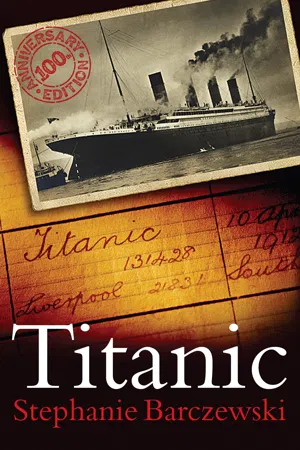
In a night of unforgettable tragedy, the world's most famous liner struck an iceberg on 14 April 1912 and sank. Over 1500 people died. Whose fault it was, and how the passengers and crew reacted, has been the subject of continuing dispute over the 100 years since the disaster. This is an account of Titanic's tragic maiden voyage which also focuses on some of those who died: among them Titanic's captain Edward Smith and builder Thomas Andrews, John Jacob Astor, the richest man on board, and the bandmaster, Wallace Hartley, who played as the ship sank. In this centenary edition Stephanie Barczewski traces the events of that fatal night. Many of those who died were treated as heroes and how these men were remembered says much about contemporary values of manhood, chivalry and national pride. Titanic: A Night Remembered also sets the liner in the context of three ports: Belfast, where she was built; Southampton, which lost 600 citizens as members of her crew; and Queenstown in Ireland, her last port of call.
1
What Have We Struck?
Precisely at noon on 10 April 1912 a sonorous blast on the ship’s whistles signalled the departure of the first – and, as the world well knows, last – voyage of the White Star Line’s RMS Titanic. The Titanic was, as is also well known, the largest ship in the world, stretching a sixth of a mile from bow to stern, standing ten stories high from its keel to the top of its four funnels and displacing over 45,000 tons. Everything about the Titanic was on a grand scale: a locomotive could pass through each funnel, and a double-decker tramcar through each of its twenty-nine boilers. Its rudder was longer than a cricket pitch, and its anchors weighed fifteen tons each.
The Titanic was, however, more than a behemoth. Unlike the deliberately ponderous ships being built by White Star’s German competitors Hamburg-Amerika and Norddeutscher Lloyd, the Titanic was a graceful vessel, with clean lines and balanced proportions. To be sure, once its massive engines – each four stories high – began to crank and its three immense propellers started to churn, there could be no disguising the ship’s 55,000 horsepower. But as the Titanic lay in its berth at Southampton Docks, gangways buzzing as the final passengers and crew members hurried on board, the impression the ship gave was one of quiet strength, not tremendous bulk. ‘So perfect are her proportions’, declared the maritime engineering journal the Shipbuilder, ‘that it is well-nigh impossible for the inexperienced to grasp her magnitude except when seen alongside another vessel.’1
Beneath the Titanic’s hull that appearance of strength was given reality by a system of safety features designed to eliminate the risks posed by ocean travel. In contemplating those risks, the Titanic’s builders, Harland & Wolff of Belfast, had determined that there were three reasons why a ship might sink. First, it could run aground. Secondly, it could run into an object, either another ship or a natural hazard. Thirdly, another ship could run into it. Provide safety measures that could cope with those circumstances, the builders reasoned, and much of the risk would be eliminated. To deal with the first threat, Harland & Wolff gave the Titanic a double bottom, which meant that its keel carried a second set of steel plates seven feet above the first. If the keel scraped the seabed, the ship would thus not be opened to the sea. To deal with the second and third threats, the builders fitted the Titanic with a system of fifteen bulkheads that divided the hull into sixteen watertight compartments. If the Titanic ran into something that crushed its bow, it could float with the first four of these compartments flooded. And if something ran into it, then the Titanic could float with any two of the central compartments flooded, so that even if another ship hit precisely at the junction of two compartments, and breached them both, the hull would remain seaworthy. It was necessary to have some openings in the bulkheads to allow the passengers and crew to get from one part of the ship to another, but these openings were equipped with watertight doors. The twelve doors on the Tank Top Deck where the engine rooms and coal bunkers were located could be closed with the flip of a switch located on the bridge. The other twenty doors were operated manually by a hand-cranked mechanism on the floor. All the watertight doors were fitted with a float mechanism that automatically closed them if a compartment became flooded with more than six inches of water.
No wonder the builders felt proud of their new creation. Most ships, after all, had only one or two ‘collision bulkheads’ in the bow, not sixteen watertight compartments. Certainly the naval engineering world was impressed: ‘practically unsinkable’, declared the Shipbuilder.2 The system seemed foolproof. So confident were Harland & Wolff that the Titanic’s plans did not call for a double hull, as White Star’s rival Cunard had given its flagships, the Lusitania and Mauretania. This certainly pleased White Star, because it saved considerably on construction expense. And when White Star also suggested cutting the number of lifeboats from the forty-eight called for by the original plans to twenty, Harland & Wolff put up little resistance. It would cut down further on costs, after all, as well as reduce the amount of clutter on the Titanic’s decks. This meant that the Titanic would carry sufficient lifeboat space for only about a third of its 3300-person capacity, but what harm would that do? Its extensive safety features made the ship its own lifeboat, and twenty boats were still four more than the law required.3 White Star’s money, both the owners and the builders agreed, was better spent on ensuring the ship’s reputation as the most luxurious vessel afloat. About the meeting in which the plans for the Titanic and its sister ship the Olympic were finalized, Harland & Wolff’s managing director Alexander Carlisle recalled, ‘We spent two hours discussing the carpets for the first-class cabins and fifteen minutes discussing lifeboats’.4
The Titanic’s design, however, contained a flaw, or at least it was based on assumptions that proved erroneous. The watertight bulkheads that enhanced safety also created problems, for passage through them had to be limited, therefore inhibiting the movement of passengers and crew around the ship. They also added expense. For those reasons, White Star wanted the bulkheads to go no higher than was absolutely necessary. Accordingly Harland & Wolff’s designers calculated that the bulkheads needed to go only up to D Deck fore and aft and only up to E Deck amidships. This meant that in places their tops would be a mere fifteen feet above the waterline; but Harland & Wolff determined that that was sufficient. Even if two of the compartments were breached in a collision with another ship, the weight of the incoming water would not be enough to sink the ship. And even if the first four compartments were breached in a head-on collision, the bow would not dip so low as to pull it under and take the rest of the ship down. Now if, hypothetically, an accident were to occur in which the first six compartments were breached, then the bow would plunge so low that water would spill over the top of the bulkhead separating the sixth compartment from the seventh, and then the seventh from the eighth, and back and back until the ship sank. But what sort of accident could cause that kind of damage? There was no precedent in maritime history.
The Titanic’s builders and owners could have been excused a sense of pride as they gazed at their new creation as it lay in its berth at Southampton. The ship was an unparalleled technological marvel even in an age of technological marvels, representing everything that human ingenuity could accomplish.
As the Titanic’s giant engines throbbed into life and the massive triple screws at the stern began to turn, however, an incident occurred that provided a warning that even the most carefully thought out plans cannot take into account every eventuality. On that April day, Southampton’s docks were overflowing with ships that had been left idle by a coal strike.5 The ships had to be tied up side by side, for there were not sufficient berths to hold them all. Directly across from the Titanic’s berth lay the Oceanic and, on the outboard side, the New York, two smaller passenger steamers. As the tugboats helped the Titanic make its way slowly out into the harbour, the huge ship displaced a tremendous volume of water and pushed it under the New York, lifting it upwards and causing the mooring lines which secured it to the pier to slacken. Then, as the Titanic moved past the New York, the volume of water in the vicinity dramatically decreased, causing those same lines to suddenly go taut. The ropes could not take the strain and snapped one by one, sounding like gunshots. The New York’s stern started to swing out towards the Titanic and a collision appeared inevitable. At the last moment, however, the tug Vulcan was able to get a line onto the New York and, straining with all its might, managed to hold the ship just long enough for the Titanic to slip by, with only three or four feet to spare. The Titanic’s captain, Edward J. Smith, then demonstrated his seafaring experience and expertise by ordering a quick ‘full astern’ on the ship’s engines, which washed the New York back towards its berth.6
It was a narrow escape, and some of the Titanic’s passengers were a little unnerved. Renee Harris, whose husband Henry was a noted theatrical producer in New York, was watching from the rail when a stranger asked her, ‘Do you love life?’
‘Yes, I love it’, she replied, surprised by the question.
‘That was a bad omen. Get off this ship at Cherbourg, if we get that far. That’s what I’m going to do.’7
Others were more amused than alarmed by the incident. Steward Seaton Blake mailed a humorous postcard to the Mayor of New York City:
Guess you had better chain up the Statue of Liberty to a skyscraper in Fifth Avenue or to the ramparts of Fort Pitt, as I ‘reckon and calculate’ that the foundations are liable to be swallowed up by the wash of this ‘octopus’ from the other side, which sucked up from its moorings like a barnacle the Yankee Doodle liner New York yesterday in Southampton docks. Better instruct the United States fleet to tow her in, or I guess New York will be wiped off the map.8
The excitement of the near-accident soon faded, and the Titanic’s passengers and crew began settling into a shipboard routine. Stewards set out deck chairs and prepared the dining rooms for lunch, while far below in the boiler rooms stokers were busy shovelling the 650 tons of coal the Titanic’s engines devoured each day. The passengers, meanwhile, tried to find their way around the huge ship. As they boarded, stewards had greeted them and shown them to their cabins, but without their help the ship was a maze of corridors and stairwells. The crew was in many cases equally befuddled. The Titanic’s Second Officer, Charles Lightoller, was an extremely experienced seaman, but he later wrote that ‘it took me fourteen days before I could find my way with confidence from one part of the ship to the other’. The other members of the crew, many of whom did not come on board until the morning of the sailing, did not have that much time to become thoroughly acquainted with the gigantic ship. Most of them had transferred from White Star’s smaller vessels, and they found the Titanic’s vastness utterly bewildering. ‘I never knew my way’, complained Steward William Lucas.9
On the evening of 10 April the Titanic reached Cherbourg, where it took on 142 first-class, thirty second-class and 102 third-class passengers. Among the first group were some of the Titanic’s most socially prominent passengers, including the richest man on the ship, forty-seven-year-old John Jacob Astor, owner of vast holdings of New York real estate. As he boarded the Titanic, Astor’s wealth was undeniable, but his reputation was less secure. Three years earlier, he had divorced his wife of eighteen years to marry Madeleine Force, who at eighteen was younger than Astor’s son Vincent. In the early twentieth century, divorce still carried a considerable stigma, particularly under such tawdry circumstances. Astor had assumed that his wealth and name would protect him, but he was wrong. The couple was viciously ‘cut’ by New York society, who boycotted the reception that Astor gave at his Fifth Avenue mansion to celebrate his nuptials. On the opening night of the season at the Metropolitan Opera his box was ignored by former friends. In an effort to weather the storm, the Astors had fled abroad in late 1911, spending the winter in France and then travelling to Egypt. Now, however, Madeleine was four months pregnant, and they were returning home, hoping that the scandal had dissipated and that the gossipmongers had moved on to other pursuits.
While in Egypt, the Astors had been travelling with Margaret Tobin Brown, whose husband J.J. had struck it rich mining in Colorado. When Brown received news that her grandson Lawrence was ill, she decided to return home on the first available ship, which turned out to be the Titanic, on which the Astors had already booked their passage. Also boarding at Cherbourg was Benjamin Guggenheim, whose family’s business interests had expanded from their roots in mining and smelting to a variety of financial and manufacturing pursuits. In contrast to Astor, Guggenheim had adhered to social convention in his personal affairs: for the last several months, he had been in Paris with his mistress, Madame Aubart, while his wife remained at home in New York. Guggenheim’s demeanour was quiet, but his fellow first-class passengers would have been well aware of his immense wealth and power.
Astor, Brown and Guggenheim joined a glittering array of first-class passengers who collectively earned the Titanic the nickname the ‘Millionaire’s Special’; the net worth of the entire first-class complement of 337 (46 per cent of the ship’s capacity) was estimated at well over $500 million. Also included among it were Isidor Straus, part-owner of Macy’s department store; George Widener, the Philadelphia tramway magnate; John B. Thayer, president of the Pennsylvania Railroad; Arthur Ryerson, the Philadelphia steel baron; Washington Augustus Roebling, director of the engineering firm that had designed and built the Brooklyn Bridge; and Charles Hays, president of the Grand Trunk Railroad. The Titanic’s first-class passenger list included, however, more than just wealthy men of business and industry. There were also political figures such as Major Archibald Butt, military aide to the American President William Howard Taft, who was returning from a diplomatic mission to the Vatican. Amongst the American plutocrats were sprinkled a few members of the British elite, such as Sir Cosmo and Lady Duff Gordon and the Countess of Rothes, on her way to join her husband on his fruit farm in British Columbia. Finally, the Titanic carried several prominent representatives of cultural accomplishment, including the theatrical producer Henry B. Harris, the painter Frank Millet, the author Jacques Futrelle, the actress Dorothy Gibson and the journalist W. T. Stead. In the 1880s, Stead had been the editor of the Liberal Pall Mall Gazette. Its spirited crusades had attracted a wide-ranging readership as Stead railed against Bulgarian atrocities in the Balkan Wars, conditions in Siberian labour camps and slavery in the Belgian Congo. He also tackled causes closer to home, such as adoption and housing for ...
Table of contents
- Cover
- Half-Title
- 1 What Have We Struck?
- 2 The Best Traditions of the Sea
- 3 Heroes and Villains
- 4 Jack Phillips
- 5 Wallace Hartley
- 6 Thomas Andrews
- 7 Edward Smith
- 8 William Murdoch
- 9 Belfast
- 10 Southampton
- 11 Conclusion
- Appendix
- Notes
- Bibliography
- Index
Trusted by 375,005 students
Access to over 1.5 million titles for a fair monthly price.
Study more efficiently using our study tools.
Frequently asked questions
Yes, you can cancel anytime from the Subscription tab in your account settings on the Perlego website. Your subscription will stay active until the end of your current billing period. Learn how to cancel your subscription
No, books cannot be downloaded as external files, such as PDFs, for use outside of Perlego. However, you can download books within the Perlego app for offline reading on mobile or tablet. Learn how to download books offline
Perlego offers two plans: Essential and Complete
- Essential is ideal for learners and professionals who enjoy exploring a wide range of subjects. Access the Essential Library with 800,000+ trusted titles and best-sellers across business, personal growth, and the humanities. Includes unlimited reading time and Standard Read Aloud voice.
- Complete: Perfect for advanced learners and researchers needing full, unrestricted access. Unlock 1.5M+ books across hundreds of subjects, including academic and specialized titles. The Complete Plan also includes advanced features like Premium Read Aloud and Research Assistant.
We are an online textbook subscription service, where you can get access to an entire online library for less than the price of a single book per month. With over 1.5 million books across 990+ topics, we’ve got you covered! Learn about our mission
Look out for the read-aloud symbol on your next book to see if you can listen to it. The read-aloud tool reads text aloud for you, highlighting the text as it is being read. You can pause it, speed it up and slow it down. Learn more about Read Aloud
Yes! You can use the Perlego app on both iOS and Android devices to read anytime, anywhere — even offline. Perfect for commutes or when you’re on the go.
Please note we cannot support devices running on iOS 13 and Android 7 or earlier. Learn more about using the app
Please note we cannot support devices running on iOS 13 and Android 7 or earlier. Learn more about using the app
Yes, you can access Titanic 100th Anniversary Edition by Stephanie Barczewski in PDF and/or ePUB format, as well as other popular books in History & 20th Century History. We have over 1.5 million books available in our catalogue for you to explore.