Examining the nature of weakness has inspired some of the most influential aesthetic and philosophical portraits of the human condition. By reading a selection of canonical literary and philosophical texts, Michael O'Sullivan charts a history of responses to the experience and exploration of weakness.
Beginning with Plato and Aristotle, this first book-length study of the concept explores weakness as it is interpreted by Lao Tzu, Nietzsche, Derrida, the Romantics, Dickens and the Modernists. It examines what feminist writers Simone de Beauvoir and Luce Irigaray have made of the gendered biomythology constructed around the figure of the "weaker vessel" and it considers related notions such as im-potentiality, a "syntax of weakness" and human vulnerability in the work of Agamben, Beckett and Coetzee.
Through analysis of these differing versions of weakness, O'Sullivan's study challenges the popular myth that aligns masculine identity with strength and force and presents a humane weakness as a guiding motif for debates in ethics.
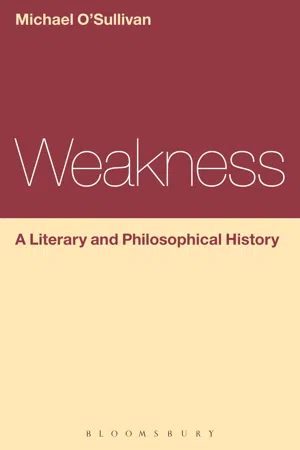
- 224 pages
- English
- ePUB (mobile friendly)
- Available on iOS & Android
eBook - ePub
Weakness: A Literary and Philosophical History
About this book
Information
Part One
Philosophy
Chapter 1
Fragile Goodness and Weakness of the Will
In the Gorgias, when Socrates and Callicles are coming to the end of their long discussion, Callicles, the young politician with ‘business in the city’ is becoming ever more infuriated by Socrates’ style of questioning. Socrates is going out of his way to describe how ineffective the philosopher can appear to a young businessman. When he comes to predicting his own death sentence because he ‘won’t know what to say in court’ (Cooper, 864) to the allegations brought against him about impiety and confusing and corrupting the youth of Athens, and, as we learn in the Apology, about ‘making the weaker argument the stronger’,1 Callicles asks in almost disbelief: ‘Do you think, Socrates, that a man in such a position in his city, a man who’s unable to protect himself, is to be admired?’ (Cooper, 865). Socrates responds: ‘Yes, Callicles, as long as he has protected himself against having spoken or done anything unjust relating to either men or gods’ (865). The vulnerable man, the man who cannot protect himself in the city, is also, for the Socrates of the Apology, as the oracle suggests, a man who, in being the ‘wisest’, accepts that his wisdom is ‘worthless’ (23). Despite the fact that Socrates, as Alcibiades suggests in the Symposium, does play games of irony, when we read on in the Gorgias we can sense that Socrates is serious about how such a man must be admired. He goes on to describe Callicles’ arguments as ‘worthless’ also (869). Callicles argues that ‘the many’ ‘conceal their own impotence’ behind law so that they can ‘enslave men who are better by nature’ (835). He therefore argues that ‘the more powerful among men’ (827) must have their ‘fair share’ (828) because those ‘who institute our laws are the weak’ (827) in seeking to control nature through law. It may sound a little Nietzschean; however, Socrates is unwilling to accept this regard for ‘impotence’ and the ‘powerful’ because ‘a person who wants to be happy must evidently pursue and practice self-control’ (851), and he says it is philosophy alone that can enable one, as Socrates describes for himself, ‘to be and to live as a very good man, and when I die, to die like that’ (868). He calls on all other people to do the same in this contest ‘that I hold to be worth all the other contests in this life’ (868). It is because he is unwilling to accept the ways of the city, to give in to ‘flattery’, and to accept Callicles’ regard for appetite, which ignores self-control and discipline, that he admits that he will be unable to defend himself to the members of the public, the ‘jurymen’, who will convict him. He says he ‘won’t be able to point out any pleasures that I’ve provided for them, ones they believe to be services and benefits, while I envy neither those who provide them nor the ones for whom they’re provided’ (865).
Socrates pays with his life for such vulnerability. But he says that he is not afraid to die because he is confident that he has ‘protected himself against having spoken or done anything unjust relating to either men or gods’. This is the kind of ‘self-protection’ he values the most and he says he would only feel shame and be ‘upset’ in death if someone could refute him and prove that he has been unable to provide such protection for himself or anyone else (865). Bernard Williams believes that shame alters early ‘ethical thought’ for good; it necessitates the incorporation of vulnerability into a theory of action. However, Socrates’ admission that he is vulnerable veils his conviction that he is capable of protecting what is truly valuable – namely, a self that he believes has not been unjust. The paradox, such a life throws up is that the stronger one’s convictions are that one is invulnerable to the allure of what is ‘unjust’, the more vulnerable one is likely to be in ‘public affairs’; as Callicles suggests, such men prove to be ‘inexperienced in the ways of human beings altogether’ (829). Despite this risk, self-protection is essential because ‘doing what’s unjust is more to be guarded against than suffering it’ (829). Socrates ultimately calls on his belief in the afterlife to defend this way of life. He tells Callicles: ‘you won’t be able to come to protect yourself when you appear at the trial and judgment’ that we all must face after death. Socrates is convinced that when Rhadamanthus comes to inspect the souls of the dead he will send Socrates’ soul, as ‘that of a philosopher who has minded his own affairs and hasn’t been meddlesome in the course of his life’, to the Isles of the Blessed. Socrates is like the private citizen ‘who has lived a pious life, one devoted to truth’ (868). Being expert, then, in the ‘weaker argument’ and vulnerable before the ways of the city and the language and antics of the courts are qualities of the philosopher because what he says and does is worthless in the eyes of the majority. However, it is because it is ‘worthless’ to such an extent that it endures like the soul that has been devoted to the ‘truth’.
Vulnerability and weakness are important for early Greek ‘ethical thought’ and there are two expressions of weakness that are influential for its theories of action. The first is what Martha Nussbaum describes as ‘the fragility of goodness’, and the second is the related notion of akrasia, which is typically translated as ‘weakness of will’. The idea that goodness is fragile – most prominent in Aristotle – means that ‘certain central human values are available and valuable only within a context of risk and material limitation’ (341). For the good life as a life of happiness to be wholesome and truly human we must accept the ‘necessary vulnerability of human eudaimonia’ (340); we must accept that there are certain human values such as love, or philia, that leave us vulnerable to risk and luck. The Greek dramatists had been staging the most extreme forms of this vulnerability for some time – we recall Medea’s killing of her children, Alcestis’ sacrificing of her life for her husband and Oedipus’s blindness – and it was time that such vulnerability was incorporated into a philosophy of life. Nussbaum argues that these risks are bound up with all human flourishing, because, as she suggests for Aristotle’s reading of love, all excellence is ‘other-related’ (351). The result is that ‘excellence . . . diminishes self-sufficiency and increases vulnerability’ (336). The central question then becomes how much vulnerability or luck should we live with? Nussbaum argues that Plato had no time for such vulnerability and that he describes a kind of ‘goodness without fragility’ and recommends an ‘ascent towards the form’ where the individual becomes, like the Socrates of the Symposium, ‘hard, indivisible, unchanging’ (195). She argues that Plato’s longing for self-transcendence results in a philosophy where the ‘everyday’ and all that risks privileging risk must be outlawed; the ‘intimate bonds of family love’ are discredited, the ‘only family’ becomes the city and love itself is only a rage or madness that must be expelled by ‘right reason’.
The presentation of Socrates’ vulnerability as that of a philosopher would seem, on first impressions, to be directly related to this necessary vulnerability of eudaimonia. However, Nussbaum’s belief that Plato describes ‘goodness without fragility’ should give us pause for thought. Socrates’ life is one that sees him die in ‘poverty’, surrounded by friends who cannot commute the death penalty. It is a life in which he admits, in the Apology, that he has ‘neglected all my own affairs . . . for so many years’ because he has seen himself as a ‘father or an elder brother’ to all citizens, believing he can ‘persuade you to care for virtue’ (29). His life is therefore a reminder of the perils of such vulnerability in the city where an emotional philosophy of friendship can seem sentimental. Plato’s ‘goodness without fragility’ may well be putting such vulnerability on trial in the Apology, and Nussbaum recommends that we must not try and ‘humanize’ Plato. Plato’s Republic would ensure that Plato himself would always be remembered, like Callicles, as a man with ‘business in the city’. As Williams reminds us, ‘Plato’s anxious question’ that the Republic keeps asking is ‘how moral knowledge could be institutionalized and effective in society’; it was supposed to ‘complete the work, and the apology, of Socrates’ (2006, 30). Even though it ‘fails’ to offer the ‘theory of effective moral education’ that it promises, Plato is clearly aware of the need to make the philosopher’s knowledge amenable to ‘public affairs’. Such a man could surely not be wholly admiring of a fellow countryman whom he describes as never ‘taking part in public affairs’ and who has followed since childhood a ‘divine or spiritual sign’, ridiculed by Menelaus at his trial, and a ‘voice’ that ‘turns me away from something I am about to do, but it never encourages me to do anything’ (29). We must, then, be wary of how Socrates presents himself here. Socrates’ death can be regarded as the ultimate expression of the kind of fragility and vulnerability that Nussbaum believes Aristotle’s good man must leave himself open to in his quest for excellence, but it can also be regarded as the staging of an old-school, sentimental philosophy removed from ‘public affairs’ that Plato needs to work through as he moves towards his vision of public man. What is clear, no matter how we read the scene, is that these early works foreground the deliberation on vulnerability. Whether the ‘tragic conflict’ is drawn from a life lived in the constant recognition of one’s lack of wisdom or in the living out of the relationships of vulnerability that philia opens us up to, it is the negotiation of man’s weakness in the context of the good life that is being examined.
Bernard Williams, who believes that ‘Greek ethical thought’ can be of great value to contemporary society’s attempts to connect theories of the self, or questions ‘of what life it is worth one’s leading’ with ‘questions of how one should relate to others and to society’ (2006, 45), describes a similar sense of vulnerability in these works in terms of ‘exposure’. Williams believes that a ‘deeper sense of exposure to fortune is expressed’ in Greek literature and ‘above all in tragedy’ (45). Exposure is, for Williams, tied to notions of shame and necessity in Greek culture, two emotions that he suggests have lost their motivational sense in modern philosophy. Because, as Williams explains, the Greeks had no need of a God for their notion of the good life, despite the fact that there are numerous references to gods, the person was more at the mercy of such humanly charged factors as fate, chance and necessity. The risk that Aristotle perhaps did most to describe and that, for Williams, was a necessary part of the ‘apparatus of social life’ (45) could result in one being taken into slavery or in one marrying one’s mother. It is this sense of risk in social life that Williams believes has been lost in philosophy. The repeated references to the insecurity of happiness get their force, for Williams, from the ‘fact that the characters are displayed as having responsibilities, or pride, or obsessions, or needs, on a scale which lays them open to disaster in corresponding measure’ (46); they encounter these disasters in ‘full consciousness’. It could be argued that the metaphysical rationalism that dominated twentieth-century Western philosophy and that, for Gianni Vattimo, inaugurated ‘the rationalization of existence guided by the mathematical sciences of nature’ (Zabala 2007, 406) spawned a literature of modernism that has been able to respond most effectively to this lost sense of risk in the modern age. However, in saying this, it may well be impossible to recapture the sense of experience and vulnerability that Williams finds in ancient Greek literature. Because Homer wrote before Plato, whom Williams credits with having invented the ‘subject philosophy’, Homer’s writing embodies a never to be regained merging of the literary and the ‘philosophical’.2 Socrates will still call on Homer’s words on numerous occasions – in the Gorgias and the Republic – but once Plato invents the ‘subject philosophy’ he inaugurates a greater separation between literature and philosophy. However, it is this attention to the role fate, chance and necessity play in the structure of happiness that is so enduringly representative of the ‘insecurity of happiness’ that Greek thought privileges. Even if it is somewhat subdued in Plato, it is revived, as Williams and Nussbaum argue, in the later philosophy of Aristotle. In other words, Greek tragedy and ‘ethical thought’ was a consistent record of what Dickens would later describe as the ‘battle of life’ or of the ‘struggle of existence’; it is caught up with the uniquely human capacity to achieve less than one’s potential, to be susceptible to failings and to human weakness. Williams refers directly to this capacity of Greek literature and ‘ethical thought’ when he writes that ‘[a] sense of such significances, that what is great is fragile and that what is necessary may be destructive, which is present in the literature of the fifth century and earlier, has disappeared from the ethics of the philosophers’ (2006, 46).
It is this concern for exposure that makes the related notions of shame and necessity so important for early ‘ethical thought’. Williams argues that the ‘root of shame lies in exposure in a more general sense, in being at a disadvantage: in what I shall call, in a very general phrase, a loss of power. The sense of shame is a reaction of the subject to the consciousness of this loss’. Shame becomes what Gabrielle Taylor calls ‘the emotion of self-protection’ (in Williams, 2008, 220). The consciousness of this ‘loss of power’ is a cause of shame because it impedes action. However, since this theory of action, in early Greek thought describes how the ‘functions of the mind, above all with regard to action, are defined in terms of categories that get their significance from ethics’, (2008, 42) and since the feeling that causes the shame that necessitates this theory is a ‘loss of power’, it is the experience of vulnerability or weakness that is at the heart of the emergence of this early ethics. We have seen that the Socrates of the Gorgias is more afraid of the shame of realizing that he has not provided himself with sufficient ‘self-protection’ from acting unjustly than he is of death itself. Williams argues that this incorporation of shame in this way into a theory of action is an idea that is not present in ‘Homer and the tragedians’ (2008, 42). It therefore describes the incorporation of weakness and vulnerability into a philosophy of life.
However, Williams notes that in incorporating the experience of shame based on weakness into philosophy and into this theory of action, not all ‘kinds of human experience and human necessity’ were being described in this early ethical thought: ‘Greek philosophy, in its sustained pursuit of rational self-sufficiency, does turn its back on kinds of human experience and human necessity of which Greek literature itself offers the purest, if not the richest, expression’ (2006, 46). In this new philosophy ‘reason operates as a distinctive part of the soul only to the extent that it controls, dominates or rises above desires’ (2008, 43); it leads, as Nussbaum suggests, to the less than wholesome examination of these ‘ethically significant distinctions of character and motive’. Aristotle will be the first to give these their due in a theory of action that speaks for the ‘excellences of character’ and not only the ‘intellectual excellences’ (43). However, when Williams describes the work of Aristotle, the philosopher who really describes the ‘fragility of goodness’, he argues that Aristotle’s ‘most famous contribution’ to the discussions on Plato’s new understanding of the soul and the individual comes in the shape of his discussion of akrasia, what approximates to ‘weakness of the will’ or ‘incontinence’. Williams tells us that Aristotle’s definition of this condition is ‘entirely shaped by ethical interests’ (2008, 44). Aristotle writes: ‘And the incontinent man [the akrates], knowing that what he does is bad, does it as a result of passion, while the continent man [the enkrates], knowing that his appetites are bad, does not follow them because of his reason’ (Barnes, NE VII, 1809). It is important, then, that we look more closely at this concept.
When Plato does come to describe his tripartite division of the soul in the Republic, it is the third part – the part that is notoriously difficult to define and that mediates between appetite and reason, an area that encompasses spirit, feelings and indignation, and that has been described as self-regard or self-preservation that causes the most difficulty. Socrates admits, in his discussion with Glaucon, that they will have to change their ‘methods of . . . argument’ in their inquiry into the ‘three parts’ of the ‘soul’ or they ‘will never get a precise answer using our present methods of argument’ (Cooper IV.V 1067). The famous Socratic paradox that ‘no one does wrong willingly’ is the idea that is turned to most frequently in examinations of how moral weakness or human failing can be incorporated into Plato’s tripartite model of the soul by way of this third part. The paradox would appear to rule out akrasia or weakness of the will. If Greek tragedy is all about staging the ‘tragic conflict’ where man’s frailties are laid bare, and if Plato’s theory of action strives to incorporate this sense of vulnerability into a philosophy of life, then it will indeed, as Williams suggests, have to avoid a great deal of ‘human experience and human necessity’ if no one is to do wrong willingly. The paradox can still allow for agents, such as a Hamlet or a Raskolnikov, who go through incredible mental torture before they kill, but it would deny the possibility of someone performing a wrong in the full knowledge that it was ‘the action judged best on the basis of all available relevant reasons’. This is an ability that the rational man possesses through applying ‘practical reasoning’, and Donald Davidson argues that it is beyond the incontinent man, who, for him, acts ‘irrationally’ (Davidson, 2006).
There has been a great deal of commentary on the notion of akrasia.3 Akrasia is generally regarded as being rejected by Socrates; however, Roslyn Weiss’s recent examination of the Socratic paradox offers a refreshing reading. She argues that the paradox is Socrates’ ‘weapon of choice for taking on the enemies of justice’ (1) and that ‘once the paradoxes are viewed as reactions to positions taken by Socrates’ opponents, it is possible to show that Socrates endorses neither the implausible doctrine that has come to be known as the denial of akrasia nor the host of other odd ideas associated with it’ (22). Because the Sophists turn intemperance and overindulgence into virtues, Socrates is pressured into responding with a theory of action that presumes a holistic view of life. It is almost as if he is describing a theory of action from a god’s perspective: ‘What Socrates means by saying that no one does wrong willingly is that whenever one chooses injustice over justice one fails to fulfill one’s arguably most importan...
Table of contents
- Cover-Page
- Half-Title
- Series
- Title
- Copyright
- Dedication
- Contents
- Acknowledgements
- Introduction
- Part One: Philosophy
- Part Two: Literature
- Conclusion: Humane Weakness
- Notes
- Works Cited
- Index
Trusted by 375,005 students
Access to over 1.5 million titles for a fair monthly price.
Study more efficiently using our study tools.
Frequently asked questions
Yes, you can cancel anytime from the Subscription tab in your account settings on the Perlego website. Your subscription will stay active until the end of your current billing period. Learn how to cancel your subscription
No, books cannot be downloaded as external files, such as PDFs, for use outside of Perlego. However, you can download books within the Perlego app for offline reading on mobile or tablet. Learn how to download books offline
Perlego offers two plans: Essential and Complete
- Essential is ideal for learners and professionals who enjoy exploring a wide range of subjects. Access the Essential Library with 800,000+ trusted titles and best-sellers across business, personal growth, and the humanities. Includes unlimited reading time and Standard Read Aloud voice.
- Complete: Perfect for advanced learners and researchers needing full, unrestricted access. Unlock 1.5M+ books across hundreds of subjects, including academic and specialized titles. The Complete Plan also includes advanced features like Premium Read Aloud and Research Assistant.
We are an online textbook subscription service, where you can get access to an entire online library for less than the price of a single book per month. With over 1.5 million books across 990+ topics, we’ve got you covered! Learn about our mission
Look out for the read-aloud symbol on your next book to see if you can listen to it. The read-aloud tool reads text aloud for you, highlighting the text as it is being read. You can pause it, speed it up and slow it down. Learn more about Read Aloud
Yes! You can use the Perlego app on both iOS and Android devices to read anytime, anywhere — even offline. Perfect for commutes or when you’re on the go.
Please note we cannot support devices running on iOS 13 and Android 7 or earlier. Learn more about using the app
Please note we cannot support devices running on iOS 13 and Android 7 or earlier. Learn more about using the app
Yes, you can access Weakness: A Literary and Philosophical History by Michael O'Sullivan in PDF and/or ePUB format, as well as other popular books in Littérature & Théorie de la critique littéraire. We have over 1.5 million books available in our catalogue for you to explore.