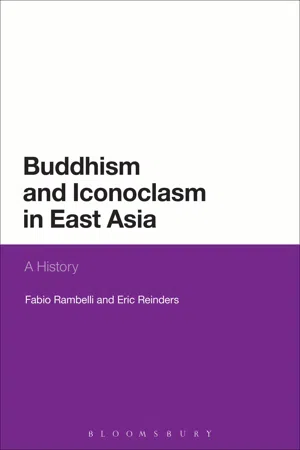
This is a cross-cultural study of the multifaceted relations between Buddhism, its materiality, and instances of religious violence and destruction in East Asia, which remains a vast and still largely unexplored field of inquiry. Material objects are extremely important not just for Buddhist practice, but also for the conceptualization of Buddhist doctrines; yet, Buddhism developed ambivalent attitudes towards such need for objects, and an awareness that even the most sacred objects could be destroyed.
After outlining Buddhist attitudes towards materiality and its vulnerability, the authors propose a different and more inclusive definition of iconoclasm-a notion that is normally not employed in discussions of East Asian religions. Case studies of religious destruction in East Asia are presented, together with a new theoretical framework drawn from semiotics and cultural studies, to address more general issues related to cultural value, sacredness, and destruction, in an attempt to understand instances in which the status and the meaning of the sacred in any given culture is questioned, contested, and ultimately denied, and how religious institutions react to those challenges.
- 256 pages
- English
- ePUB (mobile friendly)
- Available on iOS & Android
eBook - ePub
About this book
Information
Part One
Stuff
Materiality and Fragility of Dharma
1
Buddhist objects, Buddhist bodies—An outline
Buddhism has been a massive, imposing presence in East Asia. People were surrounded by concrete, material signs of Buddhism, by Buddhist objects, and also by “non-Buddhist” objects redefined by Buddhism. Material intervention on the landscape defined monastic complexes and national networks of monasteries, such as Mount Kōya, Mount Hiei, and other institutions in the Kyoto-Nara region in central Japan, or the “Five mountains and ten monasteries” system of imperial monasteries in China. Pilgrimage sites feature pious graffiti, beautifully carved on cliff faces or crudely painted on large rocks. Other marks of Buddhism are more modest, such as altars for worship, stone images (sekibutsu in Japanese), and simple pagoda-like structures. Today in Taiwan we can see “Namu Amituo-Fo” (Praise to Amitabha Buddha) bumper stickers on cars, doors, and telephone poles.
Of course, the Buddhist presence is not limited to objects and tokens of the sacred. A vast clergy, numbering hundred of thousands, has dedicated itself to spreading the teachings—an activity that involves the production, manipulation, and consumption of material objects, wealth, space, and nature. In typically hostile terms, Jacques Gernet summarized the situation thus: “There was an overabundant monastic community, incessant construction work, a prodigious consumption of metals, wood, and cloth” (Gernet, 1995, p. xv). People directly involved in activities related to Buddhism were not limited to officially ordained monks and nuns, but included novices, acolytes, itinerant religious specialists, diviners, performers and storytellers, artisans, merchants, laborers, and peasants more or less loosely associated with religious institutions. The bodies of most of these people were Buddhistically marked, as it were—ordered and/or ordained in ways that indicated their Buddhist affiliations, or at least the fact that their activities were related to Buddhism.
The reality of Buddhism for the majority of East Asians, who had neither the time nor training (nor necessarily the inclination) to engage in meditation or philosophy, was visible, as objects and wealth. Today, traces of the material presence, wealth, and labor associated with Buddhism—albeit minimal if compared with medieval or premodern eras—are still conspicuous in China and Japan. This is the stuff Buddhism is made of, and it would be unfair, if not misleading, to deal with the history of Buddhism only in a dematerialized and disembodied fashion, as if doctrines and rituals had no material and bodily substratum and import. Not surprisingly then, the maintenance, management, and control of such an array of objects and such large numbers of people have been among the major preoccupations of Buddhist institutions. At the same time, state institutions have been weary of the sheer autonomy, wealth, and mobilizing power of Buddhist institutions; whenever and wherever they had been powerful enough, states have relentlessly attempted to control the extension of the Buddhist material dimension—if needed, also through confiscation, physical violence, destruction, and murder. At times, attempts to restrain the power of Buddhist institutions became indictments of Buddhism per se.
Buddhists were painfully aware of the problems generated by their own wealth and success. Objects and bodies are essentially transient and prone to decay; objects break and people rebel. Wealth and power are signs of Buddhism’s success, but at the same time they can arouse greed and the suspicion of state institutions. Buddhist thinkers stressed that Buddhist institutions’ failure to control people and objects (including Buddhists’ own failure to control themselves in their interactions with sacred objects and wealth) would eventually result in the end of Buddhism. Indeed, prophecies about the end of the Dharma (Ch. mofa, Jp. mappō) are inextricably intertwined with misuse of objects and clerical misbehavior.
In light of the above considerations, this chapter addresses a number of issues of East Asian Buddhism’s materiality. Given the scope of the subject, we do not aim at an exhaustive account, but we limit ourselves to outline what we envision as the background for our investigations of religious destruction in East Asia. First, we discuss the importance of material objects for religious purposes; this involved the development of strategies to sacralize (i.e., transform in Buddhist ways) things and activities—including some that were originally secular and/or unrelated to Buddhism. Second, we deal with attempts to establish forms of embodiment of Buddhism, in particular the development of a clerical habitus—this amounting to the attempt to sacralize the human body. Third, we examine the widespread tendency in East Asian Buddhism to blur distinctions between animate and inanimate objects, icons, and bodies; particularly relevant in this context are the rituals of animation of sacred objects, but also the attempts to pattern monastic bodies upon an idealized Samgha (clergy) as based on monastic precepts (vinaya) and visual images of patriarchs. Fourth, we present instances of Buddhism’s ambivalence toward materiality. While Buddhist institutions needed wealth and power in order to expand and carry out their salvific mission, excessive wealth and power in themselves were essentially against the basic tenets of Buddhism as a religion of renunciation. (It is worth mentioning that this Buddhist ambivalence predates religious studies scholars’ own prejudices against materiality and preference for disembodied and immaterial “spirituality.”) Fifth, we address the pervasive awareness of the fragility of the Dharma, expressed in forms that range from monastic rules to prevent wear-and-tear at temples to doctrines about the end of Buddhism. The end of Buddhism involved both the clergy’s wrong attitude toward and misuse of objects, and secular attacks against religious institutions. In particular, the end of Buddhism was not simply the end of “belief” in Buddhist teachings, but was described in concrete terms as the destruction of Buddhist sacred objects and the dissolution (understood as both “misbehavior” and “disrobing”) of the collective body of Buddhists. Finally, we indicate the need for a new conceptual apparatus to address in a systematic way religious violence in East Asia—destruction of sacred objects and violence against Buddhists, their conceptual motivations, and Buddhist responses to them. In this final section of the chapter, we introduce an expanded and modified notion of “iconoclasm” as a useful conceptual tool to deal with these complex issues.
We should make it clear from the beginning that by “sacred” we intend nothing ontological or theological about the existence of gods and other supernatural beings; we are methodologically agnostic. Culturally, though, sacredness is a category of separation, always in a binary relation with the “profane” or with the ordinary world. Chinese and Japanese temples, their objects and clerics, are defined by various pairs of terms, such as “outside the secular world (Jp. shusse, Ch. chushi)” vs “in the secular world (seken, shijian)”; “outside the household (shukke, chujia)” vs “in the household (zaike, zaijia)”; “sagely (sei, sheng)” vs “vulgar (or lay, zoku, su)”; or by possessive identification with entities such as buddhas, bodhisattvas, devas, spirits, kami, and other powerful personalities.
A look at Buddhism’s material dimension
Ritual implements used at temples or at home include clerical robes and accessories (the three robes, staff, scepters), temple ornaments (banners, garlands, canopies, bells, boxes, lanterns, tabernacles), altar implements (vases, vessels, little stūpas, etc.), musical instruments (biwa lute, waniguchi and other cymbals, mokugyo drum), incense tools (incense burners, incense), argha (Jp. aka, consecrated water), ritual paraphernalia (vajra thunderbolts), reliquaries, rosaries, and so forth.1 In addition, we find in the religious life of East Asian Buddhists many “unofficial” gadgets that defy classification, such as postcards, temple stamps, souvenirs, jewelry, bumper stickers, and temple literature (illustrated admission tickets, maps, pamphlets, books, journals, videos and DVDs, tapes and CDs, and homepages). In Taiwan, some temples even offer ashes from their incense burner for people to take home in small paper packets. Many of these objects and services have niche markets: clergy, children, young people, students, elders, men, women, professionals, heads of households, and tourists. An interesting function of these portable, purchasable objects is that they can be used to sanctify tokens of modern life (cars, stores), giving them the mark of Buddhism. Objects are related in a way or another to some of the most important moments in life: birth, death, study, beginning a career, finding a partner, and family life. When considering the status of sacred objects in Buddhist traditions, it is interesting to note that Dharma transmission itself was often envisioned as a form of sacred transaction involving the exchange of gifts between master and disciple, especially the former’s robe and bowl.2 Buddhist notions of transmission were strongly influenced by Chinese ancestral practice, and in turn the Dharma transmission became a model for succession in general within the Buddhist world: a master transmitted to his disciples not only the Dharma but also his own possessions.
The earliest accounts of the arrival of Buddhism to Japan agree on the items that constituted the transmission of Buddhism: scriptures (no title is given), a Buddha image, and implements used to deal with the image ritually—in particular, bathing the statue (Rambelli, 2010b, pp. 148–9). Similarly, the mythic introduction of Buddhism to China, in which the Han Emperor Ming (28–75 CE) dreamed of a “golden man,” resulted in his sending envoys West, who returned with a Buddha image. These accounts of the arrival of Buddhism to Japan and China, confirmed and expanded by countless subsequent narratives, emphasize that the Dharma, in fact, is embodied by objects (and bodies), and the spread of such objects was the spread of the Dharma. Japanese priests who went to China to study Buddhism prepared long and detailed accounts of the things they brought back from their perilous voyages. The “quest for the Dharma” (Jp. guhō) was also a quest for tokens of the Dharma such as scriptures, images, relics, and ritual implements. The “Catalog of Imported Items” by the Japanese monk Kūkai (774–835) is particularly representative examples of this genre. Among “Buddha images” (butsuzō) he lists mandalas and portraits of patriarchs. He also lists ritual implements (vajras, etc.), relics, other images, shell trumpet (horagai), mendicant bowl, kāsāya monastic robe, and ceremonial bowls for offerings with precious stones (Hakeda, 1972, pp. 140–50).
East Asian Buddhists did not only produce, circulate, and collect sacred objects, they also theorized about them and about materiality in general, in what are some of the most fascinating instances of Buddhist thought. Chinese and Japanese exegetes developed a series of concepts that refer to the realm of the inanimate objects or nonsentients, that is, material objects and entities devoid of a conscious mind, which constitute and furnish the material space where sentient beings living in the Six Destinations (Jp. rokudō or rokushu, Ch. liudao or liuqu) and buddhas live and operate. In particular, “nonsentients” (Jp. hijō or mujō, Ch. feiqing or wuqing), “realm of objects” (Jp. kikai, kisekai or kiseken; Ch. qijie, qishijie, or qishijian), and the material environment (Jp. ehō, Ch. yibao, lit. “karmic support”), refer to the Umwelt of buddhas and living beings, that is, the environment and the material living conditions in which beings find themselves as a consequence of karmic retribution.3 In Japan, these terms referring to materiality and the environment were considered synonymous with more concrete expressions such as “plants and the territory” (sōmoku kokudo), “plants, rivers, bricks, and stones” (sōmoku kasen gareki), or more simply “plants” (sōmoku).
In more specific terms, Buddhism classified sacred objects on the basis of the modality in which the sacred is produced or manifested in them. Thus, we find alternate bodies (Jp. funjin, lit. “separate” bodies), condensations of the cosmos (mandalas), sacred receptacles, and objects sacralized through immolation. Alternate bodies are doubles of the deities, sort of fractal reproductions of the original sacred entity, in which the totality is identical to its parts or fragments; among this category of objects are relics (Jp. shari), but also talismans and amulets (o-mamori and o-fuda). Relics are parts of the body of a Buddha, a saint, or a past master, but amulets and talismans must be “charged” with the “spirit” of the deities of which they are alternate bodies. Mandalas are defined as condensations of the totality of the cosmos; trade tools of secular professions (such as the merchants’ scale, hakari) and ritual implements (such as the vajra club) were understood as mandalas. Sacred receptacles are objects whose status is situated somewhere between the two previous categories; as examples we find the family Buddha altar (butsudan) and the funerary tablet (ihai). The family altar, modeled after the cosmic mountain Mount Sumeru and playing the function of a feretory and, ultimately, of a temple, is in itself a cosmological model but not necessarily a mandala (since it is not coextensive with the actual form of the cosmic Buddha). The funerary tablet (doubled into ihai kept at home and sotoba kept at the family temple) is modeled after the stūpa, which is both a cosmological model and a mandala, as in the five-element mandala (gorin mandara), but it contains the spirit of the ancestors, rather than being the ancestors (Rambelli, 2010a). Finally, objects sacralized through immolation include old objects for which memorial services (kuyō) are held; here, these objects function as sacrificial offerings: while all of the objects mentioned above are sacralized after construction by summoning within them the presence of the buddhas (and in this sense, they are equivalent to buddha images), everyday objects are sacralized at the end of their life before they are disposed of, and in this sense they function a little as dead ancestors (see also Rambelli, 2007).
What are the doctrinal bases of this interest in the material dimension of reality? One of the most significant intellectual tendencies in Mahayana is the increasingly materialistic interpretation of the concept of dharmakāya (Ch. fashen, Jp. hosshin). From an originally abstract, purely conceptual and non-experiential entity signifying the fundamental nature of the Buddha and his teachings, it came to be gradually envisioned as the overall substratum of the Buddhist cosmos to the point that, in Japanese esoteric Buddhism, the cosmos (Sk. dharmadhātu, Jp. hokkai, Ch. fajie) was identified with the supreme Buddha-body (dharmakāya); this was also related to the development of the discourse on original enlightenment (hongaku). This latter move, clearly indebted to Indian Brahmanical cosmology and ontology, became the definitive justification of Buddhist interventions in the secular, material realm. However, by then many important cases of Buddhist monumentality had already been created. An influential form of intellectual substratum for Buddhist materiality, from monumental interventions to the production of countless objects, can be found in Avatamsaka (Ch. Huayan, Jp. Kegon) thought, with its positing of a universal Buddha, Vairocana, and in its emphasis on the unobstructed interpenetration of abstract principles (Ch. li, Jp. ri) and phenomena (shi, ji) on the one hand, and interpenetration among phenomena (respectively, lishi wuai/riji muge and shishi wuai/jijimuge) on the other. According to this vision, the cosmic Buddha and its principles were present in each single particle of dust of the universe, and each single particle was an essential component of the whole. In this respect, contrary to received interpretation of Huayan/Kegon thought as overly abstract and speculative, we would like to suggest that certain cases of extensive material interventions on the landscape and the everyday life of the people, from monumentality to pervasive diffusion of traces of the presence of the Buddha in the everyday world, were the results of attempts by Buddhist creators to give shape to the Avatamsaka worldview.4
Buddhist manifold interventions in the realm of materiality were also the result of devotional practices aimed at the diffusion of Buddhism through proliferation of sacred objects (temples, stupas, icons, texts, sundry implements) on the one hand, and construction works (bridges, roads, hospitals, land reclamation, irrigation works, wells) for public benefit on the other. Some of the most ancient Buddhist scriptures, including the Āgamas, extol the merit-making value of these construction and manufacturing activities.5 Scholars have generally focused on the production of temples and images as primary merit-making activities, but in fact scriptures and the actual praxis of Buddhist institutions show that there was no clear distinction between sacred and secular works.6 As mentioned by Janet Goodwin, documents by entrepreneurial, fundraising monks (kanjin hijiri) from medieval Japan about construction activities they promoted are written in a language “full of physical metaphors suggesting the equivalence of building temples and saving souls. The equation was the same in other cases, even when the construction project was a bridge” (Goodwin, 1994, pp. 140–1). We should keep in mind that merit-making is a diffusive endeavor, affecting promoters, executors, and beneficiaries of the construction. Another devotional aspect of Buddhist monumentality and landscape interventions might be related to visualization practices to the Buddha, especially those Buddhas endowed with a cosmic nature that makes them hard to experience and to relate to. Thus, decorated caves at Dunhuang and elsewhere provided a sumptuous description of the Buddha-land, and gigantic statues of buddhas were powerful aids to visualize their glory and cosmic dimension. In addition, extensive temple...
Table of contents
- Cover
- Half-Title
- Part 1 Stuff: Materiality and Fragility of Dharma
- Part 2 Histories: Instances of Religious Destruction in East Asia
- Part 3 Theories: Rethinking the Relations Between the Sacred and Destruction
- Conclusion:Destruction and cultural systems
- Notes
- Bibliography
- Index
Trusted by 375,005 students
Access to over 1.5 million titles for a fair monthly price.
Study more efficiently using our study tools.
Frequently asked questions
Yes, you can cancel anytime from the Subscription tab in your account settings on the Perlego website. Your subscription will stay active until the end of your current billing period. Learn how to cancel your subscription
No, books cannot be downloaded as external files, such as PDFs, for use outside of Perlego. However, you can download books within the Perlego app for offline reading on mobile or tablet. Learn how to download books offline
Perlego offers two plans: Essential and Complete
- Essential is ideal for learners and professionals who enjoy exploring a wide range of subjects. Access the Essential Library with 800,000+ trusted titles and best-sellers across business, personal growth, and the humanities. Includes unlimited reading time and Standard Read Aloud voice.
- Complete: Perfect for advanced learners and researchers needing full, unrestricted access. Unlock 1.5M+ books across hundreds of subjects, including academic and specialized titles. The Complete Plan also includes advanced features like Premium Read Aloud and Research Assistant.
We are an online textbook subscription service, where you can get access to an entire online library for less than the price of a single book per month. With over 1.5 million books across 990+ topics, we’ve got you covered! Learn about our mission
Look out for the read-aloud symbol on your next book to see if you can listen to it. The read-aloud tool reads text aloud for you, highlighting the text as it is being read. You can pause it, speed it up and slow it down. Learn more about Read Aloud
Yes! You can use the Perlego app on both iOS and Android devices to read anytime, anywhere — even offline. Perfect for commutes or when you’re on the go.
Please note we cannot support devices running on iOS 13 and Android 7 or earlier. Learn more about using the app
Please note we cannot support devices running on iOS 13 and Android 7 or earlier. Learn more about using the app
Yes, you can access Buddhism and Iconoclasm in East Asia by Fabio Rambelli,Eric Reinders in PDF and/or ePUB format, as well as other popular books in Theology & Religion & Buddhism. We have over 1.5 million books available in our catalogue for you to explore.