CHOICE Outstanding Academic Title 2016
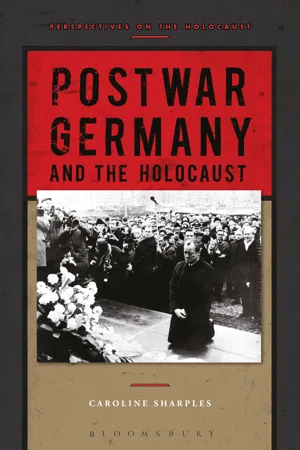
Focussing on German responses to the Holocaust since 1945, Postwar Germany and the Holocaust traces the process of Vergangenheitsbewältigung ('overcoming the past'), the persistence of silences, evasions and popular mythologies with regards to the Nazi era, and cultural representations of the Holocaust up to the present day. It explores the complexities of German memory cultures, the construction of war and Holocaust memorials and the various political debates and scandals surrounding the darkest chapter in German history.
The book comparatively maps out the legacy of the Holocaust in both East and West Germany, as well as the unified Germany that followed, to engender a consideration of the effects of division, Cold War politics and reunification on German understanding of the Holocaust. Synthesizing key historiographical debates and drawing upon a variety of primary source material, this volume is an important exploration of Germany's postwar relationship with the Holocaust.
Complete with chapters on education, war crime trials, memorialization and Germany and the Holocaust today, as well as a number of illustrations, maps and a detailed bibliography, Postwar Germany and the Holocaust is a pivotal text for anyone interested in understanding the full impact of the Holocaust in Germany.
- 240 pages
- English
- ePUB (mobile friendly)
- Available on iOS & Android
eBook - ePub
Postwar Germany and the Holocaust
About this book
Information
1
Confronting the Holocaust, 1945–9
The period of Allied occupation between 1945 and 1949 saw the German population working through their first – forced – confrontation with Nazi atrocities. Exposure to graphic images circulated by Allied photographers, together with newsreel footage from the liberated concentration camps, press reports on the subsequent war crimes trials and the first memoirs from Holocaust survivors ensured that the brutal consequences of National Socialism were becoming public knowledge. Just how closely people chose to engage with these crimes, though, varied enormously, particularly given that they were already having to contend with the realities of total defeat in the Second World War and the struggle for day-to-day survival in its aftermath. Traditionally, historians have tended to dismiss this period as one of silence in western Germany, and one of rapid purges of former Nazi personnel in the Soviet-controlled eastern sector of the country. However, as this chapter illustrates, there were competing voices trying to make themselves heard during this period, and early German responses to both Nazism in general and the Holocaust in particular merit closer attention. Indeed, it is in these initial responses, evasions and misunderstandings that we can see the foundations for persistent postwar mythologies that would have an enduring impact on Germany’s relationship with the recent past. At the same time, these early responses have to be seen within the context of foreign occupation and the Allies’ own difficulties in interpreting the enormity of the Holocaust.
Throughout the spring of 1945, the world was shocked and appalled by the terrible sights that greeted Allied troops liberating the Nazi concentration camps. Questions were raised immediately by politicians, intellectuals and the media alike: how could these crimes have happened within a hitherto civilized and cultured nation? Was there something uniquely ‘German’ about these acts of barbarism? How could a recurrence of such atrocities be prevented in the future? The Allies spent the year debating these issues, with France and the Soviet Union, raw from the recent experiences of invasion, advocating for particularly strong measures to dismantle Germany’s potential to unleash another devastating war on the continent. Questions about stripping the country of its industrial capacity were accompanied by a sense that physical reparations needed to be matched by the removal of all vestiges of National Socialism, Prussian militarism, authoritarianism and aggressive nationalism; re-education was considered essential for effecting Germany’s rebirth.
To this end, the Allies adopted three key measures. First and foremost, a forced public confrontation with the consequences of Nazi racial policy would shock the Germans into realizing the criminal nature of the Hitler regime and, it was hoped, spark a sense of contrition. For the majority of people, this would take the form of compulsory exposure to newsreel reports but for those living near a former concentration camp, tours of the site were frequently ordered by outraged Allied soldiers. Second, war crimes trials of major offenders would not only deliver justice on individuals but also underscore the institutional criminality of the Third Reich. The complicity of the armed forces, heavy industry, judiciary and the medical profession would be highlighted, alongside that of Nazi organizations such as the Gestapo and SS. Finally, a thorough denazification of the wider population would remove the most guilty members of society from positions of power and influence and make them pay (quite literally, in some cases, with the imposition of fines) for their past behaviour. The scheme would also eradicate traces of Nazism from the physical landscape, cleaning public buildings of Nazi insignia and destroying potential pilgrimage sites for any remaining Nazi sympathizers.
The emphasis throughout was on the thorough documentation of Nazi crimes and the need to bear witness to what had happened. The Allies, as we will see, were attuned to the pedagogic potential of these measures not only for the immediate re-education of Germany, but to offer a warning for future generations as well. A number of military surveys were undertaken during this period, particularly in the US zone of occupation, to trace popular German attitudes to the occupation, material conditions and denazification measures. The Allies were keen to monitor any lingering militaristic or fascist sentiments and, as such, these reports constitute a useful historical source for examining early German responses to the Nazi legacy. The licensed press also explored some of these issues, with particular discussion around the controversial concept of collective guilt (Schuldfrage). For the most part, though, ‘ordinary’ Germans seemed to be more concerned with venting their dissatisfaction with the Allies than reflecting on the crimes perpetrated by the now-defunct Nazi regime.
Confronting the camps
The Allies had received reports of Nazi atrocities during the Second World War, including the Riegner Telegram of August 1942, which warned of plans to exterminate European Jewry, and the Vrba-Wetzler Report of 1944, a forty-page document detailing events in Auschwitz. Their first physical encounter with a camp, however, came on 23 July 1944 when Soviet forces liberated Majdanek. Although SS personnel, hurrying to flee the advancing Red Army, had sent prisoners on a death march and attempted to destroy the camp, the Russians were still able to piece together evidence of the extermination process. The Russian war correspondent, Roman Karmen, declared:
I have never seen a more abominable sight than Maiden, near Lublin. Hitler’s notorious Vernichtungslager [extermination camp] where more than half a million European men, women and children were massacred … .This was not a concentration camp; it was a gigantic murder plant.1
Throughout early 1945, other concentration camps were gradually liberated, with the Russians reaching Auschwitz on 27 January and the Americans liberating Buchenwald and Dachau on 11 and 29 April, respectively. The British, meanwhile, approached camps in the north-west of Germany including Bergen-Belsen on 15 April and Neuengamme on 4 May. The need to record what the troops were seeing manifested itself very quickly. General Eisenhower, having visited Ohrdruf, a subcamp of Buchenwald, urged politicians back in the United States to come and view the horrific scenes for themselves:
We continue to uncover German concentration camps for political prisoners in which conditions of indescribable horror prevail. I have visited one of these myself and I assure you that whatever has been printed on them to date has been understatement. If you could see any advantage in asking about a dozen leaders of Congress and a dozen prominent editors to make a short visit to this theater … , I will arrange to have them conducted to one of these places where the evidence of bestiality and cruelty is so overpowering as to leave no doubt in their minds about the normal practices of the Germans in these camps.2
Politicians, religious leaders and journalists, as well as additional divisions of Allied soldiers, did, indeed, come and visit these sites for themselves and it is these first reports and footage, stemming principally from Buchenwald and Bergen-Belsen that informed the first representations and understandings of the Holocaust in the Western world. Iconic images of piles of emaciated corpses being bulldozed into a mass grave have remained with us, as have the shots of skeletal survivors peering at the camera from behind barbed wire. It is no coincidence that both Britain and the United States sent their most respected journalists to cover the liberation: Richard Dimbleby and Ed Murrow conveyed not only the necessary gravitas, but also legitimacy; it would be harder to reject the footage as atrocity propaganda with the involvement of these media heavyweights.
From encouraging members of their own side to view the camps, it was but a short step to extending this to compulsory tours for the local German population. Obviously angered by what they had encountered, there was a sense among many Allied troops that the Germans should be made to acknowledge what ‘they’ had done or allowed to happen. Forcing civilians to look upon the piles of bodies and even help bury the dead was seen as a just punishment, although there were also genuine health concerns too, with bodies needing to be disposed of as quickly as possible to halt the spread of disease. Mayors from nearby towns were brought in to view the scenes at Bergen-Belsen and, on 16 April 1945, around 2,000 citizens of Weimar were escorted around the nearby Buchenwald concentration camp by American troops, viewing the crematoria and the scenes of human experimentation. Film footage of this event shows how the smiling faces of smartly dressed local residents soon gave way to visible distress once they entered the camp. Some women held handkerchiefs to their face, others moved as if to faint and had to be supported by their fellow Germans.3 Harold Marcuse records similar behaviour at other concentration camps to the extent that the order ‘Hands Down’ became a common utterance as visitors instinctively shielded their eyes.4 Silent shock, however, soon gave way to unanimous protests of ignorance about the true nature of the camp. The diary entry of Buchenwald survivor Imre Kertész summarized their reaction: ‘they knew nothing. No one knew anything’.5 Likewise, Marguerite Higgins, reporting for the New York Herald Tribune, concluded, ‘as has been the case everywhere, the German spectators in the Buchenwald tour seemed sincerely horrified, yet maintained that they had been completely ignorant of events there, and thus were free of blame’.6
To ensure that details of Nazi atrocities reached a wider audience, the Psychological Warfare Branch (PWB) of the US army disseminated images and vivid descriptions via the licensed press, Radio Luxembourg, newsreels and special pamphlets and posters, the latter displayed on the streets and frequently emblazoned with the accusatory slogan ‘Your Fault’. A special twenty-minute documentary, Die Todesmühlen (The Death Mills), was compiled from the footage of camps in both Eastern and Western Europe and screened in German cinemas in early 1946, while another film entitled KZ was shown to German prisoners of war. How to ensure that people actually saw these films (and respond appropriately), however, would prove tricky. Susan Carruthers describes how there were initial plans to make Die Todesmühlen compulsory viewing, with Germans having to present their ration card for stamping as proof of their attendance. Given that the public was already having to pay to enter the cinema, though, this idea was eventually dropped.7 Instead, all the cinemas in the western zones were compelled to show the programme at the same time but even then, viewing figures proved disappointing from an Allied point of view. In the American sector of Berlin, for example, Carruthers notes that only 16 per cent of adults saw Die Todesmühlen, compared to the usual cinema-going population of 26 per cent. The West Berlin publication Das Tagesspeigel attributed this low turnout to ‘fear of the truth’, although Donald Bloxham argues that general apathy was a more likely factor here.8 Elsewhere, there were instances of German civilians being forcibly marched into cinemas to view newsreel reports on the concentration camps. Burgsteinfurt was nicknamed ‘the village of hate’ by British observers when two girls laughed at the film; they were forced to watch it a second time.9
During this period, the Allies monitored German public opinion in an effort to assess the effectiveness of these initiatives. A survey conducted by PWB member Morris Janowitz in June 1945 concluded that ‘almost every German had had direct and repeated contact with our campaign to present the facts’ and that most people accepted the authenticity of the images. ‘Only an isolated few’, he noted, ‘displayed strong scepticism or outright disbelief’.10 Here, there was a tendency to dismiss the scenes as Allied propaganda, while one rumour insisted that Buchenwald was merely a site for burying civilians killed during air raids – a legend that not only denied any notion of systematic abuse on the part of the Nazis, but also served to depict the Allies as the villains of the piece. When the subject of Nazi atrocities was broached with members of the German public, the most common response was usually, ‘Davon haben wir schon viel gehört’ (‘We have already heard a lot about this’).11
The Allies tended to work on the assumption that Germans, especially those living close to concentration camps, must have known what was happening. Recent histories on the early camps produced by Nikolaus Wachsmann, Jane Caplan, Christian Goeschel and Paul Moore certainly underscore the fact that sites such as Dachau, Buchenwald and Belsen had been opened in a blaze of publicity in the Nazi press, and Janowitz himself noted in 1945 that the German public was hard-pushed to deny the existence of places that had been celebrated in Nazi propaganda.12 What did emerge amidst the first postwar responses was an insistence that people had not known of the conditions within these camps. One woman, for example, told Janowitz:
Of course, there were little rumours about the camps, but no one believed them. We thought that the prisoners might be working hard, that they might not be getting plenty of good food, and we even imagined some beatings or making the prisoners shout in chorus ‘Heil Hitler’.13
Any acts of brutality, however, were generally assumed to be isolated incidents, or the work of a few sadistic concentration camp guards, rather than standard practice. Likewise, when a few Germans admitted hearing rumours of systematic mass murder taking place in the East, they added that they had just thought this to be enemy propaganda.
At the same time, people argued that even if they had known about conditions within the camps, there was nothing they could have done to challenge Nazi policy. One person informed Janowitz:
You Americans can hardly understand the conditions under which we were living. It was if all of Germany were a concentration camp and we were occupied by a foreign power. We were unable to do anything to oppose them. What could one person do against that powerful organisation?14
Such retorts could obviously enable Germans to present themselves as victims too, a people powerless under a totalitarian state. Historians such as Robert Gellately, however, have pointed to the level of consensus that lay beneath the Third Reich and demonstrated the vital role that the ‘ordinary’ population played in denouncing friends, neighbours and colleagues to the Gestapo.15
During these early discussions, few Germans were able to provide specific information on the number of camps, or the identity of the people abused and murdered within them. Janowitz noted that ‘estimates as to the number killed were usually of some tens of thousands and only a few spoke of more than one hundred thousand. One or two Social Democrats were able to conjure up the phrase “millions”.’16 As such, the claim that people had ‘heard a lot’ about Nazi atrocities did not necessarily equate to a critical understanding of the recent past. Instead, this oft-provided comment seems to have been a means of shutting down any further conversation on this uncomfortable topic.
It is important to note that the Western emphasis on camps liberated by the British and the Americans ensured that, from the very start, the full extent of the Holocaust was obscured. Overcrowded and disease-ridden sites such as Belsen, Dachau and Buchenwald were taken as representing the very worst of Nazi excesses; the distinction between these camps and the purpose-built extermination centres in the East went unrecognized. Likewise, the identity of the victims was never made explicit. The West spoke in universal terms about crimes against humanity, refusing to accentuate the suffering of any one group over another. The Soviets, meanwhile, were talking about ‘victims of fascism’ a...
Table of contents
- Cover
- Halftitle Page
- Title Page
- Contents
- List of Illustrations
- Acknowledgements
- List of Abbreviations
- Introduction: Germany and the Holocaus
- 1. Confronting the Holocaust, 1945–9
- 2. ‘Victims of Fascism’: Narratives of German Suffering since 1945
- 3. Acknowledging Suffering: Recalling the Victims of Nazi Racial Persecution since 1945
- 4. The Pursuit of Justice
- 5. The German Churches and the Holocaust
- 6. Memorializing the Holocaust
- 7. The Holocaust on Screen: Representations of the Nazi Genocide in German Film and on German Television
- 8. Holocaust Education in Germany
- Conclusion: How the Holocaust Looks Today
- Notes
- Bibliography
- Index
- Imprint
Trusted by 375,005 students
Access to over 1.5 million titles for a fair monthly price.
Study more efficiently using our study tools.
Frequently asked questions
Yes, you can cancel anytime from the Subscription tab in your account settings on the Perlego website. Your subscription will stay active until the end of your current billing period. Learn how to cancel your subscription
No, books cannot be downloaded as external files, such as PDFs, for use outside of Perlego. However, you can download books within the Perlego app for offline reading on mobile or tablet. Learn how to download books offline
Perlego offers two plans: Essential and Complete
- Essential is ideal for learners and professionals who enjoy exploring a wide range of subjects. Access the Essential Library with 800,000+ trusted titles and best-sellers across business, personal growth, and the humanities. Includes unlimited reading time and Standard Read Aloud voice.
- Complete: Perfect for advanced learners and researchers needing full, unrestricted access. Unlock 1.5M+ books across hundreds of subjects, including academic and specialized titles. The Complete Plan also includes advanced features like Premium Read Aloud and Research Assistant.
We are an online textbook subscription service, where you can get access to an entire online library for less than the price of a single book per month. With over 1.5 million books across 990+ topics, we’ve got you covered! Learn about our mission
Look out for the read-aloud symbol on your next book to see if you can listen to it. The read-aloud tool reads text aloud for you, highlighting the text as it is being read. You can pause it, speed it up and slow it down. Learn more about Read Aloud
Yes! You can use the Perlego app on both iOS and Android devices to read anytime, anywhere — even offline. Perfect for commutes or when you’re on the go.
Please note we cannot support devices running on iOS 13 and Android 7 or earlier. Learn more about using the app
Please note we cannot support devices running on iOS 13 and Android 7 or earlier. Learn more about using the app
Yes, you can access Postwar Germany and the Holocaust by Caroline Sharples in PDF and/or ePUB format, as well as other popular books in Geschichte & Geschichte des 20. Jahrhunderts. We have over 1.5 million books available in our catalogue for you to explore.