- 224 pages
- English
- ePUB (mobile friendly)
- Available on iOS & Android
eBook - ePub
About this book
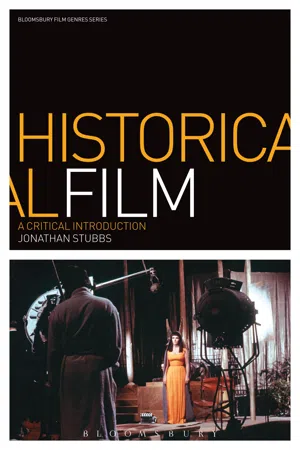
Although precise definitions have not been agreed on, historical cinema tends to cut across existing genre categories and establishes an intimidatingly large group of films. In recent years, a lively body of work has developed around historical cinema, much of it proposing valuable new ways to consider the relationship between cinematic and historical representation. However, only a small proportion of this writing has paid attention to the issue of genre. In order to counter this omission, this book combines a critical analysis of the Hollywood historical film with an examination of its generic dimensions and a history of its development since the silent period. Historical Film: A Critical Introduction is concerned not simply with the formal properties of the films at hand, but also the ways in which they have been promoted, interpreted and discussed in relation to their engagement with the past.
Information
1
What is historical cinema?
Approaches to genre
In the study of film, a genre has conventionally been understood as a group of films unified by a recognizable repertoire of textual practices—plot, setting, character, iconography, music, narrative form, performance style, etc.—around which their production, marketing, and consumption can be efficiently organized.1 Once this system of conventions has been identified, according to this line of thinking, a critic is better able to understand not only a film’s commercial context but also the way it functions within a much larger body of work. For this reason, much writing about cinema has been concerned with placing films in genre categories and with debating the boundaries between these categories. According to Richard Maltby,
Genre criticism usually identifies up to eight genres in Hollywood feature film production. The western, the comedy, the musical and the war movie are four uncontested categories. Different critics will then argue the relative independent merits of at least one of the thriller and the crime or gangster movie, and list the horror movie and science fiction as either one or two additional genres.2
As this suggests, the process of identifying genres is much less precise or unanimous than many writers have been prepared to admit. Moreover, much writing on genre has been based on a kind of reasoning which Andrew Tudor describes as the ‘empiricist dilemma’:
To take a genre such as the western, analyze it, and list its principal characteristics is to beg the question that we must first isolate the body of films that are westerns. But they can only be isolated on the basis of the ‘principal characteristics’, which can only be discovered from the films once they have been isolated.3
In other words, critics tend to select a group of films which they suppose belong to the same genre, and then work backwards to define the genre based on the characteristics that the films share, possibly overlooking information which does not confirm their preconceptions. In doing so, they simply reproduce the initial assumptions that led them to choose these films in the first place.4
These problems become even more acute in the case of films whose textual practices are harder to pin down. It may be difficult to arrive at precise definitions for Maltby’s four ‘uncontested categories,’ but telling them apart is usually straightforward. If a couple break off from their date to sing a duet, for example, you can be reasonably certain you are watching a musical. But what about historical films? Do the textual practices of the genre give it the kind of formal unity which critics have identified in the western? Ginette Vincendeau’s comments about the genre status of ‘heritage’ cinema might also apply to the historical film:
Except for the presence of period costume, they are neither defined by a unified iconography (unlike the thriller and the western), nor a type of narrative (unlike the romance or the musical), nor an affect (unlike horror, melodrama and comedy).5
Instead of presenting a broadly cohesive set of textual features, historical films exhibit a massive variance in iconography, narrative style, setting, plot, and character types. Simply being ‘in the past’ cannot be regarded as a coherent textual characteristic in itself. Moreover, the simple fact that ‘the past’ refers equally to any point in time between the ancient world and the preceding moment suggests a potential range of iconographies far larger than any other genre. Any common ground occupied by films set in the past is at best tenuous, at least in comparison to more conventional genres.
It is also worth pointing out that the term ‘historical film’ has barely featured in many of the standard, single-volume surveys of Hollywood genres, including Thomas Schatz’s Hollywood Genres: Formulas, Filmmaking, and the Studio System (1981), Nick Browne’s Refiguring American Film Genres (1998), Rick Altman’s Film/Genre (1999), Steve Neale’s Genre and Contemporary Hollywood (2000), and Barry Langford’s Film Genre: Hollywood and Beyond (2005). And yet the term ‘historical film’ is strongly represented in film scholarship. Many books have been dedicated to the subject in the past ten years alone, including Robert Burgoyne’s The Hollywood Historical Film (2008), David Eldridge’s Hollywood’s History Films (2006), J. E. Smyth’s Reconstructing American Historical Cinema (2006), and James Chapman’s Past and Present: National Identity and the British Historical Film (2005). There is also plenty of evidence to suggest that term ‘historical film’ has considerable currency outside the academy. The vast online databases operated by commercial companies provide useful examples. LoveFilm, Europe’s largest DVD rental company, allows subscribers to browse films and television shows within 20 broad categories which they identify as ‘genres.’ In an indication of the overlapping nature of such categorization, most titles are listed in more than one genre, and ‘historical’ films are listed as a sub-category of three separate genres: ‘Action/Adventure,’ ‘Drama,’ and ‘Romance’. The practices of online retailer Amazon are similar: ‘Historical’ is a sub-category of both ‘Action & Adventure’ and ‘Drama.’ The Internet Movie Database (IMDb) is owned by Amazon, but it uses a slightly different structure to organize its 1.6 million entries, listing ‘History’ as one of their 26 ‘genre’ categories. Unlike LoveFilm and Amazon, this category also features a large number of non-fiction titles, mostly television documentaries. The motives and methods used by academic writers and commercial websites are clearly different, but they underline the strong cultural presence of the historical film. Evidently, a gap exists between conventional theoretical approaches to genre on the one hand, and the operation of genre categories in popular and academic practice on the other. It seems, therefore, that conventional ideas about genre are of limited use in understanding the origins and development of historical film.
However, recent work on the function and meaning of film genres has questioned some of the tenets of conventional genre criticism, in particular the notion that genres are characterized by a historically stable and unified system of textual practices. Steve Neale has suggested that genres need to be seen as ‘ubiquitous, multifaceted phenomena rather than one-dimensional entities’ and that they reside not only in films themselves but also in the expectations which audiences bring with them when they watch films.6 He also emphasizes the institutional role played by film industries in the creation and perpetuation of these classifications, citing its ability to guide ‘the meaning, application, and use of generic terms’ in an ‘inter-textual relay’ of publicity, promotion and reception discourses.7 In a similar way, Rick Altman has suggested that genre should be understood ‘not as a quality of texts but as a by-product of discursive activity.’8 Like Neale, Altman is keen to identify these discourses with the activities of the film industry and its strategy of producing and marketing new films by promoting their likeness to existing, commercially proven properties.9 In this way, any genre unity that a body of films is perceived to possess at a given time is less the consequence of a filmmaker’s adherence to a set of predetermined, transhistorical conventions and more the short-term industry practice of recycling the textual features of popular films in order to emulate their success.
These approaches also lead to a more detailed consideration of the connection between genre and industrial practice. Maltby has argued that it is misleading to think of genre as a principle governing Hollywood’s output, arguing that the industry ‘categorizes its product by production size and the audience sector to whom it is primarily appealing’ and that the resulting production schedules are organized ‘around cycles and sequels rather than genres as such.’10 This notion is developed further in the work of Tino Balio, who dispenses with the term genre entirely in his assessment of Hollywood production in the 1930s.11 Balio suggests that in order to minimize financial risk, Hollywood production of the period tended to be planned on a seasonal basis and was essentially imitative: a film becomes popular, its textual features are quickly reworked by other films, and these new films are released and promoted in a way that stresses their closeness to the original. The cycle continues until it ceases to be profitable.12 In some cases the replicated textual features correspond to traditional critical notions of film adhering to genre templates, but the replication can also be less predictable. For example, Neale notes that the success of Grand Hotel (1933) generated a cycle of films that transposed its unusual narrative structure to a variety of completely unrelated settings.13 Missing from this approach, perhaps, is a means of accounting for the appearance of films which initiate new cycles. Nevertheless, Balio’s approach provides a more empirically grounded model for explaining and analyzing textual similarities between films over time than the conventionally defined notion of genre as a critical category, with its insistence on the transcendental unity of certain film types.
Recent work by Jason Mittell on television also enlarges the understanding of genre, particularly the role played by audiences in the creation of categories. Much more than Neale, Altman, Maltby, and Balio, Mittell has proposed ‘looking beyond the text as the centre of genre’ and instead focusing on the ‘complex interrelations among texts, industries, audiences and historical contexts.’14 He argues that media texts (including films) do not produce their own categorization, as conventional genre theory has suggested, but rather are categorized as a result of discursive practices.15 That is, genre is not an intrinsic property of any given film or group of films, no matter how closely it might appear to follow commonly understood genre conventions. Instead, genre categories are applied to films externally as they circulate through culture, generating further texts as they are marketed, reviewed, consumed, and discussed. For this reason, Mittell describes genre as emerging from the ‘intertextual relations between multiple texts.’16 Rather than the source of genre discourse, the film to which the genre category is applied is in fact a constituent part of a broader network of texts which in turn generate additional discourses. It might seem that to describe a film simply as ‘a site of discursive practice’ is to reduce its complexity, artistic value, and its centrality to the filmgoing experience. But at the same time, Mittell’s arguments are significant in the stress they place on cultu...
Table of contents
- FC
- Bloomsbury Film Genres Series
- Title
- Copyright
- Contents
- List of Illustrations
- Acknowledgments
- Introduction: Film and the invention of history
- 1 What is historical cinema
- 2 Detail, authenticity, and the uses of the past
- 3 Hollywood historical cinema up to World War II
- 4 The age of epics
- 5 New Hollywood, new histories
- 6 Spectacle, technology, and aesthetics
- 7 Prestige, education, and cultural value
- Conclusion: The role of the historian
- Annotated guide to further reading
- Bibliography
- Filmography
- Index
Trusted by 375,005 students
Access to over 1.5 million titles for a fair monthly price.
Study more efficiently using our study tools.
Frequently asked questions
Yes, you can cancel anytime from the Subscription tab in your account settings on the Perlego website. Your subscription will stay active until the end of your current billing period. Learn how to cancel your subscription
No, books cannot be downloaded as external files, such as PDFs, for use outside of Perlego. However, you can download books within the Perlego app for offline reading on mobile or tablet. Learn how to download books offline
Perlego offers two plans: Essential and Complete
- Essential is ideal for learners and professionals who enjoy exploring a wide range of subjects. Access the Essential Library with 800,000+ trusted titles and best-sellers across business, personal growth, and the humanities. Includes unlimited reading time and Standard Read Aloud voice.
- Complete: Perfect for advanced learners and researchers needing full, unrestricted access. Unlock 1.5M+ books across hundreds of subjects, including academic and specialized titles. The Complete Plan also includes advanced features like Premium Read Aloud and Research Assistant.
We are an online textbook subscription service, where you can get access to an entire online library for less than the price of a single book per month. With over 1.5 million books across 990+ topics, we’ve got you covered! Learn about our mission
Look out for the read-aloud symbol on your next book to see if you can listen to it. The read-aloud tool reads text aloud for you, highlighting the text as it is being read. You can pause it, speed it up and slow it down. Learn more about Read Aloud
Yes! You can use the Perlego app on both iOS and Android devices to read anytime, anywhere — even offline. Perfect for commutes or when you’re on the go.
Please note we cannot support devices running on iOS 13 and Android 7 or earlier. Learn more about using the app
Please note we cannot support devices running on iOS 13 and Android 7 or earlier. Learn more about using the app
Yes, you can access Historical Film by Jonathan Stubbs in PDF and/or ePUB format, as well as other popular books in Media & Performing Arts & Film & Video. We have over 1.5 million books available in our catalogue for you to explore.