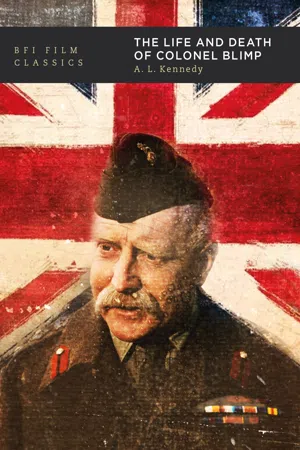
Winston Churchill hated The Life and Death of Colonel Blimp, and tried to have it banned when it was released in 1943. But Martin Scorsese, a champion of directors Michael Powell and Emeric Pressburger, considers it a masterpiece. It's a film about desires repressed in favour of worthless and unsatisfying ideals. And it's a film about how England dreamt of itself as a nation and how this dream disguised inadequacy and brutality in the clothes of honour. A. L. Kennedy, writing as a Scot, is fascinated by the nationalism which The Life and Death of Colonel Blimp explores. She finds human worth in the film and the pathos of stifled emotions and unfulfilled lives. 'If he is unaware of his passions, ' she writes of Clive Candy, the film's central figure, 'this is because his pains have become habitual, a part of personality, and because he was never taught a language that could speak of emotions like pain.'.
This edition includes a foreword by the author exploring the film's continuing relevance in an age of Brexit, when English and British national identity are deeply contested concepts.
- 88 pages
- English
- ePUB (mobile friendly)
- Available on iOS & Android
eBook - ePub
The Life and Death of Colonel Blimp
About this book
Information
Soho and Home
‘... how many times have I told you that a film is not words ... it is thoughts, and feelings, surprises, suspense, accident.’
Emeric Pressburger to Michael Powell1
In London, in Soho, in the early spring of 1996, I am walking down from Chinatown to the underground at Leicester Square and I am cold, very cold, and something catches in my mind: the inarticulate punch of somewhere I can only summarise as home. I am thinking of home.
I am a northeastern Scot and I am walking through a yapping northeastern wind that happily sharpens itself between buildings and spits narrow snow in my eyes. And this is how it always felt, the wind at home. It numbed the mouth and then the face, but reamed out the sinuses with splendidly cracking pain. It distorted vision, rounded shoulders, slowed uncomfortable time to a black-iced stop, and even twenty years later it can wrench me back to a place where I want chicken risotto for dinner because it’s Wednesday and then an empty evening, not thinking of school, and then sleep under one particular purple quilt while the big outside stays outside, but shudders at the window frames.
My forehead hurts so much that I want to cry, but I might be inclined to in any case. A person is supposed to cry when unexpectedly struck by thoughts of home.
Scots, even today, tend not to dress appropriately against cold – they thole it instead. They wince in its face and dare it to be more miserable than sin and it obliges. When I grew up in Dundee, when I went out to school in the winter in the dark and then came home again in another dark, I tholed it. I wore a school uniform composed of duffle felt and draughts and I tholed that, too. From October to May, I had a headache and persistently lost gloves and I tholed it all.
In Soho, in London, I hear myself remembering Scotland with another Scot. We exchange little myths and clichés; emotional composites standing in place of facts, because these are what make a proper sense of home and we are talking about our home. If we did not do this, we might feel lonely or undefined.
I’m afraid a good deal of my childhood and my home will shuffle through this book for a variety of reasons. This stems partly from the accidents attending my acquaintance with the work of Emeric Pressburger and Michael Powell and partly from the particular themes of The Life and Death of Colonel Blimp.
I will immediately point out that these themes have fascinated me since childhood and ran through my early years like continuing friendships. They form part of my comprehension of my self, my personal truth, my understanding of life and death, of time and home. If home is where the heart is, they are very much my home.
And what are these themes? They are comprehension of self, personal truth, understanding of life and death, time and home. Do they fascinate me because they were in at the start of me; or were they so strong, so early because I was born to be so fascinated by them? Undoubtedly, they will form a circular progress here, from beginning to beginning, childhood to childhood, of which I feel Powell and Pressburger – masters of the circular and elliptical plot – might have approved.
I first met Colonel Blimp and the other films of Powell and Pressburger, of their Archers production company, when I was still a child. I misheard their names and (not inappropriately) translated them into one entity – Powallan Pressburger. I loved everything Powallan Pressburger had ever made, accepting each film, much as Winston Churchill might have, as a magical but absolute and influential reality.
I did not understand cinema as a process, as something which might be made, as words which might be written or performed; I simply believed in the truths it made. I understood reality was very rarely best reflected by realism. My experience of reality had taught me that it was far more imaginative, quixotic and emotionally charged than anything to do with facts had a right to be. I was also entirely certain, but could not in any way have explained, that an emotional truth, a psychological honesty, a celebratory respect for a medium and those who collaborate in it (including an audience) will create a fabric which can contain the uncontainable – those parts of us which are most human and most beyond the reach of words.
Powallan Pressburger gave me the ungivable – a genuine sense of home. Because although I was born in the northeast of Scotland, although I can feel nostalgia for it now, I am equally sure it was never entirely home. My parents had arrived there from England, via Australia, and brought me up to speak as they did, using the words they used. This meant that I did not sound like the people I met in my home town, or the children I was educated with at school. I could learn the language – I still have a protective tendency to borrow other people’s accents – but it was not the language of my heart and mind. I was a foreigner.
Equally, my mother brought me a strong feeling of identification with her own Welsh inheritance. I had and have a great love for Wales, its people and its language. An oddly high proportion of my friends are Welsh. I clearly remember standing with my schoolfriends at a Wales–Scotland rugby international, the only one cheering for Wales. But of the Welsh and cheering contingent I was probably the only one who had not yet ever been to Wales. I would be a foreigner there, too.
Between the ages of five and fifteen, I was forced to inhabit the 1970s. It is, of course, de rigueur to ridicule the period now, but I loathed it even then. It was all beyond tholing. I hated the flares and the platform soles, the disco music, the hideous camp pseudo-Scottishness embodied by the Bay City Rollers and so willingly embraced by so many otherwise sane Scots. I hated the fact that Scotland seemed locked in an age where it had no culture beyond football and kilted fat men with sad kneecaps singing sentimental pap. I was out of time.
Dundee in the 70s was being knocked down to make way for an exciting succession of gap sights and temporary car parks. Our one available holiday postcard showed a sun-bleached picture of the High Street as it had been fifteen years before. First generation middle-class, I had benefited from good feeding in a working-class town where many generations had not. By the time I reached my teens, I was taller than a disturbingly large proportion of Dundonian adults. And I went to the city’s public day school – the one with the neo-classical facade, indistinguishable from that of the Utica Insane Asylum – the one that sat plumb in the middle of the city centre behind a wide, complacent playground like an open invitation to revolt. I was culpably out of place.
I am happy to admit that I was born middle-aged, that I was an unathletic, grimly reading child and that I have a temperamental tendency to feel out of joint, but even despite all this my surroundings already made me long to find some kind of genuine home, my personal roots. And roots were there and waiting in the black and white or hypernaturally coloured universe of the films I loved – the real films of the 30s, 40s and 50s. I fell in love with the quietly anarchic heroes of Capra and Korda and the Ealing Studios. I longed for honest men with achingly neat haircuts and trouser turn-ups to set everything right. Jimmy Stewart and Henry Fonda taught me about justice and integrity. I adored the gleeful sleaze and intelligence of Humphrey Bogart and James Mason. I adored the cylindrical head and stately bearing of Mervyn Johns and the animal grace of Cary Grant. I adored Alec Guinness’s everything.
And, yes, I do realise that I haven’t mentioned any of the women. Googie Withers and her ilk did very little for me, but then again, I didn’t want them to. If I needed women to look up to I could idolise Katharine Hepburn and be in awe of Marlene Dietrich. If I actually wanted entertainment and the first incomprehensible twitches of lust, I watched the men.
There were lots of men and they dressed and behaved and spoke in exactly the ways that I wanted them to. Whole reels could go by without sight of a woman and the filmic focus of attention was very often sexist and male-centred. Me, too.
And while they beguiled my budding hormones and shaped my tastes, the old movies showed me an open-hearted America and a Britain largely composed of Celtic communities, possessed of immense intelligence and perspective, who could beat the best in London. Britain’s capital was still the neat and alien standard of excellence, but there already lurked the possibility that some of us might simply not wish to beat or even acknowledge it. My films showed me people who were important – not necessarily because of what they did or had. They mattered because they were people and people matter. The human face of London they gave me was Lavender Hill and Pimlico and streets almost empty of traffic which froze for one respectful minute every Armistice Day. I am still ridiculously pleased that my publisher’s offices are in Vauxhall Bridge Road and that I can walk there through Pimlico, looking for Stanley Holloway and proper policemen with bicycle clips.
Boulting Brothers, London Films, Gainsborough, Ealing, Gaumont British, RKO Radio – those strange and long gone names – I had an almost pathetic affection for every one. Each of them brought me close to home, but no one could take me right to the doorstep the way that Powallan Pressburger could. Pressburger could build all the elements I craved into an almost entirely perfect form. He offered a fundamental belief in humanity that flowered in a depth of characterisation and dialogue and in a forgiveness and understanding that extended even to villains. Which meant, of course, that those villains were believable, while the heroes (and even Googie Withers) could break your heart. A Powallan Pressburger protagonist was real, which is to say that he or she was unreal in a way which was entirely truthful to his or her presentation within a given fiction and within an audience member’s imagination. Powallan Pressburger made possible that impossible thing – that a film should happen to a real person.
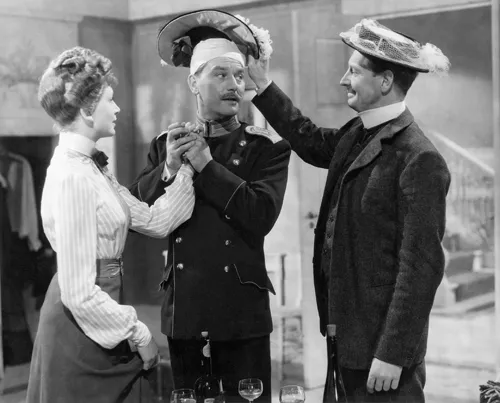
Edith, Theo and Clive in the sanatorium
Scooped up inside celluloid worlds, their characters fail and triumph and are deeply, almost palpitatingly alive; sensual in their vulnerability; hypnotising in their passion, joy and pain. They take remarkable action because they are human beings, and human beings are remarkable.
Within those celluloid worlds, film was allowed to be fully itself; articulate beyond any limits other than those of its own nature. Light and colour were manipulated to produce images which could speak as delicately as painting or still photography; which could enunciate subtexts, atmospheres and tones of emotion. Scenery might be wantonly theatrical or apparently factual, but always it would say exactly what it had to, exactly as loudly as it should.
Lay aside the screaming verticals and breathless moments of Black Narcissus, which of course was mainly about nuns and very adult sexuality and so didn’t interest me too much. Think only of Anton Walbrook as Lermontov standing still in The Red Shoes. In a wonderfully slow shot we see a silhouette against the light of a window. Our eyes become accustomed to the detail of a pale shirt, a dark suit; we can grasp the pattern of a man whose face is a mask of exhaled cigarette smoke – a barrier, a fiction, a tangible sigh. It has always hurt, just a little, to watch things so beauti...
Table of contents
- Cover
- Series
- Title
- Contents
- Acknowledgements
- Foreword to the 2020 Edition
- Soho and Home
- Notes
- Credits
- Copyright
Trusted by 375,005 students
Access to over 1.5 million titles for a fair monthly price.
Study more efficiently using our study tools.
Frequently asked questions
Yes, you can cancel anytime from the Subscription tab in your account settings on the Perlego website. Your subscription will stay active until the end of your current billing period. Learn how to cancel your subscription
No, books cannot be downloaded as external files, such as PDFs, for use outside of Perlego. However, you can download books within the Perlego app for offline reading on mobile or tablet. Learn how to download books offline
Perlego offers two plans: Essential and Complete
- Essential is ideal for learners and professionals who enjoy exploring a wide range of subjects. Access the Essential Library with 800,000+ trusted titles and best-sellers across business, personal growth, and the humanities. Includes unlimited reading time and Standard Read Aloud voice.
- Complete: Perfect for advanced learners and researchers needing full, unrestricted access. Unlock 1.5M+ books across hundreds of subjects, including academic and specialized titles. The Complete Plan also includes advanced features like Premium Read Aloud and Research Assistant.
We are an online textbook subscription service, where you can get access to an entire online library for less than the price of a single book per month. With over 1.5 million books across 990+ topics, we’ve got you covered! Learn about our mission
Look out for the read-aloud symbol on your next book to see if you can listen to it. The read-aloud tool reads text aloud for you, highlighting the text as it is being read. You can pause it, speed it up and slow it down. Learn more about Read Aloud
Yes! You can use the Perlego app on both iOS and Android devices to read anytime, anywhere — even offline. Perfect for commutes or when you’re on the go.
Please note we cannot support devices running on iOS 13 and Android 7 or earlier. Learn more about using the app
Please note we cannot support devices running on iOS 13 and Android 7 or earlier. Learn more about using the app
Yes, you can access The Life and Death of Colonel Blimp by A.L. Kennedy in PDF and/or ePUB format, as well as other popular books in Mezzi di comunicazione e arti performative & Storia e critica del cinema. We have over 1.5 million books available in our catalogue for you to explore.