G.W. Pabst's 1929 silent classic Pandora's Box (Die Büchse der Pandora), stars Hollywood icon Louise Brooks as the enigmatic heroine whose erotic charms lead to disaster for the men drawn into her web. Despite failing commercially upon release, it has evolved into a cult film long after it should have been forgotten. Pandora's Box captivates audiences with its libidinous, violent story, and its mysterious heroine whose motivations, as well as whose guilt or innocence, are difficult to determine. It is a sophisticated adaptation of Frank Wedekind's Lulu plays, and indisputably Louise Brooks' finest performance on film.
In her compelling study, Pamela Hutchinson traces Pandora's production history and the many contexts of its creation and afterlife, revisiting and challenging many assumptions made about the film, its lead character and its star. Analysing the film act by act, she explores the conflicted relationship between Brooks and the director G.W. Pabst, the film's historical contexts in Weimar Berlin, and its changing fortunes since its release.
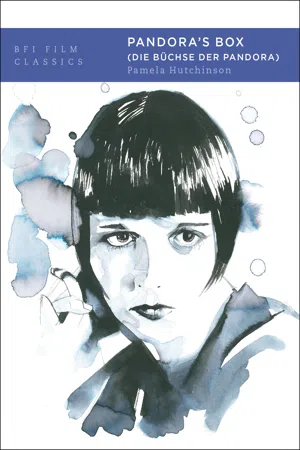
- 112 pages
- English
- ePUB (mobile friendly)
- Available on iOS & Android
eBook - ePub
Pandora's Box (Die Büchse der Pandora)
About this book
Information
1 Brooks and Pabst: The Star and the Director
Pandora’s Box (Die Büchse der Pandora, 1929) is a confounding film. It failed commercially, then soared in popularity long after it might have been forgotten. It is a masterpiece that has been mistreated and misunderstood; a work by a respected director that has come to be known as a vehicle for a foreign starlet. Exploring the film entails a journey back and forth between Europe and America, and occasionally into the gutter. The spark that illuminated this perplexing, dazzling film was the creative tension between two of film history’s most unusual characters. Louise Brooks was a reckless hedonist, a dancer turned movie actress with a riotous love life; Georg Wilhelm Pabst was a serious and diligent actor turned director with a passion for the cinema and social justice. Pabst summoned this underperforming Hollywood starlet to Europe, where she made three films that would outshine the rest of her career, the foundation for her lasting renown – then their paths diverged just a few years later. Their working relationship was dominated by conflict and a toxic sexual frisson, but they both found their greatest creative success in Europe, and butted heads with Hollywood executives. Each knew both warm critical acclaim and the cold shoulder of the industry. They were fiercely opposed to censorship and artistic timidity, and yet the films they made together were mutilated in the name of morality.
Louise Brooks, the scandalous starlet
Born in 1906 in Cherryvale, Kansas, to a mother who prioritised her own artistic endeavours over childcare, Brooks grew up with few rules and free rein to indulge her passion for dance. She joined the avant-garde Denishawn dance troupe in 1922 as a teenager, and travelled with them to New York, where she discovered the temptations of big-city nightlife and lost her rustic accent, but she was dismissed after too many infractions of their rules. She next worked as a Broadway dancer, first for the George White Scandals, then the Ziegfeld Follies, and became known, and notorious, on the New York party scene. She was asked to leave two hotels because of her scandalous behaviour, which boiled down to late nights, skimpy clothing and lost weekends of lovemaking and liquor. Her distinctive look, capped by her modern bobbed haircut, was the inspiration for the racy title character in the long-running syndicated comic strip, Dixie Dugan.

Eugene Richee portrait of Louise Brooks in 1928

Louise Brooks and Richard Arlen in Beggars of Life (William Wellman, 1928)
A pretty dancer in Manhattan was likely to be offered a movie contract, and Brooks signed with Paramount, working initially at its Astoria Studios on Long Island. By the time she moved to Hollywood, she was one of Paramount’s most photographed actors, her impish face and trim dancer’s body set off by an expensive designer wardrobe and that glossy bob: shorter and more severe than her peers dared to wear. It is worth stating at the outset that Brooks was divertingly beautiful, and appeared all the more so because she never seemed to simper or seek approval. In fact, her glittering eyes were constantly looking out for the next good time. Rather than romantic leads, Brooks specialised in Hollywood’s idea of a bad girl: two-timers and boyfriend stealers. It was not until Beggars of Life (William Wellman, 1928) that she had a starring romantic role, but even here her character kills a man and dresses in male drag as a hobo. Brooks gave a wonderful performance, but it was her behaviour off-screen that stopped her getting the plum parts: she still acted more like a chorus girl than an ingénue, making little secret of her appetite for sex and alcohol, yet was renowned as an intellectual snob, ostentatiously reading foreign literature on set. She also scorned the glad-handing that could help her to advance, and she could be downright awkward. Brooks once said she had a gift for enraging people. When Paramount wanted her to make Beggars of Life, she had to be hunted down to Washington DC, where she was enjoying herself with her married lover, the laundry magnate George Preston Marshall. By the time her contract was due for renewal, there was such a lack of enthusiasm on both sides that, aged twenty-one, Brooks took a chance on an offer from Berlin instead, setting sail to play the lead in an adaptation of a play she hadn’t read, for a director she had never heard of.
Pandora’s Box was the first and greatest of her European films, followed by Diary of a Lost Girl (Tagebuch einer Verlorenen, 1929), also with Pabst, and Prix de beauté (Miss Europe; Augusto Genina, 1930). These films brought her no immediate fame, but would be rediscovered decades later by critics who championed her as not just a star, but as a cinematic icon. In 1928, Paramount didn’t consider her worth a pay rise. In 1955, largely because of Pandora’s Box, her photograph was displayed at the entrance of a prestigious exhibition in Paris curated by Henri Langlois, director of the Cinémathèque Française, who proclaimed: ‘There is no Garbo! There is no Dietrich! There is only Louise Brooks!’1 A new phase of her celebrity began, and she was esteemed both as a star and as a writer. She burned her drafted memoir, but published several autobiographical pieces and essays on cinema, expanding on her dislike of the studio system and her memories of working with Pabst. Brooks’s writing is candid, often acerbic, offering insights into both the film business and the sexual mores of the 1920s.2 She lived her later years in Rochester, New York, close to the George Eastman House museum where her importance in film history was celebrated, and devotees came to pay homage, including documentary film-makers and the critic Kenneth Tynan, who wrote an influential profile of Brooks for The New Yorker. Her death in 1985 was swiftly followed by a definitive biography, a further ballooning of her cult celebrity and the multiplication of her sleek image across popular culture.
‘The tragedy of film history is that it is fabricated, falsified, by the very people who make film history,’3 wrote Brooks, referring to film journalism. However, nobody involved with Pandora’s Box has written or been interviewed about it so extensively as she has. This is a cause for celebration: it is rare that accounts of a film’s production are led by an actress rather than its director, and Brooks, an intelligent, well-read woman, this way assumes a powerful voice in film history. However, Brooks was discussing the film decades after it was made: she had read more about the play and her colleagues, but time may have clouded her memory. Crucially, she didn’t speak German or French or Czech (the languages spoken by the cast and crew), so her comprehension of what happened on set was limited. Brooks’s accounts are precious, but should be read with a pinch of critical salt.

G. W. Pabst behind the camera
‘Red Pabst’, the ‘nowhere man’
The Austrian director G. W. Pabst was heralded as a great talent by highbrow critics4 in the 1920s – he was what we would now describe as an auteur. He was born in Bohemia in 1885, in a village that was then Raudnitz in Austria-Hungary and is now the town of Roudnice nad Labem in the Czech Republic. He grew up in Vienna, where he studied drama, before working as an actor internationally: in Switzerland, Germany and, from 1910, at the German Theater in New York. On his return to Europe in 1914, Pabst was taken to a prisoner-of-war camp in Brest, where he was detained for the entire First World War, occupying his time with a French-language theatre group. After his release he worked in Prague, where he staged Expressionist plays to great acclaim. He was appointed director of the New Vienna Stage very soon afterwards, but in 1920 moved to Berlin to enter the film industry, as Carl Froelich’s assistant director.
Pabst’s cinematic directorial debut came late. In 1923, aged thirty-eight, Pabst made The Treasure (Der Schatz), a gothic tale that would represent his most Expressionist work on film. Through the mid-to-late 1920s, he directed accomplished, intelligent films, many of which featured or introduced great female stars (Asta Nielsen, Brigitte Helm, Greta Garbo and even Leni Riefenstahl, better known now as a director). His breakout success was The Joyless Street (Die freudlose Gasse, 1925), starring Nielsen and Garbo, a study of the deprivati...
Table of contents
- Cover Page
- Title Page
- Contents
- Acknowledgments
- 1. Brooks and Pabst: The Star and the Director
- 2. Wedekind and Lulu’s ‘Divine Birth’
- 3. The Making of Pandora’s Box
- 4. The Cast of Pandora’s Box
- 5. Pandora’s Box Act by Act
- 6. Beyond Pandora’s Box
- Notes
- Credits
- Bibliography
- eCopyright
Trusted by 375,005 students
Access to over 1.5 million titles for a fair monthly price.
Study more efficiently using our study tools.
Frequently asked questions
Yes, you can cancel anytime from the Subscription tab in your account settings on the Perlego website. Your subscription will stay active until the end of your current billing period. Learn how to cancel your subscription
No, books cannot be downloaded as external files, such as PDFs, for use outside of Perlego. However, you can download books within the Perlego app for offline reading on mobile or tablet. Learn how to download books offline
Perlego offers two plans: Essential and Complete
- Essential is ideal for learners and professionals who enjoy exploring a wide range of subjects. Access the Essential Library with 800,000+ trusted titles and best-sellers across business, personal growth, and the humanities. Includes unlimited reading time and Standard Read Aloud voice.
- Complete: Perfect for advanced learners and researchers needing full, unrestricted access. Unlock 1.5M+ books across hundreds of subjects, including academic and specialized titles. The Complete Plan also includes advanced features like Premium Read Aloud and Research Assistant.
We are an online textbook subscription service, where you can get access to an entire online library for less than the price of a single book per month. With over 1.5 million books across 990+ topics, we’ve got you covered! Learn about our mission
Look out for the read-aloud symbol on your next book to see if you can listen to it. The read-aloud tool reads text aloud for you, highlighting the text as it is being read. You can pause it, speed it up and slow it down. Learn more about Read Aloud
Yes! You can use the Perlego app on both iOS and Android devices to read anytime, anywhere — even offline. Perfect for commutes or when you’re on the go.
Please note we cannot support devices running on iOS 13 and Android 7 or earlier. Learn more about using the app
Please note we cannot support devices running on iOS 13 and Android 7 or earlier. Learn more about using the app
Yes, you can access Pandora's Box (Die Büchse der Pandora) by Pamela Hutchinson in PDF and/or ePUB format, as well as other popular books in Medios de comunicación y artes escénicas & Películas y vídeos. We have over 1.5 million books available in our catalogue for you to explore.