In the wake of the recent financial crisis, increasing the effectiveness of auditing has weighed heavily on the minds of those responsible for governance. When a business is profitable and paying healthy dividends to its stockholders, fraudulent activities and accounting irregularities can go unnoticed. However, when revenue and cash flow decline, internal costs and operations may be scrutinized more diligently, and discrepancies can emerge as a result.
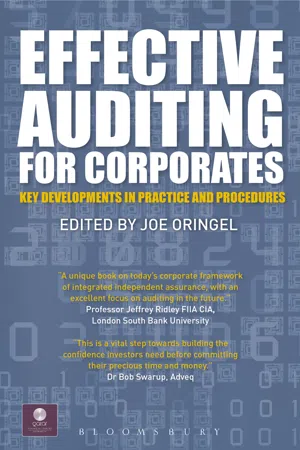
Effective Auditing for Corporates provides you with proactive advice-to help you safeguard core value within a corporation and to ensure that auditing processes and key personnel meet the expectations of management, compliance, and stockholders alike.
Aimed primarily at auditors (both external and internal), risk managers, accountants, CFOs, and consultants, Effective Auditing for Corporates covers:
* Compliance and the corporate audit
* Fraud detection
* Risk-based auditing
* The development of Sarbanes-Oxley
* Cultural changes in external auditing
* Auditing management information systems
eBook - ePub
Effective Auditing For Corporates
Key Developments in Practice and Procedures
- 240 pages
- English
- ePUB (mobile friendly)
- Available on iOS & Android
eBook - ePub
About this book
Information
The Best Practices of Tomorrow
Auditor Sensitivity to Source Reliability
This Chapter Covers

Introduction
The auditor is always playing catch-up. Both external and internal auditors have to review the work of people who do the same job day-in, day-out and who, if competent, are usually intimately familiar with the processes, systems, and information that are under their control. Looking at the transactions on a historical basis further hampers the certified public accountant, chartered accountant, or other audit professional. These difficulties have been overcome by structured professional training, on-the-job training, and thorough review of audit work.
Auditors face numerous challenges in assessing the evidence behind the statements which they are auditing:
What do these challenges have in common? Much of the risk from these areas stems from change, lack of experience, and the unknown. What else do these challenges have in common? Most will result from companywide projects and programs. The project that addresses a new regulatory requirement, product, system, service, or building, places organizations at substantial risk. Key vendors supporting change often possess greater knowledge and experience than internal staff, further increasing the risk of fraud or substandard delivery. Many projects are delivered late, fail to meet expectations, and exceed budget. Such projects need to be included within the audit universe of internal audit. High-risk projects must be audited. External audit, equally, must consider any project that impacts their client as a “going concern.”
Project audits provide an opportunity to ensure that appropriate governance is in place to report progress to senior management, ensure effective control of change, and provide quality assurance that, if absent, may well lead to adverse or even disastrous results. An audit of a project should also include an assessment of future audit trails for new products, services, and systems. This should be performed before completion of the project, when any changes or reengineering cost are likely to be far higher. It is at this stage that audit can most readily address the systemic reliability of evidence issues.
A fundamental skill is the ability to quickly assess the reliability of both people and information while applying appropriate “professional skepticism.” This chapter will explore the use, evaluation, and assessment of information—how auditors should consider reliability, and the red flags to consider when evaluating information sources in the context of a project audit.
The Institute of Internal Auditors (IIA) states: “Internal auditors must identify sufficient, reliable, relevant, and useful information to achieve the engagement’s objectives” (Standard 2310). The Institute further clarifies this to mean: “Sufficient information is factual, adequate, and convincing so that a prudent, informed person would reach the same conclusions as the auditor. Reliable information is the best attainable information through the use of appropriate engagement techniques. Relevant information supports engagement observations and recommendations and is consistent with the objectives for the engagement. Useful information helps the organization meet its goals.”
It is often the case that the information obtained or given to an auditor is subject to interpretation. This is particularly true of project audits, where information may be presented as optimistically as possible to present the best possible case rather than the most realistic. There is often external “noise” that may cloud project reporting as various stakeholders interpret results to meet their own agendas, which may or may not be aligned with the goals of the project. Auditors are faced with constraints that may tempt them to jump to conclusions or misinterpret information—or simply to “go with the flow.” Audit management should work toward eliminating or mitigating these constraints through a proper structured review of projects and supervision of assignments. Some of the constraints faced by auditors are:
Systems and Processes
As the range of activities that audit reports on is expanded (for example, to include social responsibility reporting) audit is examining many additional nonfinancial systems that historically would not have been subject to detailed audit review—if they were considered at all. Frequently such systems are not overly complex or difficult to understand in principle (e.g. facilities management, nonpayroll human resource systems, records management systems, sales databases, etc.) and should not present a major challenge for an experienced auditor. Areas to consider during review/audit of these systems should include the following.
If the auditor is not an expert in the field of the project, this involves additional challenges.
When evaluating systems the auditor should test, or ask an expert to test, for questions such as the following.
Table of contents
- Cover
- Title Page
- Contents
- Introduction
- Contributors
- External Auditing—The Rise of the Integrated Audit
- Internal Auditing—Fundamentals and the Best Practices of Today
- New Horizons—The Best Practices of Tomorrow
- Imprint
Trusted by 375,005 students
Access to over 1.5 million titles for a fair monthly price.
Study more efficiently using our study tools.
Frequently asked questions
Yes, you can cancel anytime from the Subscription tab in your account settings on the Perlego website. Your subscription will stay active until the end of your current billing period. Learn how to cancel your subscription
No, books cannot be downloaded as external files, such as PDFs, for use outside of Perlego. However, you can download books within the Perlego app for offline reading on mobile or tablet. Learn how to download books offline
Perlego offers two plans: Essential and Complete
- Essential is ideal for learners and professionals who enjoy exploring a wide range of subjects. Access the Essential Library with 800,000+ trusted titles and best-sellers across business, personal growth, and the humanities. Includes unlimited reading time and Standard Read Aloud voice.
- Complete: Perfect for advanced learners and researchers needing full, unrestricted access. Unlock 1.5M+ books across hundreds of subjects, including academic and specialized titles. The Complete Plan also includes advanced features like Premium Read Aloud and Research Assistant.
We are an online textbook subscription service, where you can get access to an entire online library for less than the price of a single book per month. With over 1.5 million books across 990+ topics, we’ve got you covered! Learn about our mission
Look out for the read-aloud symbol on your next book to see if you can listen to it. The read-aloud tool reads text aloud for you, highlighting the text as it is being read. You can pause it, speed it up and slow it down. Learn more about Read Aloud
Yes! You can use the Perlego app on both iOS and Android devices to read anytime, anywhere — even offline. Perfect for commutes or when you’re on the go.
Please note we cannot support devices running on iOS 13 and Android 7 or earlier. Learn more about using the app
Please note we cannot support devices running on iOS 13 and Android 7 or earlier. Learn more about using the app
Yes, you can access Effective Auditing For Corporates by Joe Oringel in PDF and/or ePUB format, as well as other popular books in Business & Business General. We have over 1.5 million books available in our catalogue for you to explore.