This book is available as open access through the Bloomsbury Open Access programme and is available on www.bloomsburycollections.com.
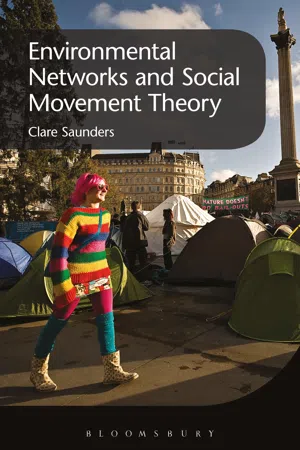
Clare Saunders' book is an important contribution to the literature on social movements and environmentalism. Using the concept of 'environmental networks', it explores the extent to which social movement theory helps us understand how a broad range of environmental organizations interact. It considers the practicalities of social movement theories and it goes on to relate them to the practices of environmental networks. Theoretically and empirically rich, the book draws on extensive survey material with 144 UK environmental organizations, as diverse as not-in-my-backyard (NIMBY) groups, reformists, conservationists and radicals; interviews with more than 40 key campaigners and extensive participant-observation, particularly in London.
Focussing particularly on the crucial question of networking dynamics, the book reveals that there are broad ranging network links across the movements' spatial and ideological dimensions. Combined with inevitable ideological clashes and a degree of sectarian rivalry, these links helps produce vibrant environmental networks that together work to protect and/or preserve the environment. This book is an invaluable resource for anyone concerned with environmental issues, politics and movements.
- 256 pages
- English
- ePUB (mobile friendly)
- Available on iOS & Android
eBook - ePub
Environmental Networks and Social Movement Theory
About this book
Information
1 Introduction
LONDON, 1 APRIL 2009. ‘Fossil Fools Day’. On this day activists from a number of different environmental and social justice organizations took to the streets for two days of action to call an end to ‘climate chaos, economic meltdown and repossessions’. These actions were planned to coincide with a meeting of the leaders of the world’s 20 richest countries: the G20. Their meeting was designed to negotiate a rescue package for the flailing world economy. There were three main protest actions, organized by different wings of what has been termed the environmental movement. The Campaign Against Climate Change, armed with a rapidly melting ‘iceberg’ (a large chunk of ice), held a ‘climate emergency’ demonstration and rally at the Excel Centre; around 4,000 Climate Campers pitched tents outside the Climate Exchange and shut it down; and there was a ‘G20 Meltdown’ street party outside the Bank of England.
After much deliberation, my husband and I decided that the Campaign Against Climate Change’s legally approved demonstration outside the Excel Centre was the most approachable; it would, we believed, land us in the least trouble. Since it was billed to last from 12.30 p.m. to 7.30 p.m., we were disappointed to find only around 40 people there for the lunchtime photo opportunity, with numbers dwindling rapidly to single figures by 2 p.m. Although there was a small rally in the evening, it seemed fruitless to wait all afternoon so we set off to visit the Climate Camp. But, before we had returned to the train station, we were stopped by police officers and searched under terrorism legislation on suspicion of intent to conduct criminal damage. If the police were behaving like that near a legally approved demonstration, what would they be like in the vicinity of the Climate Camp? Concerned about heavy-handed policing, we were put off from attending other events and returned home, instead.
Our experience in London that day is illustrative of several issues discussed in depth in this book. Why did only around 40 people attend a legal demonstration on what is, arguably, the most important issue facing humanity and all the species with which we share the planet? In particular, where were the Friends of the Earth and Greenpeace supporters? And why did the Climate Camp hold a separate demonstration rather than collaborate with the Campaign Against Climate Change?
Phil Thornhill, coordinator of the Campaign Against Climate Change, responded to the first question stating, ‘Well, this is fairly typical of a Wednesday lunchtime demonstration’ (personal correspondence, 1 April 2009). However, this could not account for the presence of thousands of people congregating elsewhere in central London at the same point in time. A better explanation, particularly to the second and third questions, stems from the fact that environmental organizations each have different strategies, degrees of reputability with decision-makers, organizational identities and resource constraints. The Campaign Against Climate Change’s approach was a media-friendly stunt. Others might interpret it as a form of lobbying – attempting to politely persuade the G20 leaders to take climate change seriously. This is part of the Campaign Against Climate Change’s broader goal to build a mass movement by attracting wide-ranging public support for demands for strong national climate change legislation and a robust international climate policy framework. In contrast, Climate Campers and G20 Meltdown participants, generally adverse to what they deem ineffectual lobbying, attempted to directly close down the institutions they considered responsible for causing climate change. Unlike the Campaign Against Climate Change and Friends of the Earth, Climate Camp and G20 Meltdown are fluid networks of activists, without formal organizational structures. Consequently, they are immune from some of the constraints faced by formal organizations. Formal organizations have to engage in organizational maintenance; it is necessary for them to maintain their memberships to keep themselves financially afloat and they have responsibilities towards their staff. The need for organizational maintenance is arguably a key reason why Friends of the Earth, conspicuously absent from events on Fossil Fools Day, had instead participated in the ‘Put People First’ march and rally the previous Saturday. This mainstream and legally authorized demonstration, organized by a coalition of over 100 environmental, social justice and labour organizations was a safer bet for an organization with a reputation to uphold. In the event, around 35,000 people marched against poverty, inequality and the threat of climate chaos. Unlike the Climate Camp and G20 meltdown, the Put People First march was non-confrontational and remained peaceful throughout, leaving Friends of the Earth’s reputation and public image untarnished.
The choices for collaboration that are made by environmental organizations are, to a large extent, determined by these strategic, identity and resource differences. In this book, I consider the extent to which social movement theory can help us understand how and why these differences occur and why they have such a profound affect on the shape and form of networking between environmental organizations. The rest of this introductory chapter outlines the central aims of the book; provides a rationale for studying the environmental networks from a social movement theory perspective; introduces the theoretical and methodological approach and gives a flavour of the chapters that follow.
Aims
This book has three central aims. The first is to evaluate and contextualize, in relation to British environmentalism, key strands of social movement theory. The second is to identify and account for interaction between environmental organizations1 within environmental networks. The third is to make a theoretical contribution by introducing and applying an analytical framework that has potential to explain the nature of inter-organizational interactions in a range of social movement fields.
I use the term ‘environmental networks’ to avoid ‘environmental movement’, which I suggest is less analytically useful. The concept of a social movement is explored in more depth in Chapter 2, but suffice it for now to point out that the concept of ‘social movement’ does not comfortably sit with the broad range of environmental organizations commonly thought to be part of the environmental movement. To be too prescriptive about which organizations are in or out of a movement would preclude examination of interesting interactions between a wide range of organizations – across the networks’ spatial dimensions (national, regional and local) and ideological strands (conservationists, political ecologists/reformists and radical environmentalists). As I have illustrated in my previous work, the concept of social movement is rather sketchy on the amount of networking required to create a social movement dynamic (Saunders 2007a, 2011). Without getting fixated on the question of whether the networking is sufficient to constitute a movement, I examine interaction mostly in terms of collaboration in campaigns, with some reference to the sharing of information. The central question then becomes not whether a movement exists, but how one might explain the patterns of interaction found.
In order to make generalizations about social movements it may be considered necessary to look beyond environmental networks. Yet there are also good reasons for restricting the study to a single field of contention. I focus specifically on environmentalism in order to give the social movement theories discussed a decent airing in relation to one particular field of contention. This helps avoid accusations of cherry-picking case studies that fit the theories, or being charged with theory bashing (a term coined by Lofland 1983, described below). Equally, there are important reasons for focusing on the British case: it is one of the most active and well-developed environmental movements in the world. In many ways it has had a similar trajectory to the equally well developed environmental movement in Germany (Rucht and Roose 2007). The most striking difference between the British and German cases is that resistance to nuclear power has been stronger in Germany, historically linking environmentalism with left-wing movements – something that has not occurred to the same extent in Britain (Rootes 1992). Despite this, the British environmental movement is not drastically different from many of its European counterparts: conservationist, reformist and radical environmental groups coexist in many Western European democracies (Rootes 2007). At the same time, the British case is illuminating because environmentalism in Britain is not torn by such dramatic divisions as it is in the United States. There, anthropes and misanthropes and preservationists and conservationists are in separate camps and are sometimes overtly hostile towards one another.
The research conducted for this book took place in London. The emphasis on London is justified because it has the highest concentration of environmental organizations in Britain (Rootes and Miller 2000). Of the 203 national environmental organizations listed in The Environment Council’s Who’s Who in the Environment (1999), 73 were located in London, as well as numerous regional groups such as the London Wildlife Trust and the Sustainable London Trust. London has also spawned vibrant local environmental networks (Rootes, et al. 2001). The abundance of different types of environmental organizations and networks provides plenty of scope for analysing interaction between and among environmental organizations working in different ways at multiple levels.
Why research networking among environmental organizations?
The most obvious reason for focusing on networking among environmental organizations is to address a gap in the literature. The three dominant phases of research on environmental movements have tended to overlook networking. The three phases are: new values, institutionalization, and radical conflicts/local oppositions (della Porta and Rucht 2002). The first suggested that environmentalism was spawned by new post-material values. The provision of economic security was considered to have made it more likely that people shift their attention to new non-material goals like securing a healthy environment (Inglehart 1971, 1987, 1990). The second phase noted how many environmental organizations had become increasingly tame as they became institutionalized – that is to say, as they grew in size, they developed formal organizational structures, gained access to policymakers and consequently lost their radical edge. The third looked at how radicals and locals crafted campaigns to supplement or supplant those of the increasingly tame national organizations.
While our understanding of environmentalism has benefited from many illuminating studies within these phases, there are some limitations in extant scholarship. The commonly used approaches have tended to result in either broad-brush descriptions of environmentalism – which sometimes mistakenly assume ideological and tactical homogeneity – and analysis of individual organizations and/or specific conflicts. The focus on environmental networks deployed in this book extends work on environmentalism beyond broad-brush approaches and case studies. It finds heterogeneity rather than homogeneity and looks at groups campaigning on a wide range of issues, despite a special focus on campaigns against aviation and climate change. It also has the advantage deploying a multilevel approach, firmly placing frequently overlooked regional (by which I mean organizations working across London) and local organizations in the picture. And it allows us to explore interactions between different types of organizations that a focus on movements might have prevented. According to some scholars, for example, organizations that do not challenge the social order should not be included as part of a social movement (see Doherty’s [2002] book on what he calls ‘the green movement’). A focus on the system-challenging green movement (Doherty 2002) would prevent us from looking at conservation groups, local residents associations and not in my back yard (NIMBY) groups, each of which plays an important role in looking after the environment in one way or another (see Chapter 3).
Although an account made at the turn of the millennium stated that local environmentalism is ‘very lively’ and ‘appears to be expanding in Britain’ (Diani and Donati 1999 : 24–5), environmentalism in Britain has generally, with the exception of Lowe and Goyder’s seminal work (1983), been interpreted through national organizations (e.g. Rawcliffe 1998). An exception is Doherty et al.’s (2007) work on local radical environmental networks in Oxford, Manchester and North Wales. By and large, though, when local environmental campaigns and organizations have been researched, findings often materialize as useful, but in some ways limited discussions of particular cases of contention (Seel 1997; North 1998; Barcena and Ibarra 2001; Fillieule 2002). To date, there has been little if any research on the relationship between local, regional and national environmental organizations in Britain, except for my own work (see Saunders 2007b).
The most extensive survey of local environmental activism to be undertaken was in a US context (Kempton et al. 2001: 578). The authors claim: ‘We know of no census of local environmental groups previously reported in the literature’. They compared two sites of local environmental activism and concluded that case studies underplay their diversity. Their research also notes the general importance of local environmental groups: ‘Local environmental groups are not pale, less influential versions of large national organizations, but are significant in their own right’ (557). Drawing on Kempton et al., Lhotka et al. (2008) studied the extent to which local environmental groups exchanged information with one another in Alabama. Parisi et al. (2004) similarly note the importance of local activism, but all three sets of scholars fail to locate local groups within broader environmental networks and none of them have considered environmentalism in Britain.
In addition to there being a lacuna in the literature, it is important to study environmental networks because they are a pervasive component of citizen politics in Britain (Carter 2001: 131). Formal environmental organizations, which are significant players in environmental networks, have a greater total membership than political parties. According to the Database of Archives of Non-Governmental Organizations (2010), 5–8 million people are members of environmental organizations2 in Britain. Besides actual membership support, the British are generally favourable towards environmental issues. Between 1996–7 and 2006–7, recycling rates rose from 7 per cent to 31 per cent, and over half of the British public claim to be considering doing more of the following: reducing water use, reducing gas and electricity use, wasting less food and recycling more (Randall 2008: 149–51). The environment clearly matters to people. But why is interaction in environmental networks important?
The importance of interaction and networks
In both environmental and social movement studies more broadly, organizational interaction within movements has been under-studied (see Zald and Ash 1966; Ash-Garner and Zald 1987). Where intra-social movement networks have been researched, disproportionate emphasis has been given to the role of individuals’ social networks in the mobilization process (e.g. Gould 2000; Passy 2003; Mische 2003).3
Even though there is little consensus as to what constitutes a social movement, most theorists agree that social movements can be conceived of as networks of interaction between individuals and organizations engaging in collective action aimed at achieving or resisting social change (Diani 1992a). This conceptualization is growing in popularity (Diani and Eyerman 1992: 7–10; della Porta and Diani 1999).4 Considering the abundant use of the term ‘network’ in social movement theory and its centrality in the concept of a social movement, it is somewhat ironic that systematic studies of intra-movement interaction are largely absent from the literature on environmental movements (note that Diani’s work is an obvious and welcome exception, 1992 and with Rambaldo 2007).
The focus on networks also addresses Melucci’s (1985: 799) concern over the inadequacy of the term movement. As he states, instead of using the term social movements, ‘I prefer to speak of movement networks or movement areas as the network of groups and individuals sharing a conflictual culture and a collective identity’ (emphasis added). While the possibility of a broad network of groups sharing a conflictual culture and collective identity is debateable (Chapter 7), the emphasis on networks is well placed. One might go so far as to argue that to understand a social movement properly requires due consideration of interaction, otherwise research becomes over-focused on mobilization processes and organizational characteristics (Diani 1992b). Little wonder, then, that Ash-Garner and Zald (1987: 179) claim that ‘inter-social movement organization relations are a central dynamic of any social movement’. Further, a focus on networks makes it possible to overcome the ‘myopia of the visible’ that Melucci (1989: 44) cautioned against. Research subject to the ‘myopia of the visible’ would involve focusing exclusively on the most visible aspects of social movements, such as active protest events. Consequently, it might miss underlying ideologies, collective identity formation and networking. Networks are important because they allow movements to be sustained during periods of latency. They also provide solidarity and reinforcement crucial for campaign success (Melucci 1985). Thus, some have argued that networks are nothing less than the glue holding movements together (Gerlach 1983: 145). Networks also bring organizations into contact with other allies (including political parties). Consequently, they make organizations difficult to repress, increase their recruitment bases, and encourage innovation and adaptability.
Despite the centrality of the concept of networks in social movement research, Jasper (1997: 61) has been critical of what he calls ‘the network approach’. He suggests that networks are overemphasized and only show the expected. This criticism stems mostly from his tendency to equate the use of networks with an approach that constitutes a single paradigm. For him, the network paradigm seeks to explain collective action solely on the basis of the extent to which actors are embedded in existing systems of social relations, ignoring other attributes of actors – such as organizational size, ideology and strategy. Part of his critique is directed towards Diani (1995), who found relatively few ties between environmental organizations in Milan, and apparently overrated their significance. Jasper (1997: 61) suggests that ‘we need to push beyond the network metaphor . . . to see what resources, rules, cultural schemas and patterns of interaction lie behind it’. My retort would be that this is exactly what this book does – it uses theoretical insights from social movement theories to explore networking. In this book, I look at resources through the lens of resou...
Table of contents
- Cover
- Title
- 1 Introduction
- 2 Environmental Movements or Networks?
- 3 Key Organizations and Campaigns in Londons Environmental Networks
- 4 The Role of Resources in Relationships
- 5 Political Structures, Political Contingencies and Environmental Networks
- 6 Environmental Networks and New Social Movement Theory
- 7 Collective Identity and Solidarity: Unity or Factionalism?
- 8 Towards a Synthetic Analytical Framework for Understanding Interaction in Environmental Networks
- Conclusion
- Appendix 1: List of interviewees
- Appendix 2: Survey
- Appendix 3: List of survey respondents
- Appendix 4: Key to Figures 6.2 and 6.3
- Notes
- References
- Index
Trusted by 375,005 students
Access to over 1.5 million titles for a fair monthly price.
Study more efficiently using our study tools.
Frequently asked questions
Yes, you can cancel anytime from the Subscription tab in your account settings on the Perlego website. Your subscription will stay active until the end of your current billing period. Learn how to cancel your subscription
No, books cannot be downloaded as external files, such as PDFs, for use outside of Perlego. However, you can download books within the Perlego app for offline reading on mobile or tablet. Learn how to download books offline
Perlego offers two plans: Essential and Complete
- Essential is ideal for learners and professionals who enjoy exploring a wide range of subjects. Access the Essential Library with 800,000+ trusted titles and best-sellers across business, personal growth, and the humanities. Includes unlimited reading time and Standard Read Aloud voice.
- Complete: Perfect for advanced learners and researchers needing full, unrestricted access. Unlock 1.5M+ books across hundreds of subjects, including academic and specialized titles. The Complete Plan also includes advanced features like Premium Read Aloud and Research Assistant.
We are an online textbook subscription service, where you can get access to an entire online library for less than the price of a single book per month. With over 1.5 million books across 990+ topics, we’ve got you covered! Learn about our mission
Look out for the read-aloud symbol on your next book to see if you can listen to it. The read-aloud tool reads text aloud for you, highlighting the text as it is being read. You can pause it, speed it up and slow it down. Learn more about Read Aloud
Yes! You can use the Perlego app on both iOS and Android devices to read anytime, anywhere — even offline. Perfect for commutes or when you’re on the go.
Please note we cannot support devices running on iOS 13 and Android 7 or earlier. Learn more about using the app
Please note we cannot support devices running on iOS 13 and Android 7 or earlier. Learn more about using the app
Yes, you can access Environmental Networks and Social Movement Theory by Clare Saunders in PDF and/or ePUB format, as well as other popular books in Politics & International Relations & Environment & Energy Policy. We have over 1.5 million books available in our catalogue for you to explore.