This book is available as open access through the Bloomsbury Open Access programme and is available on www.bloomsburycollections.com. There has been an increasing interest in research ethics over the last decade given the increasing ethical regulation of social research. 'Ethical literacy' encourages researchers to understand and engage with the ethical issues that emerge in the process of research. This book provides a short, succinct and accessible overview of the field, highlighting the key issues and everyday ethical dilemmas that researchers are likely to face in different contexts. Covering a range of methods, the book provides clear guidance for researchers on how to identify an approach that fits with their moral and intellectual framework. It explores ethical issues relating to 'traditional' research methods as well as to new and emerging methods and approaches - particularly visual and online methods.
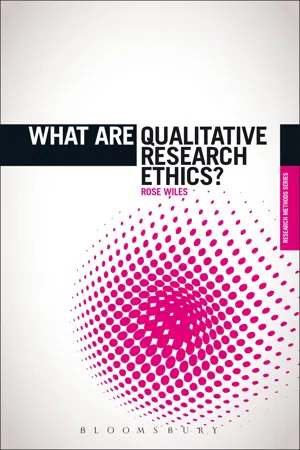
- 128 pages
- English
- ePUB (mobile friendly)
- Available on iOS & Android
eBook - ePub
What are Qualitative Research Ethics?
About this book
Information
1 Introduction
This book provides an introduction to research ethics relevant to qualitative research across the social sciences. It outlines approaches for thinking about ethical issues in qualitative social research and the key ethical issues that need consideration. It is intended to have relevance for researchers and students working across a range of social science disciplines and it explores ethical issues relating to ‘traditional’ research approaches, such as ethnography, interviews and focus groups, as well as those relating to new and emerging methods and approaches, particularly visual and online methods.
There has been an increasing interest in research ethics in the twenty-first century in the light of the increasing ethical regulation of social research. Various authors working in qualitative social science, particularly ethnographers, have contested the appropriateness of ethical regulation in social research. These academics have argued that qualitative research poses minimal risks to participants and that ethical review of research by research ethics committees is both unnecessary and detrimental to social science research (Atkinson, 2009; Dingwall, 2008; Hammersley, 2009). An alternative and perhaps less popular view is that social science research is never risk free and that systems of ethical review encourage researchers to think through ethical issues and to develop their ethical thinking (Boulton et al, 2004). Despite considerable critiques of regulation, systems of ethical review have become embedded in most research institutions. This has heightened researchers’ awareness of ethical issues and highlighted the need for training and resources to enhance researchers’ ‘ethical literacy’. Much of the drive for researchers in this area has been to enable them to manage the institutional ethical review process and a number of excellent resources have been developed with this aim in mind (for example http://www.ethicsguidebook.ac.uk/).
However, enhancing ‘ethical literacy’ means more than learning how to achieve ethics approval. ‘Ethical literacy’ means encouraging researchers to understand and engage with ethical issues as they emerge throughout the process of research and not merely to view research ethics as something that is completed once a favourable opinion on a proposed research project has been granted by a research ethics committee. While it may be the case that some ethical issues can be anticipated prior to a study commencing, often ethical issues emerge as research proceeds, sometimes in unexpected and surprising ways.
An argument frequently put forward by social researchers is that ethical decision making is inevitably situational and contextual and cannot be determined by appeal to predetermined codes and principles. It is argued that decisions about ethical issues that emerge in the process of research need to be decided on ‘in the field’ in the light of the specific issue, the people involved and the likely consequences. This is sometimes used as an argument against ethical regulation in general which is viewed as limiting researchers’ ability to act on the situation that arises. It is also used as an argument against the use of ethical frameworks (particularly principlism) in ethical decision making. It is argued that a ‘one size fits all’ approach such as principlism, in which issues such as informed consent and anonymity are viewed as essential principles to be upheld in all social research, is limiting and prevents researchers making ethical decisions in the context of their research in the ways that meet the needs of their research participants.
It is a central theme of this book that consideration of ethical frameworks is important in helping to guide researchers in thinking through the ethical challenges with which they are confronted. This is not to argue that ethical dilemmas are anything other than situational and contextual; consideration of ethical frameworks does not preclude individual deliberation on the part of researchers. The ethical dilemmas that researchers encounter in research are essentially moral dilemmas. Researchers may have a ‘gut feeling’ about the morally ‘right’ course of action in a situation that they encounter. However, ethical frameworks can help them to think about, evaluate and justify these ‘gut feelings’. Ethical frameworks do not provide clear answers to such dilemmas, simply a means of thinking about them and assessing what an appropriate and defensible course of action might be. Such actions might differ according to the ethical framework used and an individual researcher’s moral views. The important issue is that researchers use a framework that fits with their moral views and which enables them to explore and justify the decisions they make.
The focus of this book is based on three premises: first, that researchers need to consider ethical issues throughout the entirety of their research; second, that gaining an understanding of the different philosophical approaches to research ethics and identifying an approach that fits with their moral and intellectual framework will help them to engage with issues that emerge as their research unfolds; and third, that, despite the well-known horror stories of unethical conduct, most ethical issues with which researchers grapple are relatively mundane and everyday, but no less important for that. The book focuses primarily on ethical issues that emerge for researchers and research participants in the conduct of research. Researchers also have ethical responsibilities to the research team with whom they may be working, to their discipline, to the wider research community and to the public. It is incumbent on researchers to consider ethical issues within this broader context.
The book commences with an exploration of ethical frameworks as well as various forms of guidelines and regulation that guide or inform ethical decision making. This chapter also outlines relevant legislation with which researchers are obliged to comply.
The following three chapters explore three of the core issues in research ethics and the ways that researchers have engaged with them: informed consent; anonymity and confidentiality; and risk. In each of these chapters the meaning of these concepts are explored and their application, and in some cases their relevance, in different types of research approaches is outlined. In each of these three chapters, examples are provided from the literature of the ways in which researchers have managed these ethical issues in their research. Examples are also drawn on from a research project on informed consent conducted with my colleagues Sue Heath, Graham Crow and Vikki Charles as part of the Economic and Social Research Council (ESRC) Research Methods Programme as well as a project on ethical issues in visual methods conducted with my colleagues Jon Prosser, Amanda Coffey, Sue Heath and Judy Robison. Each of these projects involved interviews or focus groups with researchers exploring their views about ethical issues in qualitative research and how these issues were managed in the context of their research.
Chapter six discusses common ethical dilemmas that researchers experience and through three detailed case studies discusses the deliberation and management of such dilemmas. Finally, chapter seven explores developments in research methods over the last decade and the ethical challenges that these raise. Developments in narrative, participatory, visual, digital and e-research methods and data-sharing are discussed and the extent to which these demand new approaches to research ethics or the re-working of familiar issues in new contexts. A list of resources where further information on the various issues discussed in the book can be found is provided.
There are a number of key terms used in the literature on ethics. These are explained throughout this book. A brief definition of the key terms is given here; further information on them can be found in the relevant chapters.
Key terms
Moral judgements/morality
Morality is concerned with intentions and actions which are good (or the ‘right’ thing to do) contrasted with those that are bad or wrong. A moral judgement is made when a person decides what the right course of action is in a specific situation. Ethical dilemmas in research involve people making moral judgements.
Ethics
Ethics is the branch of philosophy which addresses questions about morality. The terms ethics and morals are often used interchangeably. Research ethics are concerned with moral behaviour in research contexts.
Ethical frameworks
Ethical frameworks provide a means of thinking about ethical dilemmas (or moral behaviour). They provide some criteria against which researchers can consider what it is right or wrong to do when presented with an ethical dilemma. Common ethical frameworks are consequentialist, principlist, non-consequentialist, ethics of care and virtue ethics.
Consequentialist approaches
Consequentialist approaches argue that ethical decisions should be based on the consequences of specific actions so that an action is morally right if it will produce a good outcome for an individual or for wider society.
Principlist approaches
Principlist approaches are non-consequentialist approaches. Rather than focusing on the consequences of an action, they draw on the principles of respect for people’s autonomy, beneficence, non-maleficence and justice in making and guiding ethical decisions in research. Respect for autonomy relates to issues of voluntariness, informed consent, confidentiality and anonymity. Beneficence concerns the responsibility to do good, non-maleficence concerns the responsibility to avoid harm and justice concerns the importance of the benefits and burdens of research being distributed equally. People using principlist approaches make ethical decisions on the basis of these specific principles. Principlist approaches hold that consent to participate in research should be freely given and that potential participants should not experience any form of coercion to encourage them to take part in research.
Ethics of care
An ethics of care approach means that ethical decisions are made on the basis of care, compassion and a desire to act in ways that benefit the individual or group who are the focus of research. This contrasts with consequentialist and principlist approaches which involve using rules or principles to address ethical dilemmas. An ethics of care approach means that researchers make decisions about ethical issues in relation to a particular case and by drawing on the notion of ‘care’ in relation to research participants, rather than applying universal rules.
Virtue ethics
Virtue ethics focus on the virtue or moral character of the researcher rather than principles, rules or consequences of an act or decision. Virtue ethics draw on the notion of researcher integrity and seek to identify the characteristics or virtues that a researcher needs in order to behave in morally (or ethically) ‘good’ ways.
Ethical regulation
Most research conducted by researchers in the UK and North America, and much research conducted in other European countries and indeed in the Western world, is subject to ethical regulation. The form this takes is review by a recognised ethics committee.
Ethical guidelines
Professional ethical guidelines and codes provide frameworks to enable researchers to think through the ethical dilemmas and challenges that they encounter in their research. In most cases, these guidelines are very general and with the exception of some specific issues such as confidentiality or matters that might result in accusations of research misconduct, they do not provide answers to how researchers should manage the specific situations that they might encounter in their research. Social researchers in many (but not all) disciplines can, and do, conduct research without being members of a professional organisation. It is also the case that guidelines are not legally enforceable. Nevertheless, a researcher may be excluded from membership of a professional organisation, damage their reputation and have difficulty getting their work published or gaining grants if they disregard these guidelines in ways that challenge disciplinary norms of ethical behaviour.
Informed consent
Informed consent involves providing participants with clear information about what participating in a research project will involve and giving them the opportunity to decide whether or not they want to participate.
Capacity
The term ‘capacity’ or ‘competence’ is used to refer to people’s ability to give consent to participate in research. There are some groups for whom questions of capacity or ‘competence’ to provide consent are raised. These groups include children and young people, people with intellectual disability and people with some physical and/or mental illness and disability. People are assumed to lack capacity to consent if they are not able to understand what participating in research will involve, to weigh up the risks and benefits to them of participating or to reach their own decision about this and/or other matters that affect their life. Assessing capacity to consent is, in many cases, a judgement made by researchers but there are some legal issues that need consideration and specific issues are relevant for research with children and young people.
Duty of confidentiality
In the research context, the duty of confidentiality is taken to mean that identifiable information about individuals collected during the process of research will not be disclosed. Additionally, the duty of confidentiality may mean that specific information provided in the process of research will not be used at all if the participant requests this. Confidentiality is closely connected with anonymity. However, anonymisation of data does not cover all the issues raised by concerns about confidentiality.
Anonymity
The ...
Table of contents
- What are qualitative research ethics?
- Copyright
- Contents
- Series foreword
- 1 Introduction
- 2 Thinking ethically: approaches to research ethics
- 3 Informed consent
- 4 Anonymity and confidentiality
- 5 Risk and safety
- 6 Ethical dilemmas
- 7 Where next for research ethics?
- Further reading and resources
- References
- Index
Trusted by 375,005 students
Access to over 1.5 million titles for a fair monthly price.
Study more efficiently using our study tools.
Frequently asked questions
Yes, you can cancel anytime from the Subscription tab in your account settings on the Perlego website. Your subscription will stay active until the end of your current billing period. Learn how to cancel your subscription
No, books cannot be downloaded as external files, such as PDFs, for use outside of Perlego. However, you can download books within the Perlego app for offline reading on mobile or tablet. Learn how to download books offline
Perlego offers two plans: Essential and Complete
- Essential is ideal for learners and professionals who enjoy exploring a wide range of subjects. Access the Essential Library with 800,000+ trusted titles and best-sellers across business, personal growth, and the humanities. Includes unlimited reading time and Standard Read Aloud voice.
- Complete: Perfect for advanced learners and researchers needing full, unrestricted access. Unlock 1.5M+ books across hundreds of subjects, including academic and specialized titles. The Complete Plan also includes advanced features like Premium Read Aloud and Research Assistant.
We are an online textbook subscription service, where you can get access to an entire online library for less than the price of a single book per month. With over 1.5 million books across 990+ topics, we’ve got you covered! Learn about our mission
Look out for the read-aloud symbol on your next book to see if you can listen to it. The read-aloud tool reads text aloud for you, highlighting the text as it is being read. You can pause it, speed it up and slow it down. Learn more about Read Aloud
Yes! You can use the Perlego app on both iOS and Android devices to read anytime, anywhere — even offline. Perfect for commutes or when you’re on the go.
Please note we cannot support devices running on iOS 13 and Android 7 or earlier. Learn more about using the app
Please note we cannot support devices running on iOS 13 and Android 7 or earlier. Learn more about using the app
Yes, you can access What are Qualitative Research Ethics? by Rose Wiles in PDF and/or ePUB format, as well as other popular books in Social Sciences & Social Science Research & Methodology. We have over 1.5 million books available in our catalogue for you to explore.