Interest in Fromm is increasing: as a prominent Marxist, sociologist, psychoanalytic theorist, and public intellectual, the unique normative-humanist thrust of his writings provides a crucial critical reference point for those seeking to understand and transcend the societal pathologies of our age.
The essays in this volume retrieve, revive, and expand upon Fromm's central insights and contributions. They offer a critical theory of culture, the self, psychology and society that goes beyond what is typical of the narrower concerns of the fragmented and isolated disciplines of today, demonstrating the pan-disciplinary potential of Fromm's work. But this book does not simply reassert Fromm's ideas and rehash his theories, but rather reconstructs them to bring them into meaningful dialogue with contemporary ideas and cultural, political and economic developments.
Providing new approaches to Fromm's ideas and work brings them up-to-date with contemporary problems and debates in theory and society and helps us understand the challenges of our times.
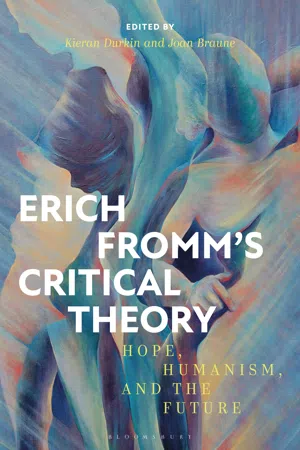
eBook - ePub
Erich Fromm's Critical Theory
Hope, Humanism, and the Future
- 248 pages
- English
- ePUB (mobile friendly)
- Available on iOS & Android
eBook - ePub
Erich Fromm's Critical Theory
Hope, Humanism, and the Future
About this book
Information
Part 1
Radical and Prophetic Humanism
Chapter 1
Erich Fromm and the Ontology of Social Relations
Michael J. Thompson
Once central to critical theory was the thesis that critical reflection on social reality was only possible via a capacity to grasp the whole, the social totality, within which the subject and social phenomena occurred. Beginning with Hegel’s dictum in the Phenomenology of Spirit that only the whole was true to Marx’s exhaustive project to demonstrate the coherence of capitalism as a total system, the first generation of critical theorists took this as a basic paradigm of thought from which to develop their own critical projects. At the core of the Hegelian-Marxist structure of thought therefore is the axiomatic premise that we take human beings as essentially associative, social beings. The social totality was therefore seen as a concrete totality of social relations and processes that was constitutive of the development of individuality, consciousness, and reflective capacities. Whether expressed in terms of Hegel’s conception of a sociality of reason via metaphysical relations of interdependence or Marx’s Theses on Feuerbach that maintains the essentially social nature of human activity, a central concept emerges capturing the idea that social-relational structures are active in shaping human life and culture.
Recently, a new generation of critical theorists has taken the concept of social relations in a very different direction. This move toward Kantian and pragmatist themes has meant thinning the conception of human sociality and interdependence. Reconceived as intersubjectivity, or a conception of social relations that stresses cognitive and symbolic forms of interaction, this paradigm shift has all but eclipsed the Hegelian-Marxian structure of thought that was once the infrastructure for critical theory. This new paradigm, heralded by Jürgen Habermas, Karl-Otto Apel, Axel Honneth, Rainer Forst as well as a myriad of others, essentially reduces social relations to cognitive structures of consciousness. Whether it be in linguistic, pragmatic, communicative, or recognitive terms, what unites these neo-idealist theories is the premise that our relations with others are essentially cognitive and affective. What they are not is in any sense ontological with causal powers or in possession of structures and functions that circumscribe them.
The reductive intersubjectivity that characterizes these approaches should be contrasted to what Erich Fromm saw as distinctive about human sociality. For Fromm, our relations with others have an ontological ballast in that they are structures that constitute both our social reality and the psychic structures of the self. The ontological thickness of our relations with others is not meant to be interpreted as some form of communitarianism, but rather in the Marxian sense of a structure of relations that have constitutive force on our social reality. This is in stark contrast to the intersubjectivist-pragmatist approach that currently characterizes critical theory in that relations cannot be simply made and remade via our capacities for communication or recognition. They have a deep embeddedness in the way we have organized our relations with nature as well as the power relations that are inherent in the control over the institutions that reproduce those relations. In this sense, Fromm’s conception of human relations is historical as well as critical. We must be able to discern those forms of relations and relational activity that promote human flourishing—the creative, active, nondestructive, and emancipated manifestation of self that can only thrive and in fact be instantiated by a particular kind of social-relational ontology.
My thesis in this chapter is that Erich Fromm’s work evinces a distinctive way of thinking about the nature of social relations and the ways that these relations possess causal powers over the development of the self as well as the social world more generally. More concretely, I want to argue that Fromm’s conception of critical theory is rooted in a theory of freedom and judgment that takes into account the ontological shape of social relations that have constitutive power over the self and the society as a whole. As I see it, Fromm’s distinctive take on a critical theory of society takes the social ontology of our relational sociality as the primary source of social and personal pathologies. In this sense, he is in line with the evolution of the Hegelian-Marxist paradigm that takes the ontological-material structures of human sociality as having causal powers over the phenomenological and cognitive structures of consciousness and self. Comprehending these relations is central in the sense (i) that they antecede the self and thereby are active in the shaping and contouring of psychological structures and drives of the self; and (ii) that it is only through the overcoming of pathological social forms (i.e., structures of relations) that a more concrete, total reality of freedom be achieved. After pointing to how Fromm unfolds this argument and exploring its implications, I will then explore how Fromm develops a distinctively Marxian conception of freedom as well as an objective ethics that can help reconstruct critical theory as well as a more humane, rational form of critical politics.
Robust and Defective Relations and the Nature of the Self
Fromm is insistent that Marx’s conception of human being contains a crucial dimension lacking in Freudian theory. Whereas Freud saw the individual as self-contained, Marx sees that the nature of human psychology is dynamic, functionally related to the relations in which the individual is embedded: “Marx’s dynamic psychology,” Fromm writes, “is based on the primacy of man’s relatedness to the world, to man, and to nature, in contrast to Freud’s, which is based on the model of an isolated homme machine.”1 Fromm notes in his psychological interpretation of Marx that Marx’s theory of needs and drives is dependent on this sociality. We need our relations to others, to the world and to nature. This need, in turn, provides the basis for our drives: “Man’s ‘drives,’ then, are an expression of a fundamental and specifically human need, the need to be related to man and nature, and of confirming himself in this relatedness.”2
This relatedness is not a merely structural reality; it is also an active one. Fromm’s Marxism is expressed in the notion that our relations with others are not only ontologically prior to us as subjects but also enacted by us through our activities. The essence of any social relation is therefore constituted by practices, by conscious activity. But it is also structured by the patterns of relations shaped by forms of social power as well as norms, values, and functional roles that these patterns of social power exhibit. The relations of parent and child, teacher and student, husband and wife, owner and worker, and so on are not simply reified social scripts that we take on. They are enacted by practices. Our active social relations with others are essential to grasping the ways that pathological forms of character and consciousness emerge. Fromm is adamant that, in contrast to idealist and neo-idealist theses about human social relations that see them as “intersubjective,” we return to Marx’s conc ept of the human being “with his physical and psychic properties, the real man who does not live in a vacuum but in a social context, the man who has to produce in order to live.”3 The kinds of social relations that Fromm points to here are the thick relations of the totality of human sociality. It therefore encompasses intersubjective as well as material, structural, and functional layers of social relations and sociality. It is this that gives causal power to social relations and makes them the primary object of critique and the aim of social transformation.
To say that these relations possess an ontological character means that they are objective in nature and, although not material in nature, they also have the capacity to shape the subject via socialization, which means they also possess a causal power. Relations are therefore real in a distinctively social sense in that they are not the property of our subjectivity alone, but rather of the shared structures that we inhabit, reproduce, and which also shape us. The term “ontological” therefore contains an important difference from material or natural forms of reality in that a social-ontological relation is constituted by human intentions. The very concept of social character, for Fromm, is an example of the way that forms of existential, subjective being is shaped by the nature and structure of social relations. The reification of these relations over time—their stabilization and persistence through different social cohorts—is what gives a society its permanence and coherence. The critical question is how particular societies organize and legitimate the social-ontological structure that is constitutive of their social reality as well as their subjectivity. It is Fromm’s thesis throughout his work that these social-ontological relations can be evaluated based on the kinds of ends that they promote. Defective forms of relations are organized according to ends that are non-fulfilling in terms of the human potentialities or powers (potencies) that can be developed by any agent. Human beings should be conceived as ontological as opposed to natural insofar as what powers they can realize are dependent on the social-relational structures that shape and form them.
Socialization is the process whereby the structures, and the norms and values that undergird them, of the predominant society are absorbed by each individual within the community. Of course, this process is always insecure in that each person may not take to the absorption of the norms, resulting in neuroses or other forms of “pathological” behavior. But what Fromm sees as crucial is that the dialectic between the innate drives of the individual and the mediating powers of socialization produce our social being. These “drives,” Fromm argues, “are an expression of a fundamental and specifically human need to be related to man and nature, and of confirming himself in this relatedness.”4 The nature of our social being is therefore a product of the ways that these relations are able to enhance our real needs rather than the artificial needs that the predominant reality principles both defines for us and organizes our drives to seek.5 The problem is that, drawing from Marx, Fromm sees that true human needs are to be understood as a particular kind of active-relational life. As Fromm notes,
Marx’s concept of socialism is a protest, as is all existentialist philosophy, against the alienation of man; if, as Aldous Huxley put it, “our present economic, social and international arrangements are based, in large measure, upon organized lovelessness,” then Marx’s socialism is a protest against this very lovelessness, against his exploitiveness toward nature, the wasting of our natural resources at the expense of the majority of men today, and more so of the generations to come. The unalienated man, who is the goal of socialism as we have shown before, is the man who does not “dominate” nature, but who becomes one with it, who is alive and responsive toward objects, so that objects come to life for him.6
Relations are therefore not only between human beings but between humans and nature. Alienation—seen as those forms of life that actively negate healthy relations and states—is the product of defective relations in that they root within us artificial needs and drives: drives to power, dominance, exploitation, and destructiveness. The pathological origins of these kinds of character structure are therefore traced back to the structure of the relational nexus of society.
It is important to emphasize that social character is distinct from individual character. It is the social character that must be shaped and organized by the functional imperatives of society;...
Table of contents
- Cover
- Half-Title
- Series
- Title
- Contents
- Acknowledgments
- Introduction: Mapping Fromm’s Critical Theory
- Part I Radical and Prophetic Humanism
- Part II Social and Psychological Aspects
- Part III Authoritarianism, Fascism, and the Contested Future
- List of Contributors
- Index
- Copyright
Trusted by 375,005 students
Access to over 1.5 million titles for a fair monthly price.
Study more efficiently using our study tools.
Frequently asked questions
Yes, you can cancel anytime from the Subscription tab in your account settings on the Perlego website. Your subscription will stay active until the end of your current billing period. Learn how to cancel your subscription
No, books cannot be downloaded as external files, such as PDFs, for use outside of Perlego. However, you can download books within the Perlego app for offline reading on mobile or tablet. Learn how to download books offline
Perlego offers two plans: Essential and Complete
- Essential is ideal for learners and professionals who enjoy exploring a wide range of subjects. Access the Essential Library with 800,000+ trusted titles and best-sellers across business, personal growth, and the humanities. Includes unlimited reading time and Standard Read Aloud voice.
- Complete: Perfect for advanced learners and researchers needing full, unrestricted access. Unlock 1.5M+ books across hundreds of subjects, including academic and specialized titles. The Complete Plan also includes advanced features like Premium Read Aloud and Research Assistant.
We are an online textbook subscription service, where you can get access to an entire online library for less than the price of a single book per month. With over 1.5 million books across 990+ topics, we’ve got you covered! Learn about our mission
Look out for the read-aloud symbol on your next book to see if you can listen to it. The read-aloud tool reads text aloud for you, highlighting the text as it is being read. You can pause it, speed it up and slow it down. Learn more about Read Aloud
Yes! You can use the Perlego app on both iOS and Android devices to read anytime, anywhere — even offline. Perfect for commutes or when you’re on the go.
Please note we cannot support devices running on iOS 13 and Android 7 or earlier. Learn more about using the app
Please note we cannot support devices running on iOS 13 and Android 7 or earlier. Learn more about using the app
Yes, you can access Erich Fromm's Critical Theory by Kieran Durkin, Joan Braune, Kieran Durkin,Joan Braune in PDF and/or ePUB format, as well as other popular books in Philosophie & Kritische Theorie. We have over 1.5 million books available in our catalogue for you to explore.