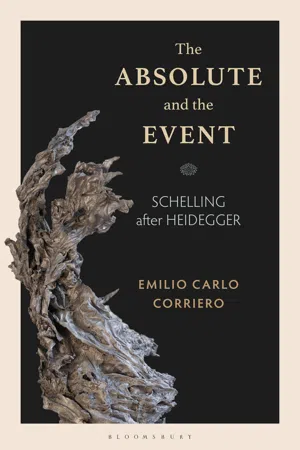
What does Heidegger's controversial notion of the Event mean? Can it be read as an historical prophecy connected to his political affinity with Nazism? And what has this concept to do with the possibility of a new beginning for Western philosophy after Schelling and Nietzsche?
This book highlights the theoretical affinity between the results of Schelling's speculations and Heidegger's later theories. Heidegger dedicated a seminar to Schelling's Philosophical Investigations into the Essence of Human Freedom in 1927-28, immediately after the publication of his Sein und Zeit. He then returned to this work during the courses he taught in 1936 and again in 1941, with lectures dedicated to the Metaphysics of German Idealism. Heidegger's introduction of the Event is reminiscent of Schelling's effort to think of "being" in its organic connection to time, and is such a new form of Schelling's positive philosophy.
Thanks to a concept of being intimately linked to that of time, these latter of Heidegger's theories culminate in a form of positive, historical philosophy as well as with a definition of a post-metaphysical Absolute that, in close connection with primal Nothingness, is beyond any form of onto-theology. It also reveals close connections to Nietzsche's introduction of the eternal recurrence, which rethinks being as a never-ending becoming.
- 192 pages
- English
- ePUB (mobile friendly)
- Available on iOS & Android
eBook - ePub
About this book
Information
1
A new beginning for Western philosophy
The juxtaposition of Nietzsche’s and Schelling’s theories, in addition to being an interesting subject for historical-philological investigation aimed at establishing the former’s possible knowledge of Schelling’s philosophy, and thus quashing the belief that Nietzsche’s opinion of the philosopher from Leonberg can simply be traced back to a generically negative assessment of German Idealism as a whole, is also and above all a theoretical axis around which it is possible to reconstruct an itinerary of thought that culminates in both the explosion of the crisis of the philosophical-rational project of Modernity and its possible overcoming.
In particular, I believe that a philological treatment aimed at showing how much of Schelling’s thought Nietzsche may have encountered, and through which channels, together with the illustration of common readings that directed the two authors towards similar theoretical perspectives, can help to highlight reasons for a theoretical affinity, which explodes at the height of the crisis of modern rationalism, presenting itself, in my opinion, as a successful philosophical combination capable, among other things, of shaping the contemporary debate and suggesting possible ways out of the postmodern nihilistic drift.
The philosophical affinity between Schelling and Nietzsche as revealed in the twentieth century in particular by theorists such as Karl Jaspers, Martin Heidegger and Karl Löwith is essentially summarized in the fact that, before the conceptual non-deducibility of the being, inasmuch as it simply exists, both philosophers identify the correspondence of the original being (inexhaustible and unprethinkable, not yet mediated by the intellect and indeed never completely consummatum within the concepts of reason) with the a-rational sphere of pure will: a sphere that exceeds (and precedes) rational unifications. Supposing pure will (without representation) as this origin and impossible grounding of being, Schelling and Nietzsche arrive – albeit along different paths – at a mutual failure that testifies to the fragility of the philosophical project of Modernity and the precariousness of its false unifications, made possible only by the claim that the ratio is an ‘exclusive court’ that judges the essential determination of being and that is able to solve within its concepts the totality of reality.
However, Schelling’s and Nietzsche’s critical phases do not culminate – as Heidegger would have it – in a sort of ‘metaphysics of the will’ that finally yields to irrationalism. In the ontological excess identified by the two philosophers and described (provisionally) as pure will, absolute Freedom breaks through as an inexhaustible source of being and as the ‘impossible’ grounding of a dynamic ontology, that is, of a form of ‘ontology of freedom’ which, going beyond the boundaries of onto-theology, recognizes in freedom itself (precisely because it is an inexhaustible source of being) its intimate essential affinity with the dynamic-real ‘natural’ ambit which, in a dialectical relationship with the Nothing of the Beginning, precedes any form of being.
1 History of an idea
In reconstructing the theoretical relationship between our authors, it is certainly not possible to resort to explicit quotations from Nietzsche: his references to Schelling are, in fact, relatively few and consist mostly in general evaluations of the Romantic era. However, believing that this meant that Nietzsche did not know Schelling’s work and that therefore it could not have influenced his philosophy, means coming to a rather hasty evaluation which does not take into account Nietzsche’s cultural education nor the development of his method of philosophical production.
Although the theoretical affinity recorded between Schelling and Nietzsche takes on a certain theoretical depth, worthy of investigation, in authors such as Jaspers, Heidegger, Löwith, Schulz and (even if in a negative way) Lukács, who do not refer directly to a philological link between the two philosophers but merely underline the common aspects present in their respective critical phases of thinking, it is worthwhile in my opinion to verify the possible philological links since they probably conceal a privileged route to a hermeneutic understanding of the relationship and its possible results.
1.1 A historical-philological link
It is well known that Nietzsche knew at least in general terms the early Schelling, in particular Ideas for a Philosophy of Nature (1797) and System of Transcendental Idealism (1800). This can be deduced already from the notes that Nietzsche collected in 1868 for a dissertation that was ‘partly philosophical and partly scientific on the concept of organic, starting with Kant’ but which never saw the light of day and where Schelling’s two titles appear in the references. However, it is also known that the affinity revealed by theorists such as Jaspers and Heidegger, through the attestation of a mutual failure which highlights the fragility and criticality of the philosophical-rational project of Modernity, presupposes some knowledge on the part of Nietzsche of the philosophy of Freedom and in particular of the results of Shelling’s later philosophy (Spätphilosophie).
In addition, the work by Otto Kein, Das Apollinische und das Dionysische bei Nietzsche und Schelling (The Apollonian and Dionysian in Nietzsche and Schelling), published in Berlin in 1935, marks the beginning of studies on this suggestive philosophical bond, which takes into consideration Schelling’s reflections on mythology in his later speculations. In drawing a parallel with the mythological figures of Apollo and Dionysus within their respective philosophical paths, Kein does not, however, intend to establish a direct dependence on Schelling’s figures of mythology within Nietzsche’s approach, but rather to underline a continuity and a common ‘romantic’ mood (Stimmung) at the basis of their affinity. The reading of Herder’s reflections on mythology, the knowledge and use of Creuzer’s work (which certainly goes beyond romantic theses on the subject, and goes in the very direction preferred by both Schelling and Nietzsche) or of A.W. Schlegel’s Vorlesungen über schöne Literatur und Kunst (Lectures on Dramatic Art and Literature), without forgetting the common interest in his brother Friedrich’s work (who was, among other things, the first to use the contrast between Apollo and Dionysius), Schelling’s philosophical friendship with Hölderlin and Nietzsche’s veneration of the poet from Tübingen, are simply examples of a cultural affinity, whic h, however, do not fully explain the comparisons that have emerged over the years between two of the greatest contemporary philosophers.
It was Manfred Frank who stressed the incontrovertible affinity between Schelling and Nietzsche with regard to the figure of Dionysus. However, unlike Kein, in his books Der kommende Gott (The Coming God) (1982) and Gott im Exil (God in Exile) (1988) he did not limit himself to underlining the points in common, but rather he wanted to demonstrate the direct ‘dependence’ of Nietzsche’s ‘dionysology’ on Schelling’s definition of the philosophy of Mythology: a ‘dependence’ (Abbängigkeit) on the part of Nietzsche with respect to Schelling’s interpretation that directly concerned the triadic figure of Dionysus and the doctrine of the Eleusinian Mysteries. The particular position of Zagreus, Bacchus and Iacchus (reunited to epitomize the doctrine of the Mysteries) and the general reference to the figure of Demeter, as the mother of Iacchus, just as they appear in paragraph 10 of Geburt der Tragödie (The Birth of Tragedy), leaves little room for doubt, according to Frank, about Nietzsche’s direct knowledge of Schelling’s ‘dionysology’.
The passages that Frank emphasizes to highlight Nietzsche’s use of Schelling’s theses all belong to his Spätphilosophie, in clear contrast to the most widespread theory according to which Nietzsche knew, at most, some works by Schelling belonging to the early years but none of his subsequent philosophical developments. The idea apparent in Frank’s work is that Nietzsche had learned about Schelling’s theses on the myth of Dionysus first from Bachofen, his colleague in Basel and Schelling’s pupil, and secondly from Burckhardt. It is, in fact, well known that Burckhardt attended Schelling’s Berlin lectures in 1841–2 and therefore would have heard Schelling’s mythological-Christological claims. It is difficult to imagine that Nietzsche never discussed with these illustrious colleagues a figure like Schelling and the latter’s position on the myth of Dionysus, an issue that so impassioned Nietzsche, especially since while writing Geburt Nietzsche had borrowed Bachofen’s Gräbersymbolik (Tomb Symbolism) several times and, thanks to Overbeck, had developed a friendship with Burckhardt.
The centrality of the figure of Dionysus in Nietzsche’s philosophy is not, however, doubted when tracing points in common with the later Schelling, as this aspect is relatively marginal when not associated with the overall theoretical approach and therefore with the passage from negative philosophy to positive philosophy. The common reference to Dionysus must certainly be read as a mythical exemplification of the crisis of Modernity and of its possible overcoming, but above all it must be read in dialectical continuity with the doctrine of Christianity: if for Schelling Dionysus is a central figure within his positive philosophy, essentially representing the link in the transition from Mythology to Revelation, then for Nietzsche Dionysus is in contrast with the apostle Paul’s reading of Christ and constitutes the tension towards the ‘new beginning’ represented by the semper adveniens Übermensch. Both unite the gods of Zagreus, Bacchus and Iacchus into a single deity, as stages of a theogonic process that will have a new beginning in the adveniens Dionysus, Iacchus. Both Schelling and Nietzsche insist on the figure of the third Dionysus as a precursor to the future beginning, represented in Schelling by Jesus and in Nietzsche by the Übermensch, however, they do not fall within the ‘modern’ perspective where value is given by the novum, because the new beginning promised by Dionysus goes beyond the ‘history of being’, beyond any project of universal history.
Although already in Philosophical Investigations into the Essence of Human Freedom there are themes that decisively resurface in Nietzsche1 and which anticipate the subsequent distinction between a negative philosophy and a positive philosophy, we know that in Nietzsche’s official library there is no trace of any books by Schelling and that in the University of Basel’s library records, where Nietzsche’s interest in Dionysus essentially began, there is no mention of Nietzsche borrowing any of his works. Demonstration of direct influence is therefore rather complex.
It is worth noting, however, that by Nietzsches Archiv’s own admission, Max Oehlers’ Nietzsches Bibliothek (Weimar, 1942), which aimed to list the texts present in Nietzsche’s personal library, appears to be significantly incomplete. Even the most recent studies on Nietzsche’s books2 remain inevitably incomplete in this regard, and there is the possibility that Nietzsche may have seen some of Schelling’s work, for example, at his friend Franz Overbeck’s father-in-law’s house, where, as can be seen from ...
Table of contents
- Cover
- Half-Title
- Series
- Dedication
- Title
- Contents
- Acknowledgements
- Introduction
- 1 A new beginning for Western philosophy
- 2 Heidegger’s reading of Schelling
- 3 The unyielding excess of Being
- 4 The positive beyond the presence
- 5 Being that can (make happen) Being
- Notes
- Bibliography
- Index
- Copyright
Trusted by 375,005 students
Access to over 1.5 million titles for a fair monthly price.
Study more efficiently using our study tools.
Frequently asked questions
Yes, you can cancel anytime from the Subscription tab in your account settings on the Perlego website. Your subscription will stay active until the end of your current billing period. Learn how to cancel your subscription
No, books cannot be downloaded as external files, such as PDFs, for use outside of Perlego. However, you can download books within the Perlego app for offline reading on mobile or tablet. Learn how to download books offline
Perlego offers two plans: Essential and Complete
- Essential is ideal for learners and professionals who enjoy exploring a wide range of subjects. Access the Essential Library with 800,000+ trusted titles and best-sellers across business, personal growth, and the humanities. Includes unlimited reading time and Standard Read Aloud voice.
- Complete: Perfect for advanced learners and researchers needing full, unrestricted access. Unlock 1.5M+ books across hundreds of subjects, including academic and specialized titles. The Complete Plan also includes advanced features like Premium Read Aloud and Research Assistant.
We are an online textbook subscription service, where you can get access to an entire online library for less than the price of a single book per month. With over 1.5 million books across 990+ topics, we’ve got you covered! Learn about our mission
Look out for the read-aloud symbol on your next book to see if you can listen to it. The read-aloud tool reads text aloud for you, highlighting the text as it is being read. You can pause it, speed it up and slow it down. Learn more about Read Aloud
Yes! You can use the Perlego app on both iOS and Android devices to read anytime, anywhere — even offline. Perfect for commutes or when you’re on the go.
Please note we cannot support devices running on iOS 13 and Android 7 or earlier. Learn more about using the app
Please note we cannot support devices running on iOS 13 and Android 7 or earlier. Learn more about using the app
Yes, you can access The Absolute and the Event by Emilio Carlo Corriero in PDF and/or ePUB format, as well as other popular books in Philosophy & Phenomenology in Philosophy. We have over 1.5 million books available in our catalogue for you to explore.