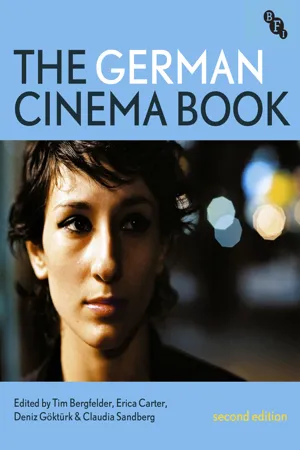
This comprehensively revised, updated and significantly extended edition introduces German film history from its beginnings to the present day, covering key periods and movements including early and silent cinema, Weimar cinema, Nazi cinema, the New German Cinema, the Berlin School, the cinema of migration, and moving images in the digital era. Contributions by leading international scholars are grouped into sections that focus on genre; stars; authorship; film production, distribution and exhibition; theory and politics, including women's and queer cinema; and transnational connections. Spotlight articles within each section offer key case studies, including of individual films that illuminate larger histories ( Heimat, Downfall, The Lives of Others, The Edge of Heaven and many more); stars from Ossi Oswalda and Hans Albers, to Hanna Schygulla and Nina Hoss; directors including F.W. Murnau, Walter Ruttmann, Wim Wenders and Helke Sander; and film theorists including Siegfried Kracauer and Béla Balázs. The volume provides a methodological template for the study of a national cinema in a transnational horizon.
eBook - ePub
The German Cinema Book
- 624 pages
- English
- ePUB (mobile friendly)
- Available on iOS & Android
eBook - ePub
The German Cinema Book
About this book
Information
PART 1
GENRE
INTRODUCTION
Tim Bergfelder
In the first edition of The German Cinema Book, this opening section was called “Popular Cinema.” The purpose of placing this term so prominently at the forefront of the volume was to draw attention to an area of study we felt was neglected and/or unjustly maligned. Nearly two decades later, and in the wake of substantial publications on numerous aspects of popular forms,1 an explicit championing of the “popular” seems no longer as necessary or urgent. Crucially, as many (new and old) contributions in this section, but also a number of other recent publications, recognize, a clear-cut division between popular and art cinema is often difficult to justify, given their frequent overlaps and interdependencies.2 Thus Johannes von Moltke discusses the New German anti-Heimat film of the 1970s as simultaneously rejecting and still drawing on the genre’s conventions; Jan-Christopher Horak describes how modernism and popular traditions in regional culture coalesce in the work of comedians such as Karl Valentin and Herbert Achternbusch; and Tim Bergfelder equally charts the adoption of generic conventions and iconography of lowbrow sources into the work of modernist playwrights, painters, and film directors. Indeed one should not forget that many of the most esteemed auteurs of the Weimar period worked with explicitly lowbrow sources: witness the productive and only superficially incongruous collaboration of Fritz Lang and the pulp novelist and screenwriter Thea von Harbou, resulting in films that straddle generic and artistic boundaries, as in the case of Lang’s M (1931, discussed here by Todd Herzog).3
Throughout the twentieth century and beyond, German cinema has shared with most other film cultures a tradition of diverse genres, whose continuous as well as prolific production dates back to the earliest days of cinema. However, unlike in the contexts of British or Hollywood cinema, where homegrown genres have frequently been celebrated both by critics and audiences at large as a legitimate and fondly cherished expression of national culture, in German cinema there have often been sharp boundaries between a critical orthodoxy for which the very term “popular” is suspect (hence what Jan-Christopher Horak terms in his chapter the “bias against genre”), and a national audience that shows a remarkable enthusiasm for, and loyalty to, German genre traditions.
At the same time, certain forms of popular German cinema have often been ill-equipped to meet expectations from outside Germany, partly because of established perceptions of what German cinema should and should not be, and partly owing to national differences in popular traditions (buttressed by specific cultural contexts and references) that do make some genres less amenable to travel abroad. Hence the often limited distribution and success of popular German films beyond the domestic market; witness in particular, as Horak’s contribution in this section documents, the long-standing hostility toward, and incomprehension of, German comedy among foreign critics and audiences. Nevertheless, other genres and films have conformed better to established expectations about Germany from the outside. In the new millennium war-themed films such as Der Untergang (Downfall, 2004), or historical dramas depicting life in the shadow of totalitarianism such as Das Leben der Anderen (The Lives of Others, 2006) have proved extraordinarily successful both as cultural exports and in their appeal to domestic audiences. Jennifer Kapczynski’s chapter demonstrates how this success builds on decades of generic precedents and continuities from the Wilhelmine period to the unified Germany of the present, and in more recent decades has expanded into television, exemplified by the phenomenally successful wartime family TV drama series Unsere Mütter, unsere Väter (Generation War, 2013).
Looking at the output of the German film industry over the last century, one finds many genres familiar from Hollywood and elsewhere: alongside war films and comedies, there are musicals, melodramas, crime thrillers, historical epics, westerns, horror films, and science fiction, to name but a few. There are also a number of often temporary genres for which one cannot determine an exact foreign equivalent, such as the post-First World War Aufklärungsfilm (sex education melodramas, providing often lurid, yet sometimes progressive exposés on issues such homosexuality and prostitution); the “mountain film” (Bergfilm) of the 1920s and early 1930s; “Doctors’ films” (a melodrama subgenre particularly popular in the 1940s and 1950s), or the post-Second World War “rubble” cycle that comprised existentialist and highly stylized dramas set against urban ruins (for an interesting hybrid between the rubble film and a children’s film, see Horst Claus’s study of Irgendwo in Berlin).4 Finally, there is one genre that appears in its iconography to be exclusively defined, indeed overdetermined, by its Germanness, the Heimatfilm, a genre that spans the entire history of German cinema in many permutations, which transcend not only different historical periods but also the boundaries between the “popular” and auteurist art cinema, as the Heimat or anti-Heimat productions by filmmakers such as Rainer Werner Fassbinder, Herbert Achternbusch, or Edgar Reitz attest to (see von Moltke’s discussion of Reitz’s Heimat).
One could be tempted to divide this plethora of different genres according to their perceived national specificity, which might locate the Heimatfilm with its iconic German locations and themes at one end of the spectrum, and the West and East German variants of the western in the 1960s (with their obvious reference to, but “faked” representation of, the American Wild West) at the other. On closer inspection though, such rigid classifications are difficult to maintain. For example, while exploring the Heimatfilm in his chapter in this part of the volume, von Moltke argues that this genre is at its core as concerned with wider, and often supranational, constructions of modernity as other spatial genres elsewhere, such as the Hollywood western, film noir, or the British “heritage” film. This argument not only allows von Moltke to establish illuminating connections and similarities beyond national specificity but also to draw productively on an Anglophone critical tradition of genre analysis that eschews the ideology critique traditionally associated with evaluations of the Heimatfilm.
Conversely, a closer study of the German western reveals a genre inflected both by national discourses and international influences that is far from being just an inauthentic version of the superior Hollywood original. As Deniz Göktürk has shown, the earliest German westerns in the 1910s evolved in parallel to the development of their US counterpart.5 They drew in equal part on Hollywood iconography, and on German literary and filmic narratives about America that predate the conventionalization of the Hollywood western as a genre, and which reflected on the social and psychological repercussions of German mass emigration to America during the nineteenth and early twentieth centuries. Thus, the focus in the early German western is frequently to explore the dichotomies of “home” and “abroad,” mapped onto the transatlantic division between European/German traditions and national roots and American modernity, cosmopolitanism, and uprootedness. The later German westerns in both West and East Germany in the 1960s, too, articulate their very specific takes on the genre, in the former case in a negotiation of an increasingly global and consumer-oriented society of spectacle and tourism, in the latter in an anti-imperialist revision of the American frontier myth (see Jon Raundalen’s spotlight).6
What this suggests is that rather than being, as has often been claimed, exclusively parochial and introspective, German genres and their audiences have frequently engaged in an active dialogue with other cultures and global concerns. This is perhaps not surprising given the international diversity of, and particularly the presence of Hollywood in, the German film market. In any event, a critical exploration of German cinema’s dialogic dimension emerges as a far more productive approach to German genres than the presumption of stable national characteristics. Indeed a number of contributors to this section analyze their generic case studies through an investigation of both their cultural and historical specificity (which includes an acknowledgment of both dominant and marginal cultural groups and discourses), and their relationship to international contexts.
Jan-Christopher Horak points out that while German comedy may not have been successful with foreign audiences, the imprint that German-Jewish exiles such as Ernst Lubitsch, Billy Wilder, and Henry Koster have left on Hollywood, and on international conventions of film comedy, has been immense. Horak locates the American success of such directors (and the renaissance of their work in Germany since the late 1960s) in a shared legacy of German-Jewish comedy, which demonstrates that the cultural exchange between German and international cinema can be reciprocal. Tim Bergfelder’s contribution on the developments of the German crime film also charts a cross-cultural discourse that allowed German audiences to negotiate conceptions of national belonging through an engagement and identification with an imagined cultural other, at a time when the very idea of national identity was in question. However, while transnational perspectives expand our understanding of generic flows and adaptations, it is still important to recognize that popular genres and their circulation sometimes also follow more unique pathways in particular national contexts, as the trajectories of figures such as Reinhold Schünzel, Kurt Hoffmann, and Michael “Bully” Herbig, or industrial stalwarts such as Gloria’s Ilse Kubaschewski illustrate.
Another emphasis that runs through many of the contributions in Part 1 is the importance accorded to popular cinema’s intertextual connections with, and indebtedness to, other media. Thus, von Moltke traces the Heimat genre from its late nineteenth-century origins in novels by bestselling authors such as Ludwig Ganghofer and Ludwig Anzengruber, to its subsequent incarnation on television. Horak’s contribution determines the dual influence of working-class Jewish stage farces and regional, especially Bavarian, folk theatre as crucial for the conventionalization of German film comedy. Bergfelder sees the development of the German crime film as inseparably intertwined with the industrial and promotional strategies of mass publishing, which fostered a cross-fertilization of different art forms and media, but also, especially in recent decades, with the interdependence between film and television. Kapczynski’s chapter and her study of Unsere Mütter, unsere Väter also charts a trajectory from film to television.
Reframing Part 1 under the broader umbrella of “genre,” finally, allows to reflect on generic codes and hierarchies that lie beyond the parameters of the commercial film industry, such as the diverse intersections of social realism and melodrama in the films produced by DEFA in the company’s forty years of existence, or the unique achievements of GDR documentary, illustrated in Part 4 by a spotlight on Helke Misselwitz. The DEFA films from the late 1980s discussed in Annie Ring’s chapter in Part 5 and the case study of Jahrgang ’45 in Part 4 can also be read as poignant examples of genres precisely because of their untimeliness and their failure as “popular” or “successful” films. They provide a necessary corrective to the assumption that history only proceeds in smooth continuities and generic repetitions, and instead they draw attention to ruptures, discontinuities, and dead ends.
NOTES
1. See, for example, Randall Halle and Margaret McCarthy (eds.), Light Motives: German Popular Films in Perspective (Detroit: Wayne State University Press, 2003); Jaimey Fisher (ed.), Generic Histories of German Cinema: Genre and Its Deviations (Rochester, NY: Camden House, 2013).
2. See, for example, John Davidson and Sabine Hake (eds.), Framing The Fifties: Cinema in a Divided Germany (Oxford: Berghahn, 2007); Hester Baer, Dismantling The Dream Factory: Gender, German Cinema and the Postwar Quest for a New Film Language (Oxford: Berghahn, 2009).
3. Reinhold Keiner, Thea von Harbou und der deutsche Film bis 1933 (Hildesheim: Olms, 1991).
4. See, for example, Robert Shandley, Rubble Films: German Cinema in the Shadows of the Third Reich (Philadelphia, P...
Table of contents
- Cover
- Halftitle Page
- Title Page
- Contents
- List of Figures
- Notes on Contributors
- Acknowledgments
- Introduction
- Part 1 Genre
- Part 2 Stars
- Part 3 Authorship
- Part 4 Film Production and Circulation: Institutions and Sites
- Part 5 Theory, Memory, Counter-Cinema
- Part 6 Transnational Connections
- Glossary
- Bibliography
- Index
- Imprint
Trusted by 375,005 students
Access to over 1.5 million titles for a fair monthly price.
Study more efficiently using our study tools.
Frequently asked questions
Yes, you can cancel anytime from the Subscription tab in your account settings on the Perlego website. Your subscription will stay active until the end of your current billing period. Learn how to cancel your subscription
No, books cannot be downloaded as external files, such as PDFs, for use outside of Perlego. However, you can download books within the Perlego app for offline reading on mobile or tablet. Learn how to download books offline
Perlego offers two plans: Essential and Complete
- Essential is ideal for learners and professionals who enjoy exploring a wide range of subjects. Access the Essential Library with 800,000+ trusted titles and best-sellers across business, personal growth, and the humanities. Includes unlimited reading time and Standard Read Aloud voice.
- Complete: Perfect for advanced learners and researchers needing full, unrestricted access. Unlock 1.5M+ books across hundreds of subjects, including academic and specialized titles. The Complete Plan also includes advanced features like Premium Read Aloud and Research Assistant.
We are an online textbook subscription service, where you can get access to an entire online library for less than the price of a single book per month. With over 1.5 million books across 990+ topics, we’ve got you covered! Learn about our mission
Look out for the read-aloud symbol on your next book to see if you can listen to it. The read-aloud tool reads text aloud for you, highlighting the text as it is being read. You can pause it, speed it up and slow it down. Learn more about Read Aloud
Yes! You can use the Perlego app on both iOS and Android devices to read anytime, anywhere — even offline. Perfect for commutes or when you’re on the go.
Please note we cannot support devices running on iOS 13 and Android 7 or earlier. Learn more about using the app
Please note we cannot support devices running on iOS 13 and Android 7 or earlier. Learn more about using the app
Yes, you can access The German Cinema Book by Tim Bergfelder, Erica Carter, Deniz Göktürk, Claudia Sandberg, Tim Bergfelder,Erica Carter,Deniz Göktürk,Claudia Sandberg in PDF and/or ePUB format, as well as other popular books in Media & Performing Arts & Film & Video. We have over 1.5 million books available in our catalogue for you to explore.