- 440 pages
- English
- ePUB (mobile friendly)
- Available on iOS & Android
eBook - ePub
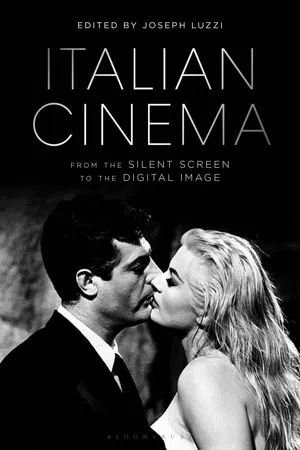
Italian Cinema from the Silent Screen to the Digital Image
About this book
In this comprehensive guide, some of the world's leading scholars consider the issues, films, and filmmakers that have given Italian cinema its enduring appeal. Readers will explore the work of such directors as Federico Fellini, Michelangelo Antonioni, and Roberto Rossellini as well as a host of subjects including the Italian silent screen, the political influence of Fascism on the movies, lesser known genres such as the giallo (horror film) and Spaghetti Western, and the role of women in the Italian film industry. Italian Cinema from the Silent Screen to the Digital Image explores recent developments in cinema studies such as digital performance, the role of media and the Internet, neuroscience in film criticism, and the increased role that immigrants are playing in the nation's cinema.
Information
PART ONE
Periods and Movements
1
Italian Silent Film
Antonio Costa
For a long time in Italy, little was done to deepen and spread the knowledge of silent film. Italians have neglected to set a serious policy for the recovery, conservation, and restoration of the film heritage from that era. In general, film critics seem more focused on interpretive issues, discussing, say, how Giovanni Pastrone’s Cabiria (1914) influenced D. W. Griffith’s Intolerance (1916). And while much has been written on how neorealism was anticipated by such works as Nino Martoglio’s Sperduti nel buio (Lost in the Dark, 1914) or Gustavo Serena’s Assunta Spina (1915), the original copies of those films have been lost. Fortunately, the situation has changed in recent decades. Film libraries and major festivals have done great recovery work on lost or forgotten films, or on films that are now close to disappearing.1 The possibility of viewing under optimal conditions many works that had long fallen out of historical memory now enables us to revisit long-held critical clichés. The bibliography on Italian silent film has become truly impressive, and at the same time there are various editions of silent films on restored versions in DVD format.
1 The Invention of Italian Cinema
Italian cinema was born in Rome, one evening in the late summer of 1905. On September 20, the thirty-fifth anniversary of the Breach of Porta Pia, the military capture of Rome and a decisive event in the decadelong process of Italian unification known as the Risorgimento. Filoteo Alberini, cofounder and artistic director of the Primo Stabilimento di Manifattura Cinematografica Alberini and Santoni, had the idea of projecting his first film, La presa di Roma (The Capture of Rome), on a large screen set up at the site where soldiers had entered the Papal State, forcing Pope Pius IX to surrender.2 In the very place where the final event of the Risorgimento took place, the film commemorating it was shown. Cinema, which was then still considered a vaudeville sideshow, thus evolved into an instrument capable of capturing an episode that had produced lacerations in the social conscience. Although the Porta Pia breach evoked “memories of an outrage” for the church, for the Italian state it was “a sign of victory.”3 Italian cinema was born, therefore, as a public event that called into question historical memory, social conscience, and opposing passions that were lived in a collective dimension, in the “public square.”4
Many of the hallmarks of Italian cinema, which would gather momentum over time, were present in this inaugural event, from its technical means of production to its mix of public ritual, scenic installation, and publicity stunt. In the wake of this “media event” that the historian Aldo Bernardini (Cinema muto, 26) defined as the true masterpiece of Alberini, his production company realized that they were on to something. The following year, thanks to new financial contributions, the company became a joint stock venture called Cines, destined to become one of the most prestigious and enduring brands in the history of Italian cinema. But at the time it was only one of several production companies of the nascent film industry.
2 The Production System
What we can call polycentrism was a characteristic feature of Italian filmmaking in the era of silent film. Unlike what would happen with the centralizing policy of Fascism, which culminated in the creation of Cinecittà in 1937, the Italian film industry’s origins were shaped by the presence of several production centers located in various cities, even small ones, in a kind of productive federalism. This situation would attenuate, if not disappear altogether, in the 1930s. But before then, many cities of differing cultural and economic characteristics contributed to the growth of Italian film: Turin, Naples, Milan, and naturally Rome, but also such smaller urban centers as Genoa and Catania. Yet at the same time this disjointed polycentrism was also a weakness of the Italian economy because of the fragmented nature of the investments held by a myriad of small companies with limited business skills. In the beginning of the century, it was actually Turin, and not Rome, that had the largest film production center, which was aided by the entrepreneurial activism of a city that also developed the first Italian car industry. Fiat was created in Turin in 1899, and its rapid growth would soon intertwine with the rising fortunes of the city’s film industry. If Turin achieved its international success through large, spectacular films that reached their apex with Cabiria in 1914, Naples rose to prominence as a film center with strong regionalist and “vernacular” traits.5 Naples was also the home of Gustavo Lombardo, future founder of the important production company Titanus.6 Cultured and progressive, Lombardo developed a coherent promotion policy for cinema through his magazine Lux and distributed films such as Dante’s Inferno (1911) as well as Futurist works including Vita futurista (Futurist Lifestyle, 1916) by Arnaldo Ginna (now lost) and Thaïs (1917) by Anton Giulio Bragaglia.
3 Birth of the Feature Film and the Epic-historical Genre
The first Italian feature film was Dante’s Inferno, produced by Milano Films and directed by Adolfo Padovan, Francesco Bertolini, and Giuseppe de Liguoro. It was inspired by the first canticle of Dante’s Divine Comedy and had a decisive impact on the artistic and industrial development of Italian cinema. At the very moment it started to undertake complex and challenging productions, the early film industry turned to Dante’s text, a work that was surrounded like no other by an aura of prestige and classicism, while also being deeply rooted in the popular imagination. In the film version of Dante’s Inferno, Italian cinema found an original way to access the themes and iconography of the fantasy genre, imbuing it with a unique civil and political dimension. Dante’s Inferno, which premiered at the Teatro Mercadante in Naples on the fiftieth anniversary of the proclamation of the Kingdom of Italy (1861–1911)—and which was projected in the presence of such prestigious intellectuals as Benedetto Croce and Matilde Serao—ended with an image of the monument to Dante in the city of Trento, then still under Austrian rule. This evocation of Dante’s universe acquired a great political significance: the screening took place on the eve of the outbreak of the First World War, at the end of which would come the annexation of Trento and Trieste to Italy.7
Though it broke away from current productions, Dante’s Inferno had some affinity with the historical costume genre. From Gli ultimi giorni di Pompei (The Last Days of Pompeii), directed by Luigi Maggi in 1908 for Ambrosio Film of Turin and based on the novel by E. G. Bulwer-Lytton, Italian cinema achieved great success abroad, reaching its peak with Cabiria. Other titles that contributed to the great fortune of the epic-historical genre include: L’Odissea (The Odyssey, 1911), Giuseppe de Liguoro’s adaptation of the Homeric epic (Milano Films); La Gerusalemme liberata (Jerusalem Delivered, 1911), a Cines production by Enrico Guazzoni, who also directed Quo vadis? (1913) based on the eponymous novel by Henryk Sienkiewicz; and La caduta di Troia (The Fall of Troy, 1911), an Itala Film production also by Pastrone.
There are various reasons for the good fortune and strategic importance of this popular genre in the development of Italian film. The genre had its roots in a past rife with historical, artistic, and literary riches, traces of which are still evident in the Italian cultural landscape today. The increasing length of films made cinema competitive with the more established media of theater and opera. Moreover, early cinema’s iconographic references, literary sources, and artistic ambitions attracted a large middle- and upper-class audience, which had originally rejected the supposed lowbrow of film spectacle. Filmgoers were seduced by the magnificent scenic innovations, accuracy of the productions, and technical innovations of the historical cinematic blockbusters. Among these films, the most important techniques were the expressive use of light and the systematic use of camera movements that enhanced the impressive scenery and crowd scenes, and which also gave the sequences a rhythmic and spatial organization. Such were the extraordinary artistic and spectacular results of Cabiria, for example, that the film exerted great influence in the United States in scenes like the Babylonian episode of Intolerance by D. W. Griffith in 1916.
In Italy, the epic-historical genre was a rather composite phenomenon. On the one hand, it brought together literary aspects that were exploited with entrepreneurial flair, drawing on the success of a very popular narrative genre. But the epic-historical film also contained an educational and pedagogical intent, as it reflected the basic classics of the Italian school curriculum. So the cinematic historical blockbuster became a kind of experimental laboratory as well as a lucrative cultural product for mass consumption, which undoubtedly explains the involvement of the poet Gabriele D’Annunzio in the making of Cabiria.
4 D’Annunzio and Pirandello
The presence of the larger-tha...
Table of contents
- Cover
- Half-Title
- Dedication
- Title
- Contents
- Chronology
- Introduction
- PART ONE Periods and Movements
- PART TWO Gender, Genre, Theory
- PART THREE Relations and Debates
- PART FOUR Films in Focus
- PART FIVE Behind the Scenes
- Glossary
- Contributors
- Index
- Copyright
Trusted by 375,005 students
Access to over 1.5 million titles for a fair monthly price.
Study more efficiently using our study tools.
Frequently asked questions
Yes, you can cancel anytime from the Subscription tab in your account settings on the Perlego website. Your subscription will stay active until the end of your current billing period. Learn how to cancel your subscription
No, books cannot be downloaded as external files, such as PDFs, for use outside of Perlego. However, you can download books within the Perlego app for offline reading on mobile or tablet. Learn how to download books offline
Perlego offers two plans: Essential and Complete
- Essential is ideal for learners and professionals who enjoy exploring a wide range of subjects. Access the Essential Library with 800,000+ trusted titles and best-sellers across business, personal growth, and the humanities. Includes unlimited reading time and Standard Read Aloud voice.
- Complete: Perfect for advanced learners and researchers needing full, unrestricted access. Unlock 1.5M+ books across hundreds of subjects, including academic and specialized titles. The Complete Plan also includes advanced features like Premium Read Aloud and Research Assistant.
We are an online textbook subscription service, where you can get access to an entire online library for less than the price of a single book per month. With over 1.5 million books across 990+ topics, we’ve got you covered! Learn about our mission
Look out for the read-aloud symbol on your next book to see if you can listen to it. The read-aloud tool reads text aloud for you, highlighting the text as it is being read. You can pause it, speed it up and slow it down. Learn more about Read Aloud
Yes! You can use the Perlego app on both iOS and Android devices to read anytime, anywhere — even offline. Perfect for commutes or when you’re on the go.
Please note we cannot support devices running on iOS 13 and Android 7 or earlier. Learn more about using the app
Please note we cannot support devices running on iOS 13 and Android 7 or earlier. Learn more about using the app
Yes, you can access Italian Cinema from the Silent Screen to the Digital Image by Joseph Luzzi in PDF and/or ePUB format, as well as other popular books in Media & Performing Arts & Film & Video. We have over 1.5 million books available in our catalogue for you to explore.