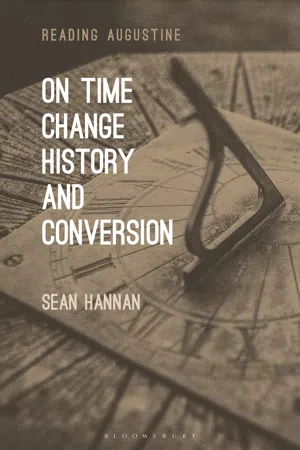
Sean Hannan offers a new interpretation of Augustine of Hippo's approach to temporality by contrasting it with contemporary accounts of time drawn from philosophy, political theology, and popular science. Hannan argues that, rather than offering us a deceptively simple roadmap forward, Augustine asks us to face up to the question of time itself before we take on tasks like transforming ourselves and our world.
Augustine discovered that the disorientation we feel in the face of change is a symptom of a deeper problem: namely, that we cannot truly comprehend time, even while it conditions every facet of our lives. This book puts Augustine into creative conversation with contemporary thinkers, from Pierre Hadot and Giorgio Agamben to Steven Pinker and Stephen Hawking, on questions such as the definition of time, the metaphysics of transformation, and the shape of history. The goal is to learn what Augustine can teach us about the nature of temporality and the possibility of change in this temporal world of ours.
- 176 pages
- English
- ePUB (mobile friendly)
- Available on iOS & Android
eBook - ePub
On Time, Change, History, and Conversion
About this book
Information
1
The Reality of Time
Between Idealism and Materialism
Introduction
In a dialogue published in 2017, the object-oriented ontologist Graham Harman and the neo-materialist Manuel DeLanda cordially clarified the differences between their respective approaches to philosophy. Both are opposed to what they see as widespread acceptance of naïve idealism among thinkers in the contemporary continental tradition. For DeLanda, a robust materialism, rooted in the “projectiles” and “shrapnel” of the late modern battlefield, offers the best rejoinder to these anti-realists. Harman, meanwhile, rejects materialism in favor of a realism rooted in all objects, regardless of the question of their materiality or immateriality (DeLanda and Harman 2017: 3). As the dialogue progresses, it turns out that a number of divergences between these two approaches can be dissolved simply by translating the terminology of object-oriented ontology into that of neo-materialism and vice versa. Even so, real differences do remain. The most divisive dispute emerges only later in the discussion, when Harman and DeLanda discover that they disagree about whether objective existence can be ascribed to time itself.
Setting aside the merits of the anti-idealism espoused by Harman and DeLanda, it must be admitted that, at least in the philosophy of time, even the analytic tradition continues to wrestle with idealism. This is in part due to the long shadow cast by the British idealist J. M. E. McTaggart’s 1908 essay “The Unreality of Time,” the meaning of which continues to be debated. McTaggart, for his part, thought he was clarifying matters by distinguishing between the A-Series (temporal sequence considered in terms of past, present, and future) and the B-Series (temporal sequence considered merely in terms of earlier and later). If both series could be proven to be products of the mind rather than properties of a mind-independent time, then the idealist conclusion would follow: time is unreal. It is this idealizing approach that the new wave of realists seeks to overcome. The question of time, in their view, should be answered not with logical subtleties, but with inescapable realities.
Looking further into the past, we can see that the disagreement between Harman and DeLanda brings us back beyond nineteenth-century British idealism, even to the writings of a fourth-century North African bishop. In Confessions 11, Augustine tackled the problem of time’s being from a perspective informed not just by his Christianity, but also by the developed Platonism he had encountered in the teachings of Plotinus. His response to the paradoxes of temporality would nonetheless prove distinctive. While some interpreters of Augustine have positioned him as a subjectivist or an idealist with regard to time, a close reading of Augustine’s account reveals that he attributes objective reality to the force of time. His central discovery is that time is a distensive force which stretches many things, including the human soul, apart. By rereading Augustine in light of the new realisms of Harman and DeLanda, perhaps we can better appreciate the objective dimensions of his argument, as well as what it might have to offer to contemporary debates about temporality.
Temporal Materialisms
The disagreement between Harman and DeLanda emerges as they confront the confusion caused by their jargon. In order to determine whether or not they agree, the two authors first have to get straight what their words actually mean. Nowhere is this clearer than in the matter of time.
For DeLanda, time is simply time. It is the objective time measured by clocks. It is duration in the plainest sense. It is the unidirectional arrow of time, equally compatible with the physical world of entropy and the martial world of soldiers torn apart by shrapnel, never again brought back to life. For Harman, temporality is not so straightforward. His system ascribes new meaning to the word “time,” which must be understood in light of his fourfold division of the modes of tension that can obtain between objects and their qualities. The system breaks down into four kinds of tension (and here comes the jargon): tension between sensual objects and sensual qualities; tension between real objects and sensual qualities; tension between real objects and real qualities; and tension between sensual objects and real qualities. Each mode of tension corresponds to one of four load-bearing terms: time (SO-SQ), space (RO-SQ), essence (RO-RQ), and eidos (SO-RQ). Harman’s time, following this model, has to do with relations between sensual objects and sensual qualities. It is this association of temporality with the sensual that alarms DeLanda, who suspects it leads down a slippery slope to subjectivism. “Is this real time, as measured by clocks,” asks DeLanda (2017: 122), “or subjectively experienced time?”
Harman’s reply initially lends credence to DeLanda’s worries. “Here I’m speaking about the lived time of experience,” says Harman (2017: 122), adding that “it is the relative endurance of sensual objects amidst a constant shift of adumbrations.” The subjective air of this response risks confusing the situation. “Are you not a realist with respect to time?” prods DeLanda (2017: 122). If time is reduced to a function of the sensual, there may be no room left for the objective duration which seems necessary for any realism worth the name. Harman, of course, disagrees. For him, reducing time to the sensual need not undermine the possibility of physical change, entropy, or any of the objective processes which DeLanda means to protect. All of these, Harman implies, can be categorized under his concept of “space,” which deals with the tension between real objects and sensual qualities, and is therefore capable of preserving succession, alteration, and so on. “What you’re calling real time as measured by a clock belongs, for me, to space,” says Harman (2017: 122), “since it has to do with changes in real objects rather than just sensual experience.” Time, meanwhile, remains framed in terms of a living present. Elsewhere, Harman (2011: 176) writes of the centrality of presentism in object-oriented ontology:
According to the object-oriented model, only the present exists: only objects with their qualities, locked into whatever their duels of the moment might be. In that sense, times seem to be illusory, though not for the usual reason that time is just a fourth spatial dimension always already present from the start. Instead time does not exist simply because only the present ever exists.
The living present of sensual time reminds many readers of subjective interpretations of temporality. Some have even criticized Harman as a philosopher of stasis (Shaviro 2011; Gratton 2013). From DeLanda’s point of view, it seems Harman stumbled into a form of subjectivism at the heart of his objective thinking, which in turn led him to rule objective temporality out of his analysis.
Even in earlier works like Guerrilla Metaphysics, Harman (2005: 248–53) happily conceded he harboured doubts about time as an objective dimension of the cosmos. Here Harman (2017: 124) is more emphatic: “If we consider time as belonging to the real itself, then I guess I’m not a realist about time.” Yet, despite DeLanda’s protests, Harman is not committing himself to subjectivism. As becomes clearer near the end of the dialogue, Harman (2017: 131) finds his refuge in the proposition both authors agree to denote as R7: “The relation of the human subject with the world is not a privileged relation for philosophy.” What R7 allows Harman to do, in the matter of temporality, is preserve the idea of the living present by liberating it from the human subject and projecting it out onto everything that exists. This is to mobilize anthropomorphism in order to overcome anthropocentrism, he suggests. The living present is not just for subjects perceiving phenomena; the living present is the key to the structure of time itself.
As the dialogue ends, DeLanda magnanimously grants most of his interlocutor’s claims. He concedes that proposition R7 helps Harman escape the accusation of subjectivism about time. Nevertheless, he remains suspicious that Harman’s temporality is insufficiently objective. The concern seems to be no longer that this account of time privileges human experience, but rather that material changes taking place in the real world (as DeLanda sees it) demand a temporality closer to objective duration than any “living present” model could allow. And so we arrive at a clarified but still meaningful divergence. Harman offers us a new vantage point on time, which suits his system but demands we shift features long associated with time (e.g., succession) into the category of space. DeLanda, meanwhile, argues for the necessity of taking time as real duration, although he is unable to undermine Harman’s own arguments to the contrary. These are not the only two available positions, however. As we turn to Augustine, we will see that it is possible to hold simultaneously to an objective account of time and a non-presentist account of temporal duration. Harman’s centering of objects is already provocative, but more provocative still would be an account of objective temporality that found itself rooted in the death of the living present.
Time as Distentio
The context for Augustine’s account of an objective, non-presentist temporality is his exegesis of Genesis in Confessions 11–13. Already with the words “in the beginning,” he spies potential confusion. Was this the beginning of time or the beginning of the universe in time? And what is time anyway? Given the importance of time to our workaday existence, it seems the answer should be obvious, though it is not. It feels like we understand time, but, when pressed, we fail to express anything close to a compelling description (CF 11.14.17). Nevertheless, some things have passed away; others are still to come. This arising and passing occur in time. They could also be correlated to the linguistic tenses of past and future. And yet the past and future pose more problems than they solve, since they deal with what is not (either what has passed away or what has yet to arrive) rather than what is. What then about the present? If present time truly is, in a way that past and future are not, must this mean that the present is beyond arising or passing away? Is it pure presence without any vulnerability to time’s passage? If so, the present would be eternity, says Augustine (CF 11.14.17):
In what way, then, “are” those two times, past and future, when the past “is” no longer and the future “is” not yet? The present, moreover, if it were always present and did not pass away into the past, would no longer be time, but eternity. In order that there be time, then, the present is created for this reason: in order to pass over into the past. How, then, can we also say that this present “is,” whose cause for being is that it will not be? That is to say: is it that we cannot say in truth that time “is,” unless because it tends to not-be?1
Arising and passing away reveal to us that there is nothing eternal about our world. For Augustine, eternity amounts to timelessness, and so to posit the present as a quasi-eternity within time would be incoherent and potentially blasphemous (since eternity is proper to God). Our present time, if there is one, would always be in the process of passing away. The present too has become a problem for Augustine.
Yet even if he has stumbled out of the gate in his search for time’s definition, Augustine had to admit that we are always talking about the measurement of time. Some times appear to be short; others strike us as long. But when we speak of short or long times, we are treating time-spans as if they were entities. We are taking “a time” to be long or short. As van Dusen (2014) has argued, Augustine’s language brings us face to face with the flexibility of the Latin tempus, not unlike the English “time.” Both terms could mean: (1) time itself, as the pure passage that we later cut up into tenses of past, present, and future; or (2) a time-span within that overall passage, which we mark out and measure as long or short. Such spans can be as short as a line from a hymn or as long as the circuit of a star. In cases like these, we are talking not about time proper, but rather about our own cognitive measurements of delineated spans of time. Augustine dubs these morae or delays (CF 11.15.19). These spans or delays can only be measured as long or short by way of our memories.
If we look for something like length or shortness in time itself, we come up short. It is only in the soul’s psychological experience of time that we find such measurements. The soul measures these magnitudes neither as solely past nor as solely future, but rather as a kind of duration through which we seem to live in the present. After pointing his readers to the present as the only conceivable site of duration, however, Augustine turns the tables on us, intensifying his critique of the present. He starts by calling attention to the relativism involved in our talk about present spans of time. The present year or month or day or hour, which we might be tempted to call long, can always be whittled down into smaller pasts and futures. Within each minute there are always some seconds that are past and others to come. Even one second harbours within itself ever-more-microscopic past and future spans (CF 11.15.20):
Look at how the present time, which we found to be the only thing that ought to be called “long,” has with difficulty been reduced to the space of one day. But let us break it apart even further. One day is not present as a whole. It is filled out with all twenty-four daytime and night-time hours. The first hour holds the rest as “going-to-be,” the last as “having-passed-away,” and, of course, one of the middle hours would hold those before itself to be past and those after itself to be future. Even an hour itself passes by little bits which flee away. Whatever part of it has flown away is past; whatever remains for it is future.2
If we want to be rigorous about our definition of the present, then we must not allow ourselves lazy locutions that treat as present that which is still divisible into past and future. Augustine draws from this the following consequence (CF 11.15.20):
If we conceive of something temporal which could no longer be divided into little parts of movements: that alone is what could be called “present.” And yet it flies immediately from future to past, so that it is stretched out by not even the smallest pause. For if it is stretched out, it is divided between past and future. But the present has no span.3
If the present is without pause or quasi-spatial extent, it cannot have duration of either the long or short variety. This is in keeping with what Augustine said earlier about the three temporal tenses all collapsing into an abyss of non-being.
Next, however, Augustine reminds us that we nevertheless do “experience intervals of time and compare them with one another”4 (CF 11.16.21). Time-spans are still a part of temporal experience, even though they are not a part of time. It cannot be denied that people never stop talking about past and future things. But Augustine is quick to point out that even when we speak of past or future things as present, we are talking about images of what was or will be, not the things themselves. Past things are mediated to us by images in our memory, future things by images of what we expect or await. Augustine is preparing to work these aspects of the soul into a triadic structure of temporal experience. This is what is usually called his threefold present (CF 11.20.26):
Neither future nor past things are, and it is not correct to say: “there are three times—past, present, and future.” Rather, it would perhaps be more correct to say: “there are three times—the present time concerning what has passed away; the present time concerning what is ‘there;’ and the present time concerning what will be.” These three somethings are in the living soul. I do not see them anywhere else. The present time having to do with past things is memory. The present time having to do with present things is awareness. The present time having to do with future things is expectation.5
The triad of tenses long plaguing Augustine is revealed for what it really is: a categorization of temporal experience, not of time. The scheme of past, present, and future has failed to give us a coherent way of speaking about time proper.
By saying that past, present, and future really pertain only to the ongoing experience of the soul, however, Augustine is not saying that time is identical to the soul. Time was created along with the universe; its passage continues according to God’s wisdom. Nor is he saying that there is no distinction between what has yet to arise and what has already passed away. The flux of creation does not collapse into a quasi-eternity made possible by the soul’s threefold present. On the cont...
Table of contents
- Cover
- Halftitle Page
- Title Page
- Dedication Page
- Contents
- List of Abbreviations
- Introduction
- 1 The Reality of Time: Between Idealism and Materialism
- 2 A Brief Theology of Time: From Creation to the Eschaton
- 3 Enlightenment Never: Eschatology Without Progress
- 4 Do Not Live in the Now: A Critique of Mindfulness
- 5 The Instant of Indecision: Possibility of Personal Change
- 6 The Time Is Not Now: Activism Despite Quietism
- Conclusion: This Life’s Future
- Notes
- References
- Index
- Imprint
Trusted by 375,005 students
Access to over 1.5 million titles for a fair monthly price.
Study more efficiently using our study tools.
Frequently asked questions
Yes, you can cancel anytime from the Subscription tab in your account settings on the Perlego website. Your subscription will stay active until the end of your current billing period. Learn how to cancel your subscription
No, books cannot be downloaded as external files, such as PDFs, for use outside of Perlego. However, you can download books within the Perlego app for offline reading on mobile or tablet. Learn how to download books offline
Perlego offers two plans: Essential and Complete
- Essential is ideal for learners and professionals who enjoy exploring a wide range of subjects. Access the Essential Library with 800,000+ trusted titles and best-sellers across business, personal growth, and the humanities. Includes unlimited reading time and Standard Read Aloud voice.
- Complete: Perfect for advanced learners and researchers needing full, unrestricted access. Unlock 1.5M+ books across hundreds of subjects, including academic and specialized titles. The Complete Plan also includes advanced features like Premium Read Aloud and Research Assistant.
We are an online textbook subscription service, where you can get access to an entire online library for less than the price of a single book per month. With over 1.5 million books across 990+ topics, we’ve got you covered! Learn about our mission
Look out for the read-aloud symbol on your next book to see if you can listen to it. The read-aloud tool reads text aloud for you, highlighting the text as it is being read. You can pause it, speed it up and slow it down. Learn more about Read Aloud
Yes! You can use the Perlego app on both iOS and Android devices to read anytime, anywhere — even offline. Perfect for commutes or when you’re on the go.
Please note we cannot support devices running on iOS 13 and Android 7 or earlier. Learn more about using the app
Please note we cannot support devices running on iOS 13 and Android 7 or earlier. Learn more about using the app
Yes, you can access On Time, Change, History, and Conversion by Sean Hannan in PDF and/or ePUB format, as well as other popular books in Philosophy & Christian Theology. We have over 1.5 million books available in our catalogue for you to explore.