A WIRED 2020 Book of the Year
Object Lessons is a series of short, beautifully designed books about the hidden lives of ordinary things.
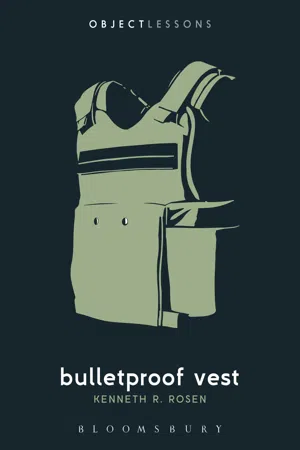
"Nothing's bulletproof," the salesman said. "The thing's only bullet resistant." The New York Times journalist Kenneth R. Rosen had just purchased his first bulletproof vest and was headed off on assignment. He was travelling into Mosul, Iraq, when he realized that the idea of a bulletproof vest is more effective than the vest itself. From its very inception, poly-paraphenylene terephthalamide, or Kevlar, was meant for tires. Its humble roots and mundane applications are often lost, as it is now synonymous with body armor, war zones, and domestic terrorism.
What Rosen learned through intimate use of his vest was that it acts as a metaphor for all the precautions we take toward digital, physical, and social security. Bulletproof Vest is at once an introspective journey into the properties and precisions of a bulletproof vest on a molecular level and on the world stage. It's also an ode to living precariously, an open letter that defends the notion that life is worth the risk.
A portion of the author's proceeds will be donated to RISC, a nonprofit that provides emergency medical training to freelance conflict journalists. For more information, go to www.risctraining.org.
Object Lessons is published in partnership with an essay series in The Atlantic.
- 144 pages
- English
- ePUB (mobile friendly)
- Available on iOS & Android
eBook - ePub
Bulletproof Vest
About this book
Information
1 Every Day Was Striking
Rockville, Maryland
February 2017
About ten years pass. During that time I pawn my handgun back to the pawnshop and because self-loathing is easily transferable from manifestation in an object to a profession, I become a writer and journalist. Around my nineteenth birthday a reporter for The New York Times is freed in a raid by British commandos, but his interpreter—while leading the journalist to rescue—is killed when he emerges from behind a wall, the journalist closely following. Journalists do not carry weapons in war zones, lest they be mistaken for active combatants, though some photojournalists have been mistaken for armed insurgents: an Apache helicopter crew misidentified a shoulder-slung camera as a rocket-propelled grenade. A few years later, in 2014, journalists were beheaded in the sand dunes outside Raqqa, Syria. I wonder if they had wanted their own weapons after they were captured. I wonder if they would have seized a chance to blast their way to freedom in a gunfight. I befriend a writer who was held captive in Somalia and says he almost lunged at a chance to wield a Kalashnikov while in captivity, but ultimately decided against it. Each passing year brought increasing concern to journalists. In 2015, 110 reporters were killed and nearly 200 were jailed worldwide. It’s a dangerous job and it is why, whether covering a protest or an active military operation, many chose to wear body armor.
In that rough decade since my salad days, my undergraduate companions were replaced by new classmates who are now, in the winter of 2017 in a suburb of D.C., bound and blindfolded, locked in tiny, ramshackle rooms below the yip-yipping of their captors. We are inside a warehouse, somewhere in the Maryland suburbs, a chorus of car alarms and howling rioters embellishing the realism of this mock-kidnapping and detainment. The sounds inter-stitch with strobe lights for nearly twenty minutes. All I can do is watch. I recuse myself from participating in this portion of the hostile environment training course for journalists and aid workers, in which I enrolled before taking reporting assignments in Iraq. I am not proud of abstaining from the activities at hand. But I cannot shake the angst and anxiety that was woven into me over many years, to say nothing of what it means for me to take an assignment in a war zone thousands of miles away from my rituals of comfort. This class is a prerequisite for reporting in war-torn Mosul, a city in Iraq I will visit in a few weeks as the last fighters of the Islamic State in Iraq and Syria, also known as ISIS or ISIL, are driven out. I have never visited the Middle East. I have never willingly covered an ongoing conflict.
The course instructors — former combat and special forces veterans — stress the importance of becoming a hard target. Never remain still. Never lose focus on your surroundings. Remain ever-vigilant and hyper-focused. It is not so much the course that is useful to me as what it illuminates— I have spent the past decade preparing for extreme, anxiety-inducing situations. I even welcome them. My inconsolable need to check over my shoulder every moment, or the way I jump when someone touches me, the unchecked burden of my past wrongs and worthlessness make sense in a country like Iraq. It’s only at home, devoid of those situations, that I have not conquered the hardest part of my disorientation: what to do with silence.
The instructors say nothing of my recusal and offer no signs of concern that I will fly to a war zone ill-prepared. Though, if they do say something, I imagine it might be me responding that this assignment was something I need to do.
My anxiety has gotten to the point of damnable complacency and self-destruction that all but cripples me from social and professional aspirations. If I balk at the chance to cover these stories, then I might as well give into the wretched shell of fear and isolation that have controlled me since that small studio, which now feels forever ago.
Without anything to restrain the strife, the anxiety reappears in ways I’m unable to handle. Some days I shun the world, the feelings so crippling that it seems reasonable to just stay in bed. Inevitably I find myself contemplating how few people would miss me were I to vanish. During these moments, of course, my phone hardly rings, which in turn perpetuates my self-loathing, and I curl back into a ball.
I could blame the root of these feelings of worthlessness on an elementary school crush. Co-ed dances became a thing in elementary school, and I had no luck there. No one would dance with me. But one day, miraculously, someone did agree to a slow dance. I could feel the girl looking over my shoulder as we moved, waiting desperately for the song to end, after which she quickly ran away, back to her friends who surrounded her in a shield of giggles. She had won a bet. Fearing that rejection, I never danced again.
Or perhaps, I might blame my father. He is not a commanding presence, but what he lacks in dominating appearance he makes up for with intelligence. At restaurants he meticulously corrects menus, scanning them for typos with his ballpoint pen. My mother blames him for discouraging my twin sister, Rachele, and me when we were younger, excitable, and eager to share. I’d begin telling a story by saying, “Today me and Rachele — ” and my father’s stern, low growl of a voice would cut me short, correcting me. “Rachele and I,” he’d say, and by then I’d forgotten what I’d wanted to say.
Later still, when I was thirteen years old and attending a military academy, I was often met by physical punishment. Some nights my commanding officers, only seventeen years old themselves, made me assume a push-up position, maintaining it until I collapsed and could not feel my arms. One night, facing a wall, nose pressed against the drywall for hours before my knees buckled, one of them took a sword and shoved it into my back. I wondered if I had invited this behavior. Perhaps they, too, knew of my worthlessness, which is how I became the obvious outlet for their misplaced aggression. Then a sock filled with pennies connected against my head, followed by darkness.
While my patterns of anxiety started young, they slithered into postsecondary school life and a master’s degree I couldn’t finish. The thought that everyone on campus hated me for the same reasons that I hated myself — because I couldn’t formulate, vocalize, and defend an argument without becoming enraged, because I never spoke much and when I did it was only to criticize, because I couldn’t handle feedback, because why was a troubled man-child attending the Ivy League — was unbearable. That particular spiral found me standing on a southbound train platform one autumn afternoon, popping anxiety medications, and contemplating what pleasant end would be met at the front of an oncoming subway car.
Thank god for writing and reporting, which helps me straighten these coils into something more manageable. My extroverted work emboldens my introverted self: it grants me brief public achievements that set me on an even keel and save me from a darkly permanent and hermetic life. Otherwise I generally prefer the solitude of my home, where my cat won’t confront me about a choice made earlier in my life. I relish the comfort of my squeaky wooden office chair, from which I know my mistakes can be discarded onto the editing room floor and swept away.
Publishing, seeing my name in print or pixels, allows me some self-actualization. I celebrate at each proper paycheck because they mean, in some small way, that I have been somewhere. Someone saw me. I’m not worthless, and neither are the stories I write. The checks are my hedge against the twitch of anxiety that tells me to stay indoors and placate my inherent worries with solitude.
It’s this need to push myself out into the open that has caused me, for example, to chaperone a man who tried to mug me at gunpoint in Georgia. He needed a lift to his girlfriend’s house and since I didn’t have any cash, I offered him a ride and a chance to tell me his story. This is also how, as one of my early beat reporting assignments, I landed in Alaska on a damp spring evening after flying into the airport sideways and barely landing, my excitement pounding through my chest.
My heart ripples through my chest, hooked by the sight of my classmates curled into admissions of defeat, their bodies like white rags of surrender flapping at the breeze and the actors who are terrorists screaming in their ears. At the end of the class I purchase a medical kit—QuikClot hemostatic blood agent, trauma shears, Band-Aids, gauze, and alcohol prep wipes—and feel that if there is one thing I treasure most from this class it is this kit. My personal security grows with the things I carry, the places I have been, and the people I meet.
Building ahead of my trip, the medical kit adds to my growing collection of tools and equipment at home that serve to bring comfort on the battlefield. A mix between retail and practical therapy, I go overboard during an Amazon shopping spree, and I now have splayed out in my home office in Brooklyn what I will bring on my first trip to Iraq: my personal cellphone and a secondary cellphone and a GPS tracking device and a burner laptop and travel power outlet adapters and Sharpies and pens and maps and cash in several currencies and travel documents and antidiarrheal pills and a prescription for Azithromycin, to aid me in the event I drink unsanitary water, which rattles next to a full bottle of over-the-counter sleep medication, enough to anesthetize a gorilla. Still, I pack foam earplugs.
I call my friend seeking advice. He has just returned from Mosul. He tells me to never stand still, like the class taught me. He says be careful of snipers. The members of ISIS are a good shot, regardless of what they say in the media. I call another friend, The New York Times Baghdad bureau chief. I ask him a question that has been troubling me since I was assigned the story. Do I need body armor? He says yes, but to keep it in the trunk. The next question I ask is silly and ridiculous: How will I know when to use the flak jacket and helmet? His answer amounts to, “you’ll know,” as though it was a choice when someone wanted to be safe and when they were willing to risk the absence of the protective vest. He made it sound like casually deciding when to unpack a duvet for winter.
The shopping spree continues because clicking “Buy Now” is an uninhibited catharsis. How liberating it is to choose something you want and simply, instantly, it becomes yours. I also begin shopping for tactical combat helmets and flak jackets online. I have been reading the memoir of a photojournalist in which she mentions the retailer where she purchased her first set of PPE, or personal protective equipment: bulletproofme.com.
They are based in Texas and tell me that there are several types of protection, rated by the National Institute of Justice, which provides the standards for several body-armor protective types used by police and military. The type of ballistic performance of each armor panel—though the plates, or panels, themselves are placed often within synthetic or fabric “plate carriers”—are combined to different standards of ballistic survivability.
Type IIA and Type II can withstand 9 mm and .40 mm Smith & Wesson Full Metal Jacket rounds and .357 Magnum rounds, respectively, all of which are fairly common handgun calibers used by everyone from active shooters to your local law enforcement officers. Type III can come in a plate carrier or be the rating of an actual plate inserted into an unrated or stab-proof-only plate carrier, meant to be used to deter stab wounds but also used by physical trainers who load the pockets not with bulletproofing but with lead weights. The Type IIIA stops threats such as .357 SIGs and .44 Magnums, heavier handgun calibers used in pistols such as the Desert Eagle. Type III can stop six rounds of a 7.62 x 51 mm known colloquially as the 7.62 NATO because of its use in rifles by allied countries. The 7.62 NATO is the military version of the .308 Winchester Full Metal Jacket, a popular hunting round used to kill whitetailed deer, pronghorn, caribou, elk, or black bear. Type IV, which may also come as a plate carrier, and can withstand a single .30-06 Armor-Piercing round alongside at least a single hit from a .308, AK-47, and other Type I through III calibers.
While placing my order on the phone, I spend less time concerned about the protection type than the color. (I choose a ProMAX Tactical, non-concealable Type IV plate carrier, which can accommodate front and rear Type IIIA lightweight ceramic rifle plates, meant to withstand not one, but two .30-08 armor-piercing rounds.)
“Usually journalists go with our blue variation with a white-letter PRESS patch,” Nick, the salesman, tells me over the phone.
“Yeah, I get that, and they also have the groin and neck protectors,” I say, “but blue . . . in the desert . . .”
“Yeah,” Nick says, “I get your point. You’ll stick out with all that sand. Where are you going, again?” I tell him Iraq. “Ah, yeah, then maybe you wanna go tan rather than blue. We also have black.”
“Black sounds, too—I’m not sure—commando?”
“Tan it is,” he says. (It is still many weeks before I learned that the blue is meant to stand out, to show that the wearer is not a combatant in the military but rather media apart from the fighting.)
“Do I need to match the helmet?”
“I’m not sure what you mean,” he says.
I’m too embarrassed to say I wonder whether I should match my Type IIIA NATO combat fragmentation helmet with the color of my vest and simply order black. I figure I can spray paint it later.
I nervously wait for the package to arrive, counting down the weeks, then days, until my trip. It finally arrives ten days before my plane departs for Erbil, in Northern Iraq.
The vest and helmet arrive in a large package. I tear off the tape and peel back the corrugated sections of the box to reveal four plastic bags. In one bag there is the PRESS patch, in another the rifle plates, in another the helmet, and, in the last, the bulletproof vest. I stop dead, disappointed and flummoxed. There are clips and straps on the side, which make the vest bulky and look more like a special operator’s gear. I thought I had ordered something concealable. I wanted something I could wear without anyone knowing, appearing full of machismo though really terrified and trembling beneath the weight of the vest. Before I call Nick, I unlatch the Velcro pouches in the front and back of the vest and slide the ceramic plates into the vest and pull the ensemble over my head. I buckle the clasps, cinch tight the Velcro rib bands. I go into the bathroom and take a look. It fits, but it is my eyes that are bulging. I snap a photo and send to my friend Brett, one of the very few people who knows I’m heading overseas.
“You look terrified,” he says in a text message. I am.
I call Nick and tell him that I believe my bulletproof vest is the wrong one, that they have sent me the wrong version. He calls my set my PPE, a phrase which seemed to distance me still from the purpose of this purchase. I simply continued preferring to call it my bulletpr...
Table of contents
- Cover
- Series
- Dedication
- Title
- Epigraph
- Contents
- Preface: Notes from My Suicide
- 1 Every Day Was Striking
- 2 A Thin Metal Sheet
- 3 Enjoy the War
- 4 Wholly Aromatic Carbocylic Polycarbonamide Fiber Having Orientation Angle of Less Than About 45 Degrees
- 5 PPE for Your Thoughts?
- 6 Support Your Local War Correspondent
- 7 A Cult of Anxiety
- 8 Safety is a Cabin in the Woods
- References
- Acknowledgments
- Index
- Copyright
Trusted by 375,005 students
Access to over 1.5 million titles for a fair monthly price.
Study more efficiently using our study tools.
Frequently asked questions
Yes, you can cancel anytime from the Subscription tab in your account settings on the Perlego website. Your subscription will stay active until the end of your current billing period. Learn how to cancel your subscription
No, books cannot be downloaded as external files, such as PDFs, for use outside of Perlego. However, you can download books within the Perlego app for offline reading on mobile or tablet. Learn how to download books offline
Perlego offers two plans: Essential and Complete
- Essential is ideal for learners and professionals who enjoy exploring a wide range of subjects. Access the Essential Library with 800,000+ trusted titles and best-sellers across business, personal growth, and the humanities. Includes unlimited reading time and Standard Read Aloud voice.
- Complete: Perfect for advanced learners and researchers needing full, unrestricted access. Unlock 1.5M+ books across hundreds of subjects, including academic and specialized titles. The Complete Plan also includes advanced features like Premium Read Aloud and Research Assistant.
We are an online textbook subscription service, where you can get access to an entire online library for less than the price of a single book per month. With over 1.5 million books across 990+ topics, we’ve got you covered! Learn about our mission
Look out for the read-aloud symbol on your next book to see if you can listen to it. The read-aloud tool reads text aloud for you, highlighting the text as it is being read. You can pause it, speed it up and slow it down. Learn more about Read Aloud
Yes! You can use the Perlego app on both iOS and Android devices to read anytime, anywhere — even offline. Perfect for commutes or when you’re on the go.
Please note we cannot support devices running on iOS 13 and Android 7 or earlier. Learn more about using the app
Please note we cannot support devices running on iOS 13 and Android 7 or earlier. Learn more about using the app
Yes, you can access Bulletproof Vest by Kenneth R. Rosen in PDF and/or ePUB format, as well as other popular books in Literature & Literary Criticism Theory. We have over 1.5 million books available in our catalogue for you to explore.