In der Reihe Lexicographica. Series Maior erscheinen schwerpunktmäßig Monographien und Sammelbände zur Lexikographie und Metalexikographie. Darüber hinaus werden Arbeiten aus dem weiteren Bereich der Lexikologie aufgenommen, sofern sie Ansätze bieten, die einen Beitrag zum Ausbau der theoretischen, methodischen und empirischen Grundlagen von Lexikographie und Metalexikographie leisten.
In den seit 1984 erschienenen mehr als 160 Bänden spiegeln sich anschaulich die Schwerpunkte und Entwicklungstendenzen der einschlägigen Forschung. Das Spektrum der behandelten Themen reicht von Problemen der Mikro- und Makrostruktur über typologische und wissenschaftsgeschichtliche Aspekte bis hin zur anwendungsorientierten lexikographischen Dokumentation.
Section 1:Multilingual electronic lexicography in a new society
Pedro A. Fuertes-Olivera and Henning Bergenholtz
Towards a new definition of multilingual lexicography in the era of internet
Pedro A. Fuertes-Olivera: International Centre for Lexicography, University of Valladolid (Spain), Department of Afrikaans and Dutch, University of Stellenbosh (South Africa), Plaza del Campus 1, 47011, Valladolid, tel. +34 983423582, [email protected]
Henning Bergenholtz: Centre for Lexicography, University of Aarhus (Denmark), Department of Afrikaans and Dutch, University of Stellenbosh (South Africa), Department of Information Science, University of Pretoria (South Africa), College of Foreign Studies, University of Jinan (China), Centre for Lexicography, School of Communication and Culture, Fuglesangs Allé 4, 8210 Aarhus V (Denmark), [email protected]
Abstract: This chapter reviews the traditional concept of multilingual lexicography and offers some examples of traditionally conceived multilingual lexicographic projects that are abundant in the era of the Internet: IATE; The Logos Dictionary; The Diccionari de la Llengua Catalana Multilingüe. Our analysis shows that this traditional approach is erroneous and does not help potential users. Consequently, we offer a different approach, which stems from our definition of multilingual lexicography as the theory and practice of unified and well-connected monolingual, bilingual and multilingual dictionaries using data from a multilingual database. These dictionaries are information tools that cover words, terms, facts, and/or things in several languages, have the same conceptualization at the pre-compilation phase, and make use of lexicographic and technological know-how. This allows (a) lexicographers to add new languages to the same information database from which new monolingual, bilingual and multilingual dictionaries can be extracted, and (b) users to retrieve connected data easily and to spot and understand possible similarities and differences among the several languages covered. We also illustrate the operational side of this definition in some of our accounting dictionaries.
Keywords: multilingual lexicography, e-lexicography, function theory, dictionary writing system, integrated information tools
1Introduction
Although the coming of age of the Internet has brought about many changes and modifications to lexicography, it has not affected the core of lexicography, i.e. the aspects and elements common to all dictionaries and other lexicographic reference works regardless of their nomenclature (Fuertes-Olivera/Bergenholtz 2011, Fuertes-Olivera/Tarp 2014, Tarp 20084). These are information tools that are designed and compiled for assisting specific types of users to satisfy their punctual information needs in specific types of extra-lexicographic situations in a quick and easy way. This has several implications, but one that is relevant for this chapter is the idea that users, lexicographic data and access routes –the three core lexicographic elements− are interconnected, and, therefore, whatever modification is made in any of them must be approached holistically, both in theory and in practice.
A holistic approach basically means that any important change in, let us say, the way lexicographic data are searched for may also affect target users and access routes. For instance, a lexicographic project using literary works as source data and targeting native speakers does not need links to external corpus data. The merits of links to such data may not compensate for the amount of time and resources needed for preparing the corpus, selecting the concordances, paragraphs, hyperlinks and so on, especially as most target users –native speakers in this hypothetical case− require only a few examples and contexts of use for disambiguating the meaning and usage of most lemmas.
Lexicographic modifications and changes are more typically connected with the specifics of lexicography, i.e. the lexicographic features that make a particular dictionary or reference work different from others. The specifics of lexicography highlight the interdisciplinary vocation of lexicography and its connections with many other different disciplines. This interdisciplinary vocation also explains the necessity of adopting a holistic approach to dictionary making. For instance, the conception of an online dictionary cannot take place without IT knowledge (Bergenholtz/Nielsen 2013). Similarly, crafting definitions of, for instance, accounting terms is inconceivable without accounting knowledge (Fuertes-Olivera/Tarp 2014). Many dictionary projects fail or result in poor quality reference works (e.g. IATE) because they do not adopt a holistic approach, i.e. one in which user’s needs as well as lexicographic data and access routes to these data are conceptualised holistically and evaluated in terms of cost and time.
This chapter proposes a modification of the concept of multilingual lexicography as this is traditionally understood and used (Section 2). Our proposal respects the core and specifics of lexicography in the era of the Internet, employs some of the technical possibilities idiosyncratic lexicographic databases (i.e. storage systems specially prepared and designed for a particular lexicographic project) offer, and provides an illustration of our work in several lexicographic projects; in these we have prepared an array of changes and modifications, all of which take into consideration the holistic relationship among the three main components of lexicography (Section 3). A final conclusion summarises the main ideas discussed (Section 4).
2Multilingual lexicography: traditional view
In traditional lexicographic thinking, monolingual lexicography is understood as the part (of lexicography) dealing with the theory and practice of dictionaries covering one language. Similarly, bilingual lexicography is concerned with the theory and practice of dictionaries which incorporate two languages, and multilingual lexicography with these criteria in dictionaries covering three or more languages. In this traditional view, a dictionary is apparently only about words. We believe that this view is a fallacy and, therefore, we advocate and adopt a broader view of dictionary, i.e. a lexicographic tool that deals with words, terms, facts and things. However, for the purpose of this chapter we will use language or words as an umbrella term for these four items.
Traditional lexicographers also describe several subtypes of monolingual, bilingual or multilingual dictionaries, which are grouped in terms of the number of languages used. Regarding monolingual lexicography, lexicographers typically use the lemma language L1 (= A) and the explanation language in L1 (in most cases), or in L2 for dictionary users with L2 as the mother language (Figure 1):
Fig. 1: Typical Monolingual Dictionary
There may be some differences, such as in particular the presence of variants of A in the lemma list of certain dictionaries, e.g. a dictionary of Spanish in which the lemma list also includes variants of Mexican Spanish, Cuban Spanish, or of some dialect, e.g. Andalusian. Figure 2 shows this sub-type of monolingual dictionaries:
Fig. 2: Monolingual Dictionaries with Lemma Variants
Regarding bilingual lexicography, the situation is similar, although here there are more models or subtypes of dictionaries. Firstly, the lemma list of unidirectional dictionaries contains lemmas from L1 (= A) and the equivalent list contains explanations in L1, L2 (= B) or in both L1 and L2 (Figure 3):
Fig. 3: Unidirectional Bilingual Dictionaries
Secondly, if the lemma list contains lemmas with variants of L1, lexicographers also include variants of A (Figure 4):
Fig. 4: Unidirectional Bilingual Dictionaries with Variants of Lemmas
Thirdly, in very few cases, the equivalent list also contains variants of B (Figure 5):
Fig. 5: Unidirectional Bilingual Dictionaries with Variants of Lemmas and Equivalents
Fourthly, the lemma list of bidirectional dictionaries contains lemmas from L1 (= A) and the equivalent list from L2 (= B) with explications in both directions in L1, L2 or in both L1 and L2 (Figure 6):
Fig. 6: Bidirectional Bilingual Dictionaries
Finally, variants of both A and B can also be included in the lemma list (Figure 7):
Fig. 7: Bidirectional Bilingual Dictionaries with Variants of Lemmas and Equivalents
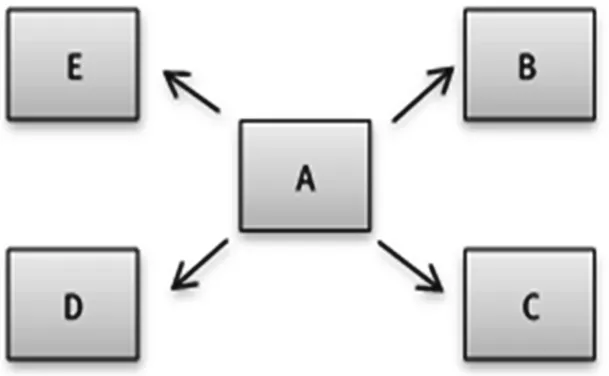
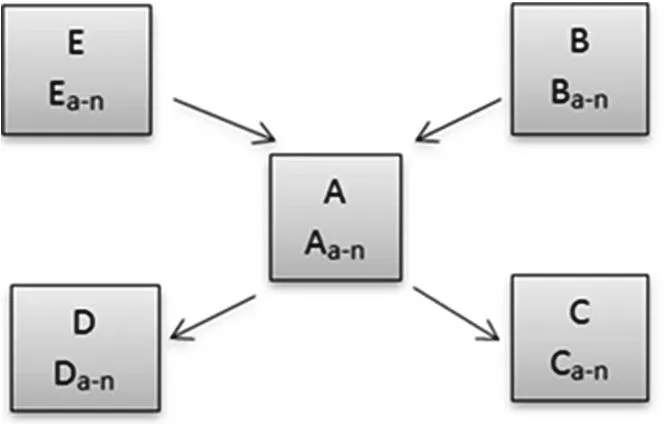
Regarding multilingual lexicography, the situation is usually simpler: there is a lemma list of A (with or without variants of A) and two or more equivalent lists (B, C, D, E, etc.) also with or without variants (Figures 8 and 9). Items of meaning, collocations, examples, grammar data types and so on are not normally included:
Fig. 8: Typical Multilingual Dictionaries
Fig. 9: Multilingual Dictionaries with variants of Lemmas and Equivalents
The above models (represented as Figure 1 to 9) are widespread and can be easily illustrated with examples taken from either print or online lexicographic projects. For the purpose of this chapter, we will focus on three online lexicographic projects that represent widespread practice in traditionally-conceived lexicographic circles: (a) InterActive Terminology for Europe (IATE), (b) The Logos Dictionary and (c) the Diccionari de la Llengua Catalana Multilingüe.
2.1InterActive Terminology for Europe (IATE)
On the homepage of the Inter-Active Terminology for Europe (IATE), we are informed that IATE is the “EU inter-institutional terminology database”. An analysis of publications and Internet documents on IATE shows that it has been used in EU institutions and agencies since 2004 for the collection, dissemination and management of EU-specific t...
Table of contents
Cover
Title Page
Copyright
Contents
Studies on multilingual lexicography: an introduction
Section 1: Multilingual electronic lexicography in a new society
Section 2: Multilingual electronic dictionaries
Trusted by 375,005 students
Access to over 1.5 million titles for a fair monthly price.
Study more efficiently using our study tools.
Frequently asked questions
Yes, you can cancel anytime from the Subscription tab in your account settings on the Perlego website. Your subscription will stay active until the end of your current billing period. Learn how to cancel your subscription
No, books cannot be downloaded as external files, such as PDFs, for use outside of Perlego. However, you can download books within the Perlego app for offline reading on mobile or tablet. Learn how to download books offline
Perlego offers two plans: Essential and Complete
Essential is ideal for learners and professionals who enjoy exploring a wide range of subjects. Access the Essential Library with 800,000+ trusted titles and best-sellers across business, personal growth, and the humanities. Includes unlimited reading time and Standard Read Aloud voice.
Complete: Perfect for advanced learners and researchers needing full, unrestricted access. Unlock 1.5M+ books across hundreds of subjects, including academic and specialized titles. The Complete Plan also includes advanced features like Premium Read Aloud and Research Assistant.
Both plans are available with monthly, semester, or annual billing cycles.
We are an online textbook subscription service, where you can get access to an entire online library for less than the price of a single book per month. With over 1.5 million books across 990+ topics, we’ve got you covered! Learn about our mission
Look out for the read-aloud symbol on your next book to see if you can listen to it. The read-aloud tool reads text aloud for you, highlighting the text as it is being read. You can pause it, speed it up and slow it down. Learn more about Read Aloud
Yes! You can use the Perlego app on both iOS and Android devices to read anytime, anywhere — even offline. Perfect for commutes or when you’re on the go. Please note we cannot support devices running on iOS 13 and Android 7 or earlier. Learn more about using the app
Yes, you can access Studies on Multilingual Lexicography by María José Domínguez Vázquez, Mónica Mirazo Balsa, Carlos Valcárcel Riveiro, María José Domínguez Vázquez,Mónica Mirazo Balsa,Carlos Valcárcel Riveiro in PDF and/or ePUB format, as well as other popular books in Languages & Linguistics & Linguistics. We have over 1.5 million books available in our catalogue for you to explore.