"You could be forgiven for taking Bristow's story as the invention of an action thriller writer . . . One of the best flying books you'll ever read." —
Pilot Magazine
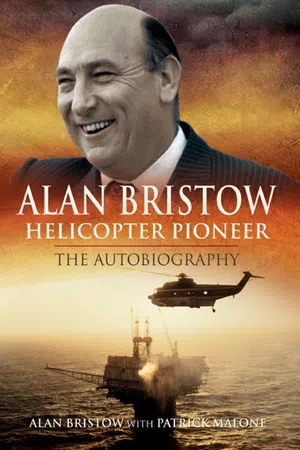
Alan Bristow was a truly remarkable man. As a merchant navy officer cadet during the war, he survived two sinkings, played a part in the evacuation of Rangoon and was credited with shooting down two Stukas in North Africa. He joined the Fleet Air Arm and trained as one of the first British helicopter pilots, becoming the first man to land a helicopter on a battleship and Westland's first helicopter test pilot. He flew in France, Holland, Algeria, Senegal and elsewhere, narrowly escaping many helicopter crashes before winning the Croix de Guerre evacuating wounded French soldiers in Indochina. For four years he flew for Aristotle Onassis's pirate whaling fleet in Antarctica before joining Douglas Bader and providing support services to oil drillers in the Persian Gulf. Out of that grew Bristow Helicopters Ltd, the largest helicopter company in the world outside America.
Bristow's circle included the great helicopter pioneers such as Igor Sikorsky and Stan Hiller, test pilots like Harold Penrose and Bill Waterton, Sheiks and Shahs and political leaders, business giants like Lord Cayzer and Freddie Laker, and the author James Clavell, a lifelong friend whose book
Whirlwind was a fictionalized account of Bristow's overnight evacuation of his people and helicopters from revolutionary Iran. Bristow and precipitated the Westland Affair when he made a takeover bid which eventually led to the resignation of Michael Heseltine and Leon Brittain, and almost to the downfall of Margaret Thatcher.
"Has all the ingredients of a bestselling novel." —
Firetrench
- 384 pages
- English
- ePUB (mobile friendly)
- Available on iOS & Android
eBook - ePub
About this book
Information
Subtopic
Business BiographiesCHAPTER 1
Danger Money
Rarely does a single catastrophic blow kill you; it’s the cumulative effect of small difficulties, individually benign, that build and build into a deadly threat while the realisation grows that you’re in over your head and the cold sweat rises on your spine. Sensible people said it was too risky to fly a primitive Hiller helicopter, with balsa wood rotor blades and vintage piston engine, out over the Antarctic Ocean from a small, difficult-to-find ship in weather that could not be accurately forecast; whenever the notion crossed my mind I would think of the extraordinary sums of money Aristotle Onassis was paying into my Swiss bank account. When your safety margins are cut down further by a fog that materialises all about, you just have to get down low over the grey waves and slow down to forty, maybe even thirty knots, whatever the visibility allows, and set course for wherever you think the ship is. But when those balsa wood blades start to take on ice and the helicopter begins to shake and rattle, you lose power and lift and you find yourself descending inexorably towards the cold ocean depths, it’s difficult to find much comfort in the thought of Onassis’s money.
Helicopters fly only if the shape of the rotor blades remains as the designer intended; an accumulation of ice from freezing fog or sleet destroys that shape, kills lift and forces the aircraft out of the air. I was wearing my patented Frankenstein Rubber Co. survival suit but I knew my lifespan would be measured in minutes when I went in; the chances of the ship finding me were virtually non-existent, even if expedition commander Fanden Andersen – known to his crews as the ‘Devil’ – could be bothered to look for me.
The Hiller rattled out its dying protest as I wound on throttle to stay above the waves. In a few moments, I knew, I would run out of lift. My wife and daughter back in Somerset would receive a telegram saying I’d been lost at sea, and nobody would know how it happened. Strangely, fear was not an issue; I was wholly focussed on the problem of how to extend my life by another minute. Suddenly I became aware of a marked increase in the light level, a brighter glow ahead of me. I slowed the helicopter to a crawl, and out of the murk loomed the side of an enormous iceberg. I came to a hover in front of this vast wall of ice, which disappeared into the fog left, right, and over my head. I sat there for a few moments with my heart beating fast. The vibrations from the rotor head were getting critical. What to do? These tabular bergs could be more than a mile long, and my chances of getting around it were poor. The only way was up. I opened the throttle to take what little power there was left and raised the collective lever to maximum pitch. Slowly, the Hiller rose up this ice cliff, the only visual clue I had to my horizontal situation. With the Franklin engine screaming, the machine began to shake like a wet dog and the rate of climb dropped almost to zero. Just as I thought it would not climb another inch, the light changed again and the ice wall disappeared. I saw what seemed to be a snow ledge ahead of me, nudged the azimuth stick forward and settled on top of the iceberg in a blizzard of my own making as those crippled blades whipped up the snow which now reached up to the door sills. The berg was perhaps fifty feet high. Another ten feet and the Hiller would have run out of power and would have had to descend, and I wouldn’t have been able to stop it.
I sat for a moment collecting my thoughts. The helicopter seemed quite stable, so I shut down the engine, then wondered if I’d done the right thing – would I ever be able to start it again? But if I didn’t get the ice off the rotor blades, there would be no point in trying to start up. I waited for the blades to stop turning, then stepped carefully out into the snow and climbed up to look at them. There was a layer of rime ice about an inch thick on top of the blades, right across their span and about three inches in from the leading edge. How had she ever stayed airborne? As was my habit in difficult circumstances, I lit a cheroot, took a deep drag and thought about things. I was alone with a crippled helicopter on an iceberg somewhere between South Georgia and the Pole. Try as I might, I couldn’t make the vision of Mr Onassis’s money compensate for this fact. Indeed, I would have given all of it to be back with the Foreign Legion in Indo-China, taking my chances with the Vietminh.
Fast forward a couple of years and I’m standing on the corner of Leadenhall Street in the City of London trying very hard not to look like a man who is carrying the best part of a million pounds in cash. Pedestrians bustle by. They must know, I thought; it must be obvious to a blind man that the suitcases on which I had a death grip were stuffed to bursting with big white five pound notes. I turned up the collar of my sports jacket and tried to shrink into it. This was 1955 and street mugging was less of an issue than it is today. But a million pounds was a lot of money in 1955. This was the real birth of Bristow Helicopters; I had indeed survived the Antarctic, survived Indo-China, survived wartime sinkings and the early days of unreliable, pioneering helicopters, I had lived to bank Onassis’s money and more besides, and things were starting to get interesting.
In the absence of an armed escort, I hailed a taxi. ‘Yeovil, please.’
‘Where?’ asked the startled driver.
‘Yeovil,’ I repeated. ‘It’s in Somerset.’
‘It’ll cost you,’ he said suspiciously.
‘I’m aware of that,’ I said. ‘You’ll be well paid.’
Near Blackfriars Bridge we passed a line of telephone boxes and I asked the driver to pull over. He watched me suspiciously as I manhandled the cases to the phone box. I couldn’t get them in the door. I called my accountant, George Fry.
‘George? It’s Alan. I’m in a taxi.’
‘Bit extravagant, isn’t it?’ said George.
‘I’ve got about a million quid in two suitcases,’ I said.
George was not easily perturbed. ‘Hmm,’ he said.
‘It was the damnedest thing, George, I never saw a living soul. Some disembodied voice told me to shove the suitcases through a hatch, they came back full of money, and I walked out. I kept thinking they’d come after me saying there was a mistake. Or somebody would knock me on the head.’
‘Strange business,’ said George. ‘Better get it to the bank.’
‘My thoughts precisely.’
The taxi puttered through the London suburbs and out into the countryside, and I sat wondering why the Dutch had insisted on paying so much in cash. But there were all sorts of restrictions on the movement of money in those days, and it didn’t pay to ask questions. They could pay me in cowrie shells for all I cared, as long as they were negotiable at the bank.
The money was in payment for the patents on a helicopter-borne harpoon I had invented, a fleet of helicopters I didn’t yet own, and a contract to operate them hunting for whales in the Antarctic. The fact that only a few months later the patents were utterly worthless didn’t seem to bother the Dutch. I thought at best they might want their money back, at worst I might wake up dead with a harpoon between my shoulder blades, but they even settled a hefty bill I sent them afterwards for conversion work on their helicopters. I have sometimes wondered since what their game was, but it’s never cost me any sleep.
Hours later I was decanted in Yeovil, paid off the delighted driver and added a fat tip, and hauled the suitcases up the steps of the National Provincial Bank. ‘I want to see the manager, please,’ I said.
The clerk smiled. ‘I’m afraid Mr Cudlipp is with a customer, sir. Would you like to make an appointment?’
‘Young lady, if you value your job, tell him now that Mr Bristow is here and wishes to deposit one million pounds.’
A hush fell on the bank. Suddenly the manager’s door sprung open and an aggrieved customer was pushed out, still grappling with loose papers. The manager beckoned me in, turning the key in the lock behind us.
I placed a suitcase on his desk and clicked it open. The money glistened. New five pound notes, fat bundles of them, each one as big as a pocket handkerchief and covered in swooping script, all together promising to pay the bearer on demand a sum that the average labourer would earn in a thousand years. The manager, a friendly chap with whom I was on good terms, was washing his hands with invisible soap.
‘Have a cigar, Mr Bristow,’ he said.
He fired up my cigar and I sat watching while the staff was dragooned into counting tall bundles of money. Even as the work went on, the remainder of my money was being transferred to Switzerland by more orthodox channels. It was a very satisfactory day, I thought. There were to be many more millions to come, but I remember that one with particular fondness because it was my first, and because everything really took off from there.
We – myself, a handful of my closest friends and an army of good men and women – built on that foundation the best helicopter service company in the world. There is no corner of the globe over which Bristow Helicopters have not flown. We have opened up the jungles and great sand seas, the ice fields and mountain ranges, and we have pioneered delivery services far, far offshore in places where people once said helicopters could not fly. We have carried employment and prosperity to countries which, but for oil and mineral exploration, would still be languishing in poverty and despair. Our helicopters have saved thousands of lives in rescues at sea and ashore, and perhaps millions more indirectly through our assault on the mosquito and the tsetse fly. In doing all this we have helped to shape the modern world, and not incidentally, we have made a lot of people very rich. One year soon, the Bristow Group will turn over a billion pounds.
So it’s been lucky for everybody that I’ve been difficult to kill. I have been torpedoed and sunk by gunfire, grenades and mortar bombs have been lobbed at me, and the Vietminh once put a bomb under my bed, blowing me into a nearby jeweller’s shop, still in the bed. I have flown cranky helicopters with bolshy engines, which people now look at in museums and shake their heads, and I have narrowly escaped from flying stunts of my own devising, which were, frankly, bloody insane.
Nor have the companies I have led – among them Air Whaling, Bristow Helicopters, and British United Airways – prospered by observing the constraints of business orthodoxy. The story is told of how I stuck my Foreign Legion throwing knife into the kitchen table of the trade union leader Clive Jenkins while he danced around the room telling me that this was not the way that the chief executive of a major airline should handle industrial relations. ‘You’ll hang for this!’ he said. But he was wrong, too.
Confidence is the name of the game. You fly with confidence, you drive with confidence, you swim with confidence, you play a golf shot with confidence, you make business decisions with confidence in your own gut feelings. And I was confident to the point of arrogance. In fact, looking back, I’d say I was so bloody cocky I could take on the world. And I did!
I might have been a knight of the realm, but I jibbed at the cost. I had made a bid for the Westland Helicopter Company, and twice it was indicated that I would get a knighthood if I threw my shareholding behind a wrong-headed scheme to sell it to the Americans. I held out; the episode, which came to be known as the Westland Affair, cost Michael Heseltine the Premiership of Great Britain, forced the resignation of another Cabinet minister and didn’t do me any favours either, but it was the right thing to do.
I have twice been hauled before magistrates, once for stealing a bus. I have drunk champagne with billionaires in the best hotels in the world and hauled my men out of some of the seediest whorehouses in South America. I have been court-martialled for desertion and awarded the Croix de Guerre and the Order of the British Empire, I have triumphed in shipboard brawls that would have appalled the Marquis of Queensbury and have represented my country at four-in-hand carriage driving with the Duke of Edinburgh. I have put a lot of backs up and disjointed a lot of noses, physically and metaphorically, and in an era when most companies are controlled by risk-averse men in suits shuffling other people’s money and creaming off their cut, my way of doing business is perhaps an anachronism. But by god, it was fun while it lasted!
The subtitle of this book ought to be ‘I met a man .. .’ because whenever I’ve been in difficulty, someone has come along who has opened a door, or shown me the way. Some of them you will know. Douglas Bader, DSO, DFC, who put me into the oil business. Freddie Laker, with whom in 1960 I tossed a coin for £67,000. Nick Cayzer, Aristotle Onassis, James Clavell, Lord Beaverbrook, the Shah of Iran. Some, equally important to me, you will not know: Harald Penrose, who taught me what being a test pilot was all about, Henry Boris, Fanden Andersen, George Fry, Captain Patterson of the Matiana. Some you may not know, but ought to: Igor Sikorsky and Jimmy Viner, Stanley Hiller and Frank Piasecki. A thousand more men travelled this journey with me, and all too many of them did not live, as I have somewhat surprisingly done, to tell this tale.
CHAPTER 2
War Clouds
1930. The Great Depression cast a malign shadow on the world, but no cloud of care crossed the sun that always shone on my personal paradise. As the son of the Senior Naval Officer to His Majesty’s Dockyards Bermuda I enjoyed a life of privileged comfort, attended by servants and wholly free from worry and want. Many men of my era recall the thirties as a grey grind of unemployment, hunger and hardship; I knew nothing of it.
We lived in a beautiful house befitting my father’s appointment, facing east towards Hamilton and west towards the sunset. On the sunrise side, a path led down to a sheltered cove and a dock where my friends and I would swim and fish for languid hours. I was an aquatic animal, skilled at turning an octopus inside out in the flash of an eye, twisting its pouch over its head before it could fire its blinding jet of ink. Thus disabled, it became bait to catch snapper, or was cut to pieces to entice the little grunts that swam under the dock.
I was tutored in the water by the man in charge of security on the dockside, Chief Petty Officer Stewart Dyer, an exceptionally fine swimmer who made a point of ensuring that my sister Muriel and I learned to swim properly. The water was sheltered and warm, and we were apt pupils. At the age of eight I persuaded Dyer to swim with me to the Pepperpot, a beacon that marked one of the turning points in the deep water channel for the big ships coming into the dockyard. Years later, when I set eyes on it again, I found it hard to believe I had swum two miles at such an age, through waters well populated with sharks.
My father got to hear of it and forbade me to do it again. Dad’s word was law, not only to me but to the army of men who kept the dockyard running like a machine. Bermuda was an important promotion for my father, who despite his title was a civilian. During the war that was to come, when he was running the bomb-shattered dockyards of Valetta with the invasion and capture of Malta looking a distinct possibility, Sidney Bristow was made an honorary Commodore in the Royal Navy, and there were times in my life when being Commodore Bristow’s son did me no harm at all.
My father was a quiet, meticulous and able administrator with a talent for mathematics. He had the common touch, and under his guiding hand peace was declared in the perpetual conflict between naval personnel in Bermuda and the dockside navvies, who joined together in membership of a sporting club founded and built by my father largely, I believe, to further his ambition to captain the local cricket team. The members felt duty-bound to vote him into the job in return for his efforts, and he was very pleased to accept.
His common touch extended to his refusal to avail himself of the car and driver to which he was entitled – a significant perk on an island where only the Governor, the Admiral and Members of Parliament merited such a privilege. It was a sore point with my mother, for whom a car would have been useful; dad got his come-uppance when he was blown off his Rudge bicycle and into the dockyard wall in a hurricane and was quite badly cut about. His cycling came to an abrupt end and a car and chauffeur appeared, much to my mother’s satisfaction.
My mother Betty was a wholly different character. Bright, outgoing and determined, she had been to Edinburgh University – an extremely unusual achievement for a woman of her generation – and was a great sportswoman, passionate about golf. She and Sidney had met at a sporting event in Scotland, where he was working in the dockyard at Rosyth, and they married late in life – she was forty when I was born, and forty-four when she had Muriel. Astoundingly, my father was unaware of that fact. Many decades later, when I had met with some success in business and was being driven home by my chauffeur in my Rolls-Royce, the radio-phone rang. It was my father.
‘You’d better come round,’ he said. ‘Your mother is unwell.’
When we got there it was clear mum had been dead for some time. Funeral arrangements were made, paperwork was pressed on my grieving father, and he came to stay with me while I made arrangements for housekeepers. He was not a drinking man but he liked a pale ale, and one evening he was sitting in the living room, nursing his beer, lost in his own teary thoughts. Suddenly he gave forth.
‘Your mother deceived me, son.’
‘Don’t talk about Mum like that,’ I said. ‘You’re upset.’
‘No, she deceived me all of our life together.’
‘What do you mean?’ I said. ‘She was never unfaithful ...’
‘No,’ he said. ‘But I had to sign her death certificate. She was nine years older than me! She always told me we were the same age!’
Dad subsided into his chair and stared long and hard into his pale ale. ‘Come to think of it,’ he said at length, ‘she did seem to be getting a bit wrinkly.’
Mum was largely responsible for the success Dad enj...
Table of contents
- Cover Page
- Title Page
- Copyright Page
- Dedication
- Contents
- Chapter 1 Danger Money
- Chapter 2 War Clouds
- Chapter 3 In the Navy
- Chapter 4 Home and Dry
- Chapter 5 Urge to Fly
- Chapter 6 Taking to the Air
- Chapter 7 Introduction to Helicopters
- Chapter 8 Becoming a Civilian
- Chapter 9 Test Pilot
- Chapter 10 French Adventures
- Chapter 11 With Onassis to Antarctica
- Chapter 12 My First Million
- Chapter 13 Breaking into Oil
- Chapter 14 Life in the Jungle
- Chapter 15 Selling Out
- Chapter 16 World Expansion
- Chapter 17 Airline Ego Trip
- Chapter 18 Shooting for Business
- Chapter 19 Chinooks and Tigers
- Chapter 20 Aberdeen Strike
- Chapter 21 Operation Sandstorm
- Chapter 22 Resignation
- Chapter 23 The Westland Affair
- Chapter 24 Briway
- Chapter 25 Coda
- Plates
- Index
Trusted by 375,005 students
Access to over 1.5 million titles for a fair monthly price.
Study more efficiently using our study tools.
Frequently asked questions
Yes, you can cancel anytime from the Subscription tab in your account settings on the Perlego website. Your subscription will stay active until the end of your current billing period. Learn how to cancel your subscription
No, books cannot be downloaded as external files, such as PDFs, for use outside of Perlego. However, you can download books within the Perlego app for offline reading on mobile or tablet. Learn how to download books offline
Perlego offers two plans: Essential and Complete
- Essential is ideal for learners and professionals who enjoy exploring a wide range of subjects. Access the Essential Library with 800,000+ trusted titles and best-sellers across business, personal growth, and the humanities. Includes unlimited reading time and Standard Read Aloud voice.
- Complete: Perfect for advanced learners and researchers needing full, unrestricted access. Unlock 1.5M+ books across hundreds of subjects, including academic and specialized titles. The Complete Plan also includes advanced features like Premium Read Aloud and Research Assistant.
We are an online textbook subscription service, where you can get access to an entire online library for less than the price of a single book per month. With over 1.5 million books across 990+ topics, we’ve got you covered! Learn about our mission
Look out for the read-aloud symbol on your next book to see if you can listen to it. The read-aloud tool reads text aloud for you, highlighting the text as it is being read. You can pause it, speed it up and slow it down. Learn more about Read Aloud
Yes! You can use the Perlego app on both iOS and Android devices to read anytime, anywhere — even offline. Perfect for commutes or when you’re on the go.
Please note we cannot support devices running on iOS 13 and Android 7 or earlier. Learn more about using the app
Please note we cannot support devices running on iOS 13 and Android 7 or earlier. Learn more about using the app
Yes, you can access Alan Bristow, Helicopter Pioneer by Alan Bristow,Patrick Malone in PDF and/or ePUB format. We have over 1.5 million books available in our catalogue for you to explore.