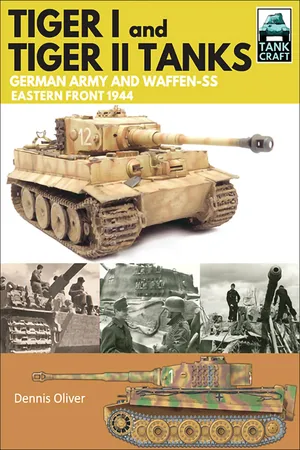
A guide blending the history behind the two World War II German tanks with resources for military vehicle modeling enthusiasts.
In spite of the relatively small numbers produced, the Tiger I and Tiger II tanks are arguably the most famous armored fighting vehicles of the Second World War. This book, the first in the TankCraft series, uses archive photos and extensively researched color illustrations to examine the tanks and units of the German Army and Waffen-SS heavy panzer battalions that attempted to hold back the Red Army during 1944. A large part of the book showcases available model kits and aftermarket products, complemented by a gallery of beautifully constructed and painted models in various scales. Technical details as well as modifications introduced during production and in the field are also examined providing everything the modeler needs to recreate an accurate representation of the tanks that fought from the snow-covered fields of Byelorussia and the Ukraine, through the Baltic States, and into Poland and Hungary.
"From a technical standpoint the book is a winner. Throw in all of the unit histories and then add the modelling, and it is a superb book on the Tiger I-II tanks. . . . The book is really a showcase of the [modelers] and their builds, and gives the rest of us a shot in the arm to up our game on our next Tiger tank." —
A Wargamers Needful Things
- 64 pages
- English
- ePUB (mobile friendly)
- Available on iOS & Android
eBook - ePub
About this book
Information
Subtopic
Military & Maritime HistoryTHE TIGER FORMATIONS - GERMAN ARMY
The development of a heavy, breakthrough tank - or Durchbruchwagen - had begun as early as 1937 and after extensive discussion it was envisaged that they should be employed in small, independent formations controlled by Corps or Army level commands and attached to divisions. The first units formed were two companies, both created on 16 February 1942, as schwere Panzer-Kompanie 501 and schwere Panzer-Kompanie 502. The exact make up of these companies is not clear as detailed organisational charts were not issued until 25 April 1942 when the first battalion-sized unit was created. These charts and tables - or Kriegsstärkenachweisungen, usually abbreviated to KStN - regulated the composition of every unit of the German Army and are discussed on page 2. By the end of the war eleven heavy battalions had been created for the Army and three for the Waffen-SS, together with the heavy company that remained with SS-Panzer-Regiment 3 until May 1945. Other units were equipped with Tiger tanks, most importantly the formations which controlled the Sprengstoffträger radio-controlled explosive charge carriers, but these for the most part operated in the west and so are not included here. Following are brief histories of the heavy tank units and although some details pre-date our study they are included to give the reader a more complete picture of the development and history of the heavy tank formations.
SCHWERE PANZER-ABTEILUNG 501
The army’s first heavy tank battalion was formed on 10 May 1942 from schwere Panzer-Kompanien 501 and 502, which were later renamed as the battalion’s first and second companies. Further personnel were drawn from Panzer-Ersatz-Abteilung 1, a replacement and training unit stationed at Erfurt in Germany and from Panzerschiess-Schule Putlos, a tank gunnery school near Holstein.
It was originally intended that this battalion would be equipped with the Tiger (P) which was then being developed by Porsche and a number of drivers were sent to the Nibelungenwerke at St.Valentin in Austria to be trained on the new tanks. The decision to drop the Porsche design in favour of Henschel’s proposal in July delayed the battalion’s training and formation and the first two Tigers did not arrive until 30 August 1942. The battalion’s first and second companies were sent to North Africa, the latter via France, with the first tanks arriving on 23 November 1942. So precarious was the supply route from Italy to the African coast that the last Tigers did not reach Tunisia until late January 1943 and the battalion’s 3.Kompanie, which was not fully formed until 6 March, remained in Europe and was eventually attached to Panzer-Regiment Grossdeutschland as a tenth company. On 12 May 1943 the remnants of the battalion, which had been combined with elements of the newly arrived schwere Panzer-Abteilung 504, surrendered to the British near El Alia in Tunisia. Beginning on 9 September 1943, and employing some 150 veterans of the original formation, the battalion was rebuilt under the command of Major Erich Löwe, an experienced tank officer who had been awarded the Knight’s Cross as a company commander during the 1940 French Campaign. The battalion spent the following months in training and on Sunday, 5 December 1943 began moving to the Eastern Front. From 19 December until the end of the year the battalion was involved in the fierce fighting between Losovka and Vitebsk and it was here, on 23 December, that the battalion commander was killed.
In January and February 1944 the battalion was operating in the area around Vitebsk, north-east of Minsk in modern day Belarus, in support of Panzergrenadier-Division Feldherrnhalle and 14. Infanterie-Division. Despite the heavy fighting just one Tiger was lost at this time when an artillery shell landed directly on the turret roof of Leutnant Schröder’s tank. In early March 1944, with just seventeen serviceable tanks, the battalion took part in Operation Hubertus, a limited offensive to retake the village of Osipenki west of Vitebsk near the current Belarus frontier, with the assault guns of Sturmgeschütz-Brigade 281 and the grenadiers of 256.Infanterie-Division. In early June nine Tigers were handed over to schwere Panzer-Abteilung 509 leaving just twenty tanks in total. On 23 June 1944, the day after the commencement of the Soviet Operation Bagration, the battalion was rushed to the area north-east of Orscha, an important rail and road junction on the Dnieper river, and immediately faced strong Russian armoured units including a number of JS-2 heavy tanks. The fighting here was extremely confused and the tanks of the battalion were widely dispersed. During the withdrawal across the Dnieper the tank of the first platoon commander crashed through the bridge and could not be recovered. In addition several other tanks were abandoned due to lack of fuel. The battalion continued to withdraw to the west and on 2 July 1944 the six remaining operational Tigers were ferried across the Berezina river.

Mid production Tigers of 2.Kompanie, schwere Panzer-Abteilung 501 said to have been photographed during Operation Hubertus in early March 1944. The accompanying grenadiers are probably from 256. Infanterie-Division.
Both tanks have the cast commander’s cupola introduced in July 1943, although they appear to retain the mountings for the two front headlights which were dropped at about the same time. The loader’s hatch of the tank nearest the camera has the small outside lock adjuster fitted to its centre that was deleted from production in September 1943. The turret ventilation fan - the flat, raised disc in front of the cupola - was moved from the rear of the turret roof to the position seen here in July1943.

Tiger II tanks of 3.Kompanie, schwere Panzer-Abteilung 501 photographed in late 1944. The vehicle furthest from the camera appears to be painted in a Dunkelgelb base coat only without any disruptive camouflage. The tank in the foreground, Tiger 313, is also shown in the illustration section on page 19.
EQUIPMENT ALLOCATIONS AND LOSSES, SCHWERE PANZER-ABTEILUNG 501,1944

Over the next few days a number of tanks were delivered from depot workshops and thrown into the defence of Minsk but most were abandoned after they ran out of fuel and two simply went missing and were never seen again. All surviving crews were withdrawn to Germany where, on 17 July 1944, the battalion was reformed. Equipped with a full complement of tanks the second and third companies returned to the front and on 11 August and were attached to 16. Panzer-Division and immediately thrown into an attack between Chmielnik and Szydlow in central Poland in an effort to reduce the so called Sandomierz Bulge. At the same time, 1.Kompanie was leaving Ohrdruf in Germany and within a week, in a dramatic turn of events, the battalion commander, Oberstleutnant von Legat, was removed from his post over suspicions of his involvement in the July plot to assassinate Hitler (1). In September the battalion was attached to XXXVIII.Panzerkorps and took part in the defensive battles near Kielce and Ostrowiec on the western bank of the Vistula. At this time a number of Tiger I tanks were handed over from schwere Panzer-Abteilung 509, which was returning to Germany (2), and by the end of September the battalion reported that fifty-three tanks in total were on hand, with thirty-six of those being combat ready. On 1 December 1944 the battalion was able to field fifty-one operational Tigers and on 21 December was renamed schwere Panzer-Abteilung 424 to avoid confusion with schwere SS-Panzer-Abteilung 501. On the last day of 1944 the battalion reported that seventeen Tigers were fully operational.
1.The eventual fate of von Legat is not known, however, his name does not appear of the list of those charged and tried and he may have been exonerated. He was replaced by Major Saemisch who was killed while leading the battalion at Lisow in January1945.
2.The exact number of Tiger I tanks is not known but schwere Panzer-Abteilung 501 reported forty-two tanks in total on 12 August 1944 and the subsequent loss of one tank by September indicating that schwere Panzer-Abteilung 509 may have relinquished as many as twelve Tigers from its total of thirteen tanks.
SCHWERE PANZER-ABTEILUNG 502
Formed on 25 May 1942 from Panzer-Ersatz-Abteilung 35, this unit was not the first of the heavy tank battalions created by the German Army, as is sometimes stated, although it was the first to receive an allocation of Tigers and the first to see action, 1. Kompanie going into combat on 21 September 1942 near Tortolovo, some 30 kilometres east of Leningrad on the Volkov Front.
These first tanks suffered almost continuous mechanical failures and during the training phase were only kept operational with the help of civilian maintenance crews from the Henschel factory temporarily attached to the battalion.
On 29 August 1942, of the four Tigers available to 1. Kompanie, offloaded at the railway junction at Mga near Leningrad, three broke down before they could reach their assigned position at the front. Although the fourth made contact with the enemy it became bogged and had to be towed to safety.
The battalion’s 2.Kompanie was formed from surplus crews of Panzer-Regiment 1 and Panzer-Regiment 35 and arrived in Russia on 7 January 1943 to be attached to Heeresgruppe Don operating in the southern Ukraine, far from the battalion’s headquarters and first company fighting on the Volkov. It seems the lessons of 1942 had been learnt, however, as the company was able to make the road march from Proletarsk, south-east of Rostov, to Ssungar (1), a journey of over 100 kilometres, on their own tracks without a single mechanical failure.
On 22 February 1943 the battalion’s second company was transferred to schwere Panzer-Abteilung 503 and renamed as that formation’s third company. While 1.Kompanie remained in the east, a new 2.Kompanie was formed in France from men of Panzer-Regiment 3 and by the end of May a third company had been raised, mainly from personnel of Panzer-Regiment 4.
By the end of July the new companies, together with the battalion staff, were reunited with 1. Kompanie in time to take part in the battles to the south of Leningrad, now Saint Petersburg.
During the remainder of the year the battalion fought in the attempts to retake Newel, south of Pskov, and as the new year approached, 1 .Kompanie was transferred to the Leningrad sector.
In January 1944 the remainder of the battalion, which was still with VIII.Armeekorps near Newel was rushed to Gatshina, south of Leningrad, in an effort to halt the Soviet attempts to break out of the Oranienbaum bridgehead. The third company commanded by Leutnant Meyer formed a Kampfgruppe with 9.Luftwaffen-Feld-Division and Grenadier-Regiment 422 and when the first and second companies arrived they were formed into a battle group with Grenadier-Regiment 377 and Panzerjäger-Kompanie 240 (2).
In the confused and desperate fighting that took place around Syaskelevo eleven Tigers were completely destroyed while a number had to be towed during the withdrawal to Volosovo. The commander of 3.Kompanie, Leutnant Meyer, finding himself surrounded, committed suicide rather than surrender and Oberleutnant Diesl, the commander of 1.Kompanie, was killed near Narva on the last day of the month.

A mid production Tiger I of schwere Panzer-Abteilung 502. This tank is shown and discussed further in the illustration section on page 20.1 am indebted to Hartmut von Holdt who was able to identify this vehicle as Tiger number305 of the battalion’s 3.Kompanie.
1.The location is given by both Schneider and Carius. I have been unable to locate Ssungar on any modern map but as Schneider’s account states 2. Kompanie was in action at Ozerskiy by the next day and Bratskiy on the following day, Ssungar may be modern Yuzhnyy which sits astride the road network west of Bratskiy.
2.This is almost certainly a company of Panzerjäger-Abteilung 240 from 170. Infanterie-Division.

A mid production Tiger 1 of 2.Kompanie, schwere Panzer-Abteilung 502. The use of a white outline and the placement of the company number were both identifying features of this battalion’s tanks.
In early February the battalion was moved to Narva-Joesuu on the Gulf of Finland north of Narva, and remained in the area until mid-April, taking part in the attempts to reduce the Soviet bridgeheads on the western bank of the Narva river near Auvere and east of modern Sirgala (1) referred to by the Germans as the Ostsack and Westsack respectively.
During this time the companies were separated and fought with the units that were collectively known as Panzer-Kampfgruppe Strachwitz (2). Operations in the Narva area only ceased when the ground, already marshy, became impassable in mid-April and the battalion used the next seven weeks to carry out urgently needed repairs.
When the Soviet summer offensive began on 22 June the battalion was attached to XXXVII.Armeekorps in the Pskov-Ostrov area, near the junction of the present day Estonian, Latvian and Russian borders. The second and third companies were ordered to counterattack immediately towards the Velikaya river in support of 121 .Infanterie-Division while 1. Kompanie was temporarily attached to the neighbouring I.Armeekorps. The Tigers were employed for the most part in platoon-sized groups in support of infantry and combat engineer units and during this time had their first experience of the US M4 Sherman tank when a single example was destroyed by Leutnant Eichorn of 2.Kompanie. On Sunday, 2 July the battalion began moving to Dünaburg, modern Daugavpils in Latvia, the last tanks arriving on the following Thursday. At that time the battalion was able to rep...
Table of contents
- Cover
- Title Page
- Copyright
- Contents
- Introduction
- The Eastern Front 1944
- Tiger Formations - German Army
- Camouflage & Markings
- Model Showcase
- Modelling Products
- Tiger Formations - Waffen SS
- Technical Details and Modifications, Tiger I
- Technical Details and Modifications, Tiger II
- Product Contact details
Trusted by 375,005 students
Access to over 1.5 million titles for a fair monthly price.
Study more efficiently using our study tools.
Frequently asked questions
Yes, you can cancel anytime from the Subscription tab in your account settings on the Perlego website. Your subscription will stay active until the end of your current billing period. Learn how to cancel your subscription
No, books cannot be downloaded as external files, such as PDFs, for use outside of Perlego. However, you can download books within the Perlego app for offline reading on mobile or tablet. Learn how to download books offline
Perlego offers two plans: Essential and Complete
- Essential is ideal for learners and professionals who enjoy exploring a wide range of subjects. Access the Essential Library with 800,000+ trusted titles and best-sellers across business, personal growth, and the humanities. Includes unlimited reading time and Standard Read Aloud voice.
- Complete: Perfect for advanced learners and researchers needing full, unrestricted access. Unlock 1.5M+ books across hundreds of subjects, including academic and specialized titles. The Complete Plan also includes advanced features like Premium Read Aloud and Research Assistant.
We are an online textbook subscription service, where you can get access to an entire online library for less than the price of a single book per month. With over 1.5 million books across 990+ topics, we’ve got you covered! Learn about our mission
Look out for the read-aloud symbol on your next book to see if you can listen to it. The read-aloud tool reads text aloud for you, highlighting the text as it is being read. You can pause it, speed it up and slow it down. Learn more about Read Aloud
Yes! You can use the Perlego app on both iOS and Android devices to read anytime, anywhere — even offline. Perfect for commutes or when you’re on the go.
Please note we cannot support devices running on iOS 13 and Android 7 or earlier. Learn more about using the app
Please note we cannot support devices running on iOS 13 and Android 7 or earlier. Learn more about using the app
Yes, you can access Tiger I and Tiger II by Dennis Oliver in PDF and/or ePUB format. We have over 1.5 million books available in our catalogue for you to explore.