- 144 pages
- English
- ePUB (mobile friendly)
- Available on iOS & Android
eBook - ePub
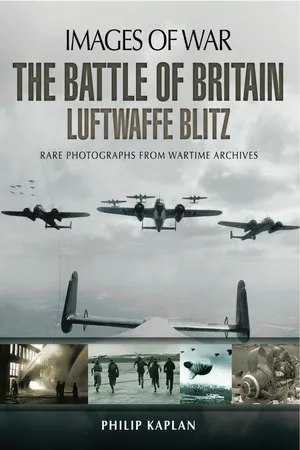
The Battle of Britain: Luftwaffe Blitz
About this book
This new collection of archive imagery from Philip Kaplan offers a gripping, graphic view of the routine repeated each day and night, from the summer of 1940 through to the following spring, by the German bomber crews bringing their deadly cargoes to Britain. Through mainly German archival photos, it profiles airmen on their French bases and in the skies over England; the aircraft they flew, fought and sometimes died in; their leaders; their targets and results; the R.A.F pilots and aircraft that stood in opposition to the German forces, and the losses experienced on both sides. The images, from the Bundesarchiv and other German and British photographic sources, vividly convey a real sense of events as they played out, as do the compelling first-hand accounts from a host of participants on both sides, eyewitnesses to one of the most brutal sustained bombardments of the Second World War.
Information
Subtopic
Military & Maritime HistoryIndex
HistoryPayback Time
The British government first began getting reports of unusual enemy activity on the Baltic coast in the spring of 1943. Their photo reconnaissance of the peninsula was showing newly-constructed laboratories, a living site and examples of what photo interpreters considered to be missile launching pads. It was known then that German atom bomb research had made relatively little progress to that date and that they were concentrating heavily on the development of both pilotless bombers and long-range rockets at Peenemünde, “the summit of research and development,” as Churchill referred to the complex. Throughout the early summer, British intelligence material about the “V-weapons” continued to accumulate, indicating that Hitler intended to begin the new bombardment of London on 30 October He expected that, by the end of the year, London would be devastated, that the British would have surrendered, and the bulk of German military might could be focused on the Soviet Union. This new German threat against London was considered real and serious, and caused the British government to look again at the evacuation plans it had made in 1939. At the same time, the government decided that a maximum effort should be mounted to eliminate Peenemünde as a specific threat. That project, code-named Hydra, was handed to Air Chief Marshal Arthur Harris, head of RAF Bomber Command.
Harris ordered, from his bunker HQ at High Wycombe, that the attack would be mounted at full strength and in full moonlight, despite the advantage to the German fighters. He said that his bomber crews were not to know the nature of the target—only that it had to be eliminated no matter how difficult the job. The bombing altitude would be between 8,000 and 12,000 feet—less than half the normal height, and a “master of ceremonies” would control the attack from over the target for the first time in a full-scale RAF raid, and that new, slow-burning Newhaven “spot fires” would be used as target markers. All across eastern England, fully 600 bomber crews were assembled in briefing rooms on the afternoon of Tuesday, 17 August.
Sergeant Jack Currie: “One of those crews was mine. We had come together in the usual random manner, responding to a call of ‘Sort yourselves out, chaps’, in an echoing hangar at the operational training unit. Within five minutes, a bomber crew was formed: three bright Australians as navigator, bomb aimer, and rear gunner, a quiet Northumbrian as wireless operator, and me. Later, converting to the Lancaster, we added two teenagers: a Welshman as mid-upper gunner and a Merseysider as flight engineer. At least I was no longer the youngest in the crew.
“We were assigned to Number Twelve Squadron, at Wickenby, near Lincoln, and they seemed to need us: they had lost four crews in seven days. Ahead lay a tour of thirty operations, and the chances of survival were roughly one in four; they improved, said the old hands, if you got through five missions. We did that, and another three; now we were ready for our ninth.
“I had come to trust the aeroplane and to know the crew. Jim Cassidy, having quietly used a sick-bag as soon as we were airborne, would navigate us to Germany and back with no further trace of frailty. He had always set his heart on being a navigator, unlike many who first aspired to be pilots; he had come out top in training and it showed. Larry Myring, with whom bloody was an all-purpose, mandatory adjective, would complain about the cold and be happy only when the target came in sight. The gunners Charlie Lanham and George Protheroe were always constantly alert; up to now, they had not been required to fire their guns in anger. Charles Fairbairn would be heard only when something urgent—a recall, a diversion, or a change of wind—came through on the radio, and Johnny Walker would do what was needed to conserve the fuel. My responsibility as captain, was to make the big decisions—like which dance hall or cinema we went to on a stand-down night.

above: A still from the film The Dam Busters, with Richard Todd, right. and Robert Shaw; below: Air Chief Marshal Arthur Harris, headed RAF Bomber Command in the Second World War; bottom: A bomb aimer in a Lancaster heavy bomber.


above: 4,000-pound ‘cookies’ ready for loading aboard Lancaster bombers participating in Bomber Command’s massive offensive against Germany; below: Lancaster forward fuselage sections in an Avro production facility in 1942; bottom: Fusing bombs on a hardstand of a U.S. Army Air Force base in England.


“The Hydra briefing started with a little white lie. The enemy, said the intelligence officer, were developing a new generation of radar-controlled night fighters on the Baltic coast. That was the carrot. The squadron commander took over with the stick. If we failed to clobber Pennemünde tonight, we would go again the next night and the next until we did. The attack, he continued, would comprise three ten-minute waves: the first would hit the scientists’ living quarters, the second wave the airfield (in reality, the rocket-launching sites), and the third the laboratories.
“ ‘Hey, skip,’ Myring whispered, ‘What’s our squadron motto?’
“I glanced at him. ‘You know perfectly well.’
“ ‘Yeah. Leads the field. So how is it we’re always in the last bloody wave?’
“The PFF would employ the Newhaven method, which meant visual ground marking—and would ‘re-centre’ the markers on each successive aiming point. We were to listen out on channel C for the MC’s instructions, and follow them to the letter. Purely as a precaution, in case the markers should be temporarily obscured, we were to approach the target on ‘time-and-distance’ runs from Cape Arkona on Rügen Island, forty miles north of Peenemünde. The outbound route would keep us clear of known flak concentrations, and the target defences were expected to be light. And, as for the enemy night fighters, they would be diverted by no less than eight Mosquitoes bothering Berlin at the time of the attack.


top: Captain John Godfrey; centre: Major Howard ‘Deacon’ Hively, both members of the 4th Fighter Group at Debden, England; below: Major John England on his return from a combat mission in ‘Nooky Booky IV’, in his 357th Fighter Group P-51 Mustang; above: the entire crew of a B-17F bomber arriving at the aircraft for a mission to a German target.

“After the navigation leader had specified the courses, heights, and airspeeds, the weatherman performed his magic-lantern show of cloud tops and bases. ‘Looks good,’ said Cassidy. ‘Larry should get plenty of visual pinpoints.’ He looked meaningfully at the bomb-aimer, whose map-reading ability he had sometimes questioned. Myring then grunted: for him, the main business of the briefing began only when the bombing leader took the stage. He licked his pencil, and made a careful note of how his five-ton load would be disposed.
“The signals leader spoke in an apologetic undertone:‘I would like to see all wireless operators for just a few minutes after briefing.’ I leaned across to ask Fairbairn ‘What’s all the secrecy, Charles? Why can’t he tell everybody?’
“ ‘It’s just technical stuff, Jack. A pilot wouldn’t understand.’
“The veteran gunnery leader, with a battered service cap worn at an angle, advised constant vigilance. Defying popular belief, he saw the moonlight as being to our advantage:‘A fighter will stick out like a sore thumb. Just keep your eyes peeled and make sure you see him before he sees you.’

The primary fighter types used by the American air force in World War Two England—above: The Lockheed P-38 Lightning; below: the North American P-51D Mustang; bottom: The Republic P-47 Thunderbolt.


“The station commander strolled onto the stage, one hand in his pocket, the other smoothing a sleek, dark moustache. He was sure he didn’t have to emphasize the importance of the target, and anxious that there should be no early returns. ‘Your flying meals will be ready at nineteen-thirty hours, transport to the aircraft at twenty-fifteen. Good luck, chaps.’
“The trouble with the Lancaster, apart from being cramped for space and deathly cold at altitude, was that it had a tendency to swing left on takeoff. If you overcorrected, it swung back to the right, and the more you tried to straighten up, the more it deviated. The trick was to eliminate the swing by leading with the throttle of the port outer engine until the speed was high enough to get the rudders in the airflow for directional control. That was what I did at thirty minutes after nine, and PH-George 2 climbed away at maximum boost and 2,850 rpm. At fields all over Lincolnshire, in Yorkshire, and in East Anglia, 595 pilots did the same. Theoretically, if every aircraft stayed within a two-mile radius of base, their climbing orbits should never coincide: in practice, they occasionally did, and we took precautions. Apart from the navigator, busy at the gee-box, every man kept watch.
“We reached 8,000 feet in under twenty minutes, and that was not too bad. Climbing in a circle wasted lift and thrust: aeroplanes climbed better in nice straight lines. When George 2 was straightened out on course, she gained another 3,000 feet in the next five minutes (it was a curious convention with aircraft as with ships that, no matter how obviously masculine their names, they were always female to their crews.)
“Beneath us there was nothing to be seen. The coastal crossing point at Mablethorpe did not exist as houses, streets, and shoreline, but as 53.20N 00.16E on the navigator’s chart. At two minu...
Table of contents
- Cover
- Title Page
- Copyright
- Contents
- In The Beginning
- Preparation
- It Starts
- Channel Attacks
- Radar Chain
- Targetting The Airfields
- Bombs For Britain
- The Defence
- Foreign Aid
- The Raiders
- Churchill 1940
- Fifty-Seven Nights
- Payback Time
Trusted by 375,005 students
Access to over 1.5 million titles for a fair monthly price.
Study more efficiently using our study tools.
Frequently asked questions
Yes, you can cancel anytime from the Subscription tab in your account settings on the Perlego website. Your subscription will stay active until the end of your current billing period. Learn how to cancel your subscription
No, books cannot be downloaded as external files, such as PDFs, for use outside of Perlego. However, you can download books within the Perlego app for offline reading on mobile or tablet. Learn how to download books offline
Perlego offers two plans: Essential and Complete
- Essential is ideal for learners and professionals who enjoy exploring a wide range of subjects. Access the Essential Library with 800,000+ trusted titles and best-sellers across business, personal growth, and the humanities. Includes unlimited reading time and Standard Read Aloud voice.
- Complete: Perfect for advanced learners and researchers needing full, unrestricted access. Unlock 1.5M+ books across hundreds of subjects, including academic and specialized titles. The Complete Plan also includes advanced features like Premium Read Aloud and Research Assistant.
We are an online textbook subscription service, where you can get access to an entire online library for less than the price of a single book per month. With over 1.5 million books across 990+ topics, we’ve got you covered! Learn about our mission
Look out for the read-aloud symbol on your next book to see if you can listen to it. The read-aloud tool reads text aloud for you, highlighting the text as it is being read. You can pause it, speed it up and slow it down. Learn more about Read Aloud
Yes! You can use the Perlego app on both iOS and Android devices to read anytime, anywhere — even offline. Perfect for commutes or when you’re on the go.
Please note we cannot support devices running on iOS 13 and Android 7 or earlier. Learn more about using the app
Please note we cannot support devices running on iOS 13 and Android 7 or earlier. Learn more about using the app
Yes, you can access The Battle of Britain: Luftwaffe Blitz by Philip Kaplan in PDF and/or ePUB format, as well as other popular books in History & Military & Maritime History. We have over 1.5 million books available in our catalogue for you to explore.