When the war was declared in August 1914, one of the first acts to be implemented by the politicians and military was a strict censorship on the newspapers. As the poacher turned gamekeeper, Winston Churchill said: The war is going to be fought in a fog and the best place for correspondence about the war is London, The military sought to have one of their officers, dubbed "Eyewitness", to be the official spokesman to enable them to control what the newspapers could print. In the early stages of the war, there were many reporters on the Continent who were evading military arrest and sending back reports about the reality of the situation. Several volunteered with the various ambulance services just to disguise their real purpose, but all were eventually banished.
Having finally cleared all reporters from fighting area, the military was persuaded to allow a small number of accredited war reporters to be chaperoned around the battle fronts. They were closely watched and their reports thoroughly scrutinised, until they eventually became almost a part of the Headquarters hierarchy. Later, diaries and letters revealed how many of them really felt and they had to bear the post-war shame of not writing the truth.
The Western Front was not the only front in this world war. Reporters found censorship less rigidly applied on the Eastern Front, Palestine and Italy. One correspondent, whose reports famously brought about the sacking of the campaign commander and the ending of the fruitless and bloody Gallipoli Expedition, bravely broke ranks and was finished as a war reporter.
War reporting was not confined to print. The emergence of photographers and cinematographers on the battlefield has left us with an extraordinary record. Unlike their writing brothers, the photographers could get close to the action and shoot what they liked. The resultant film was, of course, censored but thankfully nothing was discarded and museum archives are full of their stunning work.
Having been the pre-war stars of their newspapers, the war reporters experienced a post-war wave of anger and cynicism which took years to overcome.
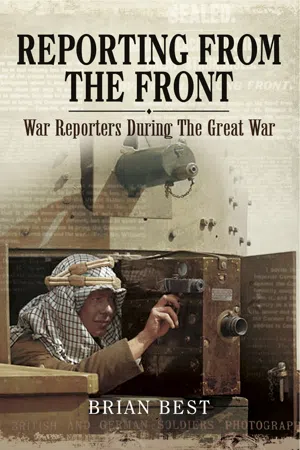
- 224 pages
- English
- ePUB (mobile friendly)
- Available on iOS & Android
eBook - ePub
About this book
Information
Subtopic
British HistoryIndex
HistoryChapter 1
Sunset of the Golden Age
When Queen Victoria died in 1901, many things passed with her. Small-scale colonial wars and a certain amount of press freedom became ‘Victorian’. Wars were about to become more far-reaching and destructive. The reporting of them became increasingly more restricted and frustrating. Although there were many things that made a correspondent’s job easier, like the portable typewriter, the camera, the telephone and, soon, the radio, officially controlled censorship and the sheer scale of modern conflicts made reporting a constant round of struggle and obstruction. The Boer War was both the last of the old-style and the first of the new-style conflicts.
War correspondents, as long as they were accredited, had still been free to wander around during a battle to observe what they liked. What the censor did not like was the reporting of morale (unless good), troop dispositions and future plans. Despite the censor, the reporters generally felt that they had done the best they could in the circumstances.
This was all about to change.
After the Boer surrender in 1902, Britain, generally, was at peace. She had been involved in a unique multi-national expedition in China during the summer of 1900. A secret society called ‘Righteous harmonious Fists’, or Boxers as they were known by Westerners, came into prominence with a call to exterminate all ‘foreign devils’ in China. They backed up this call by killing missionaries, businessmen and Chinese Christians. The Western embassies in Peking appealed to the Dowager Empress to use the Imperial Army to suppress the uprising. Instead, they found that there was considerable royal sympathy for the Boxers and that they could not rely on the Chinese authorities to supply protection of the foreign legations.
With the surrounding country in an uproar and communications being cut, the foreign diplomats sent for troops and sailors from their coastal bases. A total of 430 marines and sailors from eight different countries arrived and set to building a defensive perimeter in the Legation Quarter of the city. This had to house 353 civilian men, women and children, in addition to which there were about 2,700 Chinese Christians. From the beginning of June until their relief on 14 August, they were cut off by thousands of fanatical Boxers.
Among the civilians was Dr George Ernest Morrison, The Times’ man in China. he, like Mark Twain, became one of few people to have had the interesting experience of reading his own obituary. After the first fierce attack, the Daily Mail reported that the Legations had fallen and everyone was slain. The Times assumed that Morrison had died and printed a glowing three column obituary.
Happily Morrison survived, although he was wounded. he was even mentioned in despatches by the British Minister:
‘Dr Morrison, The Times correspondent, acted as Lieutenant to Captain Strouts and rendered most valuable assistance. Active, energetic and cool, he volunteered for every service of danger and was a pillar of strength when matters were going badly. He was severely wounded on 16th July by the same volley that killed Captain Strouts and his valuable services were lost for the rest of the siege.’
After peace returned, Morrison resumed his post for The Times until his death in 1920.
The paper had sent John Cowan as his replacement and he joined other reporters as they accompanied the relief force of 20,000 troops made up of units supplied by Britain, Japan, Russia, United States, France, Germany, Italy and Austria. George Lynch of The Illustrated London News, who had attempted to escape through the Boer siege of Ladysmith only to be captured, was also on hand. he wrote critically of the brutal treatment of Chinese civilians meted out by the Russians, French and Germans. On one occasion, British soldiers rescued a couple of women who had been thrown down a well by Russian soldiers. Overcoming stiff resistance, the Alliance fought its way to Peking and successfully relieved the Legations.
Another example of multinational co-operation occurred in 1909 during the aftermath of the Messina earthquake in southern Italy, in which 200,000 died. The ships of six navies brought relief and the crews helped look for survivors.
Sadly these two examples of international co-operation and goodwill were soon forgotten as all of the nations involved were about to become locked together in the most cataclysmic of all wars.
In 1903, Britain undertook a minor expedition in Somaliland which prompted Melton Prior and Bennet Burleigh to be diverted on their return from reporting the Delhi Durbar proclaiming Edward Vll, Emperor of India. It was just thirty years since Prior had accompanied Edward during his first trip to India. Although the old friends did not see any action, Prior found the climate good for his increasing health problems, particularly emphysema and asthma. Burleigh, in his droll way, concurred by writing: ‘It is very healthy, plenty of sun, plenty of sand but the shortest road to a public house is a thousand miles long!’. The campaign was short with little fighting but plenty of hot and thirsty marching. It also produced the awards of three Victoria Crosses, all for the same action. One of the recipients was Major Johnnie Gough, leader of the column that was attacked. Also accompanying the column was the Daily Graphic special correspondent, William Theobald Maud, a fellow Ladysmith veteran, with whom Johnnie enjoyed a good relationship. When the column came under attack, Gough and two other officers went to the rescue of a mortally wounded officer in charge of the rearguard some half a mile distant. In the absence of any officers, it was Will Maud who took charge of the column, directing fire and keeping formation, while sketching and making notes.
Maud was instrumental in Gough being awarded the Victoria Cross by ignoring the officer’s efforts to play down his part in the rescue and sending a glowing report back to his paper. Johnnie was greatly saddened by the news that Will Maud had died of fever in Aden while on his way home to his pregnant wife. he asked his father to write to the editor of the Daily Graphic to suggest a public subscription to which he would contribute anonymously. Given the general suspicion in which the military held war reporters, this was an unusually generous gesture.
In 1904, the British provoked a regrettable confrontation in Tibet. Without wishing to occupy the country, they sought a treaty with the Tibetans but, when they received no response, crossed the border and marched on the capital, Lhasa. Led by Sir Francis Younghusband, who had acted as correspondent for The Times during the Chitral Relief of 1895, 3,000 British and Indian soldiers crossed the himalayas to this remotest of countries. In several skirmishes, some 2,100 primitively armed Tibetans were killed. One of the few casualties suffered by the British was Edmund Candler of the Daily Mail. In bitterly cold weather on a mountain pass between Tuna and Guru, the two sides confronted each other in a close quarters stand-off. A misunderstood gesture led to the Tibetans reacting violently. Candler, who was standing on the end of the front rank, was hacked at by a swordsman and wounded in twelve places. Fortunately his thick poshteen1 saved his life but his right hand was badly mutilated, resulting in amputation.
The British reacted with a couple of minutes of sustained close-range rifle and machine-gun fire which left over 600 tribesmen dead. Despite his wounds, Candler remained with the expedition until its successful conclusion. Teaching himself to write with his left hand, he went on to report in the First World War.
In the same year, 1904, Japan and Russia went to war over each other’s claims of influence in Manchuria and Korea. A war involving a giant power like Russia and a swiftly modernising country like Japan attracted the world’s press. The British were well represented with veterans like Prior, Burleigh, Frederick Villiers of The Graphic, William Maxwell of the Daily Mail and the newly left-handed Edmund Candler, as well as some newcomers like Ellis Ashmead-Bartlett of the Daily Telegraph.
The Times sent Lionel James to hong Kong where he attempted a ‘first’. The paper hired a boat, the SS Haimun, installed the newly-invented wireless and went looking for news. On 14 March, he was rewarded. Off the Russian-held Port Arthur, he saw and reported the sinking of the Russian flagship by a Japanese mine. he was able to say over the airwaves: ‘In the history of journalism, the first time that a message has been sent direct from the field of war activity.’ his triumph was short-lived, however, for he also reported two Japanese ships sunk in the same minefield. This new style of news gathering was too uncontrollable for the censor-conscious Japanese, and James’s operation was banned. James concluded that there was no future for wireless as a means of reporting wars. The Japanese, on the other hand, saw its potential and used it during their operations against the Russians.
The Japanese were found to be masters of polite procrastination as the correspondents fretted in their Tokyo hotels and awaited the elusive press pass that would take them to the front. As Burleigh put it: ‘(we) ate the bread of idleness’. Melton Prior, in particular, seems to have suffered the most from the inactivity. he arrived on 7 February and kicked his heels for six months. With nothing to report, except a severe earthquake that shook the city in May, his health deteriorated. Worry and depression caused him to lose weight and his asthma attacks became more frequent.
Finally, he and Burleigh did get to Manchuria but were not allowed to get nearer the front than four miles. This final frustration and his poor health finally broke him and he returned home, never to travel again.
His increasing despondency was heightened when his first wife, whom he adored, was knocked down and killed by a tram. he still occasionally called into the offices of the Illustrated London News and, during a conversation with the new editor, was persuaded to commit to paper the story of his adventurous life. The result was a manuscript of 400,000 words! Sadly it was the last thing he did, for he died in November 1910. his funeral was a lavish and well-attended affair that befitted the passing of one of the truly great old-time ‘specials’.
Bennet Burleigh’s campaign ended not soon after as he tried to free himself from the stranglehold the Japanese had imposed on the foreign reporters. he travelled to Tientsin and attempted to get permission from the Russians to cover events from their side. Once the Japanese found out, they withdrew his accreditation and complained to the British Government until he was recalled home.
Frederic Villiers was also frustrated by the months of waiting but he was finally part of a group of ten who were chosen to observe the siege of Port Arthur. These included Richmond Smith of Associated Press, Benjamin Norregaard of the Daily Mail, Richard Barry of the San Francisco Chronicle and a newsreel cameraman named ‘Rosy’ Rosenthal of the Bioscope Company. Although he and his comrades had to travel six miles each day from their billet, he was able to see much of the bombardment and some of the Japanese attacks.
He shared a mess with the Telegraph reporter, David James, and a 50-year-old photographer named James Ricarlton. Villiers was both amused and irritated by the behaviour of the young Ellis Ashmead-Bartlett, who had served as a subaltern in the Boer War and was the son a wealthy baronet. Later he was to become a considerable correspondent but he gave the first impression of being a condescending snob. Villiers heard him say to a Japanese officer: ‘There’s my card, sir – the Junior, don’t you know and you can take it from me, as an officer and a gentleman, that what I tell you is correct.’ To Villiers and the other specials he became known as ‘The Toss’.
During the three months they were in Port Arthur they were offered every courtesy by their hosts but ended up seeing and reporting only what the Japanese wished them to see. As Villiers later wrote: ‘the correspondents are practically prisoners, held, of course, with a silken cord.’ Although the Boer War had been censored, the reporters had been free to wander where they liked. The Japanese took measures to prevent this happening and put all foreign reporters virtually under strict surveillance and, in so doing, invented the modern military censor.
William Maxwell of the Daily Mail saw the beginning of the Battle of Laio-Yang but was prevented from witnessing anything more than the artillery exchanges. he did, however, admire the Japanese control of the newsmen, something he drew from when he was acting as military censor in the First World War. One reporter who managed to evade his ‘minders’ was The Times correspondent, Lionel James, now back on dry land. Tiring of watching shrapnel bursting in the distance, he hid out in the millet fields and, for five days, witnessed the Battle of Liao-Yang.
Being an ex-military officer, he avoided describing the battle as a personal adventure and sent an accurate report from a purely military aspect. After a gruelling journey, he managed to reach a telegraph office and file his detailed and uncensored account, the only eye-witness report of the battle. This, however, was a minor success for the Japanese had gone a long way towards crushing the most romantic trade in journalism – the war correspondent.
Having said that, there were still some small colonial wars in North Africa to cover that gave the impression that things were unchanged.
In 1909, Spain was involved in a fierce six-month fight with Rif tribesmen in Spanish Morocco, which took the lives of thousands and led to unrest in Spain itself.
In 1911 the French-held city of Fez in French Morocco was twice besieged by Berber tribesmen before reinforcements arrived from France. It took weeks of hard marching and fighting in the desert to subdue the tribes.
Italy was anxious not to be left behind in the slicing up of the crumbling Ottoman Empire. She went to war in late 1911 over the area which is now modern Libya. In a nasty and cruel war, Italy finally overcame all opposition and the Turks lost their last African province. The young British war correspondent, Ellis Ashmead-Bartlett, fell foul of the Italians when he revealed that unarmed Arabs had been killed at Tanguira Oasis in what was the world’s first aerial bombing.
In 1912–13, there was yet more trouble in the Balkans, with the Turks losing more of their Empire. This was the first war assignment for Philip Gibbs of the Daily Graphic, who recalled meeting the old brigade of war correspondents:
‘Among the British contingent was H.W. Nevinson…a hater of war, though a lover of liberty, passionate in his championship of the little nations and the underdogs everywhere…Another man…who had been through the South African war and other campaigns was Bennet Burleigh – a bluff, boisterous man, who greeted Nevinson with a heartiness received rather coldly. The fact was that the old war correspondents had conducted their campaigns with ruthless rivalry to get a “beat” on the news at all costs. Burleigh had once thrown Nevinson’s baggage out of a train to prevent his getting ahead. Nevinson never forgot that episode.’
This turned out to be Burleigh’s last war, for he returned home sick and died the following year at his home in Bexhill. he may not have been the greatest writer journalism ever had, but he was certainly one of its most colourful.
Frederic Villiers was determined to explore all possibilities of the moving image and equipped himself with a new system called Kinemacolour. he did, however, draw the line on what he felt was suitable fare for the public. When the Bulgarians hanged a couple of Turkish spies, dozens of cameramen augmented the howling crowd of spectators. Sickened by this morbid circus, Villiers packed up his equipment and returned home.
The Daily Mail sent out a new reporter named G. Ward Price, who was still reporting when the Korean War ended. he teamed up with Lionel James of The Times and they were the only correspondents to have a close-up of the decisive Battle of Lule-Burgas. Ward Price described the campaign as: ‘the last of the nineteenth century type of war, in which correspondents would be dependent on horse-transport, and accompanied by a staff of interpreters, grooms and batmen.’ In this short and vicious war, Bulgaria and Serbia defeated the Turks and thus ended their centuries-long power in Europe. It was also a prelude to a catastro...
Table of contents
- Coverpage
- Titlepage
- Copyright
- Content
- Acknowledgements
- Foreword
- Prologue
- 1. Sunset of the Golden Age
- 2. Mons and the First Weeks
- 3. Cat and Mouse
- 4. Khaki War Reporters
- 5. Propaganda
- 6. Ellis Ashmead-Bartlett and the Gallipoli Disaster
- 7. Shooting the Action
- 8. 1916 – Build Up to The Somme
- 9. 1916 – The Somme
- 10. 1917 – Arras and Messines Ridge
- 11. 1917 – Passchendaele and Cambrai
- 12. The Eastern Front
- 13. Other Fronts Part 1
- 14. Other Fronts Part 2
- 15. 1918
- 16. An Uneasy Peace
- Bibliography
- Index
Trusted by 375,005 students
Access to over 1.5 million titles for a fair monthly price.
Study more efficiently using our study tools.
Frequently asked questions
Yes, you can cancel anytime from the Subscription tab in your account settings on the Perlego website. Your subscription will stay active until the end of your current billing period. Learn how to cancel your subscription
No, books cannot be downloaded as external files, such as PDFs, for use outside of Perlego. However, you can download books within the Perlego app for offline reading on mobile or tablet. Learn how to download books offline
Perlego offers two plans: Essential and Complete
- Essential is ideal for learners and professionals who enjoy exploring a wide range of subjects. Access the Essential Library with 800,000+ trusted titles and best-sellers across business, personal growth, and the humanities. Includes unlimited reading time and Standard Read Aloud voice.
- Complete: Perfect for advanced learners and researchers needing full, unrestricted access. Unlock 1.5M+ books across hundreds of subjects, including academic and specialized titles. The Complete Plan also includes advanced features like Premium Read Aloud and Research Assistant.
We are an online textbook subscription service, where you can get access to an entire online library for less than the price of a single book per month. With over 1.5 million books across 990+ topics, we’ve got you covered! Learn about our mission
Look out for the read-aloud symbol on your next book to see if you can listen to it. The read-aloud tool reads text aloud for you, highlighting the text as it is being read. You can pause it, speed it up and slow it down. Learn more about Read Aloud
Yes! You can use the Perlego app on both iOS and Android devices to read anytime, anywhere — even offline. Perfect for commutes or when you’re on the go.
Please note we cannot support devices running on iOS 13 and Android 7 or earlier. Learn more about using the app
Please note we cannot support devices running on iOS 13 and Android 7 or earlier. Learn more about using the app
Yes, you can access Reporting from the Front by Brian Best in PDF and/or ePUB format, as well as other popular books in History & British History. We have over 1.5 million books available in our catalogue for you to explore.