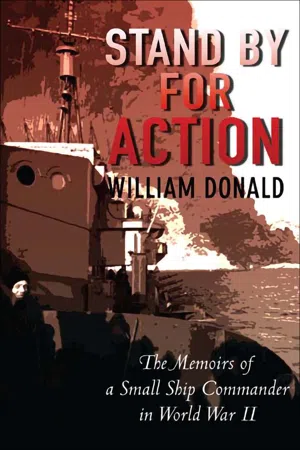
A naval memoir of the Second World War by a sea-officer who was awarded a DSC for providing anti-aircraft defense along the Norwegian coast.
The author of this compelling memoir proved himself one of the most successful small ship commanders during the Norwegian campaign in 1940, and then served at sea continuously throughout the rest of the War.
In Norway, as second-in-command of a Black Swan sloop, he experienced the suspense and nervous strain of operating in the narrow waters of a twisting fjord under heavy air attack, but his humor was never far away. "I don't want to appear fussy, but are we going to be greeted by cheers and kisses from Norwegian blondes, or a hail of gunfire from invisible Huns?" he remarked to his officers on approaching the small town of Andalsnes.
His next task—in command first of a corvette and then a destroyer—was escorting East Coast convoys, and his experiences reflect the danger of this work against the menaces of E-boats, enemy aircraft and mines. He then took part in the landings at Anzio and the Normandy landings in 1944; finally, he rescued internees from the Japanese prison camp on Stanley, Hong Kong. His career was much helped by his highly developed sixth sense for danger, the deep affection of his crews and his affinity with cats which he believed brought him luck.
This record of varied and almost incessant action ranks among the most thrilling personal stories of the war at sea.
- 208 pages
- English
- ePUB (mobile friendly)
- Available on iOS & Android
eBook - ePub
About this book
Information
Subtopic
Military BiographiesIndex
HistoryCONTENTS
PART ONE
NORWAY
NORWAY
I. INTO ACTION
II. THE GREAT ESCAPE
PART TWO
THE EAST COAST CONVOYS
THE EAST COAST CONVOYS
III. A SECOND BUMP
IV. THE LITTLE BIRD
V. THE MOON, MINES AND MUDBANKS
VI. THE E-BOAT PROBLEM
VII. THE ANCIENT WARRIOR
VIII. WINTER ON THE TRAMLINES
IX. STAND EASY AND THE SECOND HALF
PART THREE
PATROLLING TO ATTACK
PATROLLING TO ATTACK
X. A NEW TOY
XI. NIGHT ACTION
PART FOUR
THE MEDITERRANEAN
THE MEDITERRANEAN
XII. ALEXANDRIA, THE AZORES, ADRIATIC AND ANZIO
XIII. “COMBING THE MED.”
PART FIVE
OPERATION ‘OVERLORD’
OPERATION ‘OVERLORD’
XIV. STAND BY FOR ACTION
XV. THE DAWN AT LAST
EPILOGUE
WAR TO PEACE
WAR TO PEACE
XVI. EASTWARD HO!
To
all those shipmates with whom,
through many an adventure, it
was my good fortune and
privilege to serve.
through many an adventure, it
was my good fortune and
privilege to serve.
INTRODUCTION
AS A naval memoir of the Second World War, this is a remarkably self-effacing account from which the author emerges as a brave, decent and frank individual; and the lack of postwar glorification makes it a fascinating and very honest account of one naval officer’s war experiences. What adds particular value is that Donald spent much of his war in what, at least in the perception of mainstream naval history, is something of a backwater.
Donald makes little mention of his life in the service prior to the outbreak of hostilities. He was, in fact, born at Keswick Cumberland, on 1 July 1910. His father had served as mayor of Carlisle and, after Dartmouth, Midshipman William Spooner Donald was sent to serve the empire in small men-of-war, mainly on the China station. At the beginning of 1939 he was back in Britain and, with the shadow of conflict looming in the months after Munich, he and nine other lieutenants were sent to Whale Island prior to taking up appointments as first lieutenants in newly commissioning destroyers and sloops. Donald passed out tenth, but was satisfied that he had “jumped the first hurdle” to command. He joined HM sloop Black Swan and, under Captain A L Poland DSC, was part of the Rosyth Escort Force whose main task was the protection of convoys up and down the coast from Methil to the Thames. This was in due course to be the theatre in which Donald spent the greater part of the War, but for the Black Swan’s, involvement in the Norwegian campaign. What became a costly Débâcle was no fault of the forces engaged, and the Black Swan was under intermittent air attack as she provided anti-aircraft defence to troops ashore, actually sustaining a bomb-hit in her stern which fortunately failed to detonate, though it drove several holes right through three decks and a bulkhead on its passage through the lucky ship. For his services in Norway, Donald was awarded the DSC.
The Black Swan resumed the task of escorting east coast convoys which, in addition to consisting of coasters carrying general cargoes and colliers with much needed coal for power-stations, industry and domestic consumption in the south of England, also included the deep-water merchantmen dispersed from transatlantic convoys with cargoes consigned to those few east coast ports—including London—that were still able to handle the discharge of their lading in defiance of the German blitz. These convoys, which proceeded through swept channels marked by dimly lit buoys at intervals of five miles, commonly consisted of fifty ships in close order. In shallow water off the East Anglian coast, obstructed by numerous shoals and subject to fierce tides, the task would have been difficult enough in those pre-radar days, but to the further natural complications of foul weather with gales at one end of the spectrum and oily, foggy calms at the other, there were the added risks of enemy action.
Spotting aircraft could call up Luftwaffe units, usually Junkers Ju88s, which attacked by day, while at night the convoys, trundling along their predictable routes at seven knots could easily be interdicted by fast, heavily armed German E-boats. Frequent sallies were made by the enemy in order to outwit the efforts of the tireless minesweepers, and mines accounted for many vessels, further complicating the convoys’ navigation by littering the fairway with wrecks.
In due course—and after Black Swan had herself encountered a mine—Donald was promoted to lieutenant commander and appointed as captain to HMS Guillemot, a small, elegant Bird-class corvette which was also part of the Rosyth Escort Force. In Guillemot he continued the dull but dangerous task of working up and down the east coast. Although enemy attack was not inevitable, the risk of interception was constant, hence the title of his memoir, Stand by for Action, and Donald’s text is eloquent of the fatigue induced by constant vigilance, fatigue which easily turned into exhaustion. He is candid enough to admit his own fundamental errors when things went wrong, and his book is a text for any would-be ship’s captain, shorn of the glories and dwelling upon the realities of life in a small warship with its sparse pleasures and grindingly monotonous routines. There is no word of complaint and he devotes a section to the essential development of Coastal Forces and the gallantry of men like Lieutenant Commander R P Hichens who took the battle to the enemy.
Notwithstanding his modesty, Donald was clearly a dedicated and thoroughly professional sea-officer, a fact recognised by Their Lordships, who next appointed him to the old V-Glass destroyer Verdun, also part of the Rosyth Escort Force. Towards the end of the War Donald was transferred to command the new destroyer HMS Ulster in which, leading his squadron, he was engaged in a fierce engagement in the Western Channel with three German destroyers, an action which earned him a bar to his DSC. Later service in the Mediterranean confirmed his skill as a destroyer commander and he was present at the Anzio landings before being withdrawn prior to the assault on Normandy on D-Day in June 1944. His description of Operation Neptune is particularly vivid but he was now under great strain, suffering from battle-fatigue and requested to be relieved of his command.
In due course, however, he was appointed second-in-command of HMS Glengyle, a fine, fast cargo-liner which had been converted to an infantry assault vessel. Fortunately, rather than landing troops on the Japanese coast, the dropping of the atomic bomb found Glengyle repatriating internees from Hong Kong. Donald’s end-of-war foray into the eastern seas on such a mission was clearly an emotional experience for him and brings out the humanity for which he was admired by his young ship’s companies. He possessed an uncanny sense of premonition which saved lives on several occasions and which he was unable to account for.
After the War and promoted to commander, Donald commanded HM destroyer Concord before being invalided out of the Royal Navy in 1948 on account of debilitating deafness, probably brought on by exposure to frequent gunfire. He returned to his wife and daughter in his beloved Cumberland to run a business, where he died in 2002.
This book was a bestselling autobiography on its appearance in 1956 and retains a freshness and humanity which is a lasting testimony to its author.
Captain Richard Woodman FRHistS FNI
Author of the three convoy histories,
Arctic Convoys, Malta Convoys and the Real Cruel Sea
PART ONE
NORWAY
CHAPTER I
INTO ACTION
THE FIRST few months of 1939 I spent at Portsmouth Barracks as a member of the Training staff for New Entry Seamen. Life was peaceful and pleasant, and I played hockey twice a week for Portsmouth Services and the Navy hockey teams. My wife and I had just settled into a little house in Alverstoke, and the outlook in every way was quite promising.
But as the first rumbles of the approaching war gradually made themselves heard, retired officers were called up for the shore jobs, and all available active service officers like myself were appointed to ships.
“Nice job for you anyway, Donald,” said the Training Commander one April morning, “Number One of a new sloop building.”
“Where, sir?”
“Black Swan—up at Yarrow’s in Bonnie Scotland.”
Before going up to Clydeside, I had to do a three-weeks’ gunnery course at Whale Island. Ten of us took the course— all First Lieutenants of new destroyers and sloops then being built. I passed out tenth: but I had the satisfaction of knowing that I had jumped the first hurdle towards a destroyer command.
When I arrived at Yarrow’s, the Black Swan had not even been launched, and the Engineer Officer was the only other officer as yet appointed. “Chiefee” Germain was a Lieutenant (E) ex-Lower Deck, and a good deal older than myself. He was very efficient at his job, and we got on very well together. We shared an office with our opposite numbers of the Flamingo, sister ship of the Black Swan, but in a more advanced state of completion. Two other ships were also being built there, the destroyers Jupiter and Kipling. It was extremely interesting to watch the Black Swan being launched, and then gradually fitted out towards completion: and so the weeks of that glorious summer slipped agonisingly by, with the evergrowing knowledge of the certainty of approaching war.
“…and…this country is now at war with Germany.”
Those quiet words of Neville Chamberlain came to me in a tobacconist’s shop in Scotstoun. On my way to the shipyard I had called in at the shop, and asked if I could listen to the news. When it was over I walked slowly down to the yard, and stood gazing at Black Swan, as she sat, mute and half finished, in the fitting-out basin. On that still, grey Sunday morning, she did indeed look like a real swan, asleep on the surface of the water. I pondered for some time what her fate would be.
She certainly looked a grand little ship and able to give a good account of herself. She was a vessel of 2,000 tons and she had six four-inch guns, arranged in pairs on a new type of mounting. Two of these were forward and one aft; they were specially designed for anti-aircraft fire, with an elevation of 80 degrees.
As events turned out this was just as well. She had also a four-barrelled pompom, situated amidships between the masts and therefore directly below the wireless aerials. (When I pointed out to a gunnery expert that this position ensured that the aerials would inevitably be shot away when firing at an aircraft overhead, I was laughed to scorn. Six months later in the chaos of action in Norway this happened time and time again.)
She was fitted with the brand new stabiliser gear, two enormous horizontal fins that could be run out as required under water amidships to stop the ship rolling. In actual practice we did not make use of them a great deal, as when in the “out” position, the noise of the motors controlling them interfered with the working of the Asdic set. The space required to house this gear reduced the boiler space, and the ship’s maximum speed was under 20 knots. From the accommodation point of view she was very well fitted out, and it was a great thrill to see her finally finished.
But a ship is not just a matter of steel and iron and wood, she has a personality of her own. That personality comes into being through her Captain, officers and ship’s company. In Captain A. L. Poland, D.S.G. we had as fine a skipper as one could wish for: he had held destroyer command in peacetime, but his most recent appointment was Commander of Chatham Barracks. Correct, a strict disciplinarian but with a keen sense of humour, he was—by reason of the disparity in age between us—very like a father to the rest of us: which, I suppose, is what the Captain of a ship should be.
Lieutenant Jimmy Tennyson, D.S.C., the Pilot, was an ex-Dartmouth type like myself: an amusing messmate, fond of games of every sort, he did his job well and had no inhibitions. Sub-Lieutenant Jack Holmes, the Sub, had been promoted from the Lower Deck: he was very conscientious, though his main job as Correspondence Officer, without the aid of a competent Writer rating, sometimes rather got him down.
Gunner Johnnie Duggan, “Guns”, was a typical keen young West Country man: cheerful and loyal, he had his job completely buttoned up. Surgeon-Lieutenant Bob Lander, the Doc, combined reliable professional knowledge with an extensive knowledge of life with a capital “L”. Always good-humoured, generally with a ripe story on tap, he was a great asset to the ship. Himself a County rugger player, he was a good Sports Officer.
Anyhow, we all shook down together pretty well in the wardroom, and in January, 1940, the ship commissioned fully.
Deep snow lay everywhere to greet the main body of the crew who arrived, thoroughly miserable, after a typical wartime train journey from Devonport.
Next day we sailed down the Clyde to Greenock where we worked all night—in even deeper snow—ammunitioning ship. After our trials in the Clyde in pretty miserable weather, we sailed for Portland for a three-week work-up. During this time the weather was even worse, and...
Table of contents
- Cover
- The Author
- Full Title
- Copyright
- Contents
Trusted by 375,005 students
Access to over 1.5 million titles for a fair monthly price.
Study more efficiently using our study tools.
Frequently asked questions
Yes, you can cancel anytime from the Subscription tab in your account settings on the Perlego website. Your subscription will stay active until the end of your current billing period. Learn how to cancel your subscription
No, books cannot be downloaded as external files, such as PDFs, for use outside of Perlego. However, you can download books within the Perlego app for offline reading on mobile or tablet. Learn how to download books offline
Perlego offers two plans: Essential and Complete
- Essential is ideal for learners and professionals who enjoy exploring a wide range of subjects. Access the Essential Library with 800,000+ trusted titles and best-sellers across business, personal growth, and the humanities. Includes unlimited reading time and Standard Read Aloud voice.
- Complete: Perfect for advanced learners and researchers needing full, unrestricted access. Unlock 1.5M+ books across hundreds of subjects, including academic and specialized titles. The Complete Plan also includes advanced features like Premium Read Aloud and Research Assistant.
We are an online textbook subscription service, where you can get access to an entire online library for less than the price of a single book per month. With over 1.5 million books across 990+ topics, we’ve got you covered! Learn about our mission
Look out for the read-aloud symbol on your next book to see if you can listen to it. The read-aloud tool reads text aloud for you, highlighting the text as it is being read. You can pause it, speed it up and slow it down. Learn more about Read Aloud
Yes! You can use the Perlego app on both iOS and Android devices to read anytime, anywhere — even offline. Perfect for commutes or when you’re on the go.
Please note we cannot support devices running on iOS 13 and Android 7 or earlier. Learn more about using the app
Please note we cannot support devices running on iOS 13 and Android 7 or earlier. Learn more about using the app
Yes, you can access Stand By for Action by William Donald in PDF and/or ePUB format, as well as other popular books in History & Military Biographies. We have over 1.5 million books available in our catalogue for you to explore.