A
Financial Times Top Business Book 2020
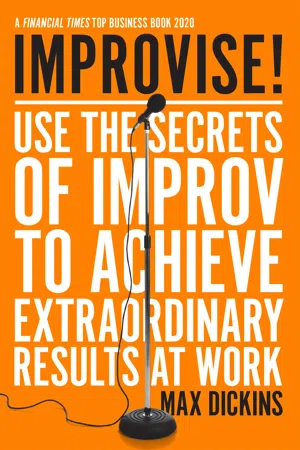
Improv performers look like creative geniuses, coming up with brilliant comedy on the spur of the moment. But they rely on some simple rules and techniques - ones which anyone can learn, and which can help us offstage to think creatively, collaborate with others and communicate with impact.
Improvise! will show you how to handle whatever comes your way at work - from giving confident presentations and handling difficult conversations to coming up with great ideas and persuading others to make them happen.
Comedian and improvisation for business coach Max Dickins combines examples from the world of work with exercises from the stage to teach you how to achieve extraordinary results with what you've already got.
eBook - ePub
Improvise!
Use the Secrets of Improv to Achieve Extraordinary Results at Work
- 304 pages
- English
- ePUB (mobile friendly)
- Available on iOS & Android
eBook - ePub
About this book
Information
Chapter 1
‘YES, AND’
‘There are people who prefer to say “yes” and there are people who prefer to say “no”. Those who say “yes” are rewarded by the adventures they have. Those who say “no” are rewarded by the safety they attain.’6
—Keith Johnstone
Yes. And. Two short, simple words which, together, define an entire approach to living, working and playing. ‘Yes, and …’ is the beating heart of all improvisation. It is the elixir that allows improvisers to create something out of nothing. There is magic in these words. Except … it’s not magical at all. It’s a simple rule of thumb that anyone can use to build almost anything. In this chapter I’ll show you how ‘yes, and’ can help make you more creative at work, have better conversations at home and be more adventurous everywhere.
But what exactly is this ‘yes, and’ concept? For improvisers, it is many different things. First, it’s a practical technique: a tool we use to build scenes or ideas together as a group. Second, it’s a way of thinking that will set us on a path to every other key concept in improvisation. By the end of this chapter we’ll see that the best way to think of ‘yes, and’ is as more than either a methodology or a philosophy, but as a Tao: a way of being in the world. You’re either a ‘yes, and’ sort of person or you’re not – but ‘yes, and’ people are made not born. That’s what this book is all about. Ready to start? It all begins with ‘yes’.
ALWAYS THINK ‘YES, AND …’
The best way to understand how this works is through example. So, here’s how it looks onstage. Say you and I are doing a scene together. I get the first line. I crouch on my haunches, pat the stage with my hand, and say:
‘It’s been a hot summer, Jack, too hot. The damn fields are like concrete. Who’d be a farmer, eh?’
You listen carefully to this blistering piece of dialogue. Then, having basked in the warm light of my celestial talent, it’s your turn to speak. How might you respond to my line? Here are two options. Choose the one you think is better for the scene:
1: ‘Aye, Ted, it’s been the hottest summer I’ve ever known. I’m sweating in places I didn’t even know I had.’
Or:
2: ‘Farm? I think you’ve been smoking something, mate! We’re on a spaceship! And who are you calling Jack? My name is Barnabus, King of the Uber drivers.’
Which line did you go for? Line 1 is a ‘yes, and’ response, whereas in improv parlance line 2 is a ‘block’. Admittedly, ‘My name is Barnabus, King of the Uber drivers’ is an amazing line. It’s just not an amazing line for this scene. In fact, it’s a terrible line for this scene. Because, first, you’ve thrown me under a bus by denying the reality of my ‘offer’. (I told the audience we were on a farm, not a spaceship!) And, second, you totally ignored my idea and steamrollered it with your own. As improvisers we now have two totally different ideas of what’s going on in the scene. Without agreement we’re not building anything, we’re moving sideways. A hard job has suddenly got harder and the audience is not impressed.
This disaster is very easily avoided. In improv, instead of blocking or negating other people’s ideas, we accept and build on them. This is the meaning of ‘yes, and’. By saying line 1, you have accepted all the details contained within my initiating line (the ‘yes’): your character’s name is Jack; we’re on a farm; it’s hot. You’ve also built on them by adding some information of your own (the ‘and’), which allows us to move the scene forwards. First, you’ve endowed me with a name, adding that my character is called Ted. Second, you’ve intimated that your personal hygiene is a disgrace. This fun offer is something that I can now build on with my own ‘yes, and’ response. For example, our scene might grow like this:
ME: It’s been a hot summer, Jack, too hot. The damn fields are like concrete. Who’d be a farmer, eh?
YOU: Aye, Ted, it’s been the hottest summer I’ve ever known. I’m sweating in places I didn’t even know I had.
ME: I’ve been meaning to talk to you about that actually, Jack. I think it’s about time you started wearing deodorant.
Now, admittedly, we’re hardly at Will Ferrell levels of zinger yet. But we do have the acorn of a fun situation. By accepting each other’s offers, we’ve established a platform from which we can build the rest of the scene together. We’ve established that there are two gruff farmers, one of whom has a body odour problem, which the other thinks he needs help with. What’s more, to the audience, we look telepathic, when really all we are doing is paying close attention to each other’s offers and then responding in kind with our own. You might continue this scene as follows:
YOU: I don’t believe in male grooming. A woman likes a man who smells of himself.
And so on. You’ll have your own views about the comedic potential of this scene. But the point stands that we would never have got to this level of complexity and fun without the simple practice of agreeing with, and then building on, the established reality. We certainly would not have got there this quickly. We’d obviously need to push things on further in order to reach comedy nirvana. But this simple process of ‘yes, and’ will get us there eventually.
APPLYING THIS OFFSTAGE
You can see that the philosophy of ‘yes, and’ is crucial for improvisers because it is an effective and efficient way to develop action onstage and therefore satisfy an audience. But not everyone treads the boards. So, let’s turn our attention now to offstage applications. Why should you care about this ‘yes, and’ thing? We’ll discover that ‘yes, and’ thinking can help you:
- Lead happier and more collaborative teams.
- Be more creative.
- Overcome conflict and negotiate effectively.
- Own the room (or screen) in meetings.
We’re going to explore all the above in depth as we move through this chapter. But, as before, let’s begin with an example. I’d like you to imagine you are part of a communications team at some glamorous marketing agency. It’s the sort of creative company where the floor is carpeted with AstroTurf. You can write on the walls. There are no chairs; everybody just sits on obsolete washing machines. The Creative Director doesn’t wear shoes, and there’s an office turtle. A meeting has been called because your team needs to come up with innovative ways to communicate a new company strategy internally. The email goes out. Everyone assembles – including you.
All the meeting rooms in your trendy office are named after former members of the Spice Girls. You’re in ‘Posh’. Behind the door, the leader of the team goes through the usual platitudes: ‘Let’s brainstorm guys’; ‘Come on, think outside of the box’; and ‘All aboard the creativity train! Next stop, Ideas City.’ The table is caked in Post-it notes, highlighter pens and Haribo. Things are looking good. Your boss looks expectantly at his battalion. Silence.
Sixty painful seconds pass. Your boss writes the word ‘Ideas’ on the wall in bright red pen and surrounds it with a cloud shape, as if this might help. Another minute passes. The wide-eyed intern James suggests a coffee run. Another minute passes. Finally, mercifully, your colleague Sindy bravely sticks her head above the parapet.
‘Why don’t we do a short YouTube video explaining what we want to do? We could stick it on the company intranet?’
Your boss laughs. ‘A video! Thank you, Steven Spielberg. Be realistic, guys. Let’s face it. No one’s going to bother watching a video.’ Sindy bows her head, her face turning as red as the Fizzy Fangs on the tabletop.
Another colleague pipes up: ‘And I’m not being funny; I’m not having a go, Sindy, but when are we going to have time to film and edit a video?’
A chorus of agreement rings out, a mumbled elegy: the idea is dead. Resting in pieces on the meeting room floor.
DELAY JUDGEMENT
The example above might seem extreme. But episodes like this play out every day in workplaces throughout the land. This blocking behaviour, anathema to improvisers, has serious short-term and long-term consequences for teams. We’ll look at the longerterm damage a bit later, but first let’s see the immediate problem that blocking has caused. The idea that Sindy pitched has been killed before it was even explored. The team has denied themselves a potentially useful solution by judging it immediately. This is a huge waste of potential because new and challenging ideas – ideas that change things – don’t often come out fully formed. They are incomplete and ugly, newborn foals stumbling around bewildered in the light, trying to work out who they are.
A central part of the ‘yes, and’ mindset is to delay judgement. This means hearing an idea and not immediately deciding if it’s right or wrong, useful or useless. It requires you to look for all the potential in an idea before you look for all the problems. This doesn’t require you to agree with the idea. (You don’t have to become some sort of inane, grinning yes man.) But it does require you to unconditionally accept the idea in a spirit of play, to decide to explore it for a while. ‘Yes, and’ doesn’t require you to believe a given idea will work, just to suppose that it might. The difference between supposing and believing is small but profound. Improvisers quickly learn that supposing can open up the world in thrilling new ways. But what exactly does it involve?
Supposing is the central skill of an actor. If I am an actor playing a milkman in a scene, I don’t need to believe that I actually am a milkman. That would be absurd. Instead, for me to convincingly play a milkman, I just need to temporarily suppose that I am one. I simply act as if it were true that I am indeed a milkman. So, I ask myself: What would I do, think and feel in this situation if I were, in fact, a milkman? In the same way, when you interact with an idea, you don’t have to believe in it. Your interaction with that idea is not contingent upon you believing it to be true or brilliant. You just have to act as if the idea were brilliant, and ask yourself: If this were a great idea, how could I explore and develop it? It’s a mind-widening business.
Although I said that we should delay judgement, that doesn’t mean we should abandon it entirely. It is simply a matter of timing. Clearly, selecting the best ideas from what we generate is crucial in getting the outcome we want. However, we often jump to criticism too quickly, at the expense of genuine exploration. After all, analysis makes us look clever. We are especially inclined to do this if we bring significant expertise and experience to the problem at hand. Experience supplies us not just with insight but also with intellectual baggage. In short, experts bring with them assumptions of what will and will not work. These assumptions can shut down their thinking and also the thinking of everyone else too. After all, who are we to question them? They’re the experts!
Just as bodybuilders maintain their physiques by working out in the gym, if we want to stay creatively flexible we need to constantly work our ‘yes, and’ muscle. This is because, just as being enormously muscular is not natural, saying ‘yes’ actually goes against some fundamental human instincts. We have evolved to hate uncertainty. Studies have shown that people would rather definitely get an electric shock now than wait to see...
Table of contents
- Praise
- Title Page
- Dedication
- Contents
- Foreword
- Introduction
- Chapter 1: ‘Yes, and’
- Chapter 2: Listening
- Chapter 3: Spontaneity
- Chapter 4: Failure
- Chapter 5: Collaboration
- Chapter 6: Agility
- Conclusion
- Notes
- Acknowledgements
- Appendices Improv warm-up exercises to try in the office
- How to improvise online
- About the Author
- Work with Max
- Copyright
Trusted by 375,005 students
Access to over 1.5 million titles for a fair monthly price.
Study more efficiently using our study tools.
Frequently asked questions
Yes, you can cancel anytime from the Subscription tab in your account settings on the Perlego website. Your subscription will stay active until the end of your current billing period. Learn how to cancel your subscription
No, books cannot be downloaded as external files, such as PDFs, for use outside of Perlego. However, you can download books within the Perlego app for offline reading on mobile or tablet. Learn how to download books offline
Perlego offers two plans: Essential and Complete
- Essential is ideal for learners and professionals who enjoy exploring a wide range of subjects. Access the Essential Library with 800,000+ trusted titles and best-sellers across business, personal growth, and the humanities. Includes unlimited reading time and Standard Read Aloud voice.
- Complete: Perfect for advanced learners and researchers needing full, unrestricted access. Unlock 1.5M+ books across hundreds of subjects, including academic and specialized titles. The Complete Plan also includes advanced features like Premium Read Aloud and Research Assistant.
We are an online textbook subscription service, where you can get access to an entire online library for less than the price of a single book per month. With over 1.5 million books across 990+ topics, we’ve got you covered! Learn about our mission
Look out for the read-aloud symbol on your next book to see if you can listen to it. The read-aloud tool reads text aloud for you, highlighting the text as it is being read. You can pause it, speed it up and slow it down. Learn more about Read Aloud
Yes! You can use the Perlego app on both iOS and Android devices to read anytime, anywhere — even offline. Perfect for commutes or when you’re on the go.
Please note we cannot support devices running on iOS 13 and Android 7 or earlier. Learn more about using the app
Please note we cannot support devices running on iOS 13 and Android 7 or earlier. Learn more about using the app
Yes, you can access Improvise! by Max Dickins in PDF and/or ePUB format, as well as other popular books in Business & Business Communication. We have over 1.5 million books available in our catalogue for you to explore.