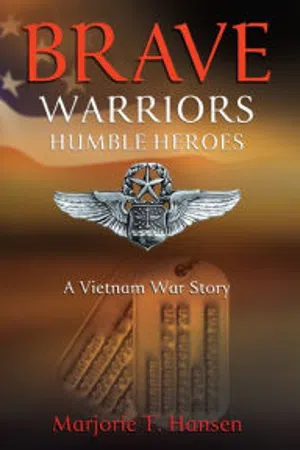
Through her husband's letters from Southeast Asia about his combat missions in Vietnam and over the Ho Chi Minh Trail in Laos in 1971 and 1972, Marge Hansen shares a gripping journey into one of the most divisive and turbulent periods in the nation's history. Brave Warriors, Humble Heroes: A Vietnam War Story captures in a flier's words the conflict, drama, frustration, heroism, and longing for home and family that mark combat missions. Through meticulous research and compelling narrative, Marge brings to readers a chance to understand what may have been only an ongoing headline in the news for those at home or a distant episode in American history for younger readers. In her voice and Charlie's, she captures the experience of those who serve and those who support them. For Marge and Charlie, the war was immediate and personal and has not ended; both were impacted by the legacy of Agent Orange—he from his assignment to front-line bases and she from her visit to him at one of those bases. Brave Warriors, Humble Heroes recounts the story of one war, one hero, one marriage, and one family. This book stands for all those whose voices have not been heard.
- 232 pages
- English
- ePUB (mobile friendly)
- Available on iOS & Android
eBook - ePub
About this book
Information
Publisher
Brown Books Publishing GroupYear
2014Print ISBN
9781612542171
9781612542096
eBook ISBN
9781612542263
1
CHARLIE’S STORY: THE EARLY DAYS
We stood on the runway at Nakhon Phanom Royal Thai Air Force Base (NKP) February 3, 1972, holding each other as I fought back tears and desperately tried to smile as we said good-bye. It was time for me to start my journey back to the States after fifteen days in Thailand with Charlie. On that hot, humid runway near the Laotian border, 235 miles from Hanoi, North Vietnam, sadness and fear washed over me like a giant ocean wave. Charlie had three more months of flying combat missions over the Ho Chi Minh Trail in Laos before he could return home, and leaving him behind in a war zone was heartbreaking, knowing the danger he faced and the possibility we would never hold each other again. As I silently prayed for God to protect him, I experienced a strong unsettling feeling that the Vietnam War would never end for us. The dark premonition was to become our fate.
Shortly after my flight departed NKP, Charlie wrote,

Thurs AM
3 Feb ’72
Dearest Marge,While you are still in the air for Bangkok and I’m waiting for someone to come get the air conditioner, I’ll jot down a few lines.I’m sure you feel like I—the past two weeks have been an almost perfect honeymoon. I say “almost” because I got left behind. You’ll really have some stories to tell your grandchildren now!So much for now. I miss you already and—
I love you,
Charlie
I really do have some stories to tell my grandchildren now! The story I love to tell the most is Charlie’s story.
Charlie’s commitment to a life of service began when he was a child growing up in East Point, Georgia. He was a Boy Scout, an acolyte in the Episcopal Church at age nine, and a summer church camp counselor. Although he had many opportunities in his childhood, his life was far from privileged. Times were hard in the South from 1934 to 1952. He was raised by his mother and maternal grandmother who worked long hours to provide private school and a loving home for him. He swept floors and bagged groceries at the local grocery store from the time he was old enough to work until he left home for college. Knowing that college would not be possible for him without a scholarship, in the eighth grade, he entered Georgia Military Academy in College Park, Georgia, as a day student where he focused on his education, with a service academy appointment as his goal. He graduated magna cum laude from GMA in 1952 with honor appointments to both the United States Naval Academy in Annapolis and the United States Military Academy in West Point. He chose the US Naval Academy and graduated with the Class of 1956 as a member of the 13th Company. He was commissioned into the United States Air Force upon graduation.
Charlie’s story became our story when I met Second Lieutenant Charles Jasper Hansen Jr. in September 1956 during my senior year at Florida State University (FSU) in Tallahassee. As a favor to my sorority sister, I had reluctantly agreed to be his blind date for an entire football weekend. I was not too happy about the arrangement since I had just returned a United States Naval Academy pin to a midshipman, Class of ’58. Disappointed about the failed relationship, I had vowed never again to date a service academy man! However, since I had attended June Week ’56 in Annapolis when Charlie Hansen graduated, my sorority sister thought we would have something to talk about over the long football weekend. She was right. Our one-weekend-only blind date led to a lifetime of adventure, joy, and love.
During that first weekend and in the months and years that followed, we discovered the many things we had in common like our traditional values, faith in God, love of education, and strong desire to serve something greater than self in our chosen careers. We were young, idealistic, in love, and ready to take on the world. After I graduated from FSU with the Class of ’57 and completed one year of secondary level teaching and Charlie completed his flight training and earned his navigator wings, we married in 1958.
I am blessed without measure to have been a part of his extraordinary life for fifty-six years—his best friend, his wife, his lover, the mother of his two fine sons, and the grandmother of his three precious granddaughters. Our life together had all the elements of a beautiful love story—glamour, excitement, adventure, travel, danger, adversity, disappointment, sacrifice, loneliness, sadness, fear, challenges, illness, and death. The most important elements were faith, hope, and love.
Our story played out all over the world—from the FSU campus to Japan; from the Florida beaches to the rugged California coast and the islands of Hawaii; from South Vietnam to the jungles in Thailand; from frozen North Dakota to deep in the heart of Texas—during one of the most divisive and turbulent times in our country’s history, 1956–2012, which saw the Cold War, the Cuban Missile Crisis, assassinations, racial unrest, the Vietnam War, riots, secret wars in Laos and Cambodia, Agent Orange, downsizing of the military, and social change.
Charlie’s first assignment after training was to Yokota Air Base, Japan, in 1959 and 1960. He spent a year flying as a crew member on a RB-66, an electronic countermeasures aircraft. As newlyweds in an exotic foreign country, we lived a life that could not have been more exciting or glamorous! We lived off base in Shimo Fussa in a tiny Japanese house that had traditional tatami mats on the floor and sliding shoji screens, and on a clear day, we had a breathtaking view of the magnificent snow-capped Mount Fujiyama from our bedroom window. In January 1960, Charlie and I were two of just a few Americans on the Imperial Palace grounds in Tokyo to see and hear the emperor of Japan speak. Fifteen years earlier, the Japanese and Americans were enemies, but on that day in 1960, Charlie and I were honored guests. Our lives were forever enriched by the friendships we made with the Japanese people, and we were sad that we had to leave Japan after just a year.
Upon the completion of his one-year tour at Yokota AB, Charlie was ordered back to the States for B-52 crew training in California and assigned to Strategic Air Command (SAC) Eglin AFB, Florida, Electronic Warfare Officer (EWO), B-52 Bomber. During our assignment at Eglin, the reality of military life hit me hard. Although Charlie had prepared me for the difficulties of Air Force life, I was not tested until the Cuban Missile Crisis in October 1962. Because of the nuclear capabilities and the geographic location close to Cuba, Eglin AFB was considered a primary target. B-52 crews were ordered to pack their flight gear and bags for an extended period away from home. Families were told only that information would be forthcoming as the situation developed, but we received no information on their location. We didn’t know if our husbands were flying, on alert at a facility on base, or evacuated to a military installation beyond the missiles’ range. When Charlie left home, I didn’t know if I would see him again. If he did return, would our baby son and I be alive?
Crippled with fear, Air Force families waited along with the entire world for thirteen days in October 1962—on the brink of nuclear war—and prayed for a peaceful end to the crisis. For the first and only time in our history, military readiness within the Strategic Air Command was raised to DEFCON 2, and Eglin AFB B-52s were staged to play a crucial role. Overnight B-52 crew wives were transformed from carefree, frolicking girls on the Ft. Walton–Destin beaches into strong, tough, mature women who came together to help each other through one of the most terrifying episodes in history. The coping and survival skills we developed served us well throughout our Air Force lives, preparing all of us for the turbulent Vietnam War era ahead—and preparing many of us for our final role: surviving spouse.
Ten months after the Cuban Missile Crisis, I experienced the difficulties of Air Force life once again. Charlie was actively pursuing a career change into engineering by testing, interviewing, filling out endless forms, and attending career counseling for graduate school, while I was preparing for the C-section delivery of our second baby due in August 1963. President Kennedy’s son died from Hyaline Membrane Disease two days after his emergency C-section delivery at Otis AFB, Massachusetts, on August 7, 1963. Thinking the early C-section might have caused the tragic death, US Air Force hospitals including Eglin AFB Hospital changed their policy on C-section deliveries. Eglin AFB Hospital immediately stopped any prearranged C-section deliveries and awaited due dates before scheduling surgery. Since my C-section had been scheduled almost three weeks early, Charlie’s personal time off to be with me was granted only if he switched crews and was not on alert when I went into labor. There was no way to schedule the event—babies and Air Force scheduling were not compatible! Charlie was on alert when I went into labor.
Everything that could have gone wrong did go wrong: the lengthy labor, drugs, and excessive blood loss complicated the C-section delivery. But our baby was beautiful, healthy, and robust. Even though Charlie was on B-52 alert at a facility only five minutes away from the hospital, he was not allowed to be with me for longer than fifteen minutes after the delivery. On our fifth wedding anniversary, two days after our baby’s birth, I was in critical condition in the Intensive Care Unit while Charlie remained on alert. I was upgraded to serious condition twenty-four hours later and discharged after nine days in the hospital. I desperately needed him with us but soon learned that Air Force wives were dependent in terminology name only—we could never be dependent. The wonderful B-52 crew wives took care of us while he was away. During the remainder of his B-52 duty at Elgin that ended in June 1964, Charlie was with us only during his compensatory time off (CTO). B-52 crew families accepted the hardships without question in those days, believing the mission had to come first. Perhaps it was the idealistic belief that we were making a difference in the world that kept our attitudes positive. Although US Air Force life was hard in 1963, it would get harder in the years ahead as idealism was replaced with realism. Charlie’s pursuit of a different career path for a better future and a better life for us paid off.
Charlie was accepted for graduate school in June 1964. He was thrilled and ready to leave flying behind him. With an advanced engineering degree, he would have opportunities in engineering that also allowed him to be with his family more. By then, we had two little sons to move with us to Dayton, Ohio. In 1966, Charlie received his master of science in aerospace engineering after two years of study at the Air Force Institute of Technology at Wright Patterson AFB, Ohio. Keeping two little boys quiet for Dad to study was a feat just as impressive as his graduate work!
Following graduate school, Charlie was assigned to Vandenberg AFB, California, as Chief, Scout Engineering Operations Branch, Scout Boosted Systems Division, 6595th Aerospace Test Wing from 1966 to 1971. He had found a career path that stimulated and challenged him, and he called the new assignment his Air Force dream job. He was recognized by the European Space Research Organization in Holland in 1968 and 1969 for his participation in the successful launches of the satellites of the ESRO-1/Boreas satellite program. In 1970, he received the Air Force Commendation Medal for five years of meritorious service.
Vandenberg AFB was a great place to raise a family. The surrounding area was beautiful. We camped in Big Sur and played up and down the spectacular California coastline. Our family life in California was all that we could have wished for. Charlie loved being with the boys, and unlike his two previous assignments, at Vandenberg he had quality time to spend with our sons each day. Watching as they played, did homework, camped, fished, worked on Boy Scout Pinewood Derby race cars, practiced Little League baseball, and built sandcastles at the beach was like having three little boys.
Charlie had an aura of authority about him that we did not challenge—he led by example, not expecting more from us than he expected from himself. But sometimes the boys would come to me to plead for help when they got out of line. I often heard, “Dad expects us to be perfect, and we are just little boys!” Unlike many Air Force husbands and fathers in the ’60s and ’70s, he never made demands nor insisted on strict rules. He left discipline to me—to my dismay at times. With just one look from their dad, the boys would transform into little angels. For me it took more than just a look. I closely observed Charlie’s effective techniques and learned so much about leadership from him.
In the summer of 1969, we traveled Space Available—on empty seats of Air Force flights—from Travis AFB, California, to Hawaii for a month of leave in paradise. Our sons had their first flight on a USAF cargo plane, seated backwards with our luggage swinging in a cargo net over our heads. What an adventure! We toured all of the islands and saw all of the sights—we even saw Kilauea Volcano erupting. We were staying at the Volcano House, an old historic hotel on the rim of the volcano at Volcano National Park on the big island of Hawaii where we watched the eruption from our windows. We had been isolated from the Vietnam War at Vandenberg and were surprised to see hundreds of military couples and families in Hawaii for Rest and Recuperation Leave (R&R) from the war. I silently prayed that we would not be among them in the coming months or years. My prayers went unanswered.
In late 1970, Charlie received orders to Lockbourne AFB, Ohio, for combat crew training as a C-123 navigator. After training, he was to report to Pacific Air Forces (PACAF) Jungle Survival School, Clark AFB, Philippines, and then proceed to Phan Rang AB, Vietnam, with a crew position as a C-123 Navigator 315 Tactical Airlift Wing, PACAF. I was numb with shock. I had thought that since Charlie had a new career field in engineering, his flying days were over. I definitely didn’t understand how the US Air Force worked. If you were rated to fly, you would fly when needed. Charlie always knew his turn would come. He shared his private thoughts about Vietnam with me, but like thousands of others called to fight in the unpopular war that was tearing the country apart, he refrained from openly discussing the policies and politics of the Vietnam War. He transitioned from his engineering duties at Vandenberg and left for combat crew training in early 1971.
Vandenberg AFB had a strict housing policy in 1971. If the sponsor was not assigned to VAFB, dependents were not allowed base housing. Even if the sponsor received orders to Vietnam while in base housing during the school year, dependents had to move. The Air Force didn’t care where we went. Our moving allowance would pay for shipping us anywhere as long as it was off base. Since there were no official support groups at VAFB for dependent families during the Vietnam War, we were responsible for ourselves. Back in the ’50s when we were newlyweds, there was an old adage: “If the Air Force wanted you to have a wife, they would have issued you a wife.” My Navy wife friends told me they had it a lot tougher than Air Force wives. In addition to the issued wife quip, they had the following: “Name three things a Navy man doesn’t need: a wife, a car, and civilian clothes.” We laughed about it at the time, but I appreciated the irony of those old adages when we had to move out of base housing when Charlie was deployed to Vietnam. How times have changed for the better.
The only way I could keep our sons in their school on base was to buy a trailer and move into the noncommissioned officer (NCO) trailer park on base. Since the park was reserved for NCO families, the base commander and the NCO families had to approve my request to move into their park. I don’t know what we would have done if the families had said no. They exemplified the very best of what Air Force life was about. Not only did they open their park to us, they opened their hearts. Air Force families, regardless of rank, race, or religion, took care of each other. I surprised Charlie with my planning and my determination to stay on base at Vandenberg. I had valid reasons for staying in our familiar surroundings: I had a great job working on base for the US Air Force as a communications instructor, contracted through the Lompoc School District; the boys didn’t need their school year disrupted at the same time they were separated from their father; and we needed the security of the base so Charlie would have one less worry on his long worry list.
Truthfully I needed to be waiting for Charlie where he had left us. I could not imagine waiting in an unfamiliar place for him to return to us. When my loneliness for him became almost unbearable, I would take the boys down to the rugged beach not far from the trailer park where they could run and build sandcastles. I felt closer to Charlie when I could look out over the Pacific Ocean, as though I could will my love to him all the way to the South China Sea.
During the time Charlie was at Lockbourne AFB, Ohio, in ...
Table of contents
- Cover Page
- Title Page
- Copyright
- Dedication
- Contents
- Acknowledgments
- Chapter 1: Charlie’s Story: The Early Days
- Chapter 2: Charlie’s Letters: War and Loneliness
- Chapter 3: War Front—Home Front
- Chapter 4: Return to War
- Chapter 5: Relocation: Ho Chi Minh Trail
- Chapter 6: Adventures in Thailand: Bangkok and Nakhon Phanom
- Chapter 7: Combat Over the Trail: Laos and Vietnam
- Chapter 8: Return from War
- Epilogue: Vietnam Legacy: Agent Orange
- Appendix
- About the Author
- Back Cover
Trusted by 375,005 students
Access to over 1.5 million titles for a fair monthly price.
Study more efficiently using our study tools.
Frequently asked questions
Yes, you can cancel anytime from the Subscription tab in your account settings on the Perlego website. Your subscription will stay active until the end of your current billing period. Learn how to cancel your subscription
No, books cannot be downloaded as external files, such as PDFs, for use outside of Perlego. However, you can download books within the Perlego app for offline reading on mobile or tablet. Learn how to download books offline
Perlego offers two plans: Essential and Complete
- Essential is ideal for learners and professionals who enjoy exploring a wide range of subjects. Access the Essential Library with 800,000+ trusted titles and best-sellers across business, personal growth, and the humanities. Includes unlimited reading time and Standard Read Aloud voice.
- Complete: Perfect for advanced learners and researchers needing full, unrestricted access. Unlock 1.5M+ books across hundreds of subjects, including academic and specialized titles. The Complete Plan also includes advanced features like Premium Read Aloud and Research Assistant.
We are an online textbook subscription service, where you can get access to an entire online library for less than the price of a single book per month. With over 1.5 million books across 990+ topics, we’ve got you covered! Learn about our mission
Look out for the read-aloud symbol on your next book to see if you can listen to it. The read-aloud tool reads text aloud for you, highlighting the text as it is being read. You can pause it, speed it up and slow it down. Learn more about Read Aloud
Yes! You can use the Perlego app on both iOS and Android devices to read anytime, anywhere — even offline. Perfect for commutes or when you’re on the go.
Please note we cannot support devices running on iOS 13 and Android 7 or earlier. Learn more about using the app
Please note we cannot support devices running on iOS 13 and Android 7 or earlier. Learn more about using the app
Yes, you can access Brave Warriors, Humble Heroes by Marjorie T. Hansen in PDF and/or ePUB format, as well as other popular books in History & North American History. We have over 1.5 million books available in our catalogue for you to explore.