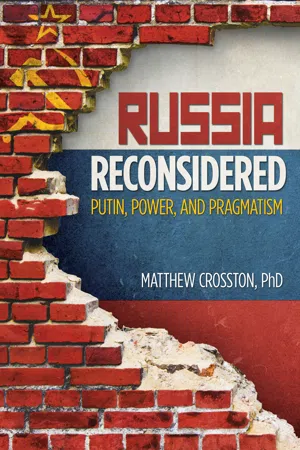
With his years of expertise in Russian studies, Dr. Matthew Crosston gives readers a close look at the many facets of the strained foreign relations between the United States of America and the Russian Federation. While acknowledging the pragmatism, self-interest, and unethical aspects of Russia's foreign policy, Crosston argues that this ever-tense situation is best viewed through an amoral, apolitical, and unbiased lens - a controversial approach in a country whose citizens have viewed Russia, the Former Soviet Union, as a black-and-white, clear-cut villain for decades. But with extensive research from the last few years, Crosston offers Americans a fresh perspective, and breaks up the current political and media narratives with a voice of hope and reason.
- 409 pages
- English
- ePUB (mobile friendly)
- Available on iOS & Android
eBook - ePub
About this book
Information
PART I
COLD WAR RESIDUES
THE BULLY BROTHERS
Why the World Should Be Happy about a Fake Cold War
FEBRUARY 17, 2017
As America slowly immolates under the creeping self-implosion of chaos and possibly dangerous, extreme partisan politics, it is time to take a step back and realize something the world should be thankful for. While most media outlets all over the world sit enraptured with and concerned over each new episode of Cold War 2.0, the majority of countries do not seem to realize that this rebirth of old animosity and tension is a boon for them.
This neo–Cold War is, in reality, much ado about nothing. It is an awful lot of posturing for the cameras and a blowing of mighty wind that signifies little. How could I say such a thing? Am I ignorant? Am I naively optimistic? Am I a Putin plant in the West trying to distract audiences from the very real and impending danger of a coming WWIII? Nothing of the sort. I believe this is a fake Cold War based on the ample evidence being provided by both sides. Allow me to count the ways.
ACTIONS BY AMERICA:
- The Magnitsky Act.
- Comprehensive sanctions after the Ukrainian affair.
- Intervening in Libya and Yemen.
- Lobbying against the JCPOA by relevant political leaders, threatening to repeal it.
- Deployment of THAAD in South Korea.
- Freedom of Navigation patrols in the South China Sea.
- Open hostility from prominent members of Congress.
- Various expulsions of Russian diplomatic corps members from Washington.
- Boots on the ground and more in Syria against Assad.
ACTIONS BY RUSSIA:
- Intervening in the Maidan revolution.
- Enforcing the secession vote in Crimea.
- Exiting specific nuclear proliferation treaties.
- Reforming and modernizing its military arsenal.
- Hacking scandals.
- Possibly compromising the US presidential election.
- Strategic moves against NATO relevance.
- Various expulsions of American diplomatic corps members from Moscow.
- Boots on the ground and more in Syria against Assad opposition.
This is not even a full list, but most of the events listed above form the core evidence used to justify the declaration that a new Cold War has begun. But I believe it is quite the opposite: several individual items on the above lists alone would be reason enough for countries in other locales and contexts to go to war with each other. Not only do we presently live in a moment where many in the United States have their perceptions reinforced that Russia apparently tried to undermine the presidential election of 2016 (though, at this point in time, the credible evidence showing that a foreign nation had a truly impactful and decisive influence on election results is quite scant) and that the current president sitting in the Oval Office is Putin’s puppet, but Russia for its part believes the United States has de facto tried to kill Russian citizens through the soft-power manipulation of sanctions, purposely trying to force a revolution from within against Putin by making regular people suffer. It is not important whether these two belief systems are factually true. What matters are the disturbing percentages within both populations that believe they are. Name me other situations where two powerful countries can think such things about the other and not end up going to war or escalating their animosity beyond competing press conferences and media blasts (which, in real time, is all this so-called new Cold War has amounted to so far).
Even more incredulously, both the United States and Russia are presently intervening inside of a foreign country that has disintegrated into near anarchy, but they are intervening on opposite sides of the conflict. Russia has openly questioned the wisdom of removing the Assad regime from power. They are at least semijustifiably suspicious of the membership of many opposition groups in terms of their allegiance to democratic institutions or radical Islamist ones. America has steadfastly accused Russia of not only supporting a man who committed war crimes by using biological weapons against his own people but using the Russian air force to indiscriminately bomb areas of Syria that were purely civilian, thereby violating the Geneva Convention. I am hard pressed to think of worse accusations for opposing sides to lob at one another during a conflict. But then remember that these two sides have both personnel and materiel in the battle arena, pursuing contradictory objectives, and that neither side has engaged the other in any manner within Syria, not even once, and the lack of escalation becomes simply incomprehensible. Incomprehensible, that is, if this truly was a real Cold War. This implausible level of good luck and/or coincidence can only come about from a deliberate strategy of restraint. And that is my point: it is a deliberate strategy of restraint manifested on both sides toward each other. Yes, Russia and America have different interests on a number of issues and have pursued those interests with an impressive projection of power in various arenas around the world. But despite this, neither has fallen victim to misperception, misdirection, manipulation, what have you, to the degree that either wanted to incite a real war between them.
I can believe in coincidence in foreign affairs. I can even believe in coincidence a couple of times. But at this point in the so-called New Cold War, these two opponents are benefiting from nearly a dozen coincidences in order to not be in an all-out, full-scale war. That is too much for even my bleeding, optimistic heart. This consistent ability to antagonize but pull back, to accuse but go no further, to reprimand but not retaliate in force, is why Cold War 2.0 is empty. And thank goodness for that: not only does it mean the world is not truly under the threat of nuclear annihilation, but as long as America and Russia continue to play enemy footsie with each other, they are suitably distracted from noticing areas where they in fact have common interests and might even benefit from uniting into a team. If most of the international community thinks the world is not in a safe place when America and Russia are not getting along, just imagine how much consternation there might be in certain places if they actually became real strategic and foreign-policy allies? The meddling under that context would make the current complaints of meddling seem infantile.
So cheer up, world. Sit back, and watch the Bully Brothers do their thing with each other. In the end, it’s not going to amount to very much, and it prevents them from ganging up on you. Because if there is one thing both Russia and America have had in common for generations, it is a sense of global importance and messianism that is breathtaking to behold, if not also mind-blowingly uncontrolled. It just might be better to have those tendencies obsessed with each other rather than focused on someone else.
CONCLUSION—STANDING FOR ICONOCLASM
What this work has aimed to provide is a foundation for all aspiring iconoclasts in the field of Russian studies. For a full generation and beyond, since the dissolution of the Soviet Union, the study of Russia has slowly disintegrated into a cynical morass of doubt, suspicion, and presumptive academic constraint. This has not only vexed those on the Russian side looking to establish relations with the United States that are not path dependent and mimics of history; it has drained an entire generation of young minds in America out of the field and left Russian studies still leaning heavily on those who were raised and baptized in the fire of the original and authentic Cold War. This work hopefully gives reason for all those who want to believe that not only is the Cold War 2.0 not nearly as authentic or as menacing as they are being driven to believe but that there is a place intellectually, diplomatically, and academically for those who do not wish to mindlessly follow an orthodox line of thinking that is hindering new ideas and new thinkers from gaining the stage. This latter fact is the true crime of modern scholarship on Russia today and something I hope this work starts to overcome.
This is, of course, not to say Russia is blameless for the state of affairs between the two countries. That accusation is also part and parcel of this damning orthodoxy: if you do not toe the line against Russia, you are labeled a sycophant or shill for Russia. We must stop this rigid binary categorization, because it completely shuts down the more accurate third line of analysis: one devoid of partisanship, nationalism, and patriotism that seeks to effectively shed light on opportunities to overcome misunderstanding and misperception so that two major powers can finally engage one another without the result predetermined in the negative. More often than not, it is the orthodoxy of assumed animosity that keeps Russia and the United States from finding negotiated common ground on a host of issues. The dozens of works you will read in this volume show just how expansive that list of issues is and will continue to be. But they also show how frustratingly misleading the standard analyses seem to be, time and time again. This is the orthodoxy that must be ameliorated if not outright defeated.
Where are the thinkers willing to step up and challenge preordained results? Who is willing to smash down the walls of academic and diplomatic orthodoxy so that the false binary we are currently being fed will disappear? This work is a clarion call for that new generation of thinkers, whether it is the millennial generation, just now entering advanced graduate study, or members of my own lost generation X, wanting to return to this field of study but wanting to do so on their own terms and with their own ambitions and projects unhindered by the scholarly legacies and assumptions of the past. To do this does not mean that everything turns upside down: that now America is the black-hatted villain, and Russia is the valiant squire trying to survive. This dichotomy has always been humorously childish and dangerously misleading. In the field of Russian studies, when it tackles the complex layers of global engagement and foreign affairs, in particular with the United States, it is time to produce an entire army of thinkers, diplomats, and scholars who understand that there is no single universal Truth with a capital T and that most of the issues to be analyzed and discussed will never be resolved by having a single victor and definitive vanquished. That language and those thought processes no longer bear any tasty fruit. Rather, they bring bitterness and resentment. So may this new cadre of iconoclastic scholars follow this humble first step: reject the presumed resentment, and follow a path that actually allows us all something other than a single dull conclusion.
This is your challenge.
This is our duty.
Perhaps the fate of the world really does depend on it.
SYRIA, RUSSIA, AND THE UNITED STATES
Cold War Residue Redux
APRIL 15, 2014
Though Syria has somewhat fallen off the media radar in the West because of a Malaysian plane crashing into the Indian Ocean and Crimean referendum consequences booming across Europe, an ongoing conflict and crisis continues in a critically important region of the world. The problems in Syria remain poorly understood in the West across the board, but especially so when it comes to understanding Russian strategy on Syria vis-à-vis the United States. The common US position has simply dismissed Russian initiatives as knee-jerk anti-Americanism: getting in the way for the sake of being a nuisance to American power. This is, in fact, incorrect: it is the somewhat myopic Western tendency to view the agendas of other states strictly through their relative positioning with the United States that blinds Western analysis to real motivations and prevents better analyses from being produced.
For example, the West on the whole wanted to see the Arab Spring more with optimism and hope, as a confirmation of its own principles and political ideals and a reflection that its engagement with the region paid off. Most Western politicians, therefore, have been reluctant to consider more cautious or even skeptical viewpoints about the long-term trajectories to come in its aftermath. Russia, however, with its unique perspective on radical Islamism because of the long and bloody conflict with Chechnya, has always been rightfully disturbed about what can emerge in the vacuum of authoritarian regime change where radical Islam already exists. While the West has been comfortable viewing the Arab Spring as a groundswell of grassroots democratic ideals and sought to actively encourage and support its development, Russia has warily seen it as a potential “Great Islamist Revolution.” Keeping in mind the new regimes in Egypt, Tunisia, Yemen, and Libya are not exactly blossoming with democratic institutions and stability, the Russian skepticism about Arab Spring futures seems somewhat affirmed. The issue, therefore, when it comes to Syria is not that Russia finds Assad superior and essential but simply that the status quo seems less chaotic and destabilizing to the region’s geopolitical future and to legitimate Russian national security interests.
Russia’s relationship with Syria has always hung on a pendulum, swinging from relatively close to relatively cool over the past half century. What remains constant for Russia’s dealings with Syria, however, is its desire to ensure America is not the only legitimate actor with international influence in the region. To that end, Syria is an arena to help facilitate those endeavors. This goal of global recognition and legitimacy has a long and documented history within the Russian diplomatic psyche. Discussions about Russian material interests in Syria create significant scholarly debate. Many consider the commercial investments to be relatively modest and not part of any larger Syrian strategy. This view, however, is too economically quantitative, missing the greater esoteric foreign-policy point behind Russia’s commercial dealings: if the greatest national security objective for Russia is to maintain global diplomatic significance and international influence, then maintaining relevance within the Middle East must be a crucial part of the master plan. Syria is by far the most convenient partner for Russia in this endeavor. As such, Russian commercial initiatives are more about strategic allegiance and perceived political dependence and less about profit. This helps explain why Russia agreed to renegotiate Assad’s debt repayment in a manner that was extremely generous and beneficial to Syria: rather than a sign of weakness or incompetence, it was an effective strategic measure that tied Syria more tightly to the Russian sphere of influence, thereby keeping a Middle East doorway open. Commercial investiture in Syria is just one tool in the Russian diplomatic pouch to keep active and engaged within the Middle Eastern sphere. With this in mind, the expansiveness of Russia’s economic engagement with Syria becomes quite impressive.
In addition to the Arab Spring and commercial activity, foreign policy is a third aspect that elucidates a more nuanced analysis of Russia’s position on Syria. Russian foreign policy is witness to a much larger vision than simply fostering anti-American sentiment. Again, by no means do these foreign-policy positions bind Russia inextricably to Assad. On the contrary, Russian foreign policy seems more pragmatic: it would not hesitate to drop support for his regime if it could see that it was ultimately going to fall. In other words, what was most important to Russia was its overall relevance in the region and that the region remained at peace and not vulnerable to radical Islamists. How close its friendship was with a particular leader or whether that particular leader remained in power was not nearly as relevant. Indeed, in 2013 President Putin himself declared, “We are not concerned about the fate of Assad’s regime. . . . We are worried about . . . what next?” He added that Russia’s position is “not to leave Assad’s regime in power at any price, but to first let Syrians agree among themselves how they should live next. Only then should we start looking at ways to change the existing order.” When dealing with Syria, Russia is for Russia far more than for Assad. In addition, when Russia looked to the dilemmas and crises rising out of Damascus and across the Syrian countryside, it did not see other interested actors, like Iran and China for example, lining up to take a leading role in conflict resolution. American infatuation with seeing Assad deposed was regarded by the Russians as an incredibly rash and poorly thought-out action that did not consider the long-term strategic consequences across the region. This alone was powerful reasoning that compelled many in the corridors of power in Moscow to act as they did.
What is most remarkable in all of these considerations is how little anti-Americanism factors as a foundational element. Russia’s interactions and support for Syria have more to do with its desire for diplomatic/political influence and legitimate national security objectives than they do with Cold War nostalgia or knee-jerk anti-Americanism. Russia sees its rightful place as a diplomatic player with independent operating power and as the only state truly able to balance the influence of America in the Middle East. Though difficult for observers in the West to believe, many outside of Washington and the European Union did not see American positions toward Syria as generally promoting peace but saw them rather exacerbating the violence further by blindly supporting questionable opposition groups that may have been against Assad but were also not for democracy. When Russia voiced its opposition against such groups, it saw itself not as a force that worsened the conflict but rather as the one state truly trying to contain the violence from exploding uncontrollably. Many Western diplomats tended to just assume anti-American sentiment always informed such Russian strategy. Still others backed up the perception by emphasizing how Russia defended the Syrian regime against Western pressure, used delay tactics, and disrupted repeated US efforts to “resolve” the crisis. These arguments are overstated, as is the conventional wisdom that supposes many of Russia’s contemporary positions have not evolved beyond the residue of Cold War mentalities. That residue, quite honestly, seems to exist more in the minds of scholars and practitioners in the West rather than in the diplomatic institutions of Russia itself.
Ultimately, what has been largely missed in contemporary debates about Syria in the West is how Russia views the conflict from perspectives that do not place America and American interests as the chief priorities. Concern over long-term American visions in Syria is real for Russia not because it must automatically oppose America but because Russia thinks America is absentmindedly pushing Syria into chaos. When American analysts downplay these concerns and focus instead on perceived anti-Americanism as the primary motivating factor, they lessen the ability to properly understand how the Syrian crisis continues to evolve and how major players may react to and interact with certain crisis stimuli. In other words, the American tendency to make itself the sun in a Copernican foreign-policy universe handicaps the United States by impairing its diplomatic vision and retarding its options for real interaction and cooperation. There is indeed a Cold War residue in the world today. But that residue, unfortunately, is not being pushed by the Russians.
PUTIN-MONGERING
JULY 15, 2015
If you spend some time listening to reputable news shows all across the West, you will start to notice several recurring “interpretations” that explain all things Russian and Vladimir Putin. Rather than being enlightening about this complex country and its perhaps even more complex leader, a series of increasingly incredulous pop-psychology analyses emerge instead. What follows are just five of the most commonly touted, with subsequent breakdowns for those who wish to read more accurate alternative considerations.
- Putin fantasizes about returning to the “glorious Soviet” past. Ukraine is just the first step.
Putin has made many comments and started many symbolic initiatives over the last decade that in some ways have reclaimed the accomplishments and history of the Soviet Union. What most in the West miss about this is the internal perception in Russia that the dissolution of the Soviet Union in 1991 was not just a historical and political transition to a new stage or a new evolution for the state ...
Table of contents
- Front Cover
- Title
- Copyright
- Dedication
- CONTENTS
- Foreword
- Acknowledgments
- Introduction: Fighting the Orthodoxy
- PART I: COLD WAR RESIDUES
- PART II: THE UKRAINE CONFLICT
- PART III: DIPLOMACY, ECONOMICS, AND FOREIGN POLICY
- PART IV: SYRIA, SANCTIONS, AND EXTREMISM
- PART V: EDUCATION, MEDIA, AND ANALYSIS
- PART VI: REGIONAL POLITICS AND GEOSTRATEGY
- PART VII: CYBER, SPIES, AND INTELLIGENCE
- Conclusion: Standing for Iconoclasm
- Suggested Readings
- Contributors
- About the Author
- Back Cover
Trusted by 375,005 students
Access to over 1.5 million titles for a fair monthly price.
Study more efficiently using our study tools.
Frequently asked questions
Yes, you can cancel anytime from the Subscription tab in your account settings on the Perlego website. Your subscription will stay active until the end of your current billing period. Learn how to cancel your subscription
No, books cannot be downloaded as external files, such as PDFs, for use outside of Perlego. However, you can download books within the Perlego app for offline reading on mobile or tablet. Learn how to download books offline
Perlego offers two plans: Essential and Complete
- Essential is ideal for learners and professionals who enjoy exploring a wide range of subjects. Access the Essential Library with 800,000+ trusted titles and best-sellers across business, personal growth, and the humanities. Includes unlimited reading time and Standard Read Aloud voice.
- Complete: Perfect for advanced learners and researchers needing full, unrestricted access. Unlock 1.5M+ books across hundreds of subjects, including academic and specialized titles. The Complete Plan also includes advanced features like Premium Read Aloud and Research Assistant.
We are an online textbook subscription service, where you can get access to an entire online library for less than the price of a single book per month. With over 1.5 million books across 990+ topics, we’ve got you covered! Learn about our mission
Look out for the read-aloud symbol on your next book to see if you can listen to it. The read-aloud tool reads text aloud for you, highlighting the text as it is being read. You can pause it, speed it up and slow it down. Learn more about Read Aloud
Yes! You can use the Perlego app on both iOS and Android devices to read anytime, anywhere — even offline. Perfect for commutes or when you’re on the go.
Please note we cannot support devices running on iOS 13 and Android 7 or earlier. Learn more about using the app
Please note we cannot support devices running on iOS 13 and Android 7 or earlier. Learn more about using the app
Yes, you can access Russia Reconsidered by Matthew Crosston, PhD in PDF and/or ePUB format, as well as other popular books in Politics & International Relations & North American History. We have over 1.5 million books available in our catalogue for you to explore.