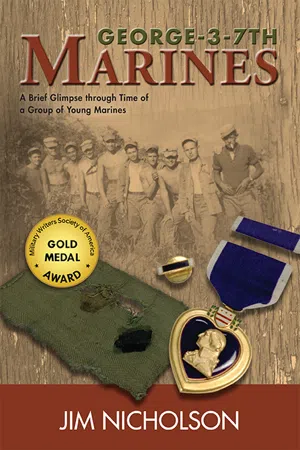
In the four years of the Korean War, America lost almost 54,000 men, roughly the same number who lost their lives in Vietnam, yet this war has almost disappeared into American history as the "Forgotten War." George-3-7th Marines recounts the bloody Marine infantry campaigns fought in the deadly mountain ranges of Korea. It is a story told by the men who fought—and died anonymously—in a little-known yet bloody war. These never-before-told tales of the battle-hardened Marines of G-3-7 have been collected and recorded by one of their own. Described by those who experienced the action firsthand, these accounts blend the shocking details of savage, bloody killing with gentle, almost heartbreaking prose seldom seen in a chronicle of war. Jim Nicholson paints a brutally accurate picture of America and the Valhalla culture that shaped the toughness of soldiers in the fifties. He examines the events and mistakes that led to a collision of the free world with the rapidly expanding Communist military machine. He reminds us that the sacrifice of young American boys saved the South Koreans, who now live freely in their beautiful "Land of the morning calm." Awarded the Military Writers Society of America Gold Medal.
“In time of peace prepare for war.” Publius Flavius Vegetius Renatus
Jim “Nick” Nicholson: “In the beginning, Korea was called the land of Silla. It was first recognized as a kingdom about 688 A.D. when the King of Silla unified the nomadic people of the Korean Peninsula. In the 10th century A.D., Wang Geon founded the Kingdom of Goryeo—hence the name Korea. Despite invasions by Mongols, Manchus, and Japanese throughout the past 10 centuries, the Korean people have remained the most ethnically homogenous race in Asia, in most part, one supposes, because geographically Korea is a rugged, mountainous, peninsular sanctuary.
An estimated 3.5 million people (combatants and civilians) were killed in four years from 1950 through 1953 and yet, throughout all the centuries, Asians have called Korea ‘The Land of the Morning Calm.’ It would seem that this impossibly rugged, beautiful land has scarcely noticed the feeble, bloody efforts of men to impose their will upon her landscape—and upon each other.”
* * *
Jim “Nick” Nicholson: “Karl Marx (1818-1883), a utopian, had formulated his vision of the worker’s paradise. Subsequent disciples, idealogues, and stone-cold killers culminated in Vladimir Lenin seizing control of Russia in the Bloody October Revolution of 1917.
From a kernel of false philosophy, Communism had taken over one-third of the world in 33 very short years. Communism was moving rapidly and all the nations peripheral to the Communist world were falling like dominoes.
Immediately after World War II, there was a global power play among the big Communist brokers, the U.S.S.R. and China. China had just emerged as a Communist power which had been in limbo while we fought World War II. Mao Tse-tung was fighting Chiang Kai-shek for control of China. We were backing Chiang Kai-shek who was a corrupt military man. Almost simultaneously with the end of the war, Mao Tse-tung swept Chiang Kai-shek into Formosa which we now call Taiwan. This created a huge Communist power.
Mao Tse-tung created Communist satellites, and North Korea was one. The Korean Premier, Kim Il-Sung, masterfully played China and Moscow against each other, and the satellite Communist Koreans, like all Communist satellites, tried to outdo the mother. They became more stringent. The Mao-ism in North Korea was over the top, stricter and more brutal than that in China itself. Kim Il-Sung wanted power; he needed to invade South Korea.
At the end of World War II, the Allied Powers had arbitrarily drawn the 38th Parallel line across the Korean Peninsula and said the Communists could have everything above. The United States got the south half of the country and turned it into a democracy. Syngman Rhee, the first president of South Korea, had been trained in the United States. He believed in democracy and he was our flag in the midst of a continent that had never seen democracy.
Inexplicably to the rest of the world who wasn’t watching, on June 25, 1950, Kim Il-Sung, the North Korean tyrant, swept over South Korea, murdering and slaughtering all the civilians they saw and killing all the South Koreans they captured. Simultaneously, Mao was purging all the small merchants in China who were residual capitalists, slaughtering them by hundreds of thousands. In conjunction with this, there was an anti-capitalist, anti-imperialist, anti-American war of words going on. It was a brutal time and it was a sudden shock to the rest of the world.
At that time, there were no Chinese, except for advisors, in North Korea. In their competition for the puppet state, there were at least as many Russians in North Korea at the time of the invasion. The United States had almost nobody in Korea. We had a few unconditioned, untrained, unarmed military police. The closest thing we had to a presence was 700 miles away in Japan.
We felt like our honor was at stake to fulfill our commitment and save this democracy. America had no choice. They were killing the only democracy in Southeast Asia. That was something we felt we couldn’t tolerate, because we were just 60 months past assuming the mantle, the cloak, of having saved the world. We still saw ourselves as the saviors of the free world so there was no reluctance to step into Korea—not in the circles I knew.
When the war started in 1950, there were 18,000 Marines. To put that in perspective, the New York police force had 29,000 policemen on the streets. Here came the armies of the entire Communist power making their bid to take over all of Asia and we had 18,000 men standing ready—somewhere between hopeless and desperate.
The Marine Corps called in its reserves immediately and began to mobilize. There were a large number of reserves. In fact, the majority of Marines in Korea were reserves. These included some of the hardest core of Marines—the Marines who had fought in the Pacific and were everywhere from Guadalcanal right on into the invasion of Tokyo Bay. By this time, though, they were old men. Instead of being 18 or 20 years old, they were 25 and 26. They were yanked from their homes and their children and many were in college on the GI bill. They were not the usual soft reservists that some people have in their minds. They were hardened veterans who went once or twice a year to intensive training on the two coasts, especially the west coast. They constituted almost immediately a cohesive fighting unit.
By that time, the South Koreans and the little handful of Army boys from the 24th and 25th Divisions of the United States Army had been hurriedly shuttled to Korea totally unprepared and thrown into the breach. They were immediately overrun. They were under the command of General Dean who was lost for many days, then captured, and I believe escaped twice and lived through the war.
Many fine, brave men died because they were not ready for battle. In just a few short weeks, everybody in South Korea had been pushed into a little area in southeast Korea that was called the Pusan Perimeter, and it was shrinking by the day. It was like the Battle of the Bulge. There were just a few Army boys and a few surviving South Korean soldiers and it was looking as if they would either all die or be pushed into the sea.
By that time the Marine Corps had managed to mobilize a tiny group of men to throw into the fight—a very tiny group called the Fire Brigade. A brigade is smaller than a regiment, but bigger than a battalion. It’s basically a battalion that is reinforced. It has extra heavy machine guns, a little bit of artillery, and with any luck at all, it has air power.
One of the major differences between the Fire Brigade and the unfortunate Army units involved in the Pusan Perimeter was that we had a cohesive unit that could bring to the table vicious ground fighting troops, heavily coordinated artillery, and air power that could strike the enemy close-up with heavy ordnance and napalm and not kill an American troop. The coordination of these three factors makes the Marine Corps unique.
So, the Fire Brigade was thrown in. The temperatures were 104 and 105 degrees. People passed out from dehydration; they were revived and went back into the fight. The brigade turned the corner and held the North Koreans at bay. This kept the North Koreans from capturing Pusan, the last city in South Korea.
At this time, General MacArthur was already drawing up one of his bold leaps. He was designing the invasion of Inchon which is in the farthest northwest corner of Korea. It is a city that one would think could not be invaded from the sea, because there are sea walls instead of beaches around most of the area—nothing that you could get a toehold on. The overwhelming factor that made the North Koreans think this was not a port that could be invaded is that it has the second highest tide in the world, second only to the Bay of Fundy around Newfoundland and Maine. It is said that a man riding a fast horse could not keep ahead of the tide when it comes in at Inchon. So MacArthur immediately, with his grand flourish, turned to the Marine general and said, ‘Do it.’
On September 19, 1950, the Marine Corps, with their mobilized reserves, were brought by sea as quickly as possible and invaded at Inchon. They went over the wall, took the city and secured it, and threw the North Korean game plan into shambles. The Communists had seen this as a two week campaign and were not prepared for the Marine Corps interdicting and cutting them in half.
In the south, the North Koreans began to scramble and break into small units. They had overrun their supply line which basically started at the Yalu River. They were short of supplies and ammunition. The Marines had severed the North Korean supply lines with constant air strikes as well as the Inchon invasion by the 1st Marine Division. They began to retreat north in disarray.
This led MacArthur to think this was his chance for his greatest glory. Instead of consolidating what he had, he pulled the Marines out of Inchon, put them back on ships and started them all the way around the peninsula of Korea to land them at the far northeast part of North Korea—not South Korea—at a port called Wonsan and then an inland port called Hungnam. This group was joined continually by more troops from the United States. The entire 1st Marine Division at that time was aboard the ships.”
Chapter 2
The Training and the Gathering
June 1950-March 1951
“Cry, ‘Havoc!’ and let slip the dogs of war.” Julius Caesar, Act III, Scene I William Shakespeare
1st Marine Division: 1st Regiment, 5th Regiment, and 7th Regiment
Jim “Nick” Nicholson: “The invincible Roman Legion developed the concept of every man having direct responsibility for only three other men in the line of command. The USMC has honed this concept into a very efficient chain of command. Colonel Carlson, of Carlson’s Raiders fame, is credited in 1942 with refining this concept for Marine combat groups.
For instance, each division, commanded by a general, is composed of three regiments that are commanded by colonels. Each regiment has three battalions and is usually commanded by a lieutenant colonel or sometimes a colonel, and typically has a major as second-in-command. Each battalion has three companies that are usually commanded by a captain. Each company is comprised of three platoons commanded by lieutenants. Each platoon has three squads lead by a sergeant. Each squad has three fire teams. Each fire team consists of a fire team leader, usually a corporal, who is responsible for three men: a rifleman or scout, a Browning Automatic Rifle man, and a rifleman who doubles as an assistant BAR man.
This may not seem very important to the uninitiated. However, when times are hard, when the ranks are decimated by casualties, when units are overrun in total darkness, the Marine infantry is still an intact fighting entity complete with leadership in small groups of fire teams.
Great flexibility is, of course, needed. Due to great attrition in Korea, privates were often squad leaders, sergeants were platoon leaders, and lieutenants were company commanders.
The Army is organized upon a much larger scale than the Corps. For instance, Army veterans will usually say, ‘I was with the (fill in the blank) Division.’
The entire concept of the Marine Corps is to have a relatively small, compact, self-contained, quick moving, aggressive fighting force. Since 1775, the Marines have usually thought of themselves as members of a regimental or ...
Chapter 7: Operation Mousetrap & the Chinese Spring Offensive–Second Phase
Chapter 8: Continuing Operation Mousetrap
Chapter 9: The Punchbowl and Beyond
Chapter 10: Return of the Mongolian Winds and the Dread of another Deadly Winter Campaign
Chapter 11: The “Bunker Wars” (The Outpost War)
Epilogue
List of Abbreviations
History of the Marine Corps Hymn
Commendation Letter, Steve Nemits
Commendation Letter, Steve Nemits
History of “Arirang”
Propaganda Leaflets
Safe Conduct Passes
North Korean & Chinese Money
Statement, MSgt James Kee Tom
Affidavit, Colonel William C. Airheart
Affidavit, Captain Charles D. McAtee
Silver Star Citation, Corporal James E. Nicholson, Jr.
Memorial Service, 7th Marines, 1st Marine Division, January–August 1951
Commendation Letter, Master Sergeant Steve Nemits
Silver Star Citation, Master Sergeant Steve Nemits
Medal of Honor Citation, Staff Sergeant William Edward Shuck, Jr.
Personnel Roster, George Company, 3rd Battalion, 7th Regiment, 1st Marine Division, September 30, 1950–July 31, 1953
KIA & MIA, “G” Company, 7th Marines, 1st Marine Division, June 1950–July 1953
Works Cited and References
Resources
Trusted by 375,005 students
Access to over 1.5 million titles for a fair monthly price.
Study more efficiently using our study tools.
Frequently asked questions
Yes, you can cancel anytime from the Subscription tab in your account settings on the Perlego website. Your subscription will stay active until the end of your current billing period. Learn how to cancel your subscription
No, books cannot be downloaded as external files, such as PDFs, for use outside of Perlego. However, you can download books within the Perlego app for offline reading on mobile or tablet. Learn how to download books offline
Perlego offers two plans: Essential and Complete
Essential is ideal for learners and professionals who enjoy exploring a wide range of subjects. Access the Essential Library with 800,000+ trusted titles and best-sellers across business, personal growth, and the humanities. Includes unlimited reading time and Standard Read Aloud voice.
Complete: Perfect for advanced learners and researchers needing full, unrestricted access. Unlock 1.5M+ books across hundreds of subjects, including academic and specialized titles. The Complete Plan also includes advanced features like Premium Read Aloud and Research Assistant.
Both plans are available with monthly, semester, or annual billing cycles.
We are an online textbook subscription service, where you can get access to an entire online library for less than the price of a single book per month. With over 1.5 million books across 990+ topics, we’ve got you covered! Learn about our mission
Look out for the read-aloud symbol on your next book to see if you can listen to it. The read-aloud tool reads text aloud for you, highlighting the text as it is being read. You can pause it, speed it up and slow it down. Learn more about Read Aloud
Yes! You can use the Perlego app on both iOS and Android devices to read anytime, anywhere — even offline. Perfect for commutes or when you’re on the go. Please note we cannot support devices running on iOS 13 and Android 7 or earlier. Learn more about using the app
Yes, you can access George-3-7th Marines by Jim Nicholson in PDF and/or ePUB format, as well as other popular books in History & Military & Maritime History. We have over 1.5 million books available in our catalogue for you to explore.