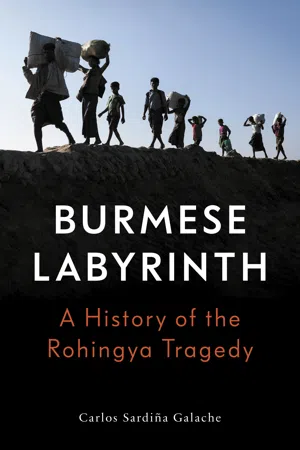
In 2011, Myanmar embarked in a democratic transition from a brutal military rule that culminated four years later, when the first free election in decades saw a landslide for the party of celebrated Nobel Prize winner Aung San Suu Kyi. Yet, even as the international community was celebrating a new dawn, old wars were raging in the northern borderlands. A crisis was emerging in western Arakan state where the regime intensified its oppression of the vulnerable Muslim Rohingya community. By 2017, the conflict had escalated into a military onslaught against the Rohingya that provoked the most desperate refugee crisis of our times, as over 750,000 of them fled their homes to neighbouring Bangladesh.
In The Burmese Labyrinth, journalist Carlos Sardi?a Galache gives the in depth story of the country. Burma has always been an uneasy balance between multiple ethnic groups and religions. He examines the deep roots behind the ethnic divisions that go back prior to the colonial period, and so shockingly exploded in recent times. This is a powerful portrait of a nation in perpetual conflict with itself.
- 352 pages
- English
- ePUB (mobile friendly)
- Available on iOS & Android
eBook - ePub
About this book
Information
Topic
GeschichtePART I
‘Discipline-Flourishing
Democracy’
Democracy’
1
The Transition
The transition to a ‘discipline-flourishing democracy’ started with an election, held on 7 November 2010. The event hardly seemed promising at the time. Few thought that it would herald a period of deep change in the country. It seemed unthinkable that an extremely repressive and deeply entrenched military dictatorship might voluntarily relinquish its power, even partially. The election itself was a tightly controlled affair, and was conducted without any transparency. Few journalists covered the election from within the country, and most of those who did so travelled clandestinely, at a moment in which it was nearly impossible to obtain a media visa.
No international observers were present, and the election was widely condemned as a sham. The results were as unsurprising as they were unlikely: the Union Solidarity and Development Party (USDP), a proxy for the military, won 50.7 per cent of the votes, and the National Unity Party, an older proxy party of the military founded in 1988, came second, with 19.3 per cent. Both parties represented a regime widely despised by most of the population, and it was difficult to believe that they could possibly have come out on top in a free and fair election.
Few doubted that the National League for Democracy (NLD) would have emerged as the victor in any fair election. For many Burmese, it was the only party that could possibly represent their democratic aspirations. Over the past twenty-two years, millions of Burmans – the majority ethnic group in the country – had placed their faith in the NLD, or more accurately, in its leader, the charismatic Aung San Suu Kyi, as the saviour of the country. Daughter of Aung San, who led the country to independence from the British in the aftermath of World War II, Suu Kyi had established herself as the leader of the pro-democratic opposition to military rule in 1988, when a massive wave of urban protests had overthrown the dictatorship of General Ne Win, who was replaced by a no-less-dictatorial military junta. Her party won an election in 1990, yet the generals refused to acknowledge the results, and she was forced to spend most of the subsequent years under house arrest for her political opposition. During this period of seclusion her mystique as a human rights icon, both within Burma and abroad, only grew. In 1991 she was awarded the Nobel Peace Prize. At the time of the 2010 election, she was still locked in her house, a lakeside villa in Rangoon where she had spent a great part of her childhood.
The NLD was undoubtedly the most popular party in the country, at least among the Burman majority, but it had decided to boycott the election. In April, the NLD had issued a statement announcing its decision on the basis that ‘the electoral laws issued by the [State Peace and Development Council] are unfair and unjust’. It also criticized the Constitution, stating that ‘forcing parties to pledge to obey and abide [by] the 2008 Constitution is a violation of democracy and human rights’.1 The electoral laws made the process of registering a party extremely cumbersome, and the decision to accept parties was made by an Election Commission controlled by the junta. It was also very expensive: the parties had to pay US$500 to register each candidate, meaning that they would have to pay the huge total of US$580,000 if they wished to compete for every available seat.2 But the main objection was to the law that banned anyone with a criminal conviction from being a member of a registered party. Most of the party leaders were political prisoners or former political prisoners. The rules were clear: if the NLD wanted to register for the elections, it had to purge its most prominent members, including Suu Kyi herself.
If the electoral law was hardly democratic, the 2008 Constitution was no more so. The process of drafting it had taken decades, and the NLD had played no significant role in it. After the NLD electoral victory in 1990, nothing happened for three years. Finally, in 1993, when the junta allowed a National Convention to draft the new Constitution, its composition did not reflect the results of the election, as most of its members were appointed by the military. Eventually, in 1996, the party of Suu Kyi boycotted the drafting process, and the Convention was suspended for eight years. When it convened again in 2004, the NLD did not participate.
It took four years to draft the new Constitution, and it was approved in a popular referendum held in 2008. In the days ahead of the referendum, a devastating cyclone hit the southern coast of the country, killing at least 138,000 people in the Burma Delta. It was the biggest natural catastrophe in the nation’s history, and the refusal of the military junta to accept any international aid for three weeks provoked a diplomatic uproar. In spite of the disaster, the junta went ahead with the referendum one week later, postponing it for three weeks in the most affected areas. The new constitution was approved by an improbable 92 per cent of the votes.
The Constitution was clearly designed to provide legal cover to the military’s permanent control over the country. It reserves 25 per cent of seats in parliament to unelected military officers appointed by the commander-in-chief of the armed forces. This military bloc makes any constitutional change extremely difficult, and dependent on the authorization of the military, as any major amendment requires ‘the prior approval of more than seventy-five per cent of all the representatives of the Pyidaungsu Hluttaw [both houses of parliament], after which in a nation-wide referendum only with the votes of more than half of those who are eligible to vote’.3
Moreover, the Tatmadaw (as the Burmese army is known locally) would retain a great measure of executive power through the appointment of the three most important ministers – those in the Ministry of Home Affairs, the Ministry of Defence and the Ministry of Border Affairs – headed by Defence Service personnel nominated by the commander-in-chief of the armed forces.4 The three security ministries are under the control of the military, while the Ministry of Home Affairs also included the General Administration Department (GAD) – the ubiquitous and all-powerful government body that controls bureaucracy and administration at all levels.5
There was also a clause in the Constitution seemingly designed to prevent Suu Kyi from ever ruling the country. Article 59d of the Constitution asserts that the president ‘shall he himself, one of the parents, the spouse, one of the legitimate children or their spouses not owe allegiance to a foreign power, not be subject of a foreign power or citizen of a foreign country’.6 This immediately excluded Suu Kyi, as she was the widow of a British citizen and had two British sons.
If the generals had designed the Constitution to ensure that the military kept a great deal of power to the detriment of any civilian government, they had also designed it to preserve a highly centralized state and make only marginal concessions to the ethnic groups that had been demanding independence, or at least greater autonomy within a federal state, since the British had left Burma in 1948. Burma is home to enormous ethno-linguistic diversity. The Burmans are the majority in the central regions, but the country’s border areas are rugged mountainous landscapes with a bewildering variety of ethno-linguistic groups, many of which have attempted to evade central government control since independence in 1948.
Since then, most of these ethnic groups have formed armed organizations to resist attempts by the Burman-dominated government to unify the state. Some continue to do so, making the armed conflicts in the borderlands of Burma among the longest running in the world. Conflicts of variable intensity have always been a crucial part of the lives of the inhabitants of some of those remote areas, isolated from the rest of the country by poor communications and infrastructure. Often the only Burmans those living in the rural border areas have met are soldiers, or the administrators of a repressive state who accompany them.
Consequently, many among the non-Burman groups bitterly resent the domination imposed by the Burmans after independence, and the new political order designed by the generals failed to address their grievances. The Constitution divided the country between seven Burman-majority ‘regions’ in Burma’s heartland and seven ‘states’ in the periphery, named after the majority ethnic group inhabiting them; but the two types of territory enjoy similar status and autonomy. Neither regions nor states can enact their own constitution or laws, and the most senior authority in each of them, the chief minister, has to be appointed by the president of the country.7 Moreover, the chief minister is not necessarily, in practice, the most powerful figure in a state or regional government, since the GAD and the security forces are constitutionally under the complete control of the Tatmadaw.
Before the election, the junta had been putting pressure on the ethnic armed organizations, some of which had maintained fragile ceasefires for years, to become border-guarding forces under the command of the military. The strongest and most important armed groups refused the order, insisting that their political demands had not been met. This created friction that included a small conflict between the army and a faction of a Karen rebel army on the border with Thailand, which sent more than 10,000 refugees to the neighbouring country the day after the election.8 Nevertheless, the junta allowed some ethnic parties to run in the election, though it selected them carefully; some, like the Kachin people, would have no voice in parliament in the upcoming administration.
In other states, ethnic parties attained more than 25 per cent of the vote. One of the most successful was the Rakhine Nationalities Development Party (RNDP), a forerunner of the Arakan National Party (ANP), representing the Rakhine Buddhist community in Arakan. Arakan is a complex state, the second-poorest in the country, and is deeply fractured along ethno-religious lines. The rift between its two main communities, Rakhine Buddhists and Rohingya Muslims, has grown during the transition period, despite the fact that the two communities have lived side by side for generations. It is often overlooked that the Rakhine, despite closing ranks with the Burmese state and military when it comes to opposing the Rohingya, are fiercely against the domination of the Burmans, whom they regard as their oppressors. They have a strong argument for such resentment in relation, for instance, to the natural resources in their state – mainly the huge gas reserves off the coast, which the central government has exploited with the help of international companies, yielding little or no benefit to the local population.
Burmans and Rakhine share the Buddhist religion and a very similar language; but for most of its history Arakan was an independent kingdom, until the late eighteenth century, when it was conquered by the Burmans. Among all the ethnic groups in the country, the Rakhine are perhaps the most similar, linguistically and culturally, to the Burmans. But despite this, or perhaps because of it, they are among the groups most vociferously assertive of their differences and autonomist aspirations. Rakhine nationalists often say that they are sandwiched between the Burmese government and the Rohingya, whom they and many others in Burma often call ‘Bengalis’, indicating their purported foreign origins. The resentment against one feeds the resentment against the other, in what is in reality a triangular conflict pitting three groups against the other: Rakhine, Burman and Rohingya.
The Rohingya Muslims, who had been stripped of citizenship by the military junta, were allowed to vote in 2010. There were even two Rohingya parties, the National Democratic Party for Development (NDPD) and the National Development and Peace Party (NDPP), the latter widely assumed to be a proxy of the military. These parties campaigned mostly in the Rohingya-majority townships of Northern Arakan, along the border with Bangladesh. There were reports that the NDPD had come under pressure from state officials to prevent it from campaigning, and even that villagers were threatened with eviction if they voted for it.9 Eventually, two Rohingya would sit in parliament – both members of the USDP. Paradoxically, during the subsequent period, in which the Rohingya community would suffer a rapid process of complete disenfranchisement, they also had representation in parliament for the first time in decades, and one of their MPs, Shwe Maung, would be a vocal critic of the government. It was widely assumed that the Rohingya were being allowed to vote in 2010 in order to prevent the Rakhine nationalists from attaining too much power; but it is also true that the Rohingya had been allowed to vote in every election or referendum held in Burma since independence. In any case, Rakhine nationalists resented that the Rohingya had a political voice at a crucial moment of transition in which the future of the country was at stake, and this may partly explain the role that Rakhine nationalists would play in the intercommunal riots two years later.
By late 2010, there remained little doubt that the new political order was scarcely conducive to fulfilling either the autonomist goals of the ethnic minorities or the democratic aspirations of the Burman majority. Nobody expected much from the new president, Thein Sein, a quiet man of the old regime who had been prime minister (a mostly ceremonial position) under the military junta. But in fact his government would introduce far-reaching political and economic reforms. During this period, the country changed at breakneck speed: hundreds of political prisoners were released; the opposition was allowed to conduct its activities more or less freely; freedom of speech was relatively respected, as the government relaxed restrictions on the media; mobile phones and access to the internet, both virtually nonexistent before 2012, spread throughout the country. Most crucially, the parliament turned out to be more open and assertive than had been thought possible. Burma, a pariah country shunned by the Western democracies for more than two decades, was now welcomed into the ‘international community’ with open arms. The United States and the European Union gradually lifted the sanctions they had imposed, and foreign investors began to flock to the country.
The transition came as a surprise that elicited much speculation over the motivations of the military. Some argued that it was due to geopolitical considerations, as Burma had come to rely too much on China as a consequence of Western sanctions and isolation.10 Pro-democracy activists abroad claimed that the sanctions had pushed the generals to introduce reforms. Thein Sein has said that the move was necessary to lift the country from its economic backwardness.11 The Burmese military is notoriously opaque, and the real causes of this period of rapid political change are difficult to know. There were probably many reasons to launch the reforms, but one thing is certain: the generals loosened their grip and allowed the transition to take place not from a position of weakness, but from the position of overwhelming strength they had achieved over many years.12 By the time of the election in 2010, after decades of crushing the opposition and strengthening itself, the military was the only well-established institution in the country, so it could afford to cede some of its power in the confidence that it would retain a pre-eminent position.
As the transition progressed, it would become increasingly clear that it was irreversible – albeit within limits that, in moments of euphoria, were not quite visible. But the transition would also bring to light complexities and dark aspects of Burmese society to which very few had previously paid attention: the intercommunal violence in Arakan and beyond; the emergence of an extremely exclusionary brand of Burman ethno-nationalism that seemed to permeate every stratum of society; and the ambiguous, and sometimes explicitly racist, positions taken by the pro-democracy camp and long-time defenders of human rights. All of this contradicted what one author has termed the ‘neat, if overly simplified, plotline of bad military versus good citizenry’13 that many foreign journalists and external observers, including me, had long taken almost for granted.
Before the transition period, the most common narrative on Burma was that of a democratic opposition led by a courageous and graceful woman, heroically combating by nonviolent means a brutal and cruel regime led by a clique of thuggish generals. Admittedly, quite what the ideology of Aung San Suu Kyi and her party was had never been clear, and nor had her vision of the country’s future, beyond some platitudes about human rights, democracy and freedom. But it was easy to believe that her heart was in the right place; and the sacrifices that she and many pro-democracy activists, who had endured years of jail, were clear proof of their courage and commitment.
The many conflicts with ethnic minorities in the country’s periphery were seen either as some sort of subplot, subsumed within the central epic story of democracy versus dictatorship, or as part of the same struggle, on the assumption that Suu Kyi’s NLD and the ethnic groups were on the same side. The plight of the Rohingya minority, in many respects unique, barely registered, or was seen as part of the wider struggle of the minorities for their rights. The communal cleavages that in the past had violently pitted Rakhine against Rohingya in Arakan, or Buddhists against Muslims in central Burma, were little understood, and were often explained away as mere manipulations by the military. At times they probably had been orchestrated by the military; but the military was exploiting deep divisions that pre-dated its rise to power, and – as would become clear during the transition – were more pervasive in Burmese society than most foreigners had realized.
Such distortions and simplifications, as well as the idealization of Suu Kyi and the pro-democracy camp, had to do with the fact that the country had been largely closed to fo...
Table of contents
- Cover Page
- Halftitle Page
- Title Page
- Copyright Page
- Contents
- Maps
- Note on Burmese Terms
- Introduction: Trapped in the Burmese Labyrinth
- Part I: ‘Discipline-Flourishing Democracy’
- Part II: History and Its Traces
- Part III. A Diarchic Government
- Conclusion: The Failure of Burmese Nationalism
- Acknowledgments
- Notes
- Index
Trusted by 375,005 students
Access to over 1.5 million titles for a fair monthly price.
Study more efficiently using our study tools.
Frequently asked questions
Yes, you can cancel anytime from the Subscription tab in your account settings on the Perlego website. Your subscription will stay active until the end of your current billing period. Learn how to cancel your subscription
No, books cannot be downloaded as external files, such as PDFs, for use outside of Perlego. However, you can download books within the Perlego app for offline reading on mobile or tablet. Learn how to download books offline
Perlego offers two plans: Essential and Complete
- Essential is ideal for learners and professionals who enjoy exploring a wide range of subjects. Access the Essential Library with 800,000+ trusted titles and best-sellers across business, personal growth, and the humanities. Includes unlimited reading time and Standard Read Aloud voice.
- Complete: Perfect for advanced learners and researchers needing full, unrestricted access. Unlock 1.5M+ books across hundreds of subjects, including academic and specialized titles. The Complete Plan also includes advanced features like Premium Read Aloud and Research Assistant.
We are an online textbook subscription service, where you can get access to an entire online library for less than the price of a single book per month. With over 1.5 million books across 990+ topics, we’ve got you covered! Learn about our mission
Look out for the read-aloud symbol on your next book to see if you can listen to it. The read-aloud tool reads text aloud for you, highlighting the text as it is being read. You can pause it, speed it up and slow it down. Learn more about Read Aloud
Yes! You can use the Perlego app on both iOS and Android devices to read anytime, anywhere — even offline. Perfect for commutes or when you’re on the go.
Please note we cannot support devices running on iOS 13 and Android 7 or earlier. Learn more about using the app
Please note we cannot support devices running on iOS 13 and Android 7 or earlier. Learn more about using the app
Yes, you can access The Burmese Labyrinth by Carlos Sardiña Galache in PDF and/or ePUB format, as well as other popular books in Geschichte & Indische & südasiatische Geschichte. We have over 1.5 million books available in our catalogue for you to explore.