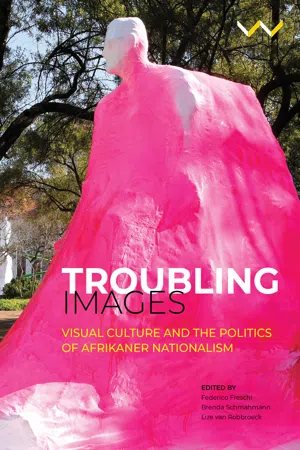
Troubling Images explores how art and visual culture helped to secure hegemonic claims to the nation-state via the construction of a unified Afrikaner imaginary
Emerging in the late nineteenth century and gaining currency in the 1930s and 1940s, Afrikaner nationalist fervour underpinned the establishment of white Afrikaner political and cultural domination during South Africa's apartheid years. Focusing on manifestations of Afrikaner nationalism in paintings, sculptures, monuments, buildings, cartoons, photographs, illustrations and exhibitions, Troubling Images offers a critical account of the role of art and visual culture in the construction of a unified Afrikaner imaginary, which helped secure hegemonic claims to the nation-state. This insightful volume examines the implications of metaphors and styles deployed in visual culture, and considers how the design, production, collecting and commissioning of objects, images and architecture were informed by Afrikaner nationalist imperatives and ideals. While some chapters focus only on instances of adherence to Afrikaner nationalism, others consider articulations of dissent and criticism.
By 'troubling' these images: looking at them, teasing out their meanings, and connecting them to a political and social project that still has a major impact on the present moment, the authors engage with the ways in which an Afrikaner nationalist inheritance is understood and negotiated in contemporary South Africa. They examine the management of its material effects in contemporary art, in archives, the commemorative landscape and the built environment. Troubling Images adds to current debates about the histories and ideological underpinnings of nationalism and is particularly relevant in the current context of globalism and diaspora, resurgent nationalisms and calls for decolonisation.
eBook - ePub
Troubling Images
Visual Culture and the Politics of Afrikaner Nationalism
- English
- ePUB (mobile friendly)
- Available on iOS & Android
eBook - ePub
Troubling Images
Visual Culture and the Politics of Afrikaner Nationalism
About this book
Information
CHAPTER ONE
The Trajectory and Dynamics of Afrikaner Nationalism in the Twentieth Century: An Overview
ALBERT GRUNDLINGH
This chapter provides a brief overview of key factors that underpinned the emergence of, and shifts within, Afrikaner nationalism. These developments necessarily informed the examples of visual culture explored in subsequent chapters of this volume.
While there can be no question that an ethnic and narrowly defined Afrikaner nationalism profoundly affected the history of twentieth-century South Africa, there has been little agreement among historians as to how this phenomenon should be interpreted. There are divergent interpretations concerning the origins of Afrikaner nationalism, the nature and contents thereof, the way in which it was manufactured, as well as the precise correlation between Afrikaner nationalism and socio-economic developments. Much Afrikaans-language historical writing that deals with this nationalism presents it as an unproblematic concept. Afrikaner nationalism has been naturalised to the extent that it is seen as the inevitable outcome of South African history. The weakness of this approach is that, rather than being interrogated and its complexity unravelled, it is accepted uncritically as a natural given entity. The result is a tautological and essentialist argument with very little explanatory value: Afrikaners are nationalistic because they are Afrikaners.
Liberal, mainly English-speaking historians have been more critical towards Afrikaner nationalism. Ironically, though, their basic point of departure does not differ much from that of their Afrikaner counterparts: they share in analytical terms an unproblematic acceptance of the concept of volk [the people], as well as the notion that nationalism was purely about ideas rather than material considerations.The only substantial difference is that, whereas some English-speaking historians generally denounced nationalism, often in value-laden terms, Afrikaner historians viewed it as a positive phenomenon. The problem here is that, although the outcome may differ, the fundamental point of departure remains the same.
Historiographical advances, however, paid greater attention to the material basis of Afrikaner nationalism that gave rise to intense ideological labour in order to fashion an appropriate cultural and political product. While the precise mix of material, cultural and political factors is a matter of debate, there is, nevertheless, a degree of consensus that these three factors constituted the prime elements of this movement.1
In line with such an approach, Afrikaner nationalism is seen in general terms as a broad social and political response to the uneven development of capitalism in South Africa, which meant that certain groups, mainly indigenous but also including a substantial number of white Afrikaners, were left behind. It was within a context of increasing urbanisation and secondary industrialisation during the period between the two world wars, as well as a continuing British imperial influence in South Africa, that Afrikaner nationalism made headway. Important ideological building blocks in this process were the following: the promotion of a common language, the emphasis on what was perceived to be a common past, and the unifying effect of a common religion.
FACTORS FACILITATING GROWTH
Prominent in the construction of and the direction in which Afrikaner nationalism was pushed was the Afrikaner middle class, comprising, inter alia, ministers of religion, teachers, academics, journalists, farmers and certain elements in the civil service. Many leading white middle-class Afrikaner men in the 1930s and 1940s belonged to a secret organisation called the Afrikaner Broederbond, which ceaselessly endeavoured to promote the exclusive interests of ‘true’ Afrikaners on behalf of the volk. The Broederbond was established in 1918, and in 1929 it became a secret organisation.
Uniting rural and urban people, rich and poor, political idealists and pragmatists under the banner of Afrikaner nationalism called for a sustained ideological effort on several levels over a number of years. The depression of the early 1930s forced a considerable number of Afrikaners off the land and into the cities. Many lacked the necessary skills to assert themselves in the new and competitive urban milieu, and were relegated to relatively low-paid positions. For example, almost 40 per cent of urbanised male Afrikaners found themselves in the following occupations in 1939: manual labourer, mine worker, railway worker, and bricklayer (O’Meara 1983, 82). According to the 1932 report of the Carnegie Commission investigation into white poverty, 200 000 to 300 000 Afrikaners could be classified as very poor. The cold statistics, however, did not reflect the profoundly human story of suffering and humiliation. A contemporary church commission sketched the lot of the new urban Afrikaner in the following empathic terms:
He was looked down upon, he had to come with his hat in hand, he had to be satisfied with the crumbs which fell from the tables of the rich. To make any sort of progress, however little, he had to beg the English oppressor and had to obey his every command. Any job that was offered him, however humiliating, dangerous and lowly paid it might have been, he had to accept with gratitude. He and his family had to be satisfied with the worst living conditions in the dirty ghettoes. The door to well-paid occupations was firmly closed. His erstwhile independence was reduced to humiliating servitude and bondage. (Albertyn 1932, 216–217)
While poverty was particularly acute in urban areas in the depression years, white poverty was not restricted to those locales. It was also especially severe in the northern Cape with its nomadic trekboers, in the Bushveld area of the Transvaal, in the Karoo and Little Karoo with their struggling peasant farmers and bywoners [sharecroppers], and in the southern Cape where formerly independent woodcutters were fighting a rear-guard action against rapacious wood merchants. Impoverished Afrikaners had to be rescued for the sake of the volk. In the Broederbond as well as other circles, a strategy combining ethnic mobilisation with the promotion of volkskapitalisme [capitalism in the interest of the volk] was seen as a possible solution to the problem. Through group identification and cooperation, it was hoped that the position of Afrikaans-speakers might be improved. Their predicament was exacerbated by competition with even poorer Africans who undercut the cost of white labour, particularly in the cities.
Identification with the group had to be complete, and had to be carried out on all levels of society. A complex network of Afrikaner organisations was established in the 1930s, with existing organisations being strengthened. Across the board, from financial institutions such as insurance companies, later known as Sanlam and Santam, and a bank, Volkskas, through to youth movements such as the Voortrekkers (named after the pioneer Voortrekkers of the nineteenth century), organisations which bore an Afrikaner imprint came into existence. Many of these had English-speaking counterparts; the Voortrekkers, for example, was specifically established to compete with the English-speaking organisation the Boy Scouts. The umbrella body was a cultural federation, the Federasie van Afrikaanse Kultuurvereniginge (FAK). Especially important in the organisational network, it ensured that all Afrikaner cultural forms took a decidedly nationalistic turn. In retrospect, the material and cultural foundations of Afrikaner nationalism were being laid systematically.
The role of visual culture in this early, programmatic construction of a national imaginary is important, as discussed by Lize van Robbroeck in the next chapter, which focuses on the Empire Exhibition of 1936, and later by Peter Vale in his chapter on political cartoons in Die Burger. It also forms a backdrop to the commissioning, in 1929, of a sculpture of Marthinus Theunis Steyn, sixth president of the Orange Free State Republic, for what was then Grey College in the Orange Free State, as discussed by Jonathan Jansen in his chapter below.
In a strongly patriarchal Afrikaner society, it was often men who took the lead in nationalistic and cultural projects. The role of women can, however, be easily underestimated. The notion of the self-sacrificing volksmoeder [mother of the nation] was an integral element in the national ethos, as demonstrated in Katharina Jörder’s chapter, which examines photographs taken at the inauguration of the Voortrekker Monument, and also in Lou-Marié Kruger’s chapter, where she engages with the reproduction of Anton van Wouw’s Noitjie van die Onderveld in the women’s magazine Die Boerevrou. It was the volksmoeder who had to transmit the appropriate aspirations and ideals to the youth, and provide a home environment in which Afrikaner ideals could be cherished. But her influence was not restricted to the household; she was also expected to play an active supportive role in the promotion of wider nationalistic politics. Although not all Afrikaner women followed the script that had been written for them, the notion of the volksmoeder was nevertheless seen as a worthy role model for young Afrikaner girls to emulate. As a result, the continued incorporation of women into a male-dominated nationalism was assured. The volksmoeder ideal meant that women could gain social recognition only as participants in the lives of their husbands and children; plotting their own course outside the prescribed framework was distinctly frowned upon, although, as Kruger shows, women did have a certain agency in the formulation of the volksmoeder discourse. The powerful hold of the volksmoeder ideal is evident from the fact that it had resonance even among working-class women who had joined socialist-inclined trade unions under non-Afrikaner leadership, such as the Garment Workers’ Union under Solly Sachs. The symbols of the volksmoeder seem to have offered working-class women opportunities to experience a sense of belonging and legitimacy within a society in which they were otherwise marginalised (Brink 1991, 156–171).
An important arena for Afrikaner cultural entrepreneurs was that of trade unionism. Afrikaner workers had to be organised within a nationalist context and weaned from existing trade unions dominated by English-speakers. Broederbond Afrikaner unions such as the Spoorbond and the Afrikaner Bond van Mynwerkers were established in the 1920s and 1930s to look after the specific interests of Afrikaans-speakers on the railways and gold mines respectively. The Spoorbond was relatively successful, but the Afrikaner Bond van Mynwerkers met with considerable opposition from the already established Mine Workers’ Union. The latter had come to an agreement with mine owners that the Afrikaner union would not be recognised, and that only members of the predominantly English-speaking union would be employed. Thus, Afrikaans-speakers were compelled to work as ‘reformers’ within the framework of the often corrupt Mine Workers’ Union. This gave rise to considerable tension, to the extent that the secretary of the Mine Workers’ Union, Charlie Harris, was shot dead by an outraged Afrikaner in 1939. Establishing an organised Afrikaner influence on the mines proved more difficult than originally anticipated.
A marked feature of the way in which Afrikaner nationalism was constructed was the emphasis on history. Past occurrences that were presented as key symbolic events were the Slagtersnek Rebellion of 1815, the Great Trek, the Day of the Covenant, the South African War, the concentration camps during that war, and the Rebellion of 1914.2 These events were cast in near-religious terms, with Afrikaners as God’s chosen people, destined to bring civilisation and Christianity to the southern tip of Africa.
Of particular significance in moulding an Afrikaner identity during the 1930s were the centenary celebrations of the Great Trek in 1938. The Great Trek, which assumed pride of place in Afrikaner history, was commemorated by nine ox-wagons, slowly making their way from Cape Town to the north. It turned out to be an unprecedented piece of cultural and political theatre, with excited crowds dressed in period Voortrekker garb welcoming the procession as it approached towns and cities. Streets were named after Voortrekker heroes; men and women were moved to tears by the spectacle; young people were married alongside the vehicles; couples christened their babies in the shade of the wagons (many infants were given names derived from the Great Trek, such as Eeufesia [Centenaria] and Kakebeenwania [Oxwagonia]). Although this ‘second Trek’ had been carefully orchestrated by Afrikaner cultural entrepreneurs, even they were taken aback by the tumultuous response (Grundlingh and Sapire 1989, 1–19).
This symbolic trek paralleled the economic trek of Afrikanerdom from a debilitating depression that had relegated even larger numbers of the volk to the ranks of poor whites. For many former platteland [rural] Afrikaners who now found themselves in an urban environment, the centenary Trek, symbolically rooted in an idyllic, heroic pastoral past, gave powerful expression to longings for a better, more prosperous future and to a nostalgia for a now fast-eroding rural social order. At the heart of the 1938 celebrations lay the perception that Afrikaners were strangers in their own land, victims of British-based capitalism and an alien political culture, and that a solution lay in unified economic, political and cultural action. And indeed, as fractured as Afrikanerdom may have been in class terms, the 1938 celebrations served as a powerful binding agent and represented a truly unique moment of cross-class ethnic mobilisation. In the celebrations and in the evocation of the heroic struggles of their forebears, Afrikaners saw themselves mirrored in history, drawing inspiration for survival and for the future.
In evaluating the place of the Voortrekker centenary celebrations in the development of Afrikaner nationalism, it is perhaps best viewed as an important populist phase. It had all the rhetoric of populist movements: ‘struggle’, ‘survival’ and ‘salvation’. It also displayed several features of populism: a moralistic rather than programmatic content; a romantic, consciously anti-intellectual, and deliberately declassed leadership; an overt alienation from the centres of political and economic power; the launching of cooperative economic ventures, involving the small man, such as the Reddingsdaadbond;3 and a strong nostalgic element in drawing upon an idealised past that might shape the present and the future. As Katharina Jörder discusses in her chapter, a similar populist celebration manifested just over a decade later, in 1949, at the inauguration of the Voortrekker Monument, where the centenary celebrations culminated.
These developments were augmented by the steady growth of Afrikaans as a language. Apart from the expansion of Afrikaans schools and higher education, there were concerted attempts, especially through print media, to reach out to and educate the masses. These included popular magazines directed at the intimate home environment, which contributed significantly to the settling of a sedimentary sense of ‘being an Afrikaner’ in many households. The memorable phrase ‘building a nation from words’ captured much of this initiative (Hofmeyr 1987).
The degree of Afrikaner unity in evidence during the celebrations was, however, of brief duration. It is probably true to say that in the long term the foundations for Afrikaner unity were laid during the centenary celebrations. But in the general euphoria of 1938, it was insufficiently recognised that no unanimity or clarity existed as to the actual shape of the building to be erected on these foundations.
Some of the issues revolved around South Africa’s constitutional position as part of the British Crown, and the extent to which republican ideals should be foregrounded and pursued. The question of participation in the network of empire generated serious schisms in Afrikaner political organisations. Motivated by anti-imperialist, republican sentiments, the Gesuiwerde Nasionale Party [Purified National Party], under the leadership of DF Malan, broke away from JBM Hertzog’s National Party. Hertzog’s National Party in turn merged with Jan Christiaan Smuts’s South African Party to form a ‘Fusion’ government under the newly minted United Party (1933–1948).
Subsequently, divisions among Afrikaners about the future direction of Afrikanerdom would be reflected in a number of organisations, with some claiming to represent the ‘soul of the nation’.
ORGANISATIONAL EXPRESSIONS
One such organisation to emerge ...
Table of contents
- Cover
- Title
- Copyright
- Contents
- Acknowledgements
- List of Illustrations
- Troubling Images: An Introduction
- 1 The Trajectory and Dynamics of Afrikaner Nationalism in the Twentieth Century: An Overview
- PART ONE: ASSENT AND DISSENT THROUGH FINE ART AND ARCHITECTURE
- PART TWO: SCULPTURES ON UNIVERSITY CAMPUSES
- PART THREE: PHOTOGRAPHY, IDENTITY AND NATIONHOOD
- PART FOUR: DEPLOYING MASS MEDIA AND POPULAR VISUAL CULTURE
- Contributor Biographies
- Index
Trusted by 375,005 students
Access to over 1.5 million titles for a fair monthly price.
Study more efficiently using our study tools.
Frequently asked questions
Yes, you can cancel anytime from the Subscription tab in your account settings on the Perlego website. Your subscription will stay active until the end of your current billing period. Learn how to cancel your subscription
No, books cannot be downloaded as external files, such as PDFs, for use outside of Perlego. However, you can download books within the Perlego app for offline reading on mobile or tablet. Learn how to download books offline
Perlego offers two plans: Essential and Complete
- Essential is ideal for learners and professionals who enjoy exploring a wide range of subjects. Access the Essential Library with 800,000+ trusted titles and best-sellers across business, personal growth, and the humanities. Includes unlimited reading time and Standard Read Aloud voice.
- Complete: Perfect for advanced learners and researchers needing full, unrestricted access. Unlock 1.5M+ books across hundreds of subjects, including academic and specialized titles. The Complete Plan also includes advanced features like Premium Read Aloud and Research Assistant.
We are an online textbook subscription service, where you can get access to an entire online library for less than the price of a single book per month. With over 1.5 million books across 990+ topics, we’ve got you covered! Learn about our mission
Look out for the read-aloud symbol on your next book to see if you can listen to it. The read-aloud tool reads text aloud for you, highlighting the text as it is being read. You can pause it, speed it up and slow it down. Learn more about Read Aloud
Yes! You can use the Perlego app on both iOS and Android devices to read anytime, anywhere — even offline. Perfect for commutes or when you’re on the go.
Please note we cannot support devices running on iOS 13 and Android 7 or earlier. Learn more about using the app
Please note we cannot support devices running on iOS 13 and Android 7 or earlier. Learn more about using the app
Yes, you can access Troubling Images by Federico Freschi,Federico Freschi,Brenda Schmahmann,Lize van Robbroeck,Michael Godby,Theo Sonnekus,Gary Baines,Albert Grundlingh,Peter Vale,Jonathan D. Jansen,Lou-Marié Kruger,Katharina Jörder,Liese van der Watt, Federico Freschi,Brenda Schmahmann,Lize van Robbroeck, Federico Freschi, Brenda Schmahmann, Lize van Robbroeck in PDF and/or ePUB format, as well as other popular books in History & African History. We have over 1.5 million books available in our catalogue for you to explore.