- 224 pages
- English
- ePUB (mobile friendly)
- Available on iOS & Android
eBook - ePub
About this book
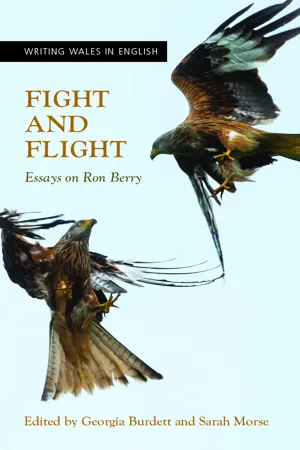
Ron Berry (1920–97) is one of the most remarkably astute yet relatively neglected twentieth-century Rhondda writers. An avid walker, birdwatcher, 'potcher', sportsman and miner, Berry is the product of a distinctive Rhondda landscape; the formidable peaks of Pen Pych and Cefn Nant y Gwair were to be a continuing source of inspiration for him in his writing. His idiosyncratic viewpoints, of which there are many, are reflected in both his memoir and fiction. As the first sustained critical study of his work, this collection seeks a literal, physical and chronological 'zooming-outwards', from the man himself to the personal and literary geographies and communities in which he was posited, to his creative legacy.
Information
Print ISBN
9781786835284
Subtopic
English Literary Criticism1
WAYS OUT: WAYS IN: WAYS BACK: AN INTRODUCTION
Dai Smith
He dealt the pay clerk a wristy backhander across the mouth. Inside the office, the portly cashier strutted about-turn like a bantam cock.
‘Lloyd! What on earth … Clear off! Go away from there!’
Pushing his head through the pay hatch, ‘Gabe,’ he said, ‘the name’s Gabe Lloyd. This isn’t the first time I’ve been robbed by you clever bastards. My water allowance, fifty pence a shift […] My money, I want it today, now.’
The cashier plucked out a fountain-pen. He sloped his jowly head over the ledger. ‘Petty cash,’ he ordered the clerk, who sorted £2.50 in coins and slid them across the hatch counter. Pen wagging, the cashier vowed a priestly edict, ‘Lloyd, you will be sorry.’
‘Very nice of you,’ said Gabe. ‘He isn’t the first mammy’s boy I’ve slapped across the chops. You sods fiddling in this office, you’d rise the bile in any man. You know sweet fuck all about what it’s like down under […] The pair of you couldn’t fill enough coal to cook a dinner.’ Gabe turned to the pay queue […] Gabe rattled the stack of coins from hand to hand, ‘These office blokes, they’ve never filled a dram, never cleared a top hole, they couldn’t pack a waste or a cog, they’ve never cut up a rib face, they’d be smothered in diarrhoea working a low seam […] How they going to think like us, ah?’1
To read Ron Berry (1920 –97) for the first time is to invite a ‘wristy backhander’ across the chops of anyone daft or ‘twp’ enough to be complacent about the conscious intent of the writer or indifferent to the accusatory nature of his subject matter. The latter was, almost exclusively, and in diminishing circles of place, the south Wales coalfield, the Rhondda valleys, the topmost settlements of Rhondda Fawr and an enfolding, unfolded landscape, then and now. Berry dealt with all the travails of that place’s fabulous twentieth-century history by means of individual witnessing:
Gabe walked home, thinking, I’m different from my father. Different from my grandfather. They believed in the rank and file. I say, never mind about the rank and file. It’s all mouth, always was, always will be. This life is for me, mine to do as I want with it.2
In his writing, Berry recounted everything that he saw and knew at first hand but did so, almost uniquely, without resorting to the literary clichés or sociological solecisms trotted out by any insider sentimentalism or outsider observation. Yet his fearless witnesses, his Gabes – ‘It’s me, first, second and last’ – are never the free agents they yearn or claim to be.
Berry knew this, too, even as he breathed the life of defiance into his characters. They may be, often literally, crushed materially and discarded culturally, or redeemed, fleetingly, by mutual love, but they are, always, given an identity bigger than their sole existence by the framing of their distinctive society, landscape and mindscape both. As in so many ways increasingly apparent to us from his work, and as this revelatory book of essays underlines, Ron Berry went to the heart of universal matter from the beat of his specific place and time. He found ways out, some answers, by delving so deeply into questions, ways in, and now speaks to the concerns of our time and place more clearly and insistently, ways back, than he was ever heard, for the most part anyway, in his lifetime.
Not that relative disregard seemed, when he first came to public notice with the appearance of his debut novel, Hunters and Hunted, in 1960, to be his likely fate. After all, he was another welcome working-class writer, a really authentic one this time, and with his own very contemporary working-class truculence. There was, from the late 1950s on, a conveyor belt of British post-war novelists setting out to reveal the disillusioned history of a welfare world. And a number of them went on, via the stage and films and television, to a modicum of worldly success and the kudos of fame. Ron Berry, along with Sillitoe and Braine and Delaney and Wesker and Storey and Barstow, had all that, but so briefly that it scarcely registered, and after 1970 there was not another novel until his final one, This Bygone, in 1996.
So why the gap? It was certainly not because he was not writing. He wrote incessantly, on and on, as the bundles and bundles of unpublished novels and memoirs and non-fiction testify in the archive of his work, which is now deposited at Swansea University. So, to put it another way, why the neglect? Some of the speculations in this current volume point to the wilful ignorance of ‘metropolitan’ critics and London publishing houses. If so, it was not a lack of interest or even respect from which he alone suffered. With very few exceptions, then or now, writers with specifically Welsh material attract limited attention beyond Wales, whilst within Wales in his lifetime publishing opportunities were few and those that were available were largely for his stories, with the novels entirely spurned. Why? The answer is that neither his content nor his style matched, for the outside world, either time-worn expectations or changing contemporary fashion, whilst, on his own patch, and never one to compromise, he was decidedly, and vocally, a literary enemy of the ‘Anglo-Welsh’ and a quizzical scorner of national parochialism in all its myriad forms.
In the mid-1990s, his last decade, Berry sent a number of publishers, in and out of Wales, the typescript of This Bygone, to no avail. Then Mairwen Prys Jones, a perceptive editor at Gomer Press, accepted it at the end of 1995 and pressed for a production grant from Arts Council Wales. Two anonymous readers, puzzled or half-hearted, could not wholly recommend it. There was to be one last throw of the dice. I was asked to be the Third Reader (anon.) and, in early 1996, having read my two predecessors’ squirmingly uneasy views I sent in my two pages’ worth. This, slightly redacted here, is what I wrote:
This Bygone
I have no doubt this novel deserves a production grant and subsequent publication. It is a major, late work by a novelist who has always made demands on his readers – in part because his themes sit so uneasily within the ‘Anglo-Welsh’ literary canon. Clearly, and not merely because it is the name at the end of the typescript, this is Ron Berry through and through – and, therefore, it does indeed have some of the ‘faults’ of authorial intrusion, and an elided, testing prose narration to place alongside the direct colloquial speech of his characters. In another way, this is to say that it is a novel of reflection in thought as well as in representation. The story of Dewi Joshua, his mother Zena and his two loves, Elsie and Greta, is a counterpoint to an assumed History. The 4 Dai Smith details of that history, from mid-1930s to later 1940s in south Wales, flit by like a newsreel.
It is not that they are unimportant for many in the novel; Elsie dies in a freak German air raid, she and others are directly affected by that accurately observed, clichéd, March of Time. It is more that the cliché is exposed as a distant, unwanted rumble and that the texture of actual life (food, sex, clothes, local corruption in business and in politics, landscape and weather) is depicted as the real stuff of existence. This may, in some ultimate scheme of things, be questioned but the passion of Berry’s viewpoint reeks with authenticity. For this reason alone the work (almost as autobiography – in fiction) is without peer in contemporary Welsh writing. Nothing is false. Nothing rings phoney. Nothing is book-derived.
In my view this is Ron Berry telling us, as he did in Hunters and Hunted for the early 1960s, that most of the life of miners, and their societies and their lovers and their wives, is about being cursed or blessed with elemental drives within the specific historical context of industrial Wales. Here, he insists it was like that even in the now mythical 1930s. The story he tells has power, drive and interest in and for itself, but what makes it special is the brilliant account of work underground as Dewi progresses from collier’s boy (he marries Llew’s widow, Elsie) to collier to small mine-owner as nationalisation and the winter’s snow arrive together in 1947. I know of no writing about work as experienced underground that touches this. This is written as if Orwell was more than an observer or if Lawrence had actually wielded a pick instead of pen. In the context of the novel it offers the illumination of the integrated nature of that work and these lives in that Bygone. And the end is the bitter-sweet pregnancy of Greta as south Wales senses a new (false) start.
If an Arts Council stands for anything it should stand for supporting an achieved writer who can link us all up to threads of literature that have been frayed as surely as their material platforms have been set adrift. I understand, to an extent, the commercial reservations of the other two readers, but to turn one on his or her head it would be a foolish publisher who did not take on such a bravura mining novel at this stage of the lives of both that south Wales and that writer. No novel like this one will be written in the future and I strongly urge you to support its publication.
Now, at the very end of his life Ron Berry did receive the fuller critical recognition he deserved. John Pikoulis’s magnificent feature article on the novel for New Welsh Review, herein revised and reprinted, was an advance standard-bearer for a new generation who would begin to discern how his originality of style matched the depth of his purpose. It was not as if he had not been telling us already. At BBC Wales I had commissioned a thirty-minute documentary about Ron in the Read All About Us series in October 1996, and way before that, in June of 1990, I had done a half-hour interview with him on Radio Wales’s First Hand arts programme. I could also look back down the years, via my essay ‘A Novel History’ in 1986, to the profile I had written, as its Arts Editor, of Ron for the fortnightly Arcade in 1980, and in which magazine his superb piece on ‘Peregrine Watching’ shortly appeared. I can say then, without any doubt, that he knew how much he was appreciated by those whose views he trusted, and none more so than his great boon friend, Alun Richards, who worked so hard over a number of years to see the autobiography, History Is What You Live, posthumously published in 1998. Ron was, too, deeply appreciative of the sensitive, pioneering work Simon Baker was doing in his lifetime to compile and introduce the Collected Stories, which came out in 2000. This was a tide turning at the ebb, and more was to set it to a rise when So Long, Hector Bebb became the very first novel, with a three-cheers ‘Foreword’ from the admiring Niall Griffiths, to spearhead the Library of Wales series in 2006.
If Ron was truly set before us to read again we needed to hear, too, what he had, often reluctantly, reflected himself as to his prolific output and its meagre antecedents. For the latter he acknowledged no native tradition, since he had read nothing, and never did, of such as Jack Jones or Lewis Jones or Gwyn Jones, and had no stomach, as he sourly opined, for Emyr Humphreys’s ‘tidy sticking plaster’ prose or ‘the straightforwardness of Raymond Williams’, which prevented any extended reading. Instead, there was this confession-cum-boast from the radio interview I had with him in 1990:
I was an omnivore [from the age of 16, after the end of his education]. I read everything […] from the Ystrad [Workingmen’s] Library and the public libraries. I remember picking up Walt Whitman from the shelves when I was seventeen. That was a revelation, never seen anything like that before [and he quoted Whitman all his life thereafter] […] My influences were American authors, English authors [Miller, Faulkner, Algren, Hemingway, Caldwell, Fitzgerald, Patchen, but also D. H. Lawrence, Waugh and Giono, all these and others later, especially Cormac McCarthy, often referenced by him] […] they certainly weren’t Anglo-Welsh in the traditional manner. I had no touch with them, no contact.3
Except, of course, with Gwyn Thomas. And therein, I believe, lies the biggest clue to the enigma of Ron Berry. He insisted, of course, that the older Rhondda writer (b.1913) had no direct knowledge of the ‘muck’ and toil which had been his own, more common lot in life, and that Gwyn Thomas had created a different ‘reality’ from the one lived by most twentieth-century Rhonddaites. Yet, that was exactly it, the very thing he recognised in himself, one also ‘foul-hooked by language’, the fact that Gwyn ‘had made gold out of dross’. He was, said his knowing admirer, ‘one of the greatest … we all owe something to Gwyn’. The ‘something’ was language itself: as a way of transmuting the commonplace of handed-down existence so that it served as a frame for the more significant reality of dreams. Such dreams were about the consciousness to be angry, the desire to be expressive, the aspiration to be free, the understanding of bonds, those that tethered us fast and the liberating ones of freely given loyalty and love.
This tension was all held within the entrammelled personality of the man himself, as Barbara Prys-Williams forensically analyses it in her essay ‘Ron Berry’s Rumination on His Conflicted Life and Times’: complex and obdurate, rooted and evanescent, and, as I can testify, wary as well as welcoming, feisty and inquisitive. Just look at the superbly evocative head and shoulders watercolour by his friend Jim ‘Chunks’ Lewis on the cover of the Collected Stories – lips tightly pursed, head cocked to the side, one eye hidden, the other fixed and unrelenting in its gaze. What you think you may be getting is not quite what he may be seeing.
That is to say, any more than his lived-in Rhondda is the same as the Rhondda he entered and left through the mind. This inner Rhondda is one conjured up to yield its meaning, rather more than its mores, by the razzle-dazzle of language he had alchemised to employ for shamanistic effect. The prose he thereby invented has been, like Thomas Hardy’s flirtation between the demotic and the dictionary, off-putting, unsettling to readers unaccustomed to literary neologisms being scattered amongst vernacular dialect studded with rococo adjectives, or by baroque nouns, themselves missing the definite or even indefinite article, turned into participles shouldering aside the clarity of verbs. When I talked to him in 1990 of the social and political and economic paraphernalia of the Rhondda of his growing up, of the interwar years, its history of fact and legend, he shrugged with indifference at a historian’s hungry interest. It was not, though lived through, what held him in any kind of thrall. He moved the conversation on, and simply said: ‘I’ve been obsessed with language, and it’s been crucifying sometimes, and sometimes it’s a kind of ecstasy. That’s what I look for still in writing – the use of language.’
His subsequent usage was, through fractured syntax and staccato dialogue, incantatory and hypnotic. What he was doing with language, however, was finding a means – one not marred by the rhetorical inflation of the melodramatic, the romantic or the epic, or diminished by the coy sentimentality of kitchen-sink historical fiction – of capturing the intimate feel and the passing uniqueness of one of the world’s most significant industrial communities. Now gone entirely, as he knew it and saw it, and of which he was the most profound remembrancer: in John Pikoulis’s apt phrase, ‘the poet-laureate of the south Wales that was’. Ron Berry himself was acutely aware of how much of the ‘evidence’, his term for that individual ingestion of the history which lived you, was deep inside him, and that to make it outwardly known he had to ‘crystallise’ it, his descriptor, into books. That did not mean any kind of documenting of the public and linear narrative of strikes and hunger marches, of pit disasters and wage settlements, of Labour governments and Aberfan, of pit closures and consumerism, of sacrifice and hedonism, of the decline of religion and the seep of economic decline. Instead, all of that received history is folded, often to brilliant structural effect, into the lives of the heroic and the bullies, and the victims and the survivors, whose singular raw material as individual receptacles for the visitations of wider events and social change we are made to perceive as both holistic and fractured. Thus, in Daryl Leeworthy’s concentration on the individual release offered by sport in this working-class world – cycling and soccer in this case, not the rugby of grammar schoolboys – it is, also, to the way in which Ron Berry’s capitalised ‘South Walian imagination’ dealt with ‘economic and social change’, his central themes, insists Leeworthy, that we are directed. The essay’s historically attuned emphasis, to the fiction as well as the life experience, astutely restores human agency to both individuals and society – hunters and hunted.
It transpires, the more we look past the bloody-minded, self-directed, fuck-you attitudes of his (largely) masculine characters, that everywhere, in the novels and especially in the stories, we are set to be disorientated by the dynamics of relationships which are more dialectical than contradictory. Tony Brown looks at the short fiction in his masterly ‘A Man’s World’, which rightly stresses that the overwhelming human focus of the stories is on the life of working men, in the pit, down the pub, at war or at play, but, too, that the stoicism of these lives is compounded by a fierce, self-defeating rebuttal of all that the ‘poxy’ world can throw at them. As time passes it brings on a narrowness of outlook as to believable possibilities, whether social or political, that leads to unease, almost anguish, yet somehow cannot be avoided. It is the ‘evidence’, Ron Berry would say, which must be assayed against any fool’s gold that might still be panned. Again, language is his testing instrument: one moment Berry is vigorously colloquial, the next he adopts a much more formal register.
Georgia Burdett’s essay, on Ron Berry’s self-isolation as the ultimate insider/outsider, daringly uses, as a provocative counterpoint to his authority as a full participant, his own physical disability in order to align him with others whose bodies, wounded or ‘crippled’ or disabled, prevented their holding any of the Rhondda’s assigned archetypal roles. Instead, like him, they discover disability to be another form of witness. Such a switch...
Table of contents
- Cover
- Title Page
- Copyright Page
- Dedication
- Contents
- Series Editors’ Preface
- Acknowledgements
- Abbreviations
- Notes on Contributors
- 1. Ways Out: Ways In: Ways Back: An introduction
- 2. History Is What You Live: Ron Berry’s Rumination on His Conflicted Life and Times
- 3. A Man’s World: The Short Fiction of Ron Berry
- 4. Reading Hector Bebb: Masculinity and Mythic Paradigms in So Long, Hector Bebb (1970)
- 5. The Full-Time Amateur: Sport in Ron Berry’s South Walian Imagination
- 6. ‘The Inadequates’: Ron Berry and Disability
- 7. ‘Green always comes back’: Ron Berry’s Ecocentric Writing
- 8. Land of My Feathers: Ron Berry and Niall Griffiths on the Wing
- 9. ‘Word-of-mouth cultures cease in cemeteries’
- Afterword, by Ron Berry’s children
- Bibliography
- Notes
Trusted by 375,005 students
Access to over 1.5 million titles for a fair monthly price.
Study more efficiently using our study tools.
Frequently asked questions
Yes, you can cancel anytime from the Subscription tab in your account settings on the Perlego website. Your subscription will stay active until the end of your current billing period. Learn how to cancel your subscription
No, books cannot be downloaded as external files, such as PDFs, for use outside of Perlego. However, you can download books within the Perlego app for offline reading on mobile or tablet. Learn how to download books offline
Perlego offers two plans: Essential and Complete
- Essential is ideal for learners and professionals who enjoy exploring a wide range of subjects. Access the Essential Library with 800,000+ trusted titles and best-sellers across business, personal growth, and the humanities. Includes unlimited reading time and Standard Read Aloud voice.
- Complete: Perfect for advanced learners and researchers needing full, unrestricted access. Unlock 1.5M+ books across hundreds of subjects, including academic and specialized titles. The Complete Plan also includes advanced features like Premium Read Aloud and Research Assistant.
We are an online textbook subscription service, where you can get access to an entire online library for less than the price of a single book per month. With over 1.5 million books across 990+ topics, we’ve got you covered! Learn about our mission
Look out for the read-aloud symbol on your next book to see if you can listen to it. The read-aloud tool reads text aloud for you, highlighting the text as it is being read. You can pause it, speed it up and slow it down. Learn more about Read Aloud
Yes! You can use the Perlego app on both iOS and Android devices to read anytime, anywhere — even offline. Perfect for commutes or when you’re on the go.
Please note we cannot support devices running on iOS 13 and Android 7 or earlier. Learn more about using the app
Please note we cannot support devices running on iOS 13 and Android 7 or earlier. Learn more about using the app
Yes, you can access Fight and Flight by Georgia Burdett,Sarah Morse in PDF and/or ePUB format. We have over 1.5 million books available in our catalogue for you to explore.