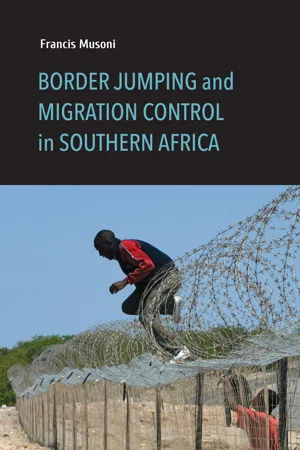
With the end of apartheid rule in South Africa and the ongoing economic crisis in Zimbabwe, the border between these Southern African countries has become one of the busiest inland ports of entry in the world. As border crossers wait for clearance, crime, violence, and illegal entries have become rampant. Francis Musoni observes that border jumping has become a way of life for many of those who live on both sides of the Limpopo River and he explores the reasons for this, including searches for better paying jobs and access to food and clothing at affordable prices. Musoni sets these actions into a framework of illegality. He considers how countries have failed to secure their borders, why passports are denied to travelers, and how border jumping has become a phenomenon with a long history, especially in Africa. Musoni emphasizes cross-border travelers' active participation in the making of this history and how clandestine mobility has presented opportunity and creative possibilities for those who are willing to take the risk.
- 218 pages
- English
- ePUB (mobile friendly)
- Available on iOS & Android
eBook - ePub
Border Jumping and Migration Control in Southern Africa
About this book
Information
Publisher
Indiana University PressYear
2020Print ISBN
9780253047144
9780253047144
eBook ISBN
9780253047168
1Colonial Statecraft and the Rise of Border Jumping
IN A STUDY of smuggling across the border between Rwanda and the Democratic Republic of the Congo, David Newbury argues that the shift from the idea of a frontier to a geopolitical boundary resulted in the illegalization of activities that had been considered perfectly reasonable and normal.1 To emphasize this point, Newbury says that the nature of the social and economic activities in the region did not change, “but a profound shift in the political/ideological context [occurred] . . . so that the same activities of at least 200 years’ duration and undoubtedly longer than that are classified in a new manner by the state system.”2 A similar scenario unfolded along the Zimbabwe–South Africa border following the British conquest of the Zimbabwean plateau in 1890. This development, which took place at the height of the European scramble for Africa, led to the reconfiguration of the Limpopo River as an interstate boundary and the beginning of state-centered controls of people’s movements between Southern Rhodesia (Zimbabwe) and the Transvaal (South Africa). As the region grappled with new ideas of borders and territoriality, people who crossed the Limpopo without following officially designated channels came to be regarded as illegal or clandestine migrants. This view was a huge departure from the previous scenario where communities astride the Limpopo moved back and forth across the river without fear of breaking any state-centered protocol.
Before the colonization of Zimbabwe, the Limpopo Valley had witnessed the development of sociocultural and economic networks that thrived on cross-Limpopo mobility. Among other factors, the existence of the Venda people on both sides of the river helped make cross-Limpopo connections stronger. For example, people from the Zoutpansberg area on the southern side of the Limpopo used to send messengers to the Marungudze (Malungudze) shrine in Beitbridge District to seek spiritual guidance in times of famines, wars, and other difficulties.3 It was also common (and still is) for the Venda people to marry across the Limpopo. As a result, some men moved permanently onto one side of the river, whereas others established multiple homes (with multiple wives and children) on both sides of the Limpopo. Some parents also used to send their adolescent sons and daughters across the Limpopo to attend initiation schools. Regardless of the side of the river where the initiation rites and classes took place, the initiates sometimes spent more than six weeks in the home area of the elders who presided over their training.4 In addition, people often moved their livestock back and forth across the Limpopo in search of pastures. Sometimes cattle herders had to migrate temporarily and spend several months in camps along the banks of the Limpopo regardless of which side of the river they came from. Whether people moved from one side of the Limpopo River to another as cattle herders, initiates, brides, bridegrooms, or mere visitors, the Venda did not think of themselves as intruders, foreigners, or even migrants because they regarded the region as unified geographically, socially, and politically.5
In ways similar to the Tonga, Nambya and other communities astride the Zambezi River—the focus of JoAnn McGregor’s Crossing the Zambezi—the Venda developed an intimate understanding of the Limpopo Valley and the river’s flowing patterns.6 In addition to acquiring the skills to build makeshift canoes to cross the Limpopo in flood, they had identified low-risk crossing points, which avoided parts of the river with crocodile-infested pools. In that respect, the Venda knew how and where to cross the Limpopo River during those times of the year when it was dangerous to cross (usually December to March). They also understood the behaviors of different kinds of animals that roamed the valley before construction of the Gonarezhou and Kruger national parks on the Zimbabwean and South African sides, respectively, of the border. As David Siyasongwe, a resident of Beitbridge, pointed out, “if they [the Venda] saw elephants from a distance they would throw dust in the air to determine the direction of the wind. Knowing that the elephant’s sense of smell is much stronger than its sense of sight, they would make sure to walk on the side where the wind was blowing.”7 In this way, the Limpopo, which the Venda referred to as Vhembe, was not a boundary per se but “just one of the perennial streams that flowed across the Venda territory on their way to the Indian Ocean.”8 With no state-based controls of mobility, the Limpopo’s flowing patterns determined when and how people moved back and forth across it.
In the same vein, the Afrikaners who occupied what became the Transvaal colony in northern South Africa in the 1850s viewed the Limpopo not as a marker of territorial limits of their state but as a river within a frontier zone. Commenting on this scenario, Stefanus Du Toit—an Afrikaner participant at the 1883–84 London Convention that restored the Transvaal’s autonomy after brief colonization by the British—wrote that although “the Transvaal bound itself to enter into no treaty with the natives to the east and west of the Republic without the sanction of England, the north was, for good reasons, left unmentioned.”9 In Du Toit’s thinking, which reflects that of many of his contemporaries, not using the Limpopo to define the northern boundary of the Transvaal meant that the Afrikaners had leeway to expand their territorial possessions and influence as far northward as they wanted. When large-scale gold mining operations began in the Witwatersrand area in the 1880s, the Transvaal officials did not see the need to restrict the entry of migrant workers from the Zimbabwean plateau, Mozambique, Malawi, Zambia, Tanzania, and other places. However, state officials actively sought to restrict the movements of people from the Transvaal to the Cape Colony and Natal, which were under the control of British settlers. Given that the British also tried to regulate people’s movements across the borders of the Cape Colony, it is no surprise that “illegal” migration became an issue of concern in pre-1890 South Africa.10 However, such concerns did not apply to movements across the Limpopo River, which were generally unregulated.
Colonial Conquest and the Rise of the Wage-Based Economy in Zimbabwe
Without the British South Africa Company (BSAC)-sponsored occupation of Zimbabwe on behalf of Britain in September 1890, the history of “illegal” migration across the country’s border with South Africa would have been different. Although previous centuries had witnessed other developments that stirred things up in the Limpopo Valley—such as the rise and fall of the Venda Kingdom and the settlement of the Shangani, Ndebele, Sotho, and other groups—the conquest of Zimbabwe significantly changed the character of the region.11 The greatest impact came from policies implemented by the BSAC administration that disrupted livelihood strategies on the Zimbabwean plateau and changed the meaning of cross-Limpopo mobility. The company’s labor mobilization efforts, which introduced the idea of wage-based livelihoods across the territory, were particularly disruptive. Although some people, especially those from the country’s border districts, had started working in the Transvaal mines before the 1890s, labor migration was not a major livelihood strategy for Zimbabweans then. It was only after the BSAC sponsored occupation of the territory that wage-based migrations became common among Zimbabweans.12
As a profit-oriented entity, the BSAC directed the bulk of the colony’s capital resources toward the labor-intensive sectors of mining and agriculture. In that respect, most policies that the company administration implemented in the early years of colonial rule sought to create a reservoir of cheap labor. For example, the company authorities introduced a “native” taxation apparatus that required Africans to pay different kinds of taxes (e.g., hut tax, dog tax, poll tax) with cash. This requirement was intended to force Africans to look for employment in various sectors of the emerging colonial economy so they could earn the money to pay taxes. Whereas most Africans on the Zimbabwean plateau previously worked only to produce food for their subsistence, they now had to work to earn money. The BSAC-administered taxation was also “arbitrary and irregular, appearing more like the levy of a tribute than the collection of a civil tax, as marauding bands of Native Department levies despoiled villages and districts of their crops and livestock.”13 As a technology of governance, taxation not only raised revenue for the colonial administration but also dragged Africans into the wage-based capitalist economy on an unequal footing.
In addition to cash taxation, the early 1890s witnessed the introduction of identity documents and travel passes in Southern Rhodesia. This process began with the BSAC administration compiling what it called the Registration of Natives Regulations in 1895. Borrowing several aspects of the pass systems that existed in the Transvaal and other parts of South Africa, the 1895 regulations stipulated that every African male who entered a township or a mining area—both of which were dominated by white settlers—must be registered and in possession of a permit (or pass) authorizing him to be in those areas. The regulations also introduced two categories of passes: one for Africans seeking employment in industrial and mining towns and the other for those taking up jobs as domestic servants in white people’s homes anywhere in the colony. Along with these requirements, the administration appointed a “registrar of natives” with the responsibility of issuing passes to Africans as they moved from one part of the colony to another.14 In most modern states, identification documents serve to distinguish between citizens and noncitizens, whereas in early colonial Zimbabwe, they were mostly used to trace the movement of Africans. As Vazira Fazila-Yacoobali Zamindar argues in her study of the chaos that emanated from the partition of India in 1947, these permits were not mere documents; they were bureaucratic tools for imposing limits on the colonized people.15
The introduction of the 1895 regulations coincided with the beginning of a territory-wide land dispossession and community restructuring process that gained momentum after the Ndebele–Shona revolts of 1896–97. As part of this process, the BSAC administration set aside large tracts of the colony’s prime lands for white settlers to use as farms and established “native reserves” mostly in areas with low rainfall and poor soils. With total disregard of preexisting community settlement patterns and ethnolinguistic boundaries, the colonists then forcibly relocated tens of thousands of Africans into the reserves. Land dispossession and forced relocations led not only to the loss of arable lands but also to overcrowding, overgrazing, and a general sense of insecurity among Africans in the reserves. It also helped to emasculate the local population to ensure their complete subjugation. More important, these policies created a pool of cheap labor for the emerging colonial economy.16 Without stable and dependable sources of livelihood, many Africans were forced to look for work on the mines, farms, and other industries in Southern Rhodesia.
It was also common for colonial officials to inflict pain on African people’s bodies to force them to sign up for jobs in different sectors of the economy. For example, while bragging about his use of coercion in dealing with Africans in 1895, the native commissioner for Hartley District wrote, “I am forcing the natives of this district to work sorely against their will.”17 As Harry Thomson noted in 1898, this meant flogging Africans to make sure they went out to work. In this regard, Thomson wrote, “I was told that if a boy will not work, or tries to run away, the usual thing is to take him to the native commissioner, and have him given twenty-five, and I found that the word ‘twenty five’ said in English to any of the boys was sufficient to make them grin in a sickly way—they quite understood what it meant.”18
In an attempt to supplement local supplies of labor, which kept fluctuating for the larger part of the first and second decades of colonial rule, Southern Rhodesian authorities made arrangements to import foreign workers. Like their counterparts in the Transvaal, Natal, and other parts of South Africa, colonial officials intended to import indentured workers from India and China. However, negative stereotypes of Indians, deriving mostly from the European–Indian interactions in other parts of the world, stirred an anti-Indian attitude among white settlers in Southern Rhodesia and led to the discontinuance of the arrangements.19 Another arrangement meant to facilitate the importation of Arabs, Shamis, and Somali workers from Djibouti to Southern Rhodesia was also implemented but only briefly because it failed to achieve desired results. Ultimately, Southern Rhodesia turned to its neighboring territories, particularly Nyasaland (Malawi), Northern Rhodesia (Zambia), and Mozambique. However, many early migrant workers from these areas did not stay long in Southern Rhodesia, which they considered a temporary stopover on their way to better-paying jobs in South Africa.20
Given that cross-Limpopo mobility had existed for centuries prior to 1890, it might appear unfair to blame the British occupation of Zimbabwe for the prevalence of border jumping across the country’s border with South Africa. However, the point I am making in this chapter and throughout the entire book is that the imposition of colonial rule in Zimbabwe changed the political, economic, and ideological context in which cross-Limpopo mobility took place. Although the Venda, Sotho, Ndebele, and other groups of people in Zimbabwe’s border districts continued to visit their relatives across the river, which had become a colonial boundary, they did so under different conditions. Because the Limpopo was no longer just another river, the act of crossing it no longer meant the same thing. In addition, the imposition of new demands on life that came...
Table of contents
- Cover
- Title Page
- Copyright
- Dedication
- Contents
- Preface
- Acknowledgments
- List of Acronyms and Abbreviations
- Introduction
- 1. Colonial Statecraft and the Rise of Border Jumping
- 2. Promoting Illegality: South Africa’s Ban on “Tropical Natives”
- 3. Border Jumping and the Politics of Labor
- 4. Apartheid, African Liberation Struggles, and the Securitization of Cross-Limpopo Mobility
- 5. Crossing the Boundary Fence: The Zimbabwe Crisis and the Surge in Border Jumping
- Conclusion
- Bibliography
- Index
- About the Author
Trusted by 375,005 students
Access to over 1.5 million titles for a fair monthly price.
Study more efficiently using our study tools.
Frequently asked questions
Yes, you can cancel anytime from the Subscription tab in your account settings on the Perlego website. Your subscription will stay active until the end of your current billing period. Learn how to cancel your subscription
No, books cannot be downloaded as external files, such as PDFs, for use outside of Perlego. However, you can download books within the Perlego app for offline reading on mobile or tablet. Learn how to download books offline
Perlego offers two plans: Essential and Complete
- Essential is ideal for learners and professionals who enjoy exploring a wide range of subjects. Access the Essential Library with 800,000+ trusted titles and best-sellers across business, personal growth, and the humanities. Includes unlimited reading time and Standard Read Aloud voice.
- Complete: Perfect for advanced learners and researchers needing full, unrestricted access. Unlock 1.5M+ books across hundreds of subjects, including academic and specialized titles. The Complete Plan also includes advanced features like Premium Read Aloud and Research Assistant.
We are an online textbook subscription service, where you can get access to an entire online library for less than the price of a single book per month. With over 1.5 million books across 990+ topics, we’ve got you covered! Learn about our mission
Look out for the read-aloud symbol on your next book to see if you can listen to it. The read-aloud tool reads text aloud for you, highlighting the text as it is being read. You can pause it, speed it up and slow it down. Learn more about Read Aloud
Yes! You can use the Perlego app on both iOS and Android devices to read anytime, anywhere — even offline. Perfect for commutes or when you’re on the go.
Please note we cannot support devices running on iOS 13 and Android 7 or earlier. Learn more about using the app
Please note we cannot support devices running on iOS 13 and Android 7 or earlier. Learn more about using the app
Yes, you can access Border Jumping and Migration Control in Southern Africa by Francis Musoni in PDF and/or ePUB format, as well as other popular books in History & African History. We have over 1.5 million books available in our catalogue for you to explore.