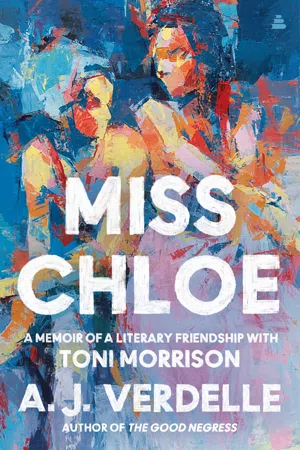
Toni Morrison had many names; I called her Miss Chloe. This was a moniker she seemed to appreciate and which, I realize, was unique. Calling her Miss Chloe was efficient: I could identify myself and greet her at once. As an address, as a phrase, “Miss Chloe” was cryptic, abbreviated, brief yet robust. I referred to her as Morrison, but I addressed her as Miss Chloe. To be able, and be allowed, to call her Miss Chloe was a privilege and was special and was inside. Ultimately, I could see that she liked being called the name she’d pointedly left behind. I’m not sure whether she applauded my nerve, but she answered seamlessly and pleasantly.
Eight years older than my mother, Miss Chloe was a generation ahead of me. The convention of using “Miss” with your first name was a familiar mode of address for both of us. It signified respect, familiarity; greater intimacy than strangers, than people thrown together. It suggested you knew somebody—often from back in the day. “Miss” was an honorific, a statement of considered, cultivated, well-trained deference—to age, to wisdom, to significance. You called Black women elders Miss because they knew more than you, were ahead of you, were leading you, were allowing you to follow them. They did not dismiss you. They might deign to tell you what’s what. But you were expected to observe them take slings and arrows in the interest of protecting your future, while you lagged behind, while you tried to grow up, while you contemplated skirts. That’s why you called them Miss.
Note that the honorific “Miss” makes absolutely no reference to a state of being wed or unwed. The state of marriage was not enfolded in this expression of cross-generational intimacy and esteem. The naming convention was “Miss + First Name.” To use this convention was to say you understood both the conventions of the community and the community itself.
All my years at Princeton, people referred to Morrison respectfully, sometimes demurely: Miss Morrison, Miss Morrison. Her audience called her Miss Morrison. Her assistant, Rene Boatman, very precisely referred to her as Ms., pronounced Miz Morrison. People close to her called her Toni. White people called her Toni. All those irritating interviewing white men called her Toni. Gloria Baldwin, Jimmy Baldwin’s surviving sister, reports that she was introduced to Toni Morrison as Chloe, and that is what Gloria has always called her—Chloe. Gloria has known Morrison for decades. I can only imagine being peer enough to legit engage with “Chloe Toni Morrison.” A different era, a different baseline. To think that James Baldwin called Toni Morrison Chloe is another wonder. Did she introduce herself that way? Did he reach back into her past, as I did? Was she not using Toni then, or not for him? Though we did have the gift of a friendship, I got all the backstory late and on the q.t. Miss Chloe and I had no history, though we would make one. But at that moment, I was a newbie: I rose to her sight line from the literati next gen.
By calling Toni Morrison Miss Chloe, I was acknowledging the power of naming, and reaching back to a fictive past. (Engaging with a herstory I did not live and could only reimagine.) A past that, in Toni Morrison’s case, could never have occurred. “Miss First Name” is a convention from the neighborhood. Young people and children called older women from around the block Miss Pat, Miss Elaine, Miss Joanne.
Miss Chloe flew the coop early, and so was not around the block. By the time she would have been Miss Chloe, Toni had already risen up and taken over. The children and young people who might have called her Miss Chloe were growing up in a neighborhood in Ohio where she did not live. And children who might have called her Miss Somebody where she did live would have had to call her Miss Toni.
She and I were both aware that I was uncovering a name that had had no purchase. There was nobody to enact the convention until . . . there I was. Motivated by convention and by linguistic history, I found a name that would announce me, that would be affectionate, but that would carry an important layer of respect. As a form of address, the name “Toni” never once crossed my lips. I. Just. Was. Not. There.
I tested the name “Miss Chloe” first. She was wearing her trademark gray that day. We’d had a visit and had come to departure time. Although I considered bluntly announcing, I’ve decided to call you Miss Chloe—I didn’t. Early on, we had a conversation about how early in my youth I had learned that her birth name was “Chloe,” and how I thought that was so avant-garde a name for her era. I contextualized my discovery, reporting also how feminized the town name “Lorain” seemed to me, but acknowledged that that was because of Lorraine (different spelling) Hansberry.
She laughed and said, “There’s nothing avant-garde about ‘Chloe.’ It’s in the Bible.”
“Well, ‘Chloe’ is a name that’s gorgeous and rare,” I said.
With Morrison’s cross-novel focus on the Black folkway of naming children with “a finger placed” on a biblical name, I might have presumed that Morrison was named that way herself. The practice developed as a measure of half-literacy. You look for a raised letter, and that would be a capital, and therefore a fine choice of name. Morrison was very serious about displaying this folk tradition, especially in her two most biblical books, Song of Solomon and Paradise. This preliteracy strategy did not always work out. See Pilate. See First Corinthians.
“Chloe” appears only once in the Bible, in First Corinthians (1:11). We get no backstory from this verse. Though Chloe is mentioned, she remains undefined.
When I left her that day, I did stand up and, by way of goodbye, did say grandly, sweepingly, “See you next time, Miss Chloe. As usual, visiting you has been so much fun.” Silly for me to use such a childish word, fun, but I was focused on a different word then. I was looking directly at her, and I carefully watched her register this brand-new reference. Miss Chloe. I gambled that she would not openly object, and she didn’t. I called her Miss Chloe forever after that, but it began on a nondescript afternoon. It felt like a personal victory, to claim that special name. Reaching into her history for nomenclature was bold, but not out of bounds. If history had been different, a real Miss Chloe could have lived. But as it was, Chloe became Ms. Morrison, who became editor, who became writer, who became the late, great Toni Morrison. “Miss Chloe” in my mouth was a term of endearment, and it was thrilling to be correctly interpreted, to be allowed.
THE WILDEST KIND OF CHOSEN
After years of reading Morrison (and scores of other writers), I wrote a book, which she read and “blurbed,” and then she called me. That is the short version of how our story began. After our first visit, years of engagement followed. Rememory carries her voice, her wit, her laughter, her communicated wisdom, her snappishness, her timbre, her daring, her willingness and ability to wrestle with the mysteries of the past.
While I was not clearing paths as she was, I shared her barely contained disdain for society’s disregard. We agreed that even in our late era, Black people were still denied intellect and/or emotion. In fiction and in real life, our human qualities were consistently erased across the broad culture. Our erasure has been intentional and multidisciplinary. Attempts to erase us continue, as if we are not here watching. Morrison and I could comfortably move forward in our assessments of our country, though she brought her truth to the page, and I still just carried mine along. Baggage. Weight. The unwritten past is its own wild chaos. Unwieldy and a drag on the spirit. Toni Morrison took to said chaos with her writing hand as machete. Get out the way.
IN LATE SPRING OF 1997, at the end of my Bunting year, Rene Boatman reached me on my cell phone; I was in New Orleans, where we spent part of the year and where I had a house. A yellow house with chartreuse trim, in the French Quarter. Between Rampart and Burgundy. Very near Louis Armstrong Park and Congo Square. Rene, whose voice and phone number I soon came to recognize, was unknown to me then. After she introduced herself, she said, “Toni Morrison would like to see you.”
In my mind, I reached for a chair’s back or a bookshelf, something to steady me. Maybe I thought I might faint. Really, I wasn’t quite that dramatic, but I could have been. I didn’t ask the silly question no doubt bouncing in my brain: For real? You serious? I’m sure I took a seat, as an investment in sounding calm and collected.
“Ms. Morrison would like for you to come meet with her. Would that be possible? Sometime later this summer?”
I’m sure I tried to reply in a reasonable register. Yes. Yes. Of course. When? August? Yes. Yes. Where? I am redundant when I’m enervated.
The answer to “where” was New York City, and the answer to “when” was TBD. Rene indicated that we’d resolve the details later, that in the next week we’d settle on a date and time that worked for both of us. I suggested that later in August would be better for me, as I would be coming northeast at that time. Of course, I would have traveled to see Morrison whenever she chose. I was not yet a mother then; I had clients but no daily workplace constraints.
Visiting Toni Morrison at her home in New York took on the character of a major life event. I was very preoccupied about this upcoming date. So huge a surprise sailing into my life. I urged myself to be nimble, humble, receptive, to use my worried energy for forethought. I plotted my strategy for the date, once announced: JetBlue direct from New Orleans to the fam in DC; then Amtrak, DC to NYC; then the A Train from Penn Station to Canal. This is a pilgrimage, I said to self, on the train.
After my long journey, I felt triumphant. I had kept my clothes clean. Prior pilgrimages included six countries overland in Africa (Togo, Senegal, Benin, Nigeria, Burkina Faso, Gambia); France, England, Canada, Mexico; umpteen united states. But compared with my prior pilgrimages, this visit to see Toni Morrison ranked high on the list. Taking that very first train ride to Morrison loomed as a huge adventure, an apex, a summons I responded to with anticipation. Wonderment had been idling in me since the first of the many steps toward this meeting was taken, nearly all the way back in spring.
That August afternoon in Lower Manhattan, I arrived early. Unusual for me. I did not have an iPhone then, did not have GPS then. Besides, I didn’t know how long each leg of the trip would take. And further, I was apprehensive, though mostly in a good way. So, I had to be early, to get my bearings, to be in place by the appointed hour. I walked past the address a couple of times, to be sure I knew where to find the buzzer I needed to use.
I did buzz exactly on time. She buzzed me in, and I elevated up. At the door on her floor, I met a woman whose eyes sparkled. She was not a tall woman, which was sweet to notice. She could have been a giant, and I would have been unsurprised. She invited me in, asked me to sit down, and we talked for two hours. Toni Morrison presented as warm, curious, and engaged, full of good humor and blunt questions. She was in no way frightening.
Before this visit was scheduled, I had not even tried to imagine Morrison up close and personal. But I knew I needed to plan what I would say. How, again, would I express my great appreciation: for her invitation, for her taking an interest in my work and in me, for blurbing my book without being asked (which I had thanked her for already). I also prepared and held in mind a few questions—in case conversation lagged, in case silence threatened, in case so few others were there that I had to converse with her directly and hold my own.
We were having a private meeting, it turned out, visiting only with each other. When I had learned that this visit was social, I presumed I would be among others. In retrospect, I hoped I wasn’t too open-mouthed, too visibly amazed. You can’t go visit somebody at their house and gawk. To be present and personable, to be conversational and affable and adept—those were my goals. The years I’d spent round musicians taking to the stage had taught me how to be engaging on demand, to raise issues the person I was talking to might care about, to listen to what they might say.
During my years in New York City and New Orleans, I bopped around the jazz community. My partner then was a concert producer, and we spent much time around genius musicians and producers. Her world was full of luminaries like Abbey Lincoln, Wynton Marsalis, James Brown, Ed Bradley, George and Joyce Wein, Regina Carter, Akua Dixon, Susan L. Taylor (of Essence fame). Abbey had the same brevity, and expressive eye light, that Morrison had. They both could be snappish, and oh so real. They both could shut a situation down with a look. Abbey Lincoln was in her wisdom years the whole time I knew her, too. I believe Abbey is one of the greatest philosophers our culture has produced. Her original lyrics—especially from her later years—are like a guidebook to life, including the spiritual part of life. Abbey Lincoln lived a Black woman genius story, too. I often wished that Morrison and Abbey had known each other. They were so alike. Both powerhouses. Both geniuses. Both completely full of disregard for any silliness or illogic or stupidity. Like Morrison, Abbey lived a long and powerful life, and in the arena she inhabited, Abbey, too, was a queen. A philosopher-queen, if you ask me.
IN MORRISON’S LOFT, ALONE WITH HER, I had to remind myself that who I was had brought me there. That the diva had called, and I had arrived. The windows were large, the ceilings were high. Her furnishings were white, and she was genial.
As there were only two of us, I could not be a wallflower. I breathed deep to calm my nerves, urging myself to be myself. All went well while we sat in her stunning apartment and talked. Seeing her in person and up close was invigorating and amusing and more than memorable—honestly, more than I thought my life might contain.
Morrison’s Tribeca apartment must have been somewhat new when I visited. Spare and vast were its primary characteristics. Not just huge for Manhattan, but enormous for anyone, for any set of people. Her rooms were a series of well-lit, breezy, airy white boxes. The white furniture was pristine. The walls, curiously unadorned. I asked no blunt questions, like Is this a new place? How long have you been here? How big is this crib? I refused to embarrass myself, though scoping out real estate is a regular and accepted behavior in NYC. I hope I didn’t seem disinterested; it was hard to know what was best to do.
Shortly after Morrison passed, the Tribeca apartment showed up on the real estate market. By then, it was lavish, saturated with the appointments of a world-class author and celebrated intellectual. Bookshelves built in corner to corner, a rail ladder installed to make high shelves accessible. Every space holding books; shelves spanning wall to wall. I looked closely at the realty pictures for signs of the place I had been, but the white-box rooms had been replaced with literature, decoration, and reward. The place was suffused with interior design and Morrison’s particular appointments. The l...