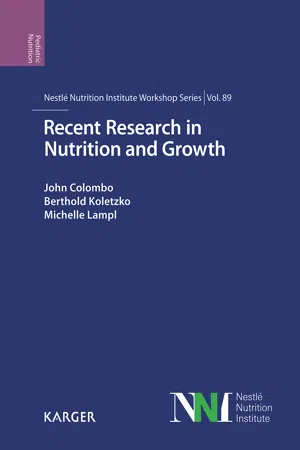
eBook - ePub
Recent Research in Nutrition and Growth
89th Nestlé Nutrition Institute Workshop, Dubai, March 2017
- 204 pages
- English
- ePUB (mobile friendly)
- Available on iOS & Android
eBook - ePub
Recent Research in Nutrition and Growth
89th Nestlé Nutrition Institute Workshop, Dubai, March 2017
About this book
As nutrition and development are closely intertwined in early childhood, this book brings together scientists, nutritionists, and psychologists to present a multidisciplinary approach. The first part examines how the biological systems of the body may contribute to healthy growth, looking at bones, muscles, and fat tissues and the optimal nutrition required for dynamic function. The second section contains updates on the latest research on dietary interventions in the areas of growth and body composition, looking at both obesity and stunting worldwide. The final part focuses on neurocognitive development in infancy and early childhood and the role of nutrients in supporting brain growth and function. Highlighting key areas of recent research and potential new fields to explore, this book is of interest for scientists, nutritionists, and psychologists alike.
Information
Topic
MedicineSubtopic
Nutrition, Dietics & BariatricsNutrition, Brain Function, and Cognitive Development
Colombo J, Koletzko B, Lampl M (eds): Recent Research in Nutrition and Growth.
Nestlé Nutr Inst Workshop Ser, vol 89, pp 131–142, (DOI: 10.1159/000486498)
Nestlé Nutrition Institute, Switzerland/S. Karger AG., Basel, © 2018
Nestlé Nutr Inst Workshop Ser, vol 89, pp 131–142, (DOI: 10.1159/000486498)
Nestlé Nutrition Institute, Switzerland/S. Karger AG., Basel, © 2018
______________________
A Nutritionist’s Perspective on Behavioral Assessment
Susan E. Carlson
Department of Dietetics and Nutrition, University of Kansas Medical Center, Kansas City, KS, USA
______________________
Abstract
The perspective shared here is that of a nutritionist who has been collaborating with a behavioral scientist for 20 years. Examples will be related to long-chain polyunsaturated fatty acids, the subject of our collaboration. While it is well accepted that nutrition is key to optimal human health and development, nutrition intervention trials in populations and randomized controlled trials of specific nutrients that have measured these outcomes have occurred relatively recently. Studies of nutrition and behavior are even less common – the first appears to have been a protein intervention that began in 1969 in Guatemala that involved developmental follow-up to adulthood. When results of multiple trials are available, findings of individual trials frequently range from no effect to benefit, making it difficult to make decisions about policy and practice. A meta-analysis that combines the results of all randomized trials of a nutrient is considered the highest level of evidence for drug trials. For studies of nutrient supplementation, however, meta-analyses can err on the side of no effect and lead to assumptions that a nutrient is adequate in populations with deficient or marginal status. In studies that assess behavior, collaboration with a behavioral scientist is necessary to determine the behavioral outcome(s) to assess, ensure the proper administration of the outcome, and analyze and interpret the results. The goal of the paper is to offer insight into issues common to all nutrition research, but especially issues unique to studies that assess behavior. As noted, industry, governments, health organizations, journals, as well as scientists have roles to play.
© 2018 Nestlé Nutrition Institute, Switzerland/S. Karger AG, Basel
Introduction
The goal of this paper is to offer the perspective of a nutritionist on behavioral assessment using examples from my 20-year experience collaborating with Dr. John Colombo, a behavioral scientist. By sharing specifics on the primary roles of the scientist from each discipline and shared roles, I hope to offer guidance to other nutritionists who wish to develop a collaboration with a behavioral scientist. The earliest collaboration of nutrition and behavior was a protein intervention from birth to 2 years of age conducted in Guatemala starting in 1969 with follow-up to adulthood [1]. In the late 1970s, advances in neonatal medicine allowed the survival of preterm infants who had previously succumbed to lung disease. Soon after, randomized clinical studies of nutrition and cognitive development in preterm infants began to be conducted, as it was recognized that their nutritional requirements were difficult to achieve and were associated with compromised neurobehavioral development. Some of the first nutrition studies in preterm infants were on the role of docosahexaenoic acid (DHA), a long-chain polyunsaturated fatty acid (LC-PUFA), in the development of visual acuity [2, 3].
This report highlights areas where the quality of interdisciplinary studies could be improved and offers suggestions how scientists and other key players like governments, organizations, industry, and journals could play a positive role in solutions. Studies of nutrition that measure outcomes of behavior/cognition have issues that are unique compared to studies of nutrients that measure biochemical makers of status or physiological outcomes. Finally, studies of nutrition and behavior/cognition are like all nutrition intervention studies in that meta-analyses are considered the highest quality of evidence. Unlike drug interventions, however, all individuals included in a trial will have some amount of the nutrient at enrollment. As will be discussed, applying a meta-analysis to questions of nutritional adequacy has serious limitations, which can result in failure to recognize the need for nutrient supplementation in deficient populations and ultimately result in bad policy decisions.
Concerns with Our Current Approach to Evaluating Quality of Evidence
Although the major focus of this report will be on issues related to studies of nutrition that assess a behavioral outcome, I wish to first mention a general issue that is increasingly being recognized as a concern for nutrient intervention trials, i.e., the fact that meta-analyses have a high probability of reaching a null conclusion even when individual studies of a nutrient in a specific population may not. Nutrients are not drugs, and the status of a given nutrient within and among populations is highly variable. In addition, most randomized trials are conducted in populations in the developed world, where a deficiency in a given nutrient may be less common than in the developing world. Consequently, a meta-analysis may further underestimate the extent of a nutritional deficiency on health outcomes.
A biomarker of nutrient status obtained at the onset of the intervention is important to determine if nutrient status is compromised, and measurement of the same biomarker at the end of the intervention identifies the degree of compliance with the intervention. The biomarker status at the end of the intervention will also demonstrate increased intake of the nutrient by the placebo and supplemented group. We have documented this behavior both by subject report and by biomarker assessment in randomized trials of DHA supplementation during pregnancy. Consent requires mention of the nutrient being studied, and subjects may wish to ensure that they receive the nutrient in case they are randomized to the placebo dose. Many published studies do not report a valid biomarker of nutrient status of groups at the beginning and end of the intervention, so it is not possible to do a secondary analysis to evaluate if responders differ from nonresponders in terms of nutrient status at enrollment or at the end of the intervention.
Nutrition scientists should insist that biomarkers of nutrient status are collected at both the onset and completion of nutritional interventions. It is well known that not all subjects are compliant with interventions. It is also the case that not all populations are equally deficient in a nutrient. The availability of biomarkers allows for secondary analyses by compliance and by nutrient status after completion of an intent-to-treat analysis. Standardization of biomarker methods among laboratories is also important as this allows for studies in different populations to be compared, and, by inference, to suggest the optimal status of a nutrient for best performance. For example, a laboratory planning to measure fatty acid status should first ensure that their results are consistent with those of a laboratory with well-developed and valid measurements for assessing fatty acid status. As a reviewer, I have seen results of fatty acid analyses that raised concern about methodology, and those concerns were confirmed when the investigators were asked to provide a sample of chromatography.
Intent-to-treat analysis has been the standard for Food and Drug Administration trials and widely adopted by reviewers for government-funded clinical trials. This means that all subjects randomized in an intervention trial are included in their randomized group in analyses regardless of whether they complied with the intervention or withdrew from the study. The idea has been applied to randomized clinical studies of nutrients as well as to drugs. The idea behind intent-to-treat analysis is that the results should be more in line with what would be expected if the intervention were to become a public health policy. As might be expected, like meta-analyses, intent-to-treat analysis can lead to acceptance of a null hypothesis when treatment as received would show a benefit. The likelihood of this outcome is increased with reliance on meta-analyses comprised of studies that used intent-to-treat analysis.
Nutrition scientists are generally most interested in whether improving the status of a nutrient is beneficial. One strategy is to follow a required intent-to-treat analysis with a secondary analysis based on compliance or change in biomarker status. Unfortunately, these published results are not included in meta-analyses though they may be included in systematic reviews. At the meeting, we heard from one of the participants that the European Food Safety Authority is now focusing more on individual studies that are included within meta-analyses and systematic reviews. Unfortunately, at the same time, the World Health Organization appears to be more inclined to require the results of meta-analyses as a basis for their recommendations.
Expectations for Trials of Nutrition and Behavioral Assessment
Before a clinical study of nutrition and behavior is started, there should be a plausible hypothesis that nutrient supplementation or improvement in status of a nutrient will favorably influence behavior. Many animal studies of DHA deficiency were done well before any studies to increase DHA were undertaken in humans. Research in animal models demonstrated clearly that reductions in brain DHA had profound effects on neurological function as seen from changes in behavior. These included altered retinal electrophysiology and lower visual acuity, changes in attention that suggested slower brain maturation and slower processing, higher impulsivity, reactivity, and increased stereotyped behavior suggestive of altered neurotransmitter function, and alterations in cortical neurotransmitters, including dopaminergic, serotonergic, cholinergic, and GABAergic systems. While the sheer number of these studies is too extensive to detail in this short report, and no recent review of this literature is available, examples of studies may be found from P.E. Wainwright, M. Neuringer, S. Innis, and S. Delion.
Studies of nutrient deficiencies in animal models are generally designed to produce a more extreme deficiency than typically found in humans; nevertheless, animal models can help identify cognitive domains affected by a nutrient and help focus behavioral assessment in targeted areas. In the case of LC-PUFA studies, the behavioral, electrophysiological, and neurotransmitter effects of deficiency guided...
Table of contents
- Cover Page
- Front Matter
- A Systems Perspective on Growth
- Dietary Modulation of Growth and Body Composition
- Nutrition, Brain Function, and Cognitive Development
- Subject Index
- Back Cover Page
Trusted by 375,005 students
Access to over 1.5 million titles for a fair monthly price.
Study more efficiently using our study tools.
Frequently asked questions
Yes, you can cancel anytime from the Subscription tab in your account settings on the Perlego website. Your subscription will stay active until the end of your current billing period. Learn how to cancel your subscription
No, books cannot be downloaded as external files, such as PDFs, for use outside of Perlego. However, you can download books within the Perlego app for offline reading on mobile or tablet. Learn how to download books offline
Perlego offers two plans: Essential and Complete
- Essential is ideal for learners and professionals who enjoy exploring a wide range of subjects. Access the Essential Library with 800,000+ trusted titles and best-sellers across business, personal growth, and the humanities. Includes unlimited reading time and Standard Read Aloud voice.
- Complete: Perfect for advanced learners and researchers needing full, unrestricted access. Unlock 1.5M+ books across hundreds of subjects, including academic and specialized titles. The Complete Plan also includes advanced features like Premium Read Aloud and Research Assistant.
We are an online textbook subscription service, where you can get access to an entire online library for less than the price of a single book per month. With over 1.5 million books across 990+ topics, we’ve got you covered! Learn about our mission
Look out for the read-aloud symbol on your next book to see if you can listen to it. The read-aloud tool reads text aloud for you, highlighting the text as it is being read. You can pause it, speed it up and slow it down. Learn more about Read Aloud
Yes! You can use the Perlego app on both iOS and Android devices to read anytime, anywhere — even offline. Perfect for commutes or when you’re on the go.
Please note we cannot support devices running on iOS 13 and Android 7 or earlier. Learn more about using the app
Please note we cannot support devices running on iOS 13 and Android 7 or earlier. Learn more about using the app
Yes, you can access Recent Research in Nutrition and Growth by J. Colombo,B. Koletzko,M. Lampl,John Colombo,Berthold Koletzko,Michelle Lampl,John, Colombo,Berthold, Koletzko,Michelle, Lampl, J. Colombo, B. Koletzko, M. Lampl in PDF and/or ePUB format, as well as other popular books in Medicine & Nutrition, Dietics & Bariatrics. We have over 1.5 million books available in our catalogue for you to explore.