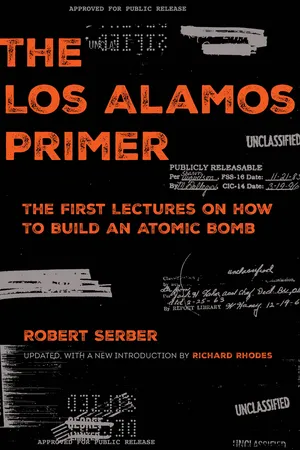
More than seventy years ago, American forces exploded the first atomic bombs over the Japanese cities of Hiroshima and Nagasaki, causing great physical and human destruction. The young scientists at Los Alamos who developed the bombs, which were nicknamed Little Boy and Fat Man, were introduced to the basic principles and goals of the project in March 1943, at a crash course in new weapons technology. The lecturer was physicist Robert Serber, J. Robert Oppenheimer’s protégé, and the scientists learned that their job was to design and build the world’s first atomic bombs. Notes on Serber’s lectures were gathered into a mimeographed document titled TheLos Alamos Primer, which was supplied to all incoming scientific staff. The Primer remained classified for decades after the war.
Published for the first time in 1992, the Primer offers contemporary readers a better understanding of the origins of nuclear weapons. Serber’s preface vividly conveys the mingled excitement, uncertainty, and intensity felt by the Manhattan Project scientists. This edition includes an updated introduction by Pulitzer Prize–winning historian Richard Rhodes.
A seminal publication on a turning point in human history, The Los Alamos Primer reveals just how much was known and how terrifyingly much was unknown midway through the Manhattan Project. No other seminar anywhere has had greater historical consequences.
eBook - ePub
The Los Alamos Primer
The First Lectures on How to Build an Atomic Bomb, Updated with a New Introduction by Richard Rhodes
- 176 pages
- English
- ePUB (mobile friendly)
- Available on iOS & Android
eBook - ePub
The Los Alamos Primer
The First Lectures on How to Build an Atomic Bomb, Updated with a New Introduction by Richard Rhodes
About this book
Information
Publisher
University of California PressYear
2020Print ISBN
9780520344174
Edition
1eBook ISBN
9780520374331
The Los Alamos Primer
The following notes are based on a set of five lectures given by R. Serber during the first two weeks of April 1943, as an “indoctrination course” in connection with the starting of the Los Alamos Project. The notes were written up by E. U. Condon.
Everybody assembled in the big library reading room on the first floor of the Technical Area, the building where the theoretical physicists had their offices. We had a little blackboard set up in front and a lot of folding chairs spread around the room. Fifty people on hand, something like that. Scientific staff, a few visiting VIPs. There was hammering off in the background, carpenters and electricians working out of sight but all over the place. At one point during the lectures a leg came bursting through the beaverboard ceiling. One of the workmen misstepped and they had to pull him out.
1. Object
The object of the project is to produce a practical military weapon in the form of a bomb in which the energy is released by a fast neutron chain reaction in one or more of the materials known to show nuclear fission.
I started lecturing. I started talking about the “bomb.” After a couple of minutes Oppie1 sent John Manley up to tell me not to use that word. Too many workmen around, Manley said. They were worried about security. I should use “gadget” instead. In the Primer Condon wrote it down both ways. But around Los Alamos after that we called the bomb we were building the “gadget.”
Section 1 emphasizes that our purpose at Los Alamos was to build a practical military weapon—one small enough and light enough that an airplane could carry it.2 There was no use making something that weighed one hundred tons. That was our concern.
We meant to build this weapon by utilizing the energy from nuclear fission. Fission had a history. For a long time before 1939, people were bombarding uranium with neutrons. Uranium was the heaviest element known up to 1939. People had the idea that the uranium they were bombarding was capturing neutrons and transmuting to heavier elements, elements beyond uranium on the periodic table, transuranics. I remember seminars in Berkeley in the 1930s when the chemists discussed the trouble they were having explaining the chemistry of these supposed transuranic elements. The chemistry didn’t seem to be working out right. Then Otto Hahn and Fritz Strassmann, in Germany, working with the physicist Lise Meitner, found out that making transuranics wasn’t what was usually happening at all. Instead, the uranium nucleus was actually splitting into two big pieces, and doing it with the release of a great deal of energy (and a couple of extra neutrons, as several people soon demonstrated). As soon as that was discovered, everybody realized the possibility both of making weapons and of getting power.
Finally, the reaction we were interested in was a fast neutron chain reaction, which I’ll discuss later in these notes.
2. Energy of Fission Process
The direct energy release in the fission process is of the order of 170 Mev per atom. This is considerably more than 107 times the heat of reaction per atom in ordinary combustion processes.
In Section 23 we immediately come to the heart of the matter: that the energy released in the fission of the uranium nucleus is considerably greater than 107—that is, ten million times the energy released in a typical chemical combustion such as an explosion or a fire. All else follows from this fact. So we should try to understand where this large number comes from.
We can do so because the origin of the energy released in fission is exactly the same as the origin of the energy released when two atoms or molecules react chemically. It’s the electrostatic energy between two similarly charged particles. Two similarly charged particles repel each other. There’s an electrical force pushing them apart. Work has to be done to overcome that repulsion and push them together from a large distance, up to a point of separation we can call R.
To start with a simpler particle than an atom, let’s look at two electrons pushed together. If you released them, they would fly apart with an amount of energy equal to the work that went into pushing them together. That energy E is given by the formula

where e is the electron charge, e2 is e multiplied by itself, and R is the distance between the particles. The electrostatic energy thus ends up as kinetic energy, the energy of motion. In chemical reactions—the burning of hydrogen and oxygen in a rocket engine, for example—electrons bound in atoms or molecules change their positions, and the change in electrostatic energy is what appears as the energy of the chemical reaction.
Now let’s consider the electrostatic energy in the uranium nucleus. The uranium nucleus contains 92 protons, each of which has the same charge as an electron, though of opposite sign—particles of opposite sign attract each other, those of the same sign repel. So the uranium nucleus has a charge 92 times as great as an electron; it’s positive rather than negative, + rather than −, but since only the square of the charge is involved, that difference doesn’t matter in equation (1). The numerator of (1) is thus 922 times bigger than for a chemical reaction. For our purposes, 922 is close enough to call 1002. So the numerator for a uranium atom would be greater by a factor of 1002, 100 times ...
Table of contents
- Title
- Copyright
- Contents
- Introduction by Richard Rhodes
- Preface by Robert Serber
- Illustrations
- The Los Alamos Primer
- Endnotes
- Appendix I: The Frisch-Peierls Memorandum
- Appendix II: Biographical Notes
- Notes
- Index
Trusted by 375,005 students
Access to over 1.5 million titles for a fair monthly price.
Study more efficiently using our study tools.
Frequently asked questions
Yes, you can cancel anytime from the Subscription tab in your account settings on the Perlego website. Your subscription will stay active until the end of your current billing period. Learn how to cancel your subscription
No, books cannot be downloaded as external files, such as PDFs, for use outside of Perlego. However, you can download books within the Perlego app for offline reading on mobile or tablet. Learn how to download books offline
Perlego offers two plans: Essential and Complete
- Essential is ideal for learners and professionals who enjoy exploring a wide range of subjects. Access the Essential Library with 800,000+ trusted titles and best-sellers across business, personal growth, and the humanities. Includes unlimited reading time and Standard Read Aloud voice.
- Complete: Perfect for advanced learners and researchers needing full, unrestricted access. Unlock 1.5M+ books across hundreds of subjects, including academic and specialized titles. The Complete Plan also includes advanced features like Premium Read Aloud and Research Assistant.
We are an online textbook subscription service, where you can get access to an entire online library for less than the price of a single book per month. With over 1.5 million books across 990+ topics, we’ve got you covered! Learn about our mission
Look out for the read-aloud symbol on your next book to see if you can listen to it. The read-aloud tool reads text aloud for you, highlighting the text as it is being read. You can pause it, speed it up and slow it down. Learn more about Read Aloud
Yes! You can use the Perlego app on both iOS and Android devices to read anytime, anywhere — even offline. Perfect for commutes or when you’re on the go.
Please note we cannot support devices running on iOS 13 and Android 7 or earlier. Learn more about using the app
Please note we cannot support devices running on iOS 13 and Android 7 or earlier. Learn more about using the app
Yes, you can access The Los Alamos Primer by Robert Serber in PDF and/or ePUB format, as well as other popular books in History & Military & Maritime History. We have over 1.5 million books available in our catalogue for you to explore.