Popular culture is rife with movies, books, and television shows that address our collective curiosity about what the world was like long ago. From historical dramas to science fiction tales of time travel, audiences love stories that reimagine the world before our time. But what if there were a field that, through the advancements in technology, could bring us closer to the past than ever before?
Written by a preeminent expert in geospatial archaeology, Maps for Time Travelers is a guide to how technology is revolutionizing the way archaeologists study and reconstruct humanity’s distant past. From satellite imagery to 3D modeling, today archaeologists are answering questions about human history that could previously only be imagined. As archaeologists create a better and more complete picture of the past, they sometimes find that truth is stranger than fiction.
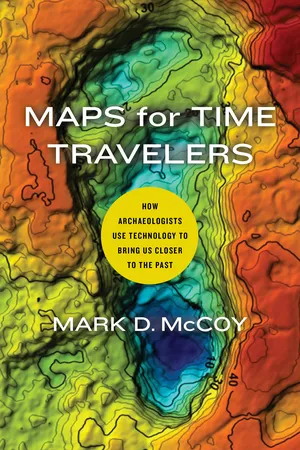
eBook - ePub
Maps for Time Travelers
How Archaeologists Use Technology to Bring Us Closer to the Past
- 280 pages
- English
- ePUB (mobile friendly)
- Available on iOS & Android
eBook - ePub
Maps for Time Travelers
How Archaeologists Use Technology to Bring Us Closer to the Past
About this book
Information
Publisher
University of California PressYear
2020Print ISBN
9780520389724
Edition
1eBook ISBN
9780520972650
Part I
1
Historical Curiosity
We are the only creatures on the planet, as far as we know, who can imagine what the world was like before we were born. The picture that each of us forms in our minds when asked to think about what it would have been like to live hundreds or thousands of years ago is distinctive. Even when considering the same object in a museum, or visiting the same ruins of an ancient city, no two people imagine the same thing. And if we are honest, lots of what we picture is pure speculation.
As it turns out, speculating about the past is something we humans have been doing for a long time. The world’s earliest examples of art preserved on cave walls provide a vivid image of a landscape full of strange animals, many now extinct. It is a safe bet that if our ancestors were capable of creating and comprehending art—a process estimated to have begun about fifty thousand years ago—then origin stories, myths, and legends describing the past were already being passed down from generation to generation.1
In popular fictions, archaeologists take risks and track down relics from the past. Indiana Jones, Lara Croft: these are adventure stories. But modern archeologists are not out to raid tombs or hunt for treasure. We are engaged in the science of reconstructing humanity’s past. So as a fiction genre analogue, adventure stories are, at best, a bad fit. Archaeologists are more like the people who create and devour stories about time travel: we are intensely curious about history. We are interested in artifacts not for their own sake, but because they can help us understand the societies that produced them.
Humanity has made massive technological leaps that have given us the evidence necessary to separate fact from fiction about what the world was like in the past. Written records, maps, and calendars, the earliest examples of which go back five thousand years, have captured certain times and places in incredible detail. Within the past two centuries, the technology to faithfully preserve images and sounds lets us experience the past through historic photographs, recordings, and films. And since the 1950s, the discovery of radiocarbon dating has allowed archaeology to take fragmented physical evidence from around the world—artifacts and architecture—and piece it together into an increasingly coherent picture of our shared history.
There has also been a leap forward in the pursuit of the distant past thanks to a host of technologies that fall under the larger category of geospatial technologies. The term geospatial refers to the relative location of things on the planet. Devices and applications that use locational data include technology with which we are well acquainted. Need a ride somewhere? The GPS inside your phone uses your location to connect you with rideshare drivers and a digital map plots the route to your destination. Want a preview of the place you are going? You have a lot of options—digital maps, satellite and street view images, and 3-D models of buildings and the landscape around them. This blending of the real world and the digital world will only continue as augmented and virtual reality become more common.
Tech companies like Google make a lot of money from geospatial technologies. But the origins of many of them are far outside Silicon Valley. GPS, for example, has a fascinating history. Developed during the Cold War, the Global Positioning System was for many years a closely guarded military secret. Even more bizarre, GPS works only thanks to advances in theoretical physics that predated the first satellite by fifty years. To be able to triangulate your location using the swarm of satellites above us requires precise synchronization of your device and the satellites. On Earth, synchronization is trivial since we have atomic clocks everywhere keeping perfect time with one another. But on GPS satellites, time moves differently. In orbit, weaker gravity and the crafts’ incredible speed mean every GPS satellite experiences a day that is thirty-eight microseconds (one millionth of a second) shorter than ours. Not spectacular time travel, but enough to put your Earth-bound device and the satellites out of sync without accounting for Einstein’s theories of special and general relativity.
Archaeologists have a track record of being early adopters of geospatial technologies to improve how we study, interpret, and represent evidence of the ancient world—and the lives of the people who lived in it (McCoy and Ladefoged 2009). Some have used lasers mounted on aircraft to reveal ruins of cities below the jungle canopy. Others have come together to create digital atlases and indices to document hundreds of thousands of places where archaeology has been found. (In this book I use the term archaeology to refer to “the scientific study of material remains (such as tools, pottery, jewelry, stone walls, and monuments) of past human life and activities,” as well as to the “remains of the culture of a people” (merriam-webster.com).) Still others have applied 3-D scanning—using images from drones and ground-based laser scanning—as a powerful tool not only for preserving sites, but also for giving virtual tourists a look inside the world’s most incredible monuments.
As the technology has evolved, geospatial tools have gone from being used for a fairly narrow scope of activities to being incorporated into almost everything we archaeologists do. The ancient world may be receding further and further into the past, but with the help of geospatial technology, archeologists are bringing us closer to it than we have ever been. At no point in human history have we been able to create a better, more complete, and more accessible rendering of the past. It is a geospatial revolution. It is still up to us as individuals to try to tell fact from fiction, but now we have an additional problem: How do we make sense of such a massive amount of information and use it to form a clear picture of the past?
• • •
Fictional time travel and the science of archaeology are almost never talked about side by side, so before we go too far down the road, I want to clear up a few things about their histories.
To begin, it is important to remember that for many years, before archaeology came along, the Bible was thought of as a history book. For example, in 1650, an Irish archbishop went as far as to calculate the specific year when the Earth was created by counting the generations of families mentioned in the Bible. He estimated our planet had been created six thousand years ago, in 4004 BC. When Europeans traveled to North and South America, some accounted for the existence of Native Americans, unmentioned in the Bible, by declaring them the lost tribes of Israel. Over the years, it became increasingly clear that such explanations could not accommodate the hard evidence that history had unfolded differently. By the nineteenth century, the young science of geology was showing that natural features like the Grand Canyon resulted from millions of years of erosion. Scientists made it clear that Earth must be many, many times older than six thousand years.
Around the same time, Christian Thomsen, tasked with displaying finds at the National Museum in Copenhagen, developed a new system for categorizing antiquities, as objects from the distant past were then called. Thomsen reasoned that stone tools found deep underground must be from a time before metallurgy. Based on the locations where other tools had been discovered, he discerned that bronze preceded iron—and thus the classifications Stone Age, Bronze Age, and Iron Age were established.2 This nineteenth century antiquarian was not working in isolation. Other natural philosophers, as they called themselves, observed Stone Age deposits that included the bones of extinct animals. This was independent confirmation of what cave paintings, like the famous ones at Lascaux, taught us: people were around tens of thousands of years ago during the last Ice Age, at the same time as long-extinct animals.
This rudimentary way to tell time was quickly joined by something that would make room for the new science of archaeology to grow: Charles Darwin’s theory of evolution by natural selection. When On the Origin of Species was published in 1859, it gave us a mechanism to understand how new life could form through random chance and circumstance. The giraffe did not will itself to grow a long neck: conditions over many generations favored the success of individuals born with a slightly longer neck. Humanity had not been designed, or magically brought to life from clay: like giraffes, we too have an evolutionary history.
In Darwin’s day, the details of our evolution were poorly known. Over the years we would come to appreciate that humans, as we are today, are relative newcomers to the Earth. We never walked with dinosaurs, unless you count the scurrying of our distant mammalian ancestors as walking. We only became biologically distinct from the common ancestor we share with chimpanzees about seven million years ago; the first stone tools were chipped into existence two to three million years ago; and the first people with our current body form came on the scene a mere 250,000 years ago. And evidence suggests that our cognitive evolution reached the point it is today only fifty thousand years ago, when we were able to conceive, among other things, of earlier eras.
At the start of the twentieth century, universities began awarding degrees in anthropology.3 Fueled by the knowledge that there were thousands of years of human life and culture before our own, early archaeologists endeavored to reconstruct the “culture histories” of people who lived long ago. When did these cultures come about? Where were they located? Did they die out, or slowly transform? The idea that there were cultures like the ones we know from the contemporary world that lay waiting to be discovered through careful study of the physical evidence left behind (artifacts, art, architecture, human remains) was now cutting-edge science. Early scholars went forth and created new long timelines for everywhere.
It was no coincidence that time travel stories became popular around the same time. Western society as a whole was so taken by new discoveries about the past that its historical imagination clicked into high gear, spawning a new market for speculative fiction. But even as archeologists plunged into the ancient past, time travel stories have tended to take place in more recent eras that authors could at least partially access through written, historical records. Perhaps authors found it easier to imagine a time in the past they could read about themselves, or, to take another tactic and send characters into a future unconstrained by historical reality.
While both time travel fiction and archaeology exhibit a concern for other eras, time travel stories have other functions as well—entertainment and social commentary chief among them.4 The other times that travelers encounter serve as mirrors of the present day. In 1889, for example, Mark Twain sent the fictional Hank Morgan back to medieval England in A Connecticut Yankee in King Arthur’s Court. The book came out when the myth of the antebellum South as a land of Arthurian nobility and romance had gained national traction. Twain set out to ridicule that myth. Hank Morgan uses his knowledge of science and technology to create miracles that earn the esteem of King Arthur’s court, but he does not content himself with a position of power. Instead, he fights for equity for an oppressed underclass. Americans, Twain suggests, needed to do the same.
The contemporaneous novels Looking Backwards, by Edward Bellamy (1887), and The Time Machine, by H. G. Wells (1895), comment upon present-day conditions by sending time travelers to the future.5 Both backward and forward time travel continue as literary conventions in the perennial BBC television favorite Doctor Who, about an alien Time Lord whose machine, the Tardis, can go anywhere in space and time. In practice, the Tardis often goes to familiar historic eras and the far distant future.6 I am a big fan of the show but I do worry that this aspect of time travel fiction unintentionally dampens our historical curiosity about the era before writing; something that archaeologists have been trying to stoke in the broader public since the early days of archaeology.
• • •
Earlier generations of professional archaeologists had far fewer tools at their disposal—an unenviable position, but one that makes their accomplishments all the more impressive. Take, for example, V. Gordon Childe. In the 1920s, Childe, a young, bespectacled, Oxford-educated Australian, started to study Stone Age Europe. He read reports of excavations, examined first-hand the bits and pieces from the past collected in museums, and conducted his own investigations. He was especially interested in the transition from what had come to be known as the Old Stone Age, or Paleolit...
Table of contents
- Subvention
- Title
- Copyright
- Dedication
- Contents
- Preface
- Acknowledgments
- Part I
- Part II
- Part III
- Conclusion
- Glossary
- Notes
- References
- Index
Trusted by 375,005 students
Access to over 1.5 million titles for a fair monthly price.
Study more efficiently using our study tools.
Frequently asked questions
Yes, you can cancel anytime from the Subscription tab in your account settings on the Perlego website. Your subscription will stay active until the end of your current billing period. Learn how to cancel your subscription
No, books cannot be downloaded as external files, such as PDFs, for use outside of Perlego. However, you can download books within the Perlego app for offline reading on mobile or tablet. Learn how to download books offline
Perlego offers two plans: Essential and Complete
- Essential is ideal for learners and professionals who enjoy exploring a wide range of subjects. Access the Essential Library with 800,000+ trusted titles and best-sellers across business, personal growth, and the humanities. Includes unlimited reading time and Standard Read Aloud voice.
- Complete: Perfect for advanced learners and researchers needing full, unrestricted access. Unlock 1.5M+ books across hundreds of subjects, including academic and specialized titles. The Complete Plan also includes advanced features like Premium Read Aloud and Research Assistant.
We are an online textbook subscription service, where you can get access to an entire online library for less than the price of a single book per month. With over 1.5 million books across 990+ topics, we’ve got you covered! Learn about our mission
Look out for the read-aloud symbol on your next book to see if you can listen to it. The read-aloud tool reads text aloud for you, highlighting the text as it is being read. You can pause it, speed it up and slow it down. Learn more about Read Aloud
Yes! You can use the Perlego app on both iOS and Android devices to read anytime, anywhere — even offline. Perfect for commutes or when you’re on the go.
Please note we cannot support devices running on iOS 13 and Android 7 or earlier. Learn more about using the app
Please note we cannot support devices running on iOS 13 and Android 7 or earlier. Learn more about using the app
Yes, you can access Maps for Time Travelers by Mark D. McCoy in PDF and/or ePUB format, as well as other popular books in Social Sciences & Anthropology. We have over 1.5 million books available in our catalogue for you to explore.