![]()
Eagles and peacocks are the birds most frequently seen in The Book of Kells and The Lindisfarne Gospels, two canonical Celtic books from circa the eighth century CE. The eagle is a symbol for the evangelist St. John, and the peacock symbolizes the purity of Christ, because in ancient times people thought that the flesh of a peacock was so pure that it would never rot. There’s no reason to limit modern Celtic art to just two kinds of birds. Birds provide plenty of opportunity for color and detail after adding their wings and tail feathers, and there’s a wide variety of birds that can serve as inspiration.
Three types of birds are shown above. Even though they’re very different, there are some common elements.
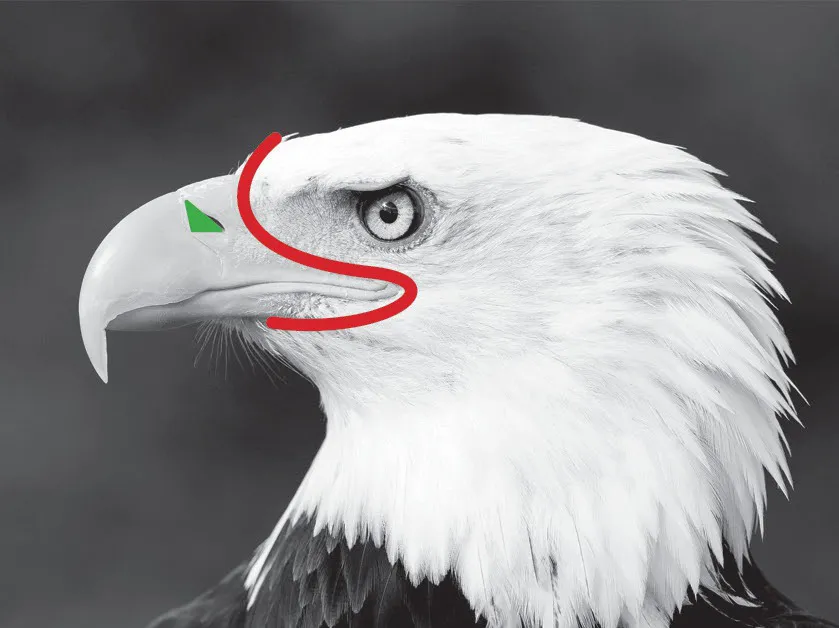
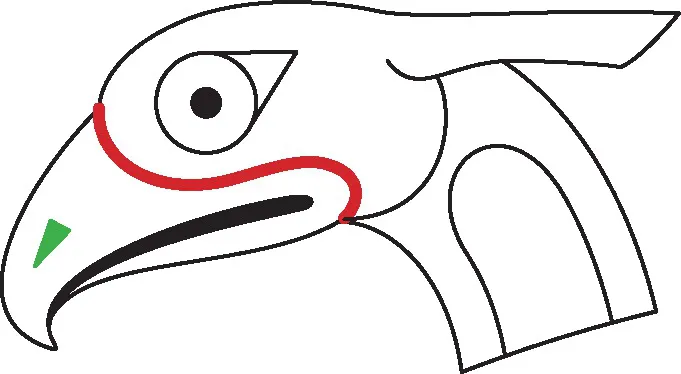
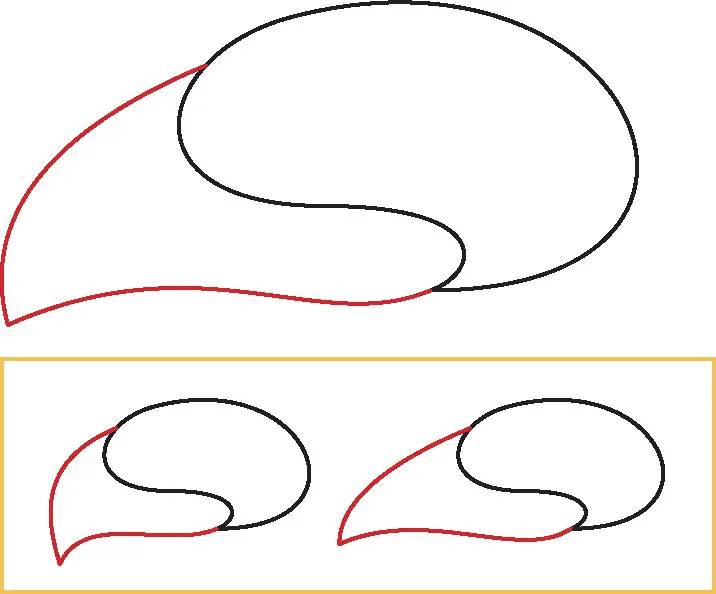
There is a dividing line, shown in red, between the feathers on the face and the hard beak, which is shaped like a curve. This dividing line is simplified and smoothed out when drawing Celtic birds, but it is essentially the same. The nostril, shown in green, can appear near the beak tip or close to the face.
The beak is drawn as in real life, but it varies depending on the type of bird. The beak could end with two tips tight and close together, like a peacock’s beak, or with a sharp hook, like an eagle’s.
Drawing a basic bird’s head shows how to bring the elements discussed on the previous page into play.
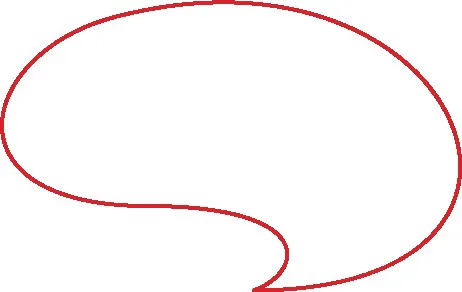
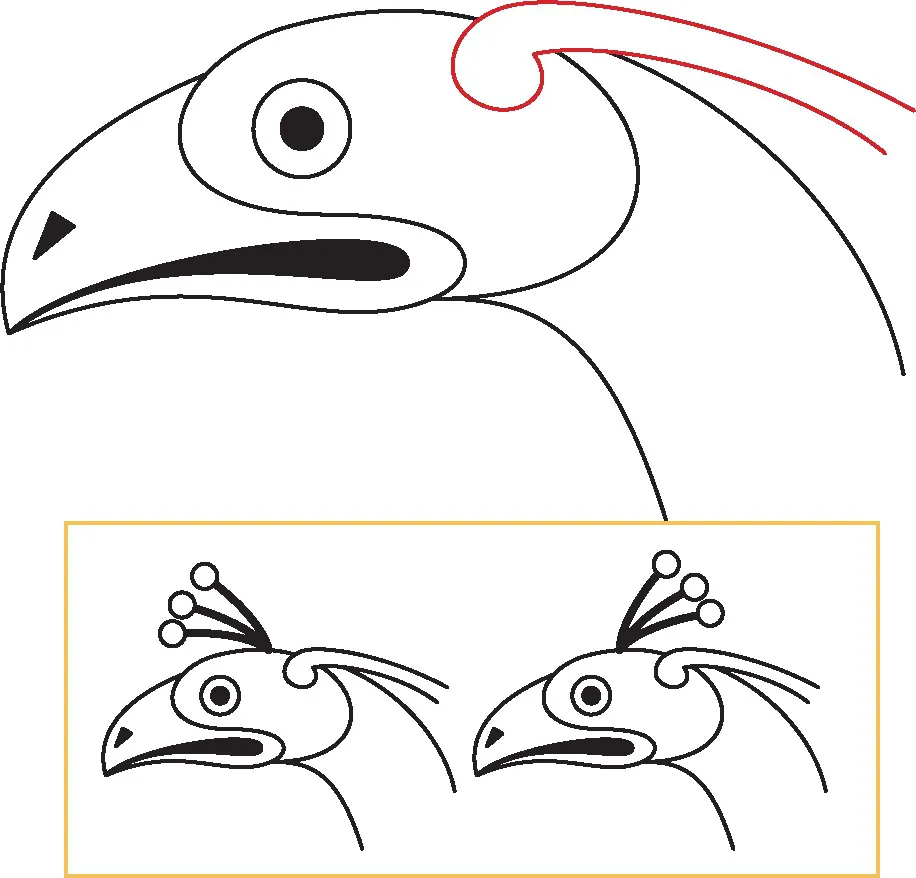
The first stage is making the head. Draw a shape that looks like a speech bubble in a comic book. It’s round or oblong, with a tapered little point on the bottom.
The beak begins from a point high on the upper rounded portion, where the forehead would be. The beak can be long or short, with a big or small tip. The shape gives the bird a different character or emotion—regal, fierce, friendly, or comical.
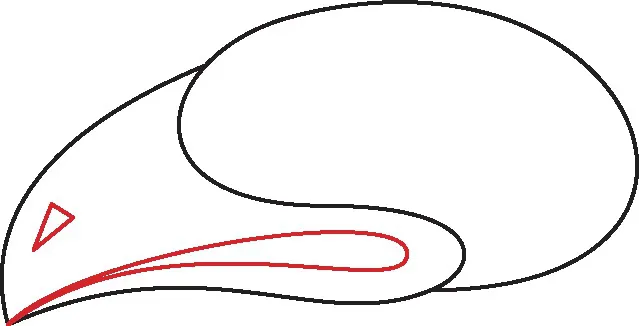
The mouth extends from the tip of the beak to the round hollow near the cheek. The nostril can be a little teardrop or a triangle.
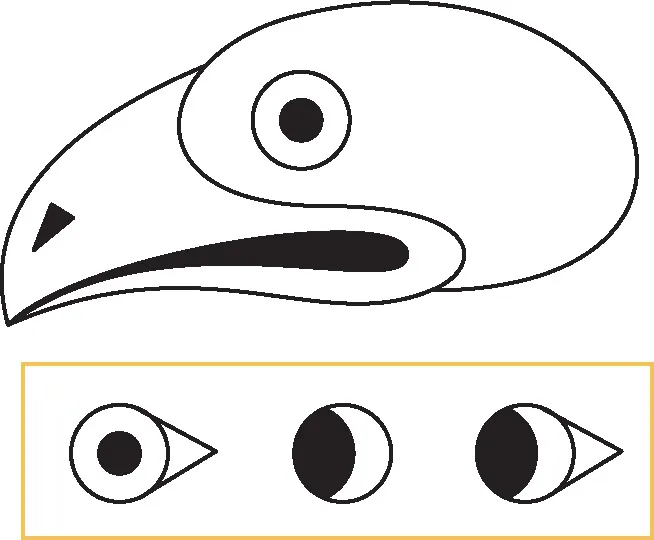
There are a few variations for the eye. One is a simple dot within a circle, and another is a dot within a circle with a little triangle pointing toward the back of the head. Or try a round eye with the pupil at the front of the eye, as if the bird is looking forward, with or without the triangle.
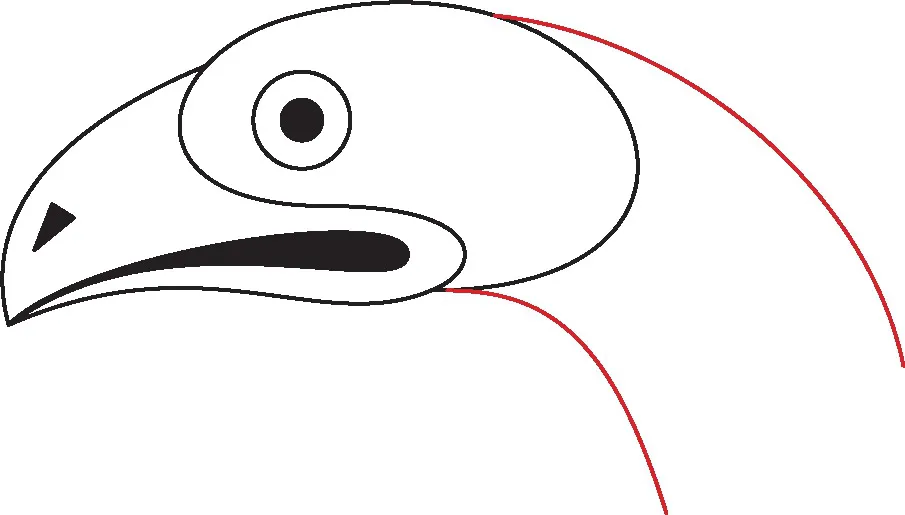
The bird’s neck extends from the back of the top of the head and under the throat, where the beak joins the head—the point of the speech bubble.
From the top of the back of the head, add a little nub with a long tail. This crest is usually lengthened and woven up as a freehand knot around the bird. Try different crests as well—or mix and match!
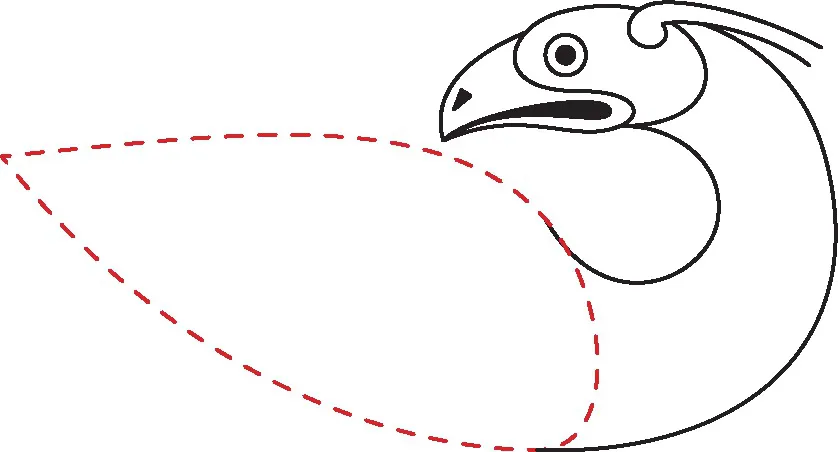
The bird can face forward or backward over his body. To make the body, add a large teardrop shape to the neck. Celtic bird necks are typically longer than a real bird’s would be, so don’t be afraid to make it long and then add the teardrop.
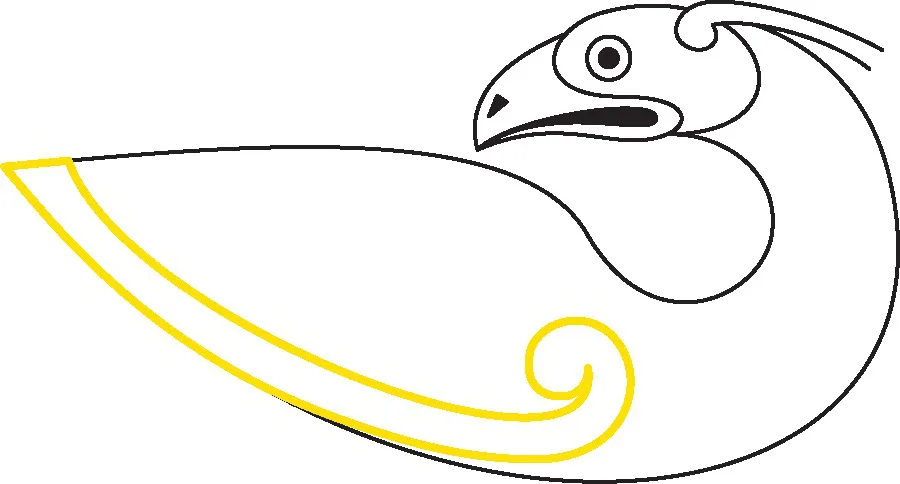
The pose of the bird in the photo depicts how a wing is shaped like a teardrop, as shown in red and yellow. For a Celtic bird, the wing connects to the shoulder with a long curled shape, which is the bottom of the teardrop, as shown in yellow. A Celtic bird usually has the wing folded tight against the body, so all that’s visible is the wing—and nothing from its back or body. This makes it easier to draw—it’s just a wing with a neck attached. Draw the curl.
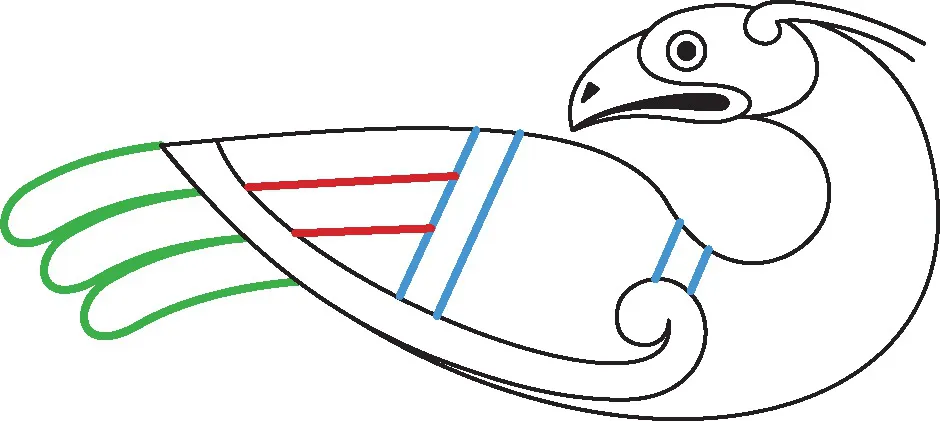
From the head of the curl, make a pair of bars that extend to the bird’s back, as shown in blue. Create a second set of bars, parallel to the first, farther down the wing.
Past the blue bars, add some lines within the tip of the wing, as shown in red. These are the long wing feathers seen at the tip of the wing in the photo. The tail feathers are drawn in green. There is no set number of feathers that needs to be drawn, but three is a mystical number for the Celts, so it’s a nice touch if there’s room.
Now add the bird’s leg(s) and foot. Draw a single foot or both feet, depending on how much space is available. The number of toes can also vary. Real birds have three forward-facing toes and one backward-facing toe. Always draw the backward-facing toe, and draw any number of forward-facing toes. The nails can be simple curves at the toe tip or be fully drawn nails, as shown in the insert to the left. Full nails usually appear more like talons or claws, so they are ...