Across Europe, politicians and economists remain locked into micromanaging the welfare state established post-war, tweaking it here and tweaking it there to ameliorate the consequences of poverty, but failing to end poverty. Instead of focusing on consequences, George Curtis seeks the cause of poverty. This was laid bare in a book,
Progress and Poverty, by an American economist, Henry George, in 1879. Two years later, without any prior knowledge of George's work, an Irish bishop, Thomas Nulty, came to the same conclusion from a theological point of view. Yet, despite poverty remaining a crisis in today's 21st century society, the moral and economic arguments made by George have remained unaddressed.
The author of this book regenerates George's ideas, recognizing that the cause of poverty is entrenched throughout the world in a widely accepted social institution, just as slavery once was. Henry George argued that a true understanding of Christianity led to the conclusion that the "right of property, originating in the right of the individual to himself, is the only full and complete right of property. It attaches to things produced by labor, but cannot attach to things produced by God." George Curtis analyzes Henry George's remedy for poverty with a fine balance between Christian moral sensitivity and economic pragmatism, observing its effect on Christian social teaching, and its relevance in addressing the contemporary nature of poverty.
Poverty is not Natural demonstrates that what is morally right is also the most economically efficient.
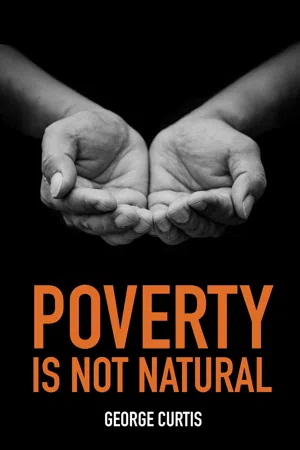
- 119 pages
- English
- ePUB (mobile friendly)
- Available on iOS & Android
eBook - ePub
Poverty is not Natural
About this book
Information
1
THE GREAT ENIGMA OF OUR TIMES
‘I believe that there is in true Christianity a power to regenerate the world’
HENRY GEORGE is best known for his 1879 classic, Progress and Poverty. This sought to explain why poverty tends to increase and deepen, just as human society becomes more efficient at producing wealth. In his Introduction, he described how ‘it was natural to expect, and it was expected, that labor-saving inventions would lighten the toil and improve the condition of the laborer’, and how ‘the enormous increase in the power of producing wealth would make real poverty a thing of the past’. Yet, in George’s day – and even now in the 21st century – all of these productivity-enhancing forces have failed to abolish widespread ‘want and fear of want’.2
Observing that poverty is as much a feature where autocratic government prevails as where political power is in the hands of the people, George inferred that there must be a common cause for this failure. He observed that we find the deepest poverty, the sharpest struggle for existence, and the most enforced idleness, where population is densest, wealth greatest, and the machinery of production and exchange most highly developed.
He acknowledged that wealth had been greatly increased by technological progress and the average standard of living had been raised with labour-saving devices making all manner of everyday tasks less toilsome, but in this the poorest did not share.
I do not mean that the condition of the lowest class has nowhere nor in anything been improved; but that there is nowhere any improvement which can be credited to increased productive power. I mean that the tendency of what we call material progress is in nowise to improve the condition of the lowest class in the essentials of healthy, happy human life.
In illustration of this, George offered an image that has been widely quoted:
The new forces, elevating in their nature though they be, do not act upon the social fabric underneath, as was for a long time hoped and believed,3 but strike it at a point intermediate between top and bottom. It is as though an immense wedge were being forced, not underneath society, but through society. Those who are above the point of separation are elevated, but those who are below are crushed down.
Unfortunately, Henry George’s explanation of the cause of this phenomenon, and the solution he proposed, have received less attention. By and large, history has looked upon Henry George’s Progress and Poverty more as a stirring call to justice than as a source of rational understanding of social problems, or as a practical means of addressing them. But he warned:
This association of poverty with progress is the great enigma of our times. It is the central fact from which spring industrial, social and political difficulties that perplex the world, and which statesmanship and philanthropy and education grapple in vain. From it comes the clouds that overhang the future of the most progressive and self-reliant nations. It is the riddle which the Sphinx of Fate puts to our civilization and which not to answer is to be destroyed.
Virtually every attempt to solve this riddle has conceived the problem in either/or terms: either society must remorselessly embrace free markets, though under present circumstances many are inevitably left behind, or it must confiscate and redistribute wealth to enforce fairness, though waste and fraud are the inevitable concomitants. Henry George rejected this dichotomy, recognising that under the right conditions labour and capital worked hand in glove.
The problem, George realised, lies with the way economics is taught as he stated in the concluding chapter of Progress and Poverty:
Political Economy has been called the dismal science, and as currently taught, is hopeless and despairing. But this, as we have seen, is solely because she has been degraded and shackled; her truths dislocated; her harmonies ignored; the word she would utter gagged in her mouth, and her protest against wrong turned into an indorsement of injustice. Freed, as I have tried to free her – in her own proper symmetry – Political Economy is radiant with hope.
This remains the case: today’s mainstream views on political economy, particularly as they inform public policy, recognize no such ‘symmetry’. In George’s view, this symmetry revealed that the natural way to fund government was from the rent of land rather than from taxation, and that, in doing so, a major cause of poverty would be removed so that all would share equitably in the wealth produced.
2 Progress and Poverty (1879), Henry George, Robert Schalkenbach Foundation, 1992.
3 President Kennedy suggested that progress was like ‘the tide that lifts all boats’.
2
JUSTICE IS THE FIRST QUALITY IN THE MORAL HEIRARCHY
‘The principles that guide us, in public and in private, as they are not of our devising, but moulded into the nature and the essence of things, will endure with the sun and the moon’
HENRY GEORGE saw, just as Mandela did, that it is only possible to overcome poverty through an act of justice. In writing ‘justice is the highest quality in the moral hierarchy’, he would have been familiar with St Paul’s famous statement ‘… now abideth, faith, hope, love, these three: and the greatest of these is love’ (1 Corinthians 13:13). George does not say that justice is the ‘greatest’, but that it is the ‘highest’. He continued:
That which is above justice must be based on justice, and include justice, And be reached through justice. It is not by accident that in the Hebraic religious development, which through Christianity we have inherited, the declaration “The Lord thy God is a just God” (The essence of Isaiah 45:21) precedes the sweeter revelation of a God of Love. Until the eternal justice is perceived, the eternal love must be hidden. As the individual must be just before he can be truly generous, so must human society be based on justice before it can be based on benevolence.
This, and this alone, is what I contend for – that our social institutions be conformed to justice; to those natural and eternal principles of right … and this I contend for – that who makes should have; that he who saves should enjoy. I ask on behalf of the poor nothing whatever that properly belongs to the rich. Instead of weakening and confusing the idea of property, I would surround it with stronger sanctions. Instead of lessening the incentive to the production of wealth, I would make it more powerful by making the reward more certain.4
If ever a scripture has been bent to the Devil’s service, George wrote, it was ‘the poor ye have always with you’ (Matthew 26:11, also Mark 14:7 and John 12:8). Despite the huge productive capacity of modern economies, these words continue to soothe the conscience into acceptance of human misery and degradation. Primarily, it bolsters the denial of Christ’s teaching, suggesting that an all-wise and merciful Father has decreed that some of his creatures must be poor in order that others should have the good things of life, or in George Orwell’s analogy: ‘Some pigs are more equal than others.’
George argued that just as man masters material nature by studying its laws, we must discover the great moral laws that govern human relations, and live in accordance with them in order for society to function harmoniously. Thus economic and social policy cannot be framed without careful consideration of natural law. Only in this way can a solution be found for the vice and misery that spring from the inequitable distribution of wealth.
While George believed that ‘there is in true Christianity a power to regenerate the world’, it must be ‘a Christianity that attacks vested wrongs, not that spurious thing that defends them. The religion which allies itself with injustice to preach down the natural aspirations of the masses is worse than atheism.’5 We can only faintly imagine the wealth-producing powers that would be unleashed in this regenerated social state based on justice, where poverty, and the fear, greed and vice that it causes are banished. What Henry George’s political economy suggests is that Christ was not a mere dreamer when he told his disciples that if they first seek the kingdom of God and its righteousness (Matthew 6:33), they could, like the lilies of the field, cease to worry about their material needs. Nor would it be necessary for many to be condemned to monotonous toil.
In his last book, The Science of Political Economy, Henry George pointed out that the validity of land ownership had not been questioned by Adam Smith and the classical economists. As economics developed into an academic subject, the status quo was accepted just as slavery had once been accepted. It was only after the publication of Progress and Poverty that it had become an issue and that George had discovered that there had been contemporaries of the classical economists who had questioned the validity of landownership.
One such was The Theory of Human Progression and Natural Probability of a Reign of Justice, published anonymously in London in 1850. It drew its inspiration from the Bible and the divinity of Christ, arguing that there was a probability of a reign of justice on earth, foretold by scriptural prophecy. Though adhering to the doctrine of the fall of man, the author was an evolutionist, believing that through scientific advances mankind would eventually evolve to a reign of justice and benevolence.
The author, it emerged later, was Patrick Edward Dove, a Scottish landowner and Presbyterian. He argued that the reign of justice would ensure that every human being in the world would at some future time have all their rights restored, and that it is only possible for some to enjoy a privilege at the expense of others. Consequently a reign of justice would ensure the destruction of every privilege and the restitution of every right. He had no hesitation in attacking the vested interests which denied the possibility of this reign of justice, writing:
Let the political arrangements be what they may. Let there be universal suffrage or any other suffrage, so long as the aristocracy have all the land, and derive the rent of it, the labourer is only a serf, and a serf he will remain until he has uprooted the rights of private landed property. The land is for the nation, and not for the aristocracy.
While George did not share his view that a just solution would arrive inevitably by an evolutionary process, they both recognised that, while universal suffrage gave everyone the right to vote, this of itself did not solve the problem of poverty. What was necessary was for everyone to be able to earn a living and provide for their family, but this was not possible unless everyone had an equal right of access to land – we all need somewhere to live and somewhere to work. Land is that somewhere and is freely provided by nature to all. It is the concentration of landownership that stands in the way.
Dove argued that just because the State recognises something as private property, this does not give that ‘property’ moral sanction. He pointed out that the state had often acquired property unjustly or violently. Furthermore, the dignity and authority of the offices of the Church and the power of administering her sacraments, had often been bought and sold.
Nevertheless, though it has long been ignored by societies and governments, and most economists have accepted the status quo, a moral basis for property rights does exist. Down the centuries there have been brave souls who have recognised this and spoken out against the injustice that arises from the private ownership of land, the gift of nature to all. From this truth, Henry George argued, there can be no escape: ‘private property in land is a bold, base, enormous wrong, like that of chattel slavery’.6
4 Social Problems (1883), Robert Schalkenbach Foundation, 1996, p.86.
5 The Land Question, Henry George (1881), Robert Schalkenbach Foundation, 2009.
6 Progress and Poverty (1879), Robert Schalkenbach Foundation, 1992.
3
LEO TOLSTOY AND HENRY GEORGE
‘Slavery has long been abolished. It was abolished in Rome, and in America, and in Russia, but what was abolished was the word not the thing itself’
AT ABOUT THE SAME TIME as Henry George was writing Progress and Poverty in California, Leo Tolstoy in Russia was growing increasingly concerned about the poverty he saw around him. Born into an aristocratic family with big estates, he felt uncomfortable about the large income he received compared with the poor conditions of the peasants. He came to understand that the royalties he received as an author were the fruits of his own labour, while the rent he received as a landowner was the fruit of other men’s labours.
When first visiting Moscow in 1881, he was shocked by the beggars on the streets. He did not at first see any connection between their poverty and his own privileged lifestyle, accepting it as an inevitable part of life. Out of compassion he began organising measures of practical relief ...
Table of contents
- Cover
- Title Page
- Copyright
- Contents
- Acknowledgements
- Introduction
- 1 The Great Enigma of Our Times
- 2 Justice is the First Quality in the Moral Hierarchy
- 3 Leo Tolstoy and Henry George
- 4 The Unflinching Service of a Holy Ecclesiastic
- 5 Henry George’s Open Letter to Pope Leo XIII
- 6 The Giving of Alms Cannot Abolish Poverty
- 7 Christian Socialism and the Labour Party
- 8 The Inadequacy of Socialistic Remedies
- 9 The Significance of Land
- 10 A Remedy for the 21st Century
- 11 The Way Forward
- About the Author
- Further Reading
Trusted by 375,005 students
Access to over 1.5 million titles for a fair monthly price.
Study more efficiently using our study tools.
Frequently asked questions
Yes, you can cancel anytime from the Subscription tab in your account settings on the Perlego website. Your subscription will stay active until the end of your current billing period. Learn how to cancel your subscription
No, books cannot be downloaded as external files, such as PDFs, for use outside of Perlego. However, you can download books within the Perlego app for offline reading on mobile or tablet. Learn how to download books offline
Perlego offers two plans: Essential and Complete
- Essential is ideal for learners and professionals who enjoy exploring a wide range of subjects. Access the Essential Library with 800,000+ trusted titles and best-sellers across business, personal growth, and the humanities. Includes unlimited reading time and Standard Read Aloud voice.
- Complete: Perfect for advanced learners and researchers needing full, unrestricted access. Unlock 1.5M+ books across hundreds of subjects, including academic and specialized titles. The Complete Plan also includes advanced features like Premium Read Aloud and Research Assistant.
We are an online textbook subscription service, where you can get access to an entire online library for less than the price of a single book per month. With over 1.5 million books across 990+ topics, we’ve got you covered! Learn about our mission
Look out for the read-aloud symbol on your next book to see if you can listen to it. The read-aloud tool reads text aloud for you, highlighting the text as it is being read. You can pause it, speed it up and slow it down. Learn more about Read Aloud
Yes! You can use the Perlego app on both iOS and Android devices to read anytime, anywhere — even offline. Perfect for commutes or when you’re on the go.
Please note we cannot support devices running on iOS 13 and Android 7 or earlier. Learn more about using the app
Please note we cannot support devices running on iOS 13 and Android 7 or earlier. Learn more about using the app
Yes, you can access Poverty is not Natural by George Curtis,George Cutis in PDF and/or ePUB format, as well as other popular books in Social Sciences & Economic Conditions. We have over 1.5 million books available in our catalogue for you to explore.