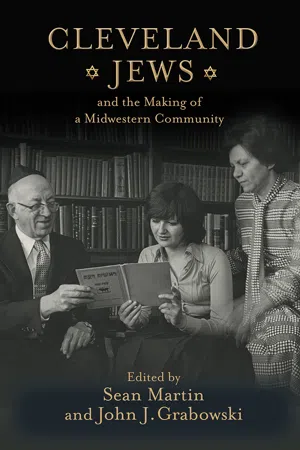
This volume gathers an array of voices to tell the stories of Cleveland's twentieth century Jewish community. Strong and stable after an often turbulent century, the Jews of Cleveland had both deep ties in the region and an evolving and dynamic commitment to Jewish life. The authors present the views and actions of community leaders and everyday Jews who embodied that commitment in their religious participation, educational efforts, philanthropic endeavors, and in their simple desire to live next to each other in the city's eastern suburbs. The twentieth century saw the move of Cleveland's Jews out of the center of the city, a move that only served to increase the density of Jewish life. The essays collected here draw heavily on local archival materials and present the area's Jewish past within the context of American and American Jewish studies.
- English
- ePUB (mobile friendly)
- Available on iOS & Android
eBook - ePub
Cleveland Jews and the Making of a Midwestern Community
About this book
Information
Topic
Teología y religiónSubtopic
Historia de NorteaméricaCHAPTER 1
“A Link in the Great American Chain”
THE EVOLUTION OF JEWISH ORTHODOXY IN CLEVELAND TO 1940
Ira Robinson
In 1945 Rabbi Israel Porath characterized the Cleveland Orthodox community as “a link in the Great American Chain.”1 The nineteenth-century founders of Cleveland’s Jewish community arrived with hardly any notion that Judaism could mean anything other than the traditional Judaism that existed in their ancestral homeland of Unsleben, Bavaria.2 The founders of Cleveland’s Jewish community certainly understood that it was possible, especially in America, to be neglectful of the laws and customs of Judaism.3 Thus the 1839 Alsbacher Document, an ethical will written by the Unsleben religious teacher Lazarus Kohn and given to the immigrants before they left, warned, “Do not turn away from the religion of our fathers . . . Don’t tear yourselves away from the laws in which your fathers and mothers searched for assurance and found it.”4 This chapter sketches the evolution of Orthodoxy in Cleveland up to 1940 and concentrates on issues of rabbinic power, including the development of synagogues, communal organizations, Jewish education, and kashrut (system of Judaic dietary laws).5 After a discussion of the earliest Jewish settlers prior to the coalescence of “Orthodox” Judaism in relation to Reform Judaism, I turn to the religious life of Eastern European immigrants before World War II.6 Comprehensive historical accounts of Orthodoxy in any other major American Jewish community have not yet been attempted.7 This chapter is necessarily preliminary; only a full, comprehensive monograph will truly do justice to this subject.
Beginnings
When in the 1840s Cleveland Jews began to create synagogues, they were designed to adhere as closely as possible to the synagogues known to the Jews of Unsleben. Lloyd Gartner describes the first synagogues as “the two little Orthodox congregations.”8 However, neither the Anshe Chesed nor the Tifereth Israel congregations were “Orthodox” because Orthodoxy implies a religious alternative—Reform Judaism, which was then coalescing in Europe but strongly manifested its presence in North America only in the mid-nineteenth century. It was in fact the leadership of Reform Judaism that designated those who resisted its claims to represent Judaism as “Orthodox.”9
When Reform did appeal to American Jews, speaking cogently to their social and religious situation, Gartner notes that certain “Reform” tendencies appeared in Cleveland (sooner in Tifereth Israel than Anshe Chesed). However, both congregations remained essentially traditional for several years, with Anshe Chesed housing a mikvah for ritual purification of women and both congregations employing shoḥtim (persons licensed by rabbinic authority to slaughter animals and poultry in accordance with Judaic law) to supply kosher meat.10 In 1857 the traditionalist leader Isaac Leeser visited Cleveland and observed that “all communities in Cleveland are Orthodox . . . Reform does not seem to have made rapid progress. There are many who keep [the Sabbath] holy.”11
Cleveland’s mid-nineteenth-century traditionalist community included Joseph Levy, who had obtained traditional rabbinic ordination in Europe and settled in Cleveland with an extensive library of rabbinic literature but did not seek a rabbinical position. American Reform leader Isaac Mayer Wise, no friend of Orthodoxy, described Levy as “a learned rabbinical Jew of the oldest stamp . . . He stands firm upon the basis of the rabbinical literature, and commands respect from [sic] his religious position by his simple, firm, and decided language.”12
In the 1850s, Levy administered a Jewish divorce (get) in Cleveland that achieved great notoriety locally and nationally. The get was administered without the participation of Cleveland’s only “official” rabbi, Isidor Kalisch. In any event, Cleveland’s Plain Dealer and the Asmonean in New York opposed the Cleveland get, while Isaac Leeser’s Occident and American Jewish Advocate not only supported Levy editorially13 but also published Levy’s Hebrew responsum defending the get’s propriety.14 This constitutes the first rabbinic responsum in Hebrew published in an American periodical.15
In the late nineteenth century, Reform Judaism made important inroads in Jewish Cleveland. Though the degree of liberation from Orthodoxy varied from synagogue to synagogue and family to family, two things are clear: first, by the 1890s, most Jewish immigrants to Cleveland had accommodated themselves to Reform Judaism; second, the established Jewish community had noticed an increasing—and to them, disturbing—presence of Eastern European Jews who did not share their cultural and religious orientation. Though Eastern European Jews varied greatly in terms of religious belief, ranging from militantly Orthodox to militantly atheist, the acculturated local Jewish establishment tended to regard all Eastern European Jews, whom they considered economically and religiously marginal, as “Orthodox” regardless of their level of Judaic observance.16 In 1895 Emma C. Davis broadly and negatively characterized Jewish newcomers to Cleveland as “these bigoted followers of the orthodox rabbinical law . . . whose minds are stunted, whose characters are warped and who have become adepts and who have grown wily in the evasions of law.”17 This mind-set of Cleveland’s Jewish elite caused a situation in which the newly arrived Eastern European Jews felt it necessary to establish their own institutions, including both synagogues and self-help organizations.
Synagogues
The immigrant Orthodox synagogues were characterized in an 1887 Cleveland newspaper as showing “the dark side of the European ghetto.”18 What do we know of these institutions in a place Rabbi Solomon Goldman characterized as “the most synagogue-minded city in the country”?19
I. J. Benjamin, who traveled through the Jewish communities of North America, visited Cleveland in January 1862. Beyond the well-established Anshe Chesed and Tifereth Israel congregations, he also noticed “a small Polish congregation, recently founded and as yet without a synagogue.”20 This was undoubtedly Anshe Emeth,21 founded by Polish Jews in 1857. Other early congregations included Beth Israel Chevra Kadisha (Lithuanian, 1860)22 and B’nai Jeshurun (Hungarian, 1866).23 The 1906 Jewish Encyclopedia entry for Cleveland counted “no less than eleven minor congregations, mostly Russian, with a combined membership of 700—the largest of them, Beth Hamidrash Hagodol Beth Israel having 600 seat-holders.”24 The list of congregations in Cleveland in the first volume of the American Jewish Year Book (AJYB), covering 1899–1900, also lists eleven.25 In 1923 Gartner states the number of Orthodox congregations as sixteen,26 while seventeen Orthodox synagogues are listed in the 1935 Cleveland directory.27
The proliferation of Orthodox congregations in Cleveland followed patterns common to most American Jewish communities. Synagogues wer...
Table of contents
- Cover
- Title Page
- Copyright Page
- Dedication
- Contents
- Foreword
- Introduction: Cleveland and Its Jews: New Perspectives on Communal History
- Chapter 1. “A Link in the Great American Chain”: The Evolution of Jewish Orthodoxy in Cleveland to 1940
- Chapter 2. Jewish Philanthropy in Cleveland to 1990
- Chapter 3. Abraham Hayyim Friedland and the Context, Structures, and Content of Jewish Education
- Chapter 4. Everyman vs. Superman: Harvey Pekar, Comics, and Cleveland
- Chapter 5. Ethnic Identity and Local Politics: Abba Hillel Silver as a Community Leader and International Politician in Cleveland, 1940–1950
- Chapter 6. “She Will Be the Mary Poppins We Have Been Searching For”: The Rise of Feminism and Organizational Change in the Cleveland Section of the National Council of Jewish Women
- Chapter 7. Trepidation, Tolerance, and Turnover: Jewish-Black Relations in Cleveland Neighborhoods, 1920–1960
- Chapter 8. Jewish Suburbanization and Jewish Presence in the “City without Jews”
- Chapter 9. Suburban Temple and the Creation of Postwar American Judaism
- Chapter 10. People-to-People: Cleveland’s Jewish Community and the Exodus of Soviet Jews
- Afterword
- Acknowledgments
- Notes on Contributors
- Index
Trusted by 375,005 students
Access to over 1.5 million titles for a fair monthly price.
Study more efficiently using our study tools.
Frequently asked questions
Yes, you can cancel anytime from the Subscription tab in your account settings on the Perlego website. Your subscription will stay active until the end of your current billing period. Learn how to cancel your subscription
No, books cannot be downloaded as external files, such as PDFs, for use outside of Perlego. However, you can download books within the Perlego app for offline reading on mobile or tablet. Learn how to download books offline
Perlego offers two plans: Essential and Complete
- Essential is ideal for learners and professionals who enjoy exploring a wide range of subjects. Access the Essential Library with 800,000+ trusted titles and best-sellers across business, personal growth, and the humanities. Includes unlimited reading time and Standard Read Aloud voice.
- Complete: Perfect for advanced learners and researchers needing full, unrestricted access. Unlock 1.5M+ books across hundreds of subjects, including academic and specialized titles. The Complete Plan also includes advanced features like Premium Read Aloud and Research Assistant.
We are an online textbook subscription service, where you can get access to an entire online library for less than the price of a single book per month. With over 1.5 million books across 990+ topics, we’ve got you covered! Learn about our mission
Look out for the read-aloud symbol on your next book to see if you can listen to it. The read-aloud tool reads text aloud for you, highlighting the text as it is being read. You can pause it, speed it up and slow it down. Learn more about Read Aloud
Yes! You can use the Perlego app on both iOS and Android devices to read anytime, anywhere — even offline. Perfect for commutes or when you’re on the go.
Please note we cannot support devices running on iOS 13 and Android 7 or earlier. Learn more about using the app
Please note we cannot support devices running on iOS 13 and Android 7 or earlier. Learn more about using the app
Yes, you can access Cleveland Jews and the Making of a Midwestern Community by Sean Martin,John J. Grabowski in PDF and/or ePUB format, as well as other popular books in Teología y religión & Historia de Norteamérica. We have over 1.5 million books available in our catalogue for you to explore.