Cities are gaining importance and influence worldwide.They sustain the global economy, set cultural trends, produce greenhouse gas emissions and consume energy; they attract migration flows and foster new political waves. While cities were supposed to be declining back in the 1980s, the globalised economy has established them as crucial world hubs leading billions of people on every continent, both at the top and the bottom of the social ladder, to move to cities. Today, global cities cry out for a more prominent role. But why and to what extent do they matter? Can they really stand alone in the global arena? How are they interacting with governments and multilateral organisations? From climate change to connectivity, from inequalities to migration: what is their contribution to key global challenges?
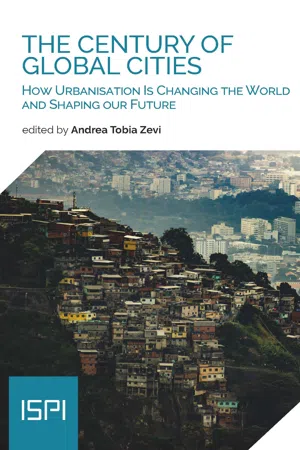
eBook - ePub
The Century of Global Cities
How Urbanisation Is Changing the World and Shaping our Future
- 156 pages
- English
- ePUB (mobile friendly)
- Available on iOS & Android
eBook - ePub
The Century of Global Cities
How Urbanisation Is Changing the World and Shaping our Future
About this book
Trusted by 375,005 students
Access to over 1.5 million titles for a fair monthly price.
Study more efficiently using our study tools.
Information
1. Why Global Cities?*
Saskia Sassen
The 1980s marks a very specific economic transformation in major western cities. It was, in many ways, the beginning of a new era, one that saw digitisation as having the capacity to launch foundational transformations. One key transformation many experts asserted would be decisive, was that cities would no longer matter for the advanced economy. Cities might still matter for people who wanted to go to the theater and such, but they would not matter much for the advanced economy. There was great conviction that powerful firms, global firms, and such would no longer need cities given the digital revolution.
This turned out to be mostly wrong. Cities have become even more important, and this is especially so for the most advanced and digitally enabled/connected sectors. Why? Because time began to matter even more – fractions of seconds mattered. And they mattered precisely because of the digital revolution: now competition was everywhere, accessing the latest innovations could be executed by anyone, and so on.
How could such smart high level professionals get it so wrong – both the developers of digitisation and the high-level users of digitisation. And why do distance and time matter even more now for the most digitised sectors?
These became some of the several key questions that led me to go digging, to understand, to discover so to say, the actual conditions and needs of digitised sectors.
Discovering the Global City
Contesting the widespread notion in the 1980s that place no longer mattered to highly digitised economic sectors turned out to be the first step towards conceptualising the Global City function1. It became an effort to detect a new, somewhat elusive formation deep inside major cities. And the Global City Function included only some of the most advanced sectors of major cities. It did not include every single resident of a global city.
Then came 8 years of endless data analyses and exciting fieldwork. My basic mode was discovery, not replication. What was the combination of elements that might produce this ironic outcome: the fact that the most powerful, rich, and digitised economic actors needed “central places”, and perhaps more than ever before? Large corporate firms engaged in routinised production did not really need to be located in cities – they could locate anywhere. What these types of firms needed if they went global was access to a whole new mix of complex specialised services almost impossible to produce in-house (as had been the way of doing things for many big firms after World War 2 especially.
A second hypothesis that was stronger than I expected was that this new economic logic, partial as it was, would generate high-level jobs and low-wage jobs; it would need far fewer middle-range jobs than traditional corporations. But those low-level jobs, whether in the office or in households, were going to matter more than one might imagine. I described them as the work of maintaining a strategic infrastructure. And this strategic infrastructure includes the family or home life of top level personnel. Everything needs to work fine, because this top level personnel could not have family crisis, children crisis… none of that.
Intermediation: From Minor Sideshow to Key Logic of the Global City
A key hypothesis I arrived at early on in my research was something I named “intermediation”. I posited that intermediation was an increasingly strategic and systemically necessary function for the global economy that took off in the 1980s2. This in turn led me to generate the hypothesis about a need for specific types of spaces: spaces for the making of intermediate instruments, form of knowledge, and capabilities. One such strategic space concerned the instruments (legal, of talent and knowledge, of transport, of where to locate the factories off-shore, etc) needed for outsourcing jobs, something I had examined in my first book (The Mobility of Labor and Capital).
But what began to emerge in the 1980s was on a completely different scale of complexity and diversity of economic sectors: it brought with it the making of a new type of city formation. I called it the Global City – an extreme space for the production and/or implementation of very diverse and very complex intermediate capabilities. This did not refer to the whole city. I posited that the Global City was a production function inserted in complex existing cities, albeit a function with a vast shadow effect over a city’s larger space.
In that earlier period of the 1980s, the most famous cases that made visible the ascendance of intermediate functions were the big mergers and acquisitions. What stood out to the careful observer was how rarely the intermediaries lost. The financiers, lawyers, accountants, credit rating agencies, and more, made their money even when the new mega-firm they helped make eventually failed. Finance became the mother of all intermediate sectors, with firms such as Goldman Sachs and JP Morgan making enormous profits, followed at a distance by the specialised lawyers and accountants.
From the early phase dominated by mergers and acquisitions, intermediation has spread to a growing number of sectors. This also included modest or straightforward sectors: For instance, most flower sellers or coffee shops are now parts of chains, they only do the selling of the flowers or the coffee, and it is headquarters that do the accounting, lawyering, acquisition of basic inputs, etc. Once, those smaller shops took care of the whole range of items; they were a modest knowledge space. Intermediation can now be thought of as a variable that at one end facilitates the globalising of firms and markets and at the other end brings into its envelope very modest consumer oriented firms.
It also contributes to explaining the expansion in the number of global cities and their enormous diversity: each major global city has specific knowledge cultures that tend to come from a deep local history.
Making and Inventing Intermediate Functions
A major concern for me was to capture the fact that intermediate functions needed to be produced, developed, refined, mixed with other types of instruments, and so on. In its narrowest sense, then, I conceived of the Global City function as a space of production: a Silicon Valley for advanced services, inventing new modes of producing wealth (notably by completely re-inventing high finance).
Finance could not have become as complex and innovative (to put it kindly) if it had not had a network of global cities. Each major city has had a history of inventing economic/financial instruments. Chicago’s was very different from New York’s. And I would argue that Shanghai’s is very different from Beijing’s, and so on.
Eventually, I expanded the category to incorporate a diversity of meanings, including the instruments needed by counter-systemic actors to operate in complex global settings – from environmental to human rights activists. And I began to include conventional actors such as museums engaging in international exchanges often for the first time because now they had access to a range of complex legal, accounting, and insurance instruments. It also enabled a massive scale up of irregular actors, from traffickers in drugs and people to an irregular market for armaments.
As a space of production, the Global City generates extreme needs. These include state of the art infrastructures that almost inevitably go well beyond the standards for the larger home cities; thus, for instance, the financial centres in New York and London in the 1990s had to develop types of digital infrastructure that were on a completely different level from most of the rest of the city. Further, the Global City generates a sharp rise in the demand for both high-level talent and masses of low-wage workers. What it needs least are the traditional modest middle classes so central to the era when mass consumption was the dominant logic; larger cities with more routinised economies do continue to need them. Finally, as the global economy globalised, this Global City function spread to more and more cities: it was a sort of frontier space enabling global corporate actors to enter national economies.
What started as a hypothesis and then became a researched fact is that such instruments for intermediation are a marking feature of the type of global economy that emerged in the 1980s and had developed its global reach by the late 1990s. Today intermediation is a major, and much needed factor. This, then, also explains the rapid increase in the number of global cities during the 1990s and onwards. Today, we can identify about 100 plus global cities. And each one has specific specialised capabilities.
Again Shanghai, Nanjing, Wuhan, and Beijing are sufficiently different, with sufficiently specialised knowledges that partly come from their long histories, that competition is not the major issue. Their diverse power to shape a major global trend, the capacity to develop/invent new instruments, and so on, in good part arises, comes out of their older deep economic histories.
I always want to tell mayors that they should never forget the fact that the deep economic history of place is what makes them different, special, and leaders in one or another domain. They compete far less with each other than much of the talking and newspaper writing would suggest. Their old histories are partly in play in those domains where they stand out, where they are the strongest. And it is often those older specific, often highly specialised knowledge domains, that gives them strength today.
Invisible but Important
Finally, and critical to the whole project was what I refer to as the infrastructure to ensure maximum performance by high-income talent – the broad range of conditions enabling their work-lives. This aspect is never really mentioned.
Prominently included in my analysis was a range of lowly rewarded tasks, from low-level office tasks to low-wage household work. I argued that in many regards the homes of top-level staff in the Global City are an extension of the corporate platform. To get such tasks out of the easy language of “low-wage jobs”, I described these tasks as the work of “maintaining a strategic infrastructure”. And, very i...
Table of contents
- Cover
- The Century of Global Cities
- Colophon
- Table of Contents
- Introduction
- 1. Why Global Cities?
- 2. Reliable Data, New Tools and Sustainable Goals to Foster Urban Growth
- 3. The Transformative Potential of Local Climate Change Strategies
- 4. Establishing Quality Infrastructure
- 5. Migrants Need Cities, Cities Need Migrants
- 6. Cities, Democracy and the 99 Percent
- The Authors
Frequently asked questions
Yes, you can cancel anytime from the Subscription tab in your account settings on the Perlego website. Your subscription will stay active until the end of your current billing period. Learn how to cancel your subscription
No, books cannot be downloaded as external files, such as PDFs, for use outside of Perlego. However, you can download books within the Perlego app for offline reading on mobile or tablet. Learn how to download books offline
Perlego offers two plans: Essential and Complete
- Essential is ideal for learners and professionals who enjoy exploring a wide range of subjects. Access the Essential Library with 800,000+ trusted titles and best-sellers across business, personal growth, and the humanities. Includes unlimited reading time and Standard Read Aloud voice.
- Complete: Perfect for advanced learners and researchers needing full, unrestricted access. Unlock 1.5M+ books across hundreds of subjects, including academic and specialized titles. The Complete Plan also includes advanced features like Premium Read Aloud and Research Assistant.
We are an online textbook subscription service, where you can get access to an entire online library for less than the price of a single book per month. With over 1.5 million books across 990+ topics, we’ve got you covered! Learn about our mission
Look out for the read-aloud symbol on your next book to see if you can listen to it. The read-aloud tool reads text aloud for you, highlighting the text as it is being read. You can pause it, speed it up and slow it down. Learn more about Read Aloud
Yes! You can use the Perlego app on both iOS and Android devices to read anytime, anywhere — even offline. Perfect for commutes or when you’re on the go.
Please note we cannot support devices running on iOS 13 and Android 7 or earlier. Learn more about using the app
Please note we cannot support devices running on iOS 13 and Android 7 or earlier. Learn more about using the app
Yes, you can access The Century of Global Cities by Andrea Tobia Zevi in PDF and/or ePUB format, as well as other popular books in Politics & International Relations & Globalisation. We have over 1.5 million books available in our catalogue for you to explore.