Today's European Union is in an identity crisis as it seems to be losing its points of reference. The principles that upheld its creation are being increasingly questioned around the world and within the EU itself. Its chances to survive hinge upon its ability to deliver at home and abroad,without abandoning its values and principles but rather adapting and re-launching them.This volume offers policy options on key questions for the future of the EU: How to scale-up its role abroad? How to benefit from new partners without severing ties with traditional allies such as the US? How to contain Eurosceptic forces by reducing inequalities? And how to reinforce the euro while aiming at more sustainable and balanced growth?
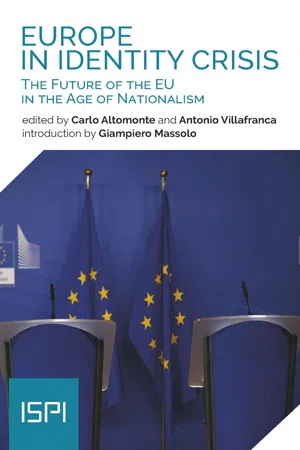
eBook - ePub
Europe in Identity Crisis
The Future of the EU in the Age of Nationalism
- 124 pages
- English
- ePUB (mobile friendly)
- Available on iOS & Android
eBook - ePub
Europe in Identity Crisis
The Future of the EU in the Age of Nationalism
About this book
Trusted by 375,005 students
Access to over 1.5 million titles for a fair monthly price.
Study more efficiently using our study tools.
Information
1. A Revived EU Identity in the Age of Nationalism
Carlo Altomonte, Antonio Villafranca
Defining the EU’s Identity
The set of aims of the European Union is enshrined in article 3 of the Treaty on the European Union. It includes both external aims – global peace, security and human rights protection – and internal goals – a borderless area of freedom, well-being, justice and cohesion. The “core identity” of the EU is therefore strictly related to its ability to deliver both in the domestic and international domains by building upon liberal values and norms.
In the relatively “frozen” world of the Cold War period, peace and security were guaranteed in Europe by the NATO alliance. Growth, well-being and cohesion also depended on the link the European markets maintained with the United States. During the 1970s and 1980s, in fact, the US was at the forefront of technological developments in virtually every field. Via trade, European firms could have access to and imitate US technologies, and through that channel catch-up to the US business model1. Not coincidentally, European productivity grew by about 3% a year in the 1970s and 1980s, twice as fast as in the US2.
Even in case of economic shocks, which certainly happened during the Cold War (notably the two oil crises of 1974 and 1980), trade and capital links with the US remained in place, along with the EU firms’ ability to continue importing technology and productivity, which was preserved out of a shared political interest.
In the post-1989 period, the “Washington consensus” and the ensuing liberal order paved the way for the emergence of an initially symmetric globalisation of economic activities. The latter was associated with a general reduction of conflicts in countries equally participating in the international division of production and the rise of Global Value Chains3. Hence, for the EU, adhesion to the multilateral rule-based system was a tool to achieve peace and security, its paramount “external” objectives.
In economic terms, the system of rules developed within the World Trade Organization since 1995 avoided the repetition of trade wars (that degenerated into military wars) and opened up new markets, notably China. The positive supply shock of globalisation induced higher growth rates both in the EU and the US. At the same time, the deflationary nature of the globalisation shock helped tame inflation, allowing both the US Federal Reserve and the newly created European Central Bank to maintain relatively low interest rates.
By participating in this multilateral global order, the EU was able to achieve its main internal objective of growth, and well-being. In fact, a record 16 million jobs were created in the Eurozone between the mid-90s and 2008: employment rose by almost 15%, while unemployment fell to about 7% of the labour force (EU Commission, EMU@10, 2008).
In this context, cohesion was achieved through a significant strengthening of the regional policy in the EU budget since the 1999 enlargement, at the expense of agriculture4. Results showed a remarkable level of economic convergence across countries in the early 2000s, although with less clear results at the regional level (i.e. within countries)5.
Such a “balanced” scenario, in which the European Union was able to guarantee its main objectives to a large proportion of its citizens, and thus legitimise its very existence, started to deteriorate with the financial crisis6. The latter was partly the outcome of the same international order that helped the EU thrive: the low interest rate environment generated by the globalisation shock was the ideal setting for asset bubbles, especially in the US, and for large current account imbalances within the Eurozone.
And yet, when the bubble burst, generating the largest financial shock since the Great Depression, its early consequences were adequately managed at the world level within the “symmetrical” order that globalisation had created. The G-20 met for the first time at the level of Heads of State and Government in November 2008, agreeing to a synchronised monetary and fiscal policy response that led to a rebound in the world economy starting in mid-20097. Since then, the United States has gone through the longest cycle of expansion in its history, with 126 month of continuous economic growth from June 2009 to December 2019, and no signs of recession on the horizon. China also avoided a recession, an event that the country has now escaped for more than a quarter century. The fate of Europe, as it is widely known, was different.
The inability of the European institutional framework to deal with what ultimately was an internal balance of payment crisis generated by “sudden stops” in internal capital flows8 led to the debt crisis in the Euro-periphery, and a “double dip” in the EU growth rate that persisted until 20149. When Europe started to re-emerge from its internally generated turmoil, the picture had dramatically changed with respect to the pre-crisis years, both externally and internally.
At the global level, the continuing rise of China not only as an export powerhouse, but increasingly as a producer of world-class technology, had started to unbalance the symmetry of the global order. When China entered the World Trade Organization in 2001, the country was poor and with a strong competitive advantage in some traditional labour-intensive sectors. China’s entry in the WTO was expected to lead to the profound restructuring of some Western industries. However, a) these restructuring costs were expected to be of a short-term and diffused nature; b) it was assumed that the economic consequences induced by Chinese competition would have been more than compensated by the larger market access that developed-nation enterprises would have gained in the country.
By 2014, the evidence began to suggest that the economic consequences of the “China shock” on Western countries were profound, had a relatively long-term nature and were concentrated in specific economic areas10. Moreover, the market access that multinationals were gaining in China appeared to be not only relatively constrained, but also subject to a number of local procedures that entailed a substantial technology transfer to Chinese firms11.
Within the Western world, the very different recovery paths from the crisis had started to create a cleavage between the EU and the US economic systems: at the end of the crisis, the symmetric globalised world had become asymmetric, with two “nodes”, the US and China, gaining higher centrality than others. The EU was born out of post-World War attitudes, values, and ideologies, and in response to the bipolar system. While it was still able to maintain its role within the symmetric, multilateral, ruled-based system at the end of the Cold War, in the post-2008 era it began having trouble defending its external identity.
At the same time, within Europe, the legacy of the financial crisis had dramatically interrupted the convergence process across countries, leading to new divergences and persistent periods of economic hardship, which are hard to reverse under the restrictive fiscal policies pursued by the Euro-area periphery. This put the EU’s internal identity under threat.
The latter, combined with the legacy of the Chinese shock that disrupted local industries throughout the continent, led to the emergence of populist/nationalist parties in most countries12,13. The result is the emergence of a widespread political narrative of criticism towards the EU within most Member States. The narrative is conditioning the political agenda of mainstream parties and putting to the test the ability of the EU itself to pursue the interests of its Member States14. These difficulties fuel further resentment and, in turn, generate an additional deterioration of the EU’s ability to deliver on its goals, leading to a vicious circle that is jeopardising the EU’s identity and, ultimately, its very existence.
To better understand the origins and implications of this identity crisis, we begin by investigating the international shifts and processes which are constraining and challenging the EU’s ability to deliver peace and security, i.e. its external identity. We then move on to analyse the extent to which the post-crisis environment has hampered the achievement of growth and cohesion within the Single Market; that is, the internal identity of the EU. We conclude with some policy p...
Table of contents
- Cover
- Europe in Identity Crisis
- Colophon
- Table of Contents
- Introduction
- 1. A Revived EU Identity in the Age of Nationalism
- 2. The EU and the World
- 3. Multilateralism in Crisis
- 4. Inequality, Growth, and Regional Disparities
- 5. Euro and Economic Governance
- The Authors
Frequently asked questions
Yes, you can cancel anytime from the Subscription tab in your account settings on the Perlego website. Your subscription will stay active until the end of your current billing period. Learn how to cancel your subscription
No, books cannot be downloaded as external files, such as PDFs, for use outside of Perlego. However, you can download books within the Perlego app for offline reading on mobile or tablet. Learn how to download books offline
Perlego offers two plans: Essential and Complete
- Essential is ideal for learners and professionals who enjoy exploring a wide range of subjects. Access the Essential Library with 800,000+ trusted titles and best-sellers across business, personal growth, and the humanities. Includes unlimited reading time and Standard Read Aloud voice.
- Complete: Perfect for advanced learners and researchers needing full, unrestricted access. Unlock 1.5M+ books across hundreds of subjects, including academic and specialized titles. The Complete Plan also includes advanced features like Premium Read Aloud and Research Assistant.
We are an online textbook subscription service, where you can get access to an entire online library for less than the price of a single book per month. With over 1.5 million books across 990+ topics, we’ve got you covered! Learn about our mission
Look out for the read-aloud symbol on your next book to see if you can listen to it. The read-aloud tool reads text aloud for you, highlighting the text as it is being read. You can pause it, speed it up and slow it down. Learn more about Read Aloud
Yes! You can use the Perlego app on both iOS and Android devices to read anytime, anywhere — even offline. Perfect for commutes or when you’re on the go.
Please note we cannot support devices running on iOS 13 and Android 7 or earlier. Learn more about using the app
Please note we cannot support devices running on iOS 13 and Android 7 or earlier. Learn more about using the app
Yes, you can access Europe in Identity Crisis by Carlo Altomonte,Antonio Villafranca in PDF and/or ePUB format, as well as other popular books in Politics & International Relations & European Politics. We have over 1.5 million books available in our catalogue for you to explore.