- 160 pages
- English
- ePUB (mobile friendly)
- Available on iOS & Android
63 Tactics for Teaching Diverse Learners, K-6
About this book
"An in-depth, effectively organized resource guide for teachers at all grade levels, putting meaningful, practical strategies and activities just a page-turn away. Filled with the voices of teachers and students, this book won?t have time to gather dust on the shelf."
āRuth Devlin, ELL Teacher
Paradise Professional Development School, Las Vegas, NV
"I love the way the book addresses specific behaviors and classroom situations. The format is consistent throughout the text, which makes finding information on a specific topic, skill, or content area easy."
āRoxie Ahlbrecht, Second-Grade Teacher
Robert Frost Elementary School, Sioux Falls, SD
Evidence-based practices for delivering instruction that meets students? diverse learning needs!
The increased inclusion of students with disabilities and learning differences in the general education elementary classroom has challenged novice and expert educators to seek more effective ways of meeting diverse learning needs. This detailed guide offers easy access to information about effective teaching methods that allow educators to be more responsive to individual concerns.
63 Tactics for Teaching Diverse Learners, Kā6 presents successful, teacher-tested instructional methods that can be used across content areas and grade levels for elementary students with or without disabilities. The authors provide a practical, research-based teaching model that focuses on planning, managing, delivering, and evaluating instruction. Readers will find:
- Descriptions of how to teach students with diverse learning styles and needs
- Feedback from teachers on how to implement or modify each tactic
- Information to help teachers choose appropriate strategies for specific subjects, grades, or learning difficulties
Motivational and multifaceted, this resource is an essential tool for providing an informed approach that improves academic performance for all elementary students.
Frequently asked questions
- Essential is ideal for learners and professionals who enjoy exploring a wide range of subjects. Access the Essential Library with 800,000+ trusted titles and best-sellers across business, personal growth, and the humanities. Includes unlimited reading time and Standard Read Aloud voice.
- Complete: Perfect for advanced learners and researchers needing full, unrestricted access. Unlock 1.4M+ books across hundreds of subjects, including academic and specialized titles. The Complete Plan also includes advanced features like Premium Read Aloud and Research Assistant.
Please note we cannot support devices running on iOS 13 and Android 7 or earlier. Learn more about using the app.
Information
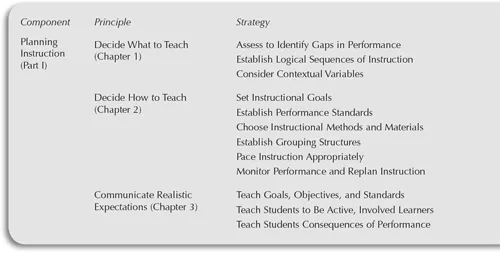
PART I
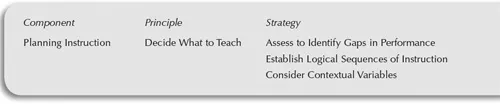
Planning Instruction

Planning Instruction Works: A Case Study
1
Decide What to Teach

Chapter 1: Decide What to Teach
| Strategy: | Assess to Identify Gaps in Performance |
| Focus: | Basic Skills; Content Skills |
| Area: | Reading; Mathematics/Problem Solving/Calculating; Writing; Social Studies; Science; Arts; Fitness |
| Learning Difference: | Attention; Cognition High; Cognition Low; Cognition Mixed; Health; Study Skills; Social Knowledge; Receptive Language/Decoding (listening, reading); Expressive |
| Language/Encoding (speaking, writing, spelling); Fine Motor (handwriting, articulation, etc.); Processing Verbal Information; Processing Visual Information | |
| Disability Category: | Specific Learning Disabilities; Attention Deficit/Hyperactivity Disorder; Visual Impairments; Deafness/Blindness; Gifted and Talented; Hearing Impairments; |
| Mental Retardation; Multiple Disabilities; Traumatic Brain Injury; Second Language Learning Needs; Serious Emotional Disturbance; Speech or Language Impairments; | |
| Orthopedic Impairments; Other Health Impairments; Autism | |
| Tactic Title: | Observing Students |
| Problem: | There are times when teachers of students with disabilities evaluate the students and design modifications for their instruction based on the studentsā assessment test scores. |
| But what do these scores mean? Do these scores allow the teacher to meet the studentsā needs appropriately? | |
| Tactic: | Direct observation can be used to gain a more comprehensive understanding of the students. While the students are working, walk around the classroom to monitor and record student progress. |
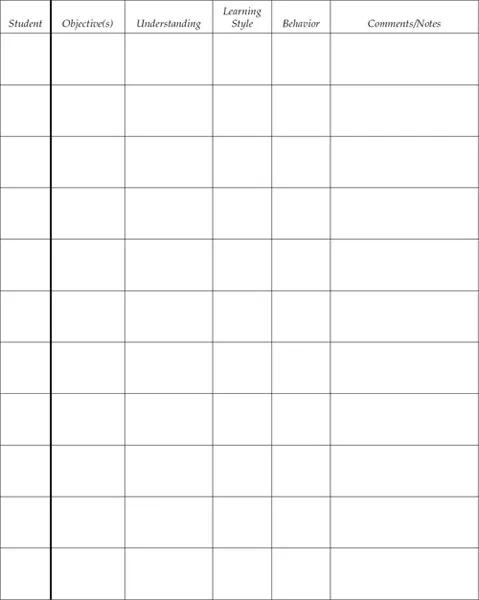
| Ask students questions regarding the lesson and the assignment. Use a checklist to assess desired objectives (see Student Observation Sheet). | |
| Write anecdotal records of studentsā learning, including notes of inappropriate behaviors, underdeveloped thinking skills, on-task behaviors, the understanding of content instruction, or any other noticeable behavior that needs to be documented. | |
| Example: | Observing students as they are working provides a wonderful way for me to monitor their understanding. In fact, I use an Observational Journal to organize my notes during observation. |
| I monitor not only my studentsā learning, but also their health. The number of days absent or their physical appearance can be a beneficial way of studying their work habits and social skills. | |
| (These areas are important to set the framework for the academic learning.) Gathering data through close observation also helps me when collaborating with parents and special education teachers. | |
| Parents and teachers can study my anecdotal records of students showing daily occurrences of behaviors and progress. In this way, decisions concerning the studentsā education can be made appropriately. | |
| Rosemary T., teacher | |
| Benefits: | Measuring learning progress informally can
|
| Literature: | Burns, M. S., Delclos, V. R., & Kulewicz, S. J. (1987). Effects of dynamic assessment on teachersā expectations of handicapped children. American Educational Research Journal, 24, 325ā336. |
Student Observation Sheet

| Strategy: | Establish Logical Sequences of Instruction |
| Focus: | Basic Skills |
| Area: | Reading; Mathematics/Problem Solving/Calculating; Writing; Social Studies; Science; Arts; Fitness |
| Learning Difference: | Attention; Cognition High; Cognition Low; Cognition Mixed; Mobility; Hearing; Health; Memory Short-Term; |
| Memory Long-Term; Seeing; Speaking/Talking; Study Skills; Fine Motor (handwriting, a... |
Table of contents
- Cover Page
- Dedication
- Title
- Copyright
- Contents
- Preface
- Acknowledgments
- About the Authors
- PART I: PLANNING INSTRUCTION
- PART II. MANAGING INSTRUCTION
- PART III. DELIVERING INSTRUCTION
- PART IV. EVALUATING INSTRUCTION
- References
- Additional Readings
- Index