![]()
1
Creativity
A Gift for the Gifted
THE SILENT CALL
It’s not easy to hear a silent call, especially in a lively classroom where everyone is learning at different levels. Often, the gifted students, sprinkled willy-nilly throughout the school, sit quiet and studious, rarely letting on that something is missing. Many couldn’t put their fingers on it if we asked them to. The creative world they lived in during their earliest years of learning as they touched, tasted, performed, molded, constructed, expressed, and explored their surroundings has lost its validity. They had to let it go in order to ply the more serious waters of skill acquisition and content mastery. The “sense of wonder” so eloquently expressed by Rachel Carson as the most precious element of learning begins to fade. The child’s world becomes subjects in a curriculum rather than a world to discover, and learning requires less of the inner life and more of the ability to comply with prescribed steps and sequences.
Gifted learners who come into the world with an abundance of curiosity and inspiration can become particularly disheartened by this process. Creativity in whatever form—from an open questioning technique in a science class to an imaginative exercise in a drama workshop to an interdisciplinary discovery process in a social studies class—revives unused talents and interests and extends their learning in significant ways. In programs across the country, gifted children compose poems and stories, write compelling speeches for simulated trials, develop unique formulas for difficult math problems, and design complex, multimedia compositions in art and film. Families report that their children are more engaged and alive in their learning than they have been for years.
WHY CREATIVITY MATTERS
The importance of creativity becomes apparent when we examine the situations in which gifted students really thrive. Obviously, a more challenging program of study than exists in the regular classroom responds to their advanced learning abilities in many subjects. But what about creativity? A child in an advanced reading group may be delighted to tackle difficult books, especially poetry and historical novels, and enjoys the guided class discussions debating and analyzing the various texts. But what about her own writing? Her own imaginary endings to stories she’s read? Or her etchings of characters in her favorite novel? Or poems she thought of writing after her teacher exposed the group to the nature poems of Mary Oliver?
In our school system, there is an unfortunate tendency to place academics and creativity on separate poles—for example, an intensive, accelerated program of advanced mathematics on one side and, on the other, a less academically rigorous “enrichment” activity. Meanwhile, the students, when left to their own devices, do both—that is, they pursue learning on their own at an advanced level and explore its creative edge. In history, they imagine living in the world they’re exploring. They wonder what motivated certain actions and what might have happened had historical figures made other choices. In science, they study the discoveries of naturalists and start nature journals with watercolors and sketches. They convert a problem involving fractions into a humorous short story and then solve it in a new way.
Pasteur wisely said, “Chance favors the prepared mind.” Possessing an advanced understanding of a field with an openness to the unconventional is the best way to discover something new. Through an education that embraces both academic mastery and creativity, gifted learners can move beyond the limits of their knowledge and skill and step out into the unknown. The likelihood of this happening in our current educational system is slim, however, because services for gifted students (when they exist at all) tend to focus more on advancing to higher levels of difficulty than on a challenging creative endeavor.
Contrary to what we might suppose, surprisingly few gifted children become creative adults (Winner, 1996). A high level of intelligence does not, in and of itself, ensure a future of creative productivity. Research has proved that the classroom environment—particularly in its influence on motivation and creative expression—plays a central role in the degree to which high-ability students can become independent, innovative, imaginative thinkers (see Amabile, 1996; Hennessey, 2004). Increased creativity among gifted students depends as much on learning situations that support it as on talent (see Feldhusen, 1995; Torrance & Sisk, 1997). The challenge is that the learning environment of the average American school includes pressures that routinely discourage creativity (Amabile, 1996). The culture of evaluation and testing, the enticements of external reward (e.g., high grade, praise, recognition), competition between students, the tendency toward perfectionism, and the imposition of time constraints all work against the creative process. Over time, sensitive gifted students tend to approach their education as a means to an end, undermining both creativity and self-determination (Hennessey, 2004).
Even so, they need times in the classroom when they can step back from these coercive forces and gain experience making their own contribution to the subjects they’re learning. This can happen only if the climate of the classroom nurtures the intrinsic motivations of children—the inner curiosity, imagination, passion. Integrating creativity into the curriculum awakens this inner spirit—the inventor, the mad scientist, the storyteller, the artist.
BENEFITS OF CREATIVITY FOR THE GIFTED
Though many of us think of gifted children as highly motivated people, this is not always the case. In fact, many struggle with motivation (Reis & McCoach, 2000) in our schools. This is understandable given that high-ability students tend to perform better in situations where they have some power over their own learning rather than in ones where they must always respond to external demands, whether from a teacher, a parent, or the curriculum (Hennessy, 2004).
The creative process—structured within the limits and demands of the classroom—offers gifted students just the sort of environment that enables them to become motivated again. A common thread among all the contributors to this book is the conviction that the creative process is of value to both the emotional well-being and the intellectual growth of gifted learners. The high motivation, engagement, and initiative it generates are often the most immediate effects. Beyond that, teachers notice that creative work stimulates higher-level thinking in a wide range of ways: analysis of problems; awareness of new questions; flexible thinking across disciplines; sensitivity to pattern, color, gesture, nuance; heightened sensory awareness; discovery of connections; probing of new mysteries. It also fosters a richer, more nuanced understanding of an issue or subject rarely achieved in ordinary ways.
In this book, teacher-authors reveal how academics and creativity can be naturally woven together. In many of their activities, the process begins with research. Gifted students first delve into the material. Being gifted, they do it with zest, examining a wide range of sources, posing questions, and gathering the data they require. “Individuals need knowledge in order to be creative; finding problems of increasing sophistication demands increased understanding of the domains in which the problems are found” (Starko, 1995, p. 126). With the knowledge they need, they launch out into the depths, seeking a path of their own—through a new insight or realization, an artistic response or novel proposition. Often, they discover areas where their understanding or skill falls short, and so they return to their teacher with new questions and new problems. This process goes on—with the creative process testing the limits of knowledge and knowledge feeding and expanding the creative process.
Among the many benefits of creativity for high-ability students are these:
- Personal connections with content areas. Because of its demand on individual thinking, imagining, and analyzing, gifted students immediately become more engaged. Their feelings, interests, and intuitions play a more central role in the learning process. In the Literacy chapter (Chapter 3), for example, Yolanda Toni explores the use of visual art sources as catalysts to inspire individual responses in the form of free verse poems (p. 65). In the Social Studies chapter (Chapter 4), Jerry Flack demonstrates the value of helping gifted learners make creative and personal connections with geography through the creation of what he calls “autobiography maps” (p. 83).
- Originality and individuality. The importance of self-expression for gifted students—discovering their own unique abilities, views, interests, tastes and so forth—can never be overestimated. Gifted children need time and opportunities to explore their individual talent, style, and vision. Frances Collins in the Literacy chapter uses what she calls “mentor texts”—examples of writing by professional authors as catalysts for her students to explore and test out their own unique writer voices and styles (p. 56). In the Arts chapter (Chapter 7), Scott Barsotti discusses strategies in acting workshops that can free the creative self of each child and enable students to work freely together as an ensemble (p. 279).
- Greater exploration of interdisciplinary connections and sources. Because of the wide range of processes and materials employed, creativity can more effectively accommodate differences in learning styles as well as socioeconomic and cultural backgrounds. Combining media (e.g., text, art, graphs, drama, design, photography, tools) and subjects (math, art, geography, architecture) provides a far richer, more interconnected world for gifted students to make creative leaps. In the Literacy chapter, Courtland Funke shares his program that involved gifted students creating a monthly podcast about their school–an endeavor that draws on their writing ability, musical talents, technical skills, and many other gifts. Lois Guderian, in the Social Studies chapter, finds rich and meaningful connections for gifted students in an interdisciplinary music–social studies project that focuses on the songs of African American spirituals (p. 104).
- Discovery. Discovery can happen in any subject and almost always emerges when children have more choices in how they approach an assignment. Even concepts in math or science units can be learned through a process of exploration and inductive reasoning. The children act on situations that, by experimenting, probing, reasoning, imagining, and so forth enable them to discover concepts and ideas that might ordinarily be learned more abstractly. For example, in the Mathematics chapter (Chapter 6), Christopher M. Freeman devises a number of gamelike activities that involve students in discovering useful insights about factorization, fraction, and stars (p. 205). In the Science chapter (Chapter 5), Carol Howe stimulates curiosity and wonder as students embark on creative explorations of the solar system (p. 170).
- Higher-level thinking and depth of learning. Creative processes stimulate higher-level thinking naturally. Children have to inquire into a question or issue, explore various approaches, analyze needs, examine sources, test options, evaluate information, apply principles, and so forth. Creating cannot take place unless they make what they have learned their own and then take it to the next level—that is, bring out another interpretation, invent a new option, diverge from a convention, and so forth. In the Social Studies chapter, for example, Carol Horn shares how in giving students the role of actual historians they develop new mastery in both cognitive and skill areas as they wrestle with the challenges of gathering data, sifting through sources and interpreting findings (p. 100). In the Mathematics chapter, Carol Fisher explores strategies for stimulating more creative thinking in mathematics, enabling gifted students to create their own equations, using fractions, exponents, and any operation they choose.
- Artistry and depth of feeling. Integrating the arts and the creative process into the daily life of the classroom awakens the keen sensibilities of gifted children. They revel in such phenomena as the beauty of numbers, the dazzling array of intricate patterns in nature, or the richness of imagery and meaning in stories or poems. Many gifted learners who qualify for and participate in accelerated learning programs miss the creative dimension, though they may not know this. Joyce Hammer in the Mathematics chapter, for example, shows how important it is for gifted children to appreciate the beauty of mathematics and explores ways teachers can use art to explore geometry (p. 216). In Chapter 8 (the conclusion), Susan Scheibel shares a range of strategies involving song, dance, music, and art that preserve the vital connections we all need to a sensory world that is rich, stimulating, and inspiring (p. 305).
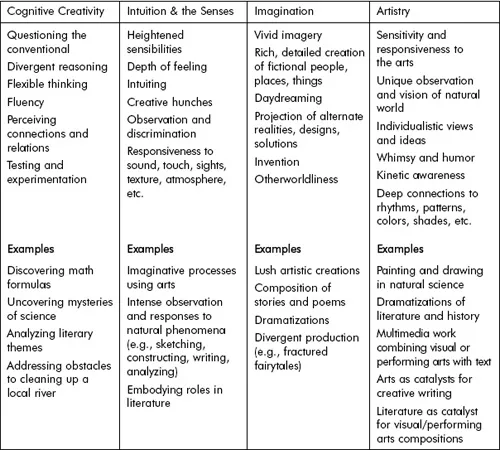
- What the authors in this book bring to the subject of creativity in the classroom is a wider spectrum of creative domains than we often see applied to the curriculum. As Clark (2002) has pointed out, the “cognitive, rational view of creativity” has become the most researched in the literature (p. 78). Certainly, much is lost if we limit our classrooms to this one domain and omit, for example, the role of the arts as a catalyst for learning. The chart below is a visual display of this wider spectrum of creativity and the different paths gifted children can take within and across subject areas. We have separated these domains for the purpose of clarifying distinctions; clearly, they overlap and interrelate in actual creative work.
Creative Paths to the Curriculum
E. Paul Torrance (1995), the great pathfinder in creative teaching and learning, wrote a book called Why Fly? that has become a guiding light for many educators who, like the teachers in this book, want to steer their students to the higher realms of the imagination. The list below combines many of his ideas with those of the compilers as well as those shared by the teacher-authors in this book.*
Preparing the Soil
- Openly share your own creative passions with your students.
- Fill the classroom with art, music, and a rich variety of enticing supplies.
- Design work spaces that beckon the creative muse in your students.
- Applaud originality whenever and wherever expressed.
- Protect students from saboteurs: criticism, censure, premature judgment.
- Celebrate risk taking and bold endeavor.
Planting the Seeds
- Awaken imagination and artistic sensibilities through example and exposure to creative people and their works.
- Create open time for creative exploration.
- Share jewels of wisdom about the creative process.
- Point out the hidden, less traveled paths; warn against set patterns.
- Celebrate the beginning steps of children’s own creative process.
Watering and Feeding
- Design activities that engage the whole child: touching, feeling, imagining, listening, sensing, composing, combining, writing, improvising, constructing, molding, shaping.
- Provide for advanced learning in a variety of fields.
- Assign work that requires creative and imaginative thinking.
- Nurture boldness in vision and endeavor.
Weeding and Growing
- Teach strategies for constructive criticism and evaluation.
- Impart coping skills to deal with peer judgment, crippling perfectionism, and frustration with the creative process.
- Support students’ trust in their own creative power.
- Give them opportunities to correct e...