
63 Tactics for Teaching Diverse Learners, Grades 6-12
- 200 pages
- English
- ePUB (mobile friendly)
- Available on iOS & Android
63 Tactics for Teaching Diverse Learners, Grades 6-12
About this book
"What a wonderful and essential resource! In the age of differentiated instruction, this resource provides a wide array of authentic approaches that I can use in my classroom today! This book offers the reader real-life solutions to a challenge that teachers face every day: truly educating all students by giving them the tools they need to have a successful future."
āKendra Sarabia, English Teacher
Cape Cod Regional Technical High School, Harwich, MA
"Grounded in research and theory, this book provides important foundational knowledge and outlines a comprehensive approach to the planning, management, delivery, and evaluation of instruction for diverse populations."
āEvelyn B. Barese, Assistant Professor of Education
Mount Saint Mary?s College
Use field-tested teaching methods to reach students with diverse needs and abilities!
This collection of evidence-based instructional strategies enables general and special education teachers, novice or experienced, to address the learning needs of all students in diverse, inclusive classrooms. The authors provide a practical, research-based teaching model that focuses on planning, managing, delivering, and evaluating instruction for middle and secondary students with or without disabilities. Readers will find:
- Descriptions of how to teach students with different learning styles and needs
- Specific instructions for using each tactic, with helpful comments from practicing teachers and literature resources
- A wealth of reproducible worksheets
- Help for choosing appropriate strategies for specific subject areas, grade ranges, or learning difficulties
- Information to help teachers comply with federal mandates such as NCLB and the reauthorization of IDEA 2004
63 Tactics for Teaching Diverse Learners, Grades 6ā12 allows teachers to match specific needs with an easily accessible set of solutions and enable all learners to achieve success in the classroom.
Frequently asked questions
- Essential is ideal for learners and professionals who enjoy exploring a wide range of subjects. Access the Essential Library with 800,000+ trusted titles and best-sellers across business, personal growth, and the humanities. Includes unlimited reading time and Standard Read Aloud voice.
- Complete: Perfect for advanced learners and researchers needing full, unrestricted access. Unlock 1.4M+ books across hundreds of subjects, including academic and specialized titles. The Complete Plan also includes advanced features like Premium Read Aloud and Research Assistant.
Please note we cannot support devices running on iOS 13 and Android 7 or earlier. Learn more about using the app.
Information
PART I
Planning Instruction

1
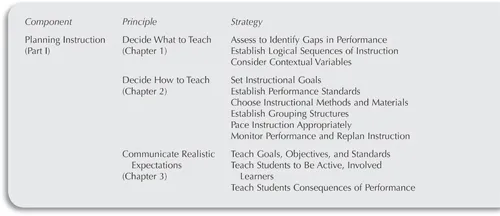
Decide What to Teach

Chapter 1: Decide What to Teach
| Strategy: | Assess to Identify Gaps in Performance |
| Content Skills: | Mathematics/Problem Solving/Calculating; Reading |
| Learning Difference: | Cognition Low; Attention; Processing Visual Information; Receptive Language/Decoding (listening, reading); Fine Motor (handwriting, articulation, etc.); Processing Verbal Information; Expressive Language/Encoding (speaking, writing, spelling); Cognition Mixed |
| Disability Category: | Specific Learning Disabilities; Mental Retardation; Speech or Language Impairments; Serious Emotional Disturbance; Attention Deficit/Hyperactivity Disorder; Autism; Gifted and Talented; Hearing Impairments; Multiple Disabilities; Traumatic Brain Injury; Visual Impairments; Deafness/Blindness; Orthopedic Impairments; Other Health Impairments |
| Tactic Title: | Think-Aloud Problem Solving |
| Problem: | Teachers often think that if they knew more about the way students were thinking and reasoning, they would be better equipped to evaluate studentsā understanding of problem-solving methods. |
| Tactic: | When evaluating problem-solving or reasoning skills of students (especially in mathematics), take students aside individually and have them describe what they are doing as they work through word problems. Tell them to say exactly what they are thinking and doing. Keep careful records of their verbalizations. (A tape recorder is helpful for this purpose.) The think-aloud procedure can be used alone or as a component of a unit test. After the evaluation is complete, review the strategies that students used to arrive at their solutions. |
| Example: | Iāve found this tactic to be very helpful because I can see exactly where a student is going astray in thinking and start reteaching at that point. In fact, the students often show me an excellent alternative to my own thinking. Sometimes, when my time is limited, Iāve organized the students into dyads and let them talk through their thinking with a peer ⦠[a] nice way to include students of differing abilities in shared problem-solving. For those students who have expressive languages issues, Iāve found that just observing their work closely provides extremely useful information for me, as the teacher. While Iāve used this idea in my algebra and general mathematics classes, Iām sure teachers in other content areas would find it very useful. |
Arturo C., teacher | |
| Benefits: | Verbalizing thinking enables teachers to
|
| Literature: | Marjorie, M., & Applegate, B. (1993). Middle school studentsā mathematical problem solving: An analysis of think-aloud protocols. Learning Disability Quarterly, 16, 19ā30. |
Chapter 1: Decide What to Teach
| Strategy: | Establish Logical Sequences of Instruction |
| Content Skills: | Mathematics/Problem Solving/Calculating; Reading; Writing; Social Studies; Science; Arts; Music |
| Learning Difference: | Self-Confidence; Social Knowledge; Social Behaviors; Expressive Language/Encoding (speaking, writing, spelling) |
| Disability Category: | Specific Learning Disabilities; Autism; Orthopedic Impairments; Other Health Impairments; Attention Deficit/Hyperactivity Disorder; Speech or Language Impairments; Specific Learning Disabilities; Serious Emotional Disturbance; Hearing Impairments; Mental Retardation; Multiple Disabilities; Traumatic Brain Injury; Visual Impairments; Deafness/Blindness; Gifted and Talented |
| Tactic Title: | Assessing Student Participation in Group Activities |
| Problem: | When teachers ask questions in a group setting, most students will volunteer answers some of the time. However, other students may hesitate to respond due to shyness, lack of confidence or knowledge, and/or misunderstanding the question. Consequently, teachers may not be able to assess what these students really know. |
| Tactic: | To encourage greater participation, first ask a question to the class as a whole. Select students who raise their hands and thank them for participating. Provide supportive and/or corrective feedback. Then, ask additional questions; however, select students who do not raise their hands as well. Encourage any response (related to the question) and, again, acknowledge participation and provide supportive/corrective feedback. Pay attention to the quieter students to ensure that you notice when they do raise their hands. Be sure that students know why it is important to participate, even if they are not sure of their responses. |
| Example: | With more and more students with disabilities being included in my classes, it is essential that I make every effort to encourage them to participate. Some are really hesitant ⦠at first, because they may not know the other students in the class and, then, because they are not sure of the content. Some are simply shy; they like to listen. However, Iāve always tried to create a community of learners that accepts others abilities and disabilities; it just makes the conversations so much richer. I make sure that I ask a variety of questions, both open-and closed-ended and at different levels of Bloomās taxonomy. In fact, I keep a āBloomās Guideā with me most of the time when Iām teaching; itās invaluable. Sometimes during class discussions, I divide the students into two groups and monitor their participation as a group. Now, so many students volunteer that it sometimes hard to keep track of it all. |
Emma F., teacher | |
| Benefits: | Using this tactic will
|
Table of contents
- Cover Page
- Dedication
- Title
- Copyright
- Contents
- Preface
- Acknowledgments
- About the Authors
- PART I: PLANNING INSTRUCTION
- PART II: MANAGING INSTRUCTION
- PART III: DELIVERING INSTRUCTION
- PART IV: EVALUATING INSTRUCTION
- References
- Additional Readings
- Index
