![]()
1
Instructional Records
Lesson plans are the foundation of every teacher training course every teacher has ever taken. When I was in school, we had to produce Madeline Hunter’s seven-part lesson plans with an objective, the standard, the anticipatory set, teaching (input, modeling, checking for understanding), guided practice, closure, and independent practice. I wrote these lesson plans until I dreamed about them controlling not only my student-teaching classroom, but my finances, my housework, my driving, even my love life. At the time I thought it was all a bit much.
When I finally got a full-time teaching job, I quit writing lesson plans as soon as possible. I had a principal who didn’t request plans from new teachers, so I wrote an occasional plan for my university supervisor and the rest of the time I flew by the seat of my pants, trying to decide what to do with my students on my way to work each morning. I told myself that I was an organic teacher, not able to plan because I wouldn’t know what my students needed from me until we had gotten through the present day. I was a student-directed teacher, letting my students’ needs determine my lesson plans. There was no way I could plan days in advance because I had no way of knowing where my students’ needs would direct my curriculum.
I soon learned that the course syllabus is my road map. With it, I have an orientation for where I am, where I am going, and what my major stops are along the way.
Lesson plans are my street map. They help me know where and when to turn. Today I write lesson plans to inform my teaching, to help me meet the ever-changing needs of my students without losing sight of our destination, and as records to justify and inform my decisions with the curriculum, with my students, and for my site organization: department, administrator, parents.
Assignment records, worksheets used, and directions given are the specific markers that make sure we are all on the right course. Standards alignments are the reward when we reach our destination and see how far we’ve come. Proper substitute plans ensure that even when we may be indisposed, the rest of the party heads in the right direction.
I’ve found that investing time at the beginning of each teaching unit actually saves me time in the long run, not to mention stress. It’s like driving somewhere new. Someone has provided you with an address, a destination. Someone may have even given you verbal directions that you wrote out diligently: turn left at the stop light, right at the third house, and so on. For some people, this is enough information. For people who get confused easily, like myself, a map, a visual representation of where I’m going, helps. I have learned that the time invested in looking up the map and familiarizing myself with my destination makes my trip less stressful and my driving time more productive.
When you invest time in planning your teaching unit before you begin, you will begin each teaching day with a destination in mind, you will know how you are going to get to your destination, and if someone in the backseat has to take a potty break, you will be able to adjust easily to the distraction. You might even lead others in the caravan, who knows.
The records you must keep as a teacher include a course syllabus, lesson plans, assignment records, worksheets used, directions given, standards alignment, and substitute plans. These documents will
• Improve the quality of your instruction
• Provide students with clear objectives and expectations
• Clarify for parents what is happening in the class
• Provide your administrator with documents for evaluations and reports to the district office
• Document for your district your classroom practices
COURSE SYLLABUS
A course syllabus or unit overview is the first ingredient in a successful teaching year. It is also a necessary document if your teaching practices are ever called into question.
With state standards becoming commonplace and district curriculum maps becoming increasing accepted as the norm, many districts will already have done this and will provide it to you (Thompson, 2002). Most school districts are recognizing the benefits of ensuring that every student receives similar curriculum in each grade level across schools in the same district. If a syllabus, curriculum map, or unit overview is not provided for you, and you are a new teacher, asking for help from a veteran teacher will alleviate much of the stress of trying to create one.
It is important to have your course syllabus written down and handy for future reference. Not only will it guide your daily lesson plans, but it will be available for you the next teaching year for adjustments and improvements. Having a written document allows you to adjust, improve, and rely on what you are already familiar with.
Once you have collected your textbooks for the course, the state standards for your grade level and course, and reviewed the curriculum covered the previous year, it is time to begin your planning. First, you will need to determine what you will teach, when you will teach it, how deep into the curriculum you will go, and how many weeks you will devote to each topic (Wyatt & White, 2002). Many of these decisions will be made for you based on the textbooks and state standards. Some teachers will even be tempted to skip this document, relying on a printout of the state standards and the table of contents of the textbook, but that may lead to covering information out of sequence, over and over in different formats, or simply prevent you from using time optimally.
If you are ever questioned about the scope and sequence of your instruction and all you can produce are the state standards and the textbook, your credibility may be damaged. Also, handing out a course syllabus specific to your class to parents and students allows them to see the objectives, the journey, and the destination of your class, which gives the students a sense of control over how well they can master the content of your class (Ryan, 2003), helping you to ensure the success of all students. A course syllabus gives you credibility and a sense of control over your curriculum.
When planning a syllabus, three documents need to be in front of you: a calendar (preferably one you can write on), the state or district standards, and the textbook(s) for the course. Working in collaboration with other teachers at your school site and/or within your district is the best scenario. Most districts provide teachers with planning days for this before each semester, and using this time to work with others will ensure that your syllabus is on track with what others are doing in your district. Whether you work alone or with others, you will want to create a rough draft syllabus that can be adjusted as you work on it.
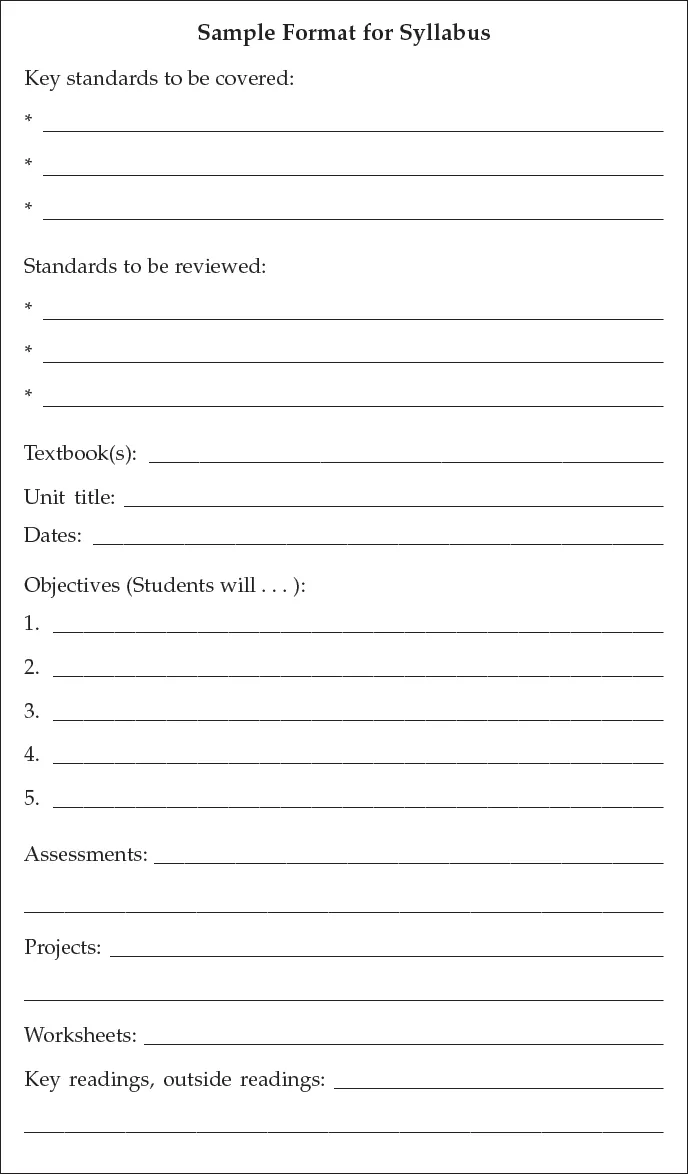
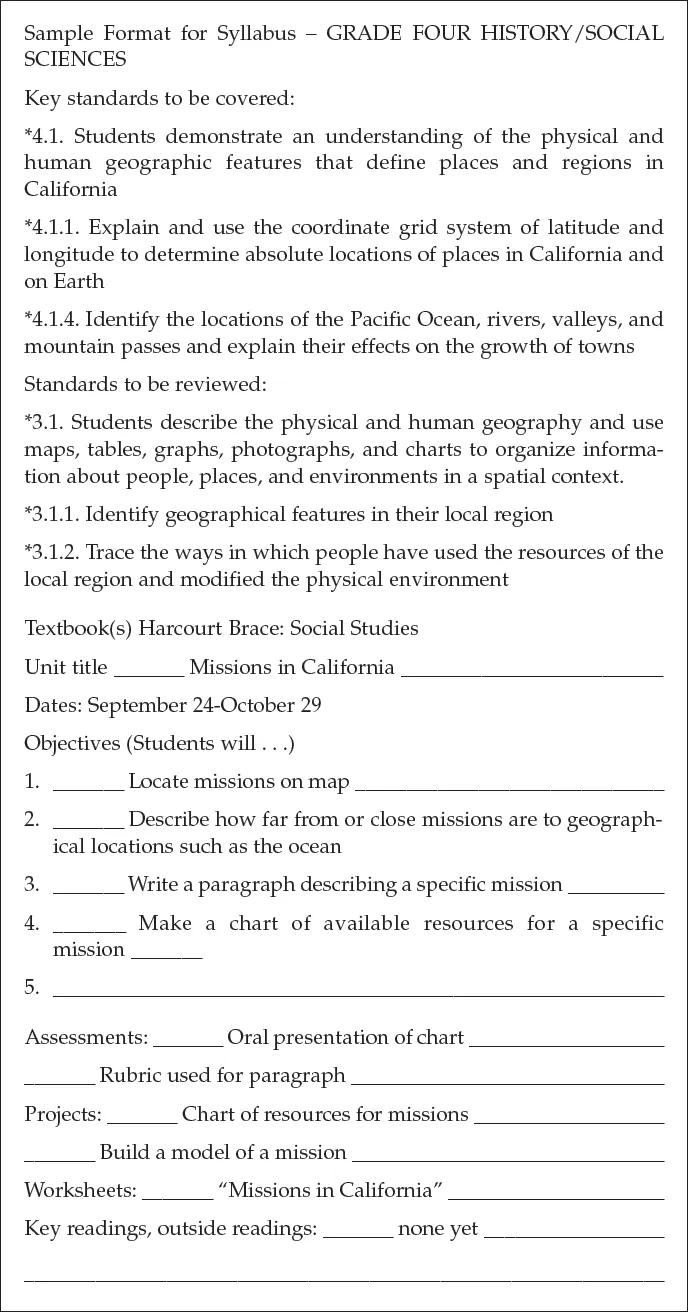
Once you have all the information recorded, you have created a record to provide your administrator or department, to justify your curricular decisions, to familiarize your students and their parents with the course expectations, and to inform your lesson planning. A sample syllabus planner might look like this:
After you have used the document for lesson planning, it will be important to keep it handy for future reference.
LESSON PLANS
One of the most important records you will keep as a teacher is your daily lesson plan book. “Careful lesson planning is mandatory if effective teaching and learning are to follow” (Johnson, Dupuis, Musial, Hall, & Gollnick, 2002). Most schools provide you with a book that you can keep your lessons in, but with technology, many will find it easier to keep plans on the computer. However you decide to record your daily lesson plans, it is important to have them in a format that is legible, that is consistent, and that is organized.
Once you have decided how and where you plan to keep records of your daily lesson plans, you should come up with a format that you are comfortable with. “There is no one right format for these plans. Develop a format that works for you. It should be simple, yet complete” (Partin, 1999). New teachers usually write lesson plans that are very detailed. This is important when you are beginning your career as a teacher because you want to ensure that you have covered all the components necessary for a successful lesson. Relying on the method taught in your teacher education courses is always a good idea.
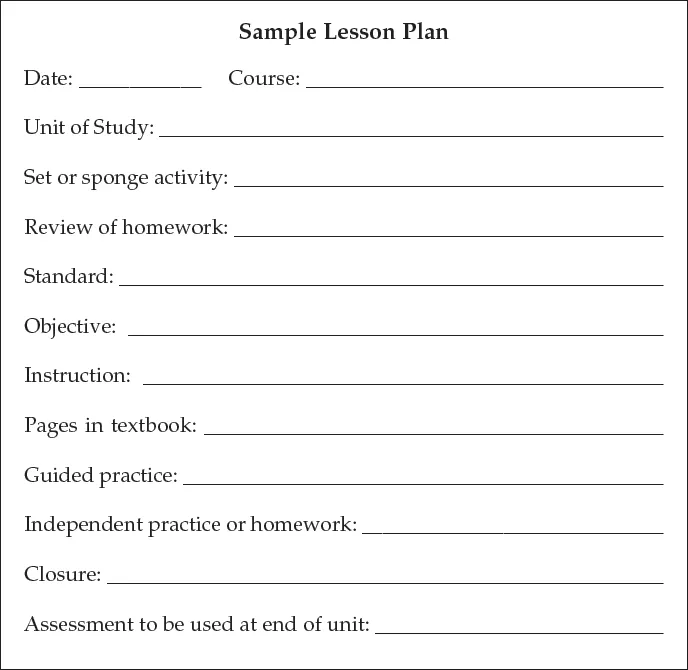
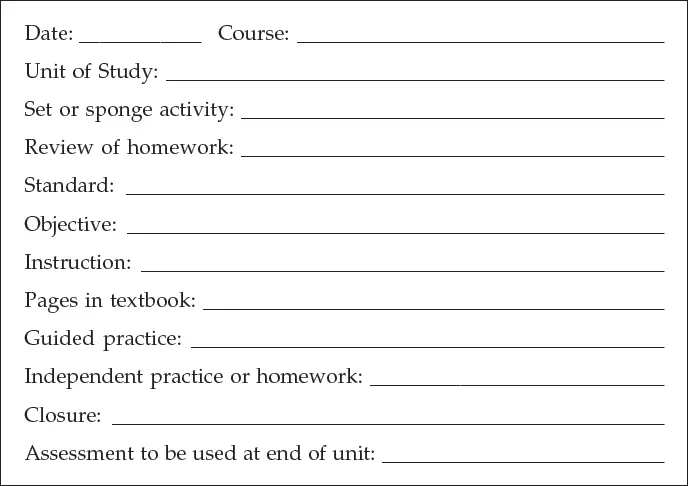
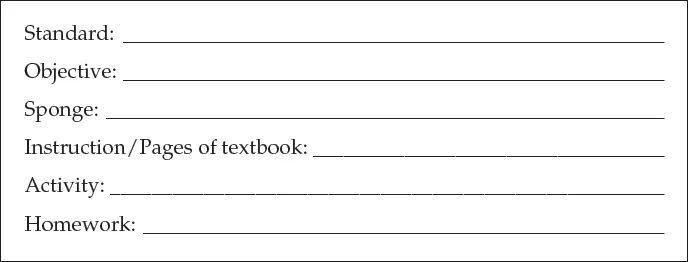
A sample lesson plan might look like this:
As teachers become more experienced, their lesson plans may become more truncated, making perfect sense to them but looking like just a bunch of notes to someone else. As stated earlier, the important component of this record is that it is consistent. Once you have adopted a format, try to stick with that format for the entire year.
After you have decided on a format, there are some key elements that should be included in every lesson: standards and objectives, necessary materials or equipment, anticipatory set, explanation or teacher input, student activities, alternative activities, closure, homework, and assessments (Burke, 2002). Including all of this information in your lessons represents the thought that has gone into your instruction.
Lesson plans as records are important to you professionally. “The lesson is where education takes place” (Slavin, 2003). If you fail to keep accurate records of your daily lessons, you leave yourself open to questions about your effectiveness as a teacher, your goals for your students, your commitment as a professional, your ability to build student knowledge, and your organization as a player in your larger school setting.
Every teacher has heard the question, “Why do we need to learn this stuff?” I heard it most often last year during my poetry unit. The students had the course syllabus, which showed the state standards the unit was addressing, and they were familiar with the end-of-unit assessment they were required by the district to complete. Still, “When will we ever use this again?”
Faced with these questions, I reviewed my lesson plans. It was clear that I hadn’t made the assignments and information pertinent enough to the lives of my students or I wouldn’t have been plagued by these questions. Course syllabi and quarter assessments are motivation enough for some students, but others want to know why the course syllabi and quarter assessments require they become familiar with this information. It was true, only a select few would ever be moved to write poetry for a living or a hobby, so why must they all learn the information? After reviewing my lesson plans, I did some adjustments and spent a day looking at how much money is spent in America on greeting cards. Then we wrote our own greeting cards using metaphors, similes, personification, rhymes, and rhythms. Suddenly, students saw how learning about poetry applied to their lives.
In my lesson plans, I knew my destination and so did my students. Convincing them to take the trip with me meant that I had to make a stop along the way that they enjoyed. Having a plan, knowing my map, gave me the flexibility to adjust to the needs of my students. Lesson plans have not prevented me from basing my instruction on my students’ needs. Actually, they help me to meet their needs more effectively.
ASSIGNMENT RECORDS
The next set of documents that will grow naturally out of your daily activities with your students is your assignment records. Assignments will be listed in your daily lesson plans, but it is important to have access to a document separate from your daily lesson plan book that lists all assignments completed in your class.
Many teachers write their daily assignments on the white board for students to copy. I have visited many classrooms in which the teacher not only had the assignments written on the board, but also had a calendar posted in the back of the classroom that had all the assignments listed. Such calendars are a great help for students to learn the importance of time-management and for students who have been absent, especially if the assignment has been erased from the board. Finally, many teachers print a weekly or monthly list of assignments due in the class for students to refer to during the course of a unit. Some teachers also keep track of their assignments using a computer grading program such as Grade Machine or Making the Grade. This option allows t...